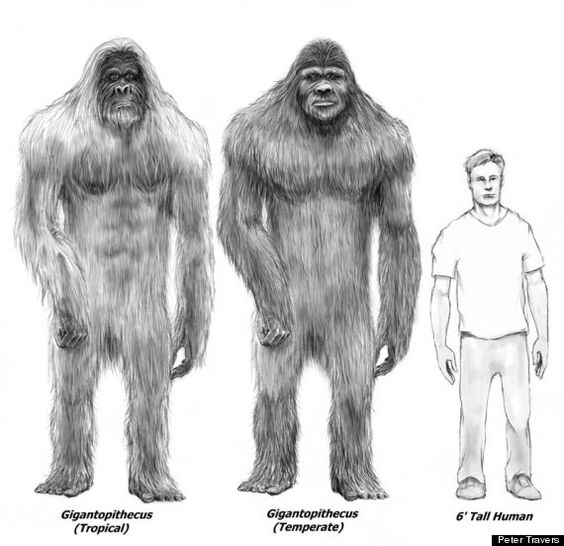
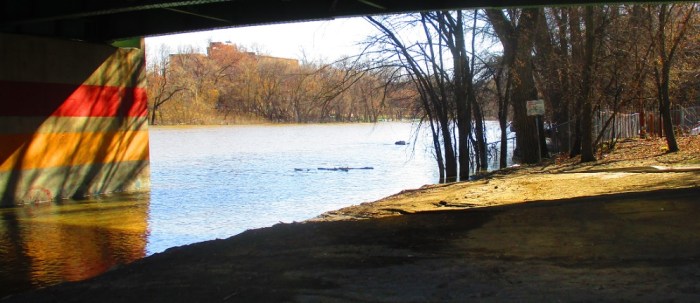
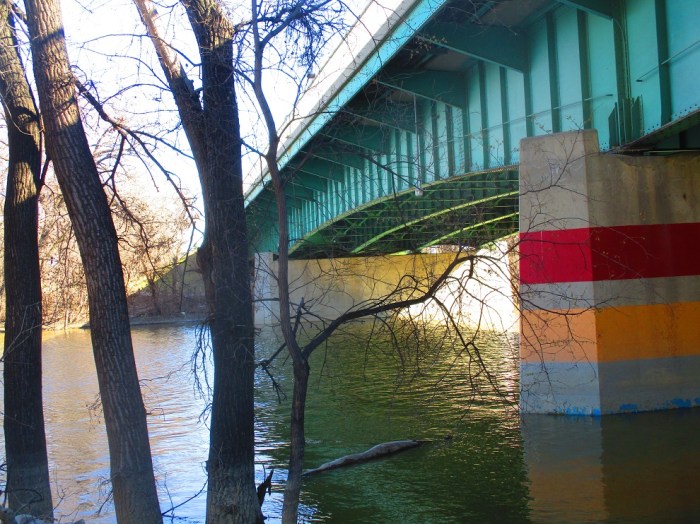
There seems to be something out there.

Over 10,000 reported Sasquatch sightings in North America over the last 70 years. Some experts put forward that only 10-20 percent of sightings are reported out of fear of being ridiculed. You could then extrapolate that there may be 100,000 sightings. Could 10,000 people be hallucinating, not to mention the footprints, hair samples, nests, tree knocks and other sounds. DNA from hair samples have come back: unknown species.

Sasquatch expert, the late John Green, was in northern California in 1969 checking on Bigfoot reports. He was at a road construction camp and checked the area around the camp. The next day a worker called him to report footprints found 75 yards from the camp. Green immediately went to the camp. Down a steep slope at the edge of a small pond he found up to 800 sasquatch footprints. Different sizes. Green had checked that area the previous day and there were no prints.  The construction workers heard nothing. The prints had impressions up to three quarters of an inch deep. Something heavy made them. To hoax such prints Green contends it would have taken some type of machine to press them into the ground.  Green wrote three different entities made the footprints.

I definitely believe there is a great possibility that an ape (that walks on 2 legs) of some sort is out there. Whatever they are, they are extremely elusive.

Robotic Dog Patrols Singapore Park

Boston Dynamics’ four-legged robotic dog, Spot, has been deployed in the Bishan-Ang Mo Kio Park in Singapore in an effort to assist visitors with maintaining safe distances from each other. The bot will patrol a 4-mile area of the park and send back ‘video analytics’ which can be used to estimate the number of park-goers. According to a statement, Spot’s cameras will not store anyone’s personal information or track specific individuals.

Cannabis shows promise blocking coronavirus infection

After sifting through 400 cannabis strains, researchers at the University of Lethbridge are concentrating on about a dozen that show promising results in ensuring less fertile ground for the potentially lethal virus to take root, said biological scientist Dr. Igor Kovalchuk.

“A number of them have reduced the number of these (virus) receptors by 73 per cent, the chance of it getting in is much lower,” said Kovalchuk.

“If they can reduce the number of receptors, there’s much less chance of getting infected.”

Employing cannabis sativa strains over the past three months, the researcher said the effective balance between cannabis components THC and CBD — the latter more typically associated with medical use — is still unclear in blocking the novel coronavirus.

Kovalchuk, whose Pathway RX is owned partly by Olds-based licensed cannabis producer Sundial Growers and partnered with Alberta cannabis researcher Swysh.

But it’s generally the anti-inflammatory properties of high-CBD content that have shown most promise, he added.

“We focus more on the higher CBD because people can take higher doses and not be impaired,” said Kovalchuk.

The study under Health Canada licence using artificial human 3-D tissue models has been seeking ways to hinder the highly contagious novel coronavirus from finding a host in the lungs, intestines, and oral cavity.

If successful, the work could find practical medical use in the form of mouth wash, gargle, inhalants or gel caps, said Kovalchuk.

“It would be cheaper for people and have a lot less side-effects,” he said.

But the absence of clinical trials remains a barrier, and funding from an increasingly cash-strapped cannabis industry isn’t there to fuel that, said Kovalchuk.

“We have clinicians who are willing to work with us but for a lot of companies in the cannabis business, it’s significant cash that they can’t afford,” he said.

The scientist emphasized the findings wouldn’t lead to a vaccine — something “less specific and precise” but nonetheless another possible weapon against COVID-19.

“The extracts of our most successful and novel high CBD C sativa lines, pending further investigation, may become a useful and safe addition to the treatment of COVID-19 as an adjunct therapy,” said Kovalchuk.

“Given the current dire and rapidly evolving epidemiological situation, every possible therapeutic opportunity and avenue must be considered.”

Israeli researchers have begun clinical trials of CBD as a treatment to repair cells damaged by COVID-19 by using its anti-inflammatory abilities.

It’s thought CBD could enhance the traditional effect of steroids in such treatment of patients in life-threatening condition and also bolster the immune system.

It’s the kind of research and his own that deserves government support in Canada, whose federal government has pledged $1.1 billion in funding for COVID-19 research said the U of L scientist.

“Our work could have a huge influence — there aren’t many drugs that have the potential of reducing infection by 70 to 80 per cent,” he said.

Cats and Dogs around the World

cat

catbox4


catzzz-7

Scuba Cat


According to Statistics Canada there are 3.5 million dogs in Canada and 4.5 million cats.


Only in China

Stairway to heaven: 300ft spiral staircase to give Chinese tourists a taste of the high life – as long as you don’t have a heart condition

Just looking at these stairs is enough to give anyone vertigo, but they are expected to attract thousands of tourists in China.

The 300ft spiral staircase has been installed on the wall of the Taihang Mountains in Linzhou to offer the thrill of mountaineering without the danger. But senior climbers beware – you have to be under 60 to be allowed on the staircase.


astairs


astairs1


Chinese tourist officials in Linzhou,  Henan province, hope the stairs will give visitors a real experience of the mountain range.

‘Here the wind blows and batters them, the birds fly past them, the stairs creak. It is a lot more authentic than an elevator,’ explained one official.

However,for health and safety reasons, the stairs do not offer admission to just anyone.  All potential climbers have to sign a form  stating that they have no heart or lung problems and are under 60 years of age.


redditnew2

Monster B-Movie Blitz

Recently there has been a swarm of monster B-Movies on television.  I PVRrd a few of them and will have to get the popcornpopping.  But these damn things are so bad that I lose interest once I see the monster.  But you have to give it to the people at SyFy productions, they do have an imagination.  Some of these devil creatures are absurd hybrids that love blood.  Below are some of the posters.


DinoShark

bmovieup_from_depths_poster_01


bmovieShark_Swarm_(2008_movie)_poster


Thank God our Sasquatches aren’t this psycho!

bmovieyeti


bmovieFire_serpent_custom___SLIM-16545210102012


bmovieflubirds


bmoviemax1299857517-front-cover


Ponch is back! Erik Estrada came out of retirement to star in this gem.

bmovieQXaij

Gloomy Place Names

There are places stuck in perpetual despair, but only by name. A new Instagram account called Sad Topographies by Australian artist Damien Rudd is dedicated to showcasing these places.

“I initially came across a place in Australia … called Mount Hopeless. The name kind of caught me off guard and I decided to come back later and research it,” Damien Rudd told CBC.  “I actually found that there were many more places that had surprisingly depressing names. That kind of got me started on the project.”


name


name1


Many of these depressing place names are connected to the dark history of early colonialism, and the mishaps of explorers and settlers. Communities are hesitant to change the names of these places because of their historical context.

“I think once you become accustomed to a name, you don’t really hear it like an outsider would,” he says. “There’s a certain type of history that gets lost when you change names.”

Rudd finds these places by typing sad words into Google Maps.


name4

Starvation Heights, an unincorporated community in Jackson County, Oregon, was named before 1883 for its poor and infertile soil, a granite-like mix which supported only scrub vegetation.


name5

Killer Lake, Addington Highlands, Canada


name2


name3

Let’s stay happy out there.

A Complete Catalog Of Every Time Someone Cursed Or Bled Out In A Quentin Tarantino Movie

By Oliver Roeder

From the minute the multiplex curtains pulled back on his first feature, director Quentin Tarantino has ignited the interest, and occasional ire, of critics for his films’ strong language and frequent violence. The New York Times called his first film, “Reservoir Dogs,” “aggressively brutal.” About his next film, “Pulp Fiction,” the Los Angeles Times wrote that there was “something wearing and repetitive about the film’s reliance on shock value and bad-boy posturing to maintain our attention.”

Tarantino’s eighth feature film, “The Hateful Eight,”, is the story of bounty hunters seeking refuge from a Wyoming blizzard after the Civil War — so basically “The Good, the Bad and the Ugly” meets “Frozen.” To get ready, I spent a week on the couch with Tarantino’s oeuvre, watching people die and swear a blue streak. When someone was killed by a gun or a sword or a venomous snake, or someone was called a “motherfucker” or a “cocksucker,” I made a note of the event and the time. Then I did it all over again a few seconds later. What resulted was hard-won data that showed me the essential tempos of Tarantino’s films, and how they’ve changed over time. The guy’s getting bloodier in his old age.


tarantino1

Some mild assumptions were necessary for this project. For one, I’m not a medical doctor, but I assumed that if, say, someone had numerous limbs cut off or took a direct blade to the torso in a samurai sword battle, that person would indeed bleed out and die.  And for profanity in foreign languages — mainly in Chinese and Japanese in the “Kill Bill” films and French in “Inglourious Basterds” — I relied on the theatrical subtitles.

Also, it’s occasionally difficult to make out the profane language precisely. If you recently had your one remaining eyeball plucked out, for example, I may not have understood every word you screamed in horror. But I did my best to count all the curses, from the mild hells and damns and asses to the more potent shits, fucks and n-words.


FILM CURSES DEATHS CURSE/DEATH RATIO
Jackie Brown 368 4 92.0
Pulp Fiction 469 7 67.0
Reservoir Dogs 421 10 42.1
Kill Bill: Vol. 2 69 11 6.3
Django Unchained 262 47 5.6
Inglourious Basterds 58 48 1.2
Kill Bill: Vol. 1 57 63 0.9
Total 1704 190 9.0

1983 Soviet nuclear false alarm incident

A very close call indeed.

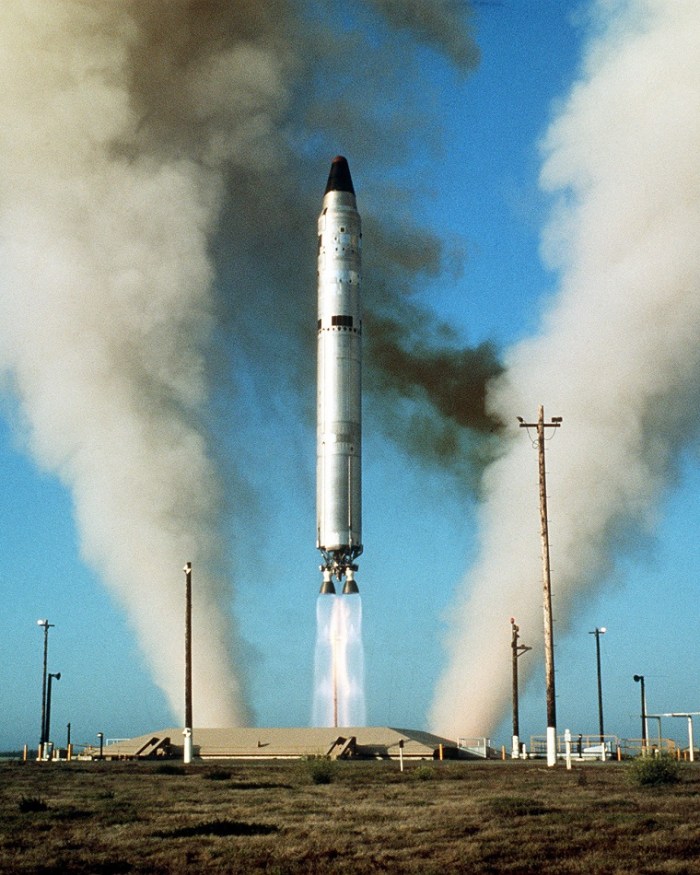
On 26 September 1983, the nuclear early-warning system of the Soviet Union reported the launch of multiple intercontinental ballistic missiles from bases in the United States. These missile attack warnings were felt to be false alarms by Stanislav Petrov, an officer of the Soviet Air Defence Forces. This decision is seen as having prevented a retaliatory nuclear attack against the United States and its NATO allies, which would have resulted in an immediate and irrevocable escalation to a full-scale nuclear war. Investigation of the satellite warning system later determined that the system had indeed malfunctioned.
Background
The incident occurred at a time of severely strained relations between the United States and the Soviet Union. Responding to the Soviet Union’s deployment of fourteen SS-20/RSD-10 theatre nuclear missiles, the NATO Double-Track Decision was taken in December 1979 by the military commander of NATO to deploy 108 Pershing II nuclear missiles in Western Europe with the ability to hit targets in eastern Ukraine, Belarus or Lithuania within 10 minutes and the longer range, but slower BGM-109G Ground Launched Cruise Missile (GLCM) to strike potential targets farther to the east. In mid-February 1981, and continuing until 1983, psychological operations by the United States began. These were designed to test Soviet radar vulnerability and to demonstrate US nuclear capabilities. They included clandestine naval operations, in the Barents, Norwegian, Black, and Baltic seas and near the Greenland-Iceland-United Kingdom (GIUK) gap, as well as flights by American bombers, occasionally several times per week, directly toward Soviet airspace that turned away only at the last moment.

“It really got to them,” recalls Dr. William Schneider, [former] undersecretary of state for military assistance and technology, who saw classified “after-action reports” that indicated U.S. flight activity. “They didn’t know what it all meant. A squadron would fly straight at Soviet airspace, and other radars would light up and units would go on alert. Then at the last minute the squadron would peel off and return home.”

From the accounts of CIA and senior KGB officers, by May 1981, obsessed with historical parallels with 1941 and Reaganite rhetoric, and with no defensive capability against the Pershing IIs, Soviet leaders believed the United States was preparing a secret nuclear attack on the USSR and initiated Operation RYaN. Under this, agents abroad monitored service and technical personnel who would implement a nuclear attack so as to be able either to preempt it or have mutually assured destruction.

On 1 September 1983, the Soviet military shot down a South Korean passenger jet, Korean Air Lines Flight 007, that had strayed into Soviet airspace. All 269 people aboard the aircraft were killed, including U.S. Congressman Larry McDonald and many other Americans. The first Pershing II missiles were reportedly deployed in late November 1983.

Bruce Blair, an expert on Cold War nuclear strategies and former president of the World Security Institute in Washington, D.C., says the American–Soviet relationship at that time

had deteriorated to the point where the Soviet Union as a system—not just the Kremlin, not just Soviet leader Yuri Andropov, not just the KGB—but as a system, was geared to expect an attack and to retaliate very quickly to it. It was on hair-trigger alert. It was very nervous and prone to mistakes and accidents. The false alarm that happened on Petrov’s watch could not have come at a more dangerous, intense phase in U.S.–Soviet relations.

In an interview aired on American television, Blair said, “The Russians (Soviets) saw a U.S. government preparing for a first strike, headed by a President Ronald Reagan capable of ordering a first strike.” Regarding the incident involving Petrov, he said, “I think that this is the closest our country has come to accidental nuclear war.”
 

Incident
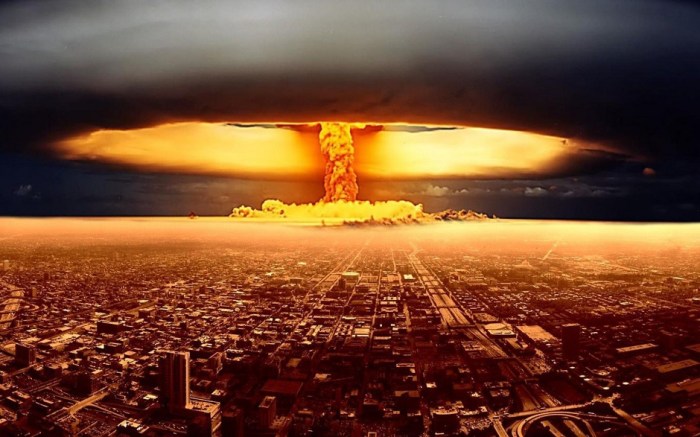
On 26 September 1983, Stanislav Petrov, a lieutenant colonel in the Soviet Air Defense Forces, was the officer on duty at the Serpukhov-15 bunker near Moscow which housed the command center of the Soviet early warning satellites, code-named Oko. Petrov’s responsibilities included observing the satellite early warning network and notifying his superiors of any impending nuclear missile attack against the Soviet Union. If notification was received from the early warning systems that inbound missiles had been detected, the Soviet Union’s strategy was an immediate and compulsory nuclear counter-attack against the United States (launch on warning), specified in the doctrine of mutual assured destruction.

Shortly after midnight, the bunker’s computers reported that one intercontinental ballistic missile was heading toward the Soviet Union from the United States. Petrov considered the detection a computer error, since a first-strike nuclear attack by the United States was likely to involve hundreds of simultaneous missile launches in order to disable any Soviet means of a counterattack. Furthermore, the satellite system’s reliability had been questioned in the past. Petrov dismissed the warning as a false alarm, though accounts of the event differ as to whether he notified his superiors or not after he concluded that the computer detections were false and that no missile had been launched. Petrov’s suspicion that the warning system was malfunctioning was confirmed when no missile in fact arrived. Later, the computers identified four additional missiles in the air, all directed towards the Soviet Union. Petrov suspected that the computer system was malfunctioning again, despite having no direct means to confirm this. The Soviet Union’s land radar was incapable of detecting missiles beyond the horizon.

It was subsequently determined that the false alarms were caused by a rare alignment of sunlight on high-altitude clouds and the satellites’ Molniya orbits, an error later corrected by cross-referencing a geostationary satellite.

In explaining the factors leading to his decision, Petrov cited his belief and training that any U.S. first strike would be massive, so five missiles seemed an illogical start. In addition, the launch detection system was new and in his view not yet wholly trustworthy, while ground radar had failed to pick up corroborative evidence even after several minutes of the false alarm.

Petrov underwent intense questioning by his superiors about his actions. Initially, he was praised for his decision. General Yury Votintsev, then commander of the Soviet Air Defense’s Missile Defense Units, who was the first to hear Petrov’s report of the incident (and the first to reveal it to the public in 1998), stated that Petrov’s “correct actions” were “duly noted.” Petrov himself stated he was initially praised by Votintsev and was promised a reward, but recalled that he was also reprimanded for improper filing of paperwork with the pretext that he had not described the incident in the military diary.

He received no reward. According to Petrov, this was because the incident and other bugs found in the missile detection system embarrassed his superiors and the influential scientists who were responsible for it, so that if he had been officially rewarded, they would have had to be punished. He was reassigned to a less sensitive post, took early retirement (although he emphasized that he was not “forced out” of the army, as is sometimes claimed by Western sources), and suffered a nervous breakdown.

Oleg Kalugin, a former KGB chief of foreign counter-intelligence who knew Soviet chairman Andropov well, says that Andropov’s distrust of American leaders was profound. It is conceivable that if Petrov had declared the satellite warnings valid, such an erroneous report could have provoked the Soviet leadership into becoming bellicose. Kalugin said, “The danger was in the Soviet leadership thinking, ‘The Americans may attack, so we better attack first.'”