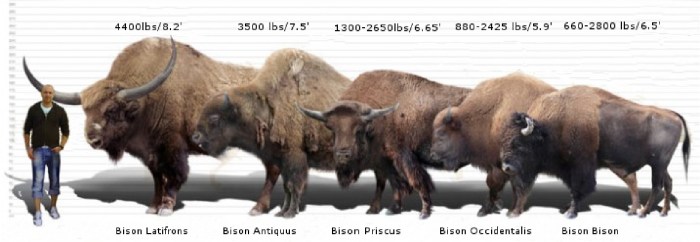
Bison from ancient to modern
A herd of lynx

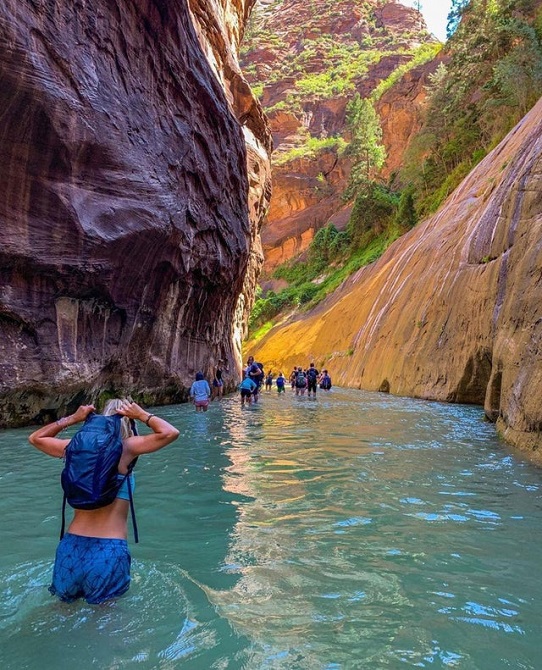
Zion national park in Utah
Bison from ancient to modern
A herd of lynx
Zion national park in Utah
In one of most macho things you could see in a country renowned for its machismo, a video has been released of three men chasing a tiger on foot and lassoing the animal with a rope.
The big cat apparently escaped from a private residence in the city of Guadalajara and was roaming the streets when the men chased and corralled the tiger before the one man (naturally) wearing a fancy cowboy hat twirled his loop and scored a bulls-eye around its neck on the first try. The video ends before viewers can see if the men were able to hog-tie the critter before returning it to its rightful owner for a presumably princely sum or giving it over to the authorities.
The local fire department received a call about the escaped feline, but presumably, the self-styled cowboys were able to reach it first. Some of the only individuals who can afford to keep such exotic pets in Mexico are the ubiquitous drug lords, among whom it is apparently fashionable to own exotic animals.

When the end came, it was just like Tom and Mary had imagined. Supply chains started to crumble. Millions of Americans lost their jobs. Grocery stores ran out of food. The nearly retired couple wasn’t going to wait for society to collapse. They hopped in their camper van and drove 19 hours to South Dakota. “To come here and experience it in person is like walking the Grand Canyon for the first time,” Tom says. But it’s not the Grand Canyon. It’s a doomsday bunker.
Tom and Mary are living at xPoint, an abandoned military facility-turned-survivalist community at the base of the Black Hills in Fall River County. Miles of plains stretch out in all directions, connected by 100 miles of private road. Along the skyline, steel doors tucked into grassy knolls indicate the openings to the bunkers. It looks like an abandoned ranch, which is more or less what it was until a real estate mogul purchased it for the price of $1.
The idea for Vivos, a global community of apocalypse bunkers, came to CEO Robert Vicino nearly four decades ago in a moment of inspiration that featured a “crystal clear” female voice in his head. It said, Robert, you need to build deep underground bunkers for people to survive something that is coming our way. He filed it away until 2008, (the year Obama was elected) when the time was finally right to start building.
Vivos has survival campuses in South Dakota, where Tom and Mary live, and Indiana. These are for the downmarket bunkers that cost roughly $35,000 each. Vivos Europe, in contrast, is marketed as “the ultimate life assurance solution for high net worth families.” Apartments there cost upwards of $2 million.
:no_upscale()/cdn.vox-cdn.com/uploads/chorus_asset/file/19963658/vivosxpoint_landscape5.jpg)
:no_upscale()/cdn.vox-cdn.com/uploads/chorus_asset/file/19963636/Vivos_xPoint_Bunker_Showroom.jpg)
:no_upscale()/cdn.vox-cdn.com/uploads/chorus_asset/file/19963663/Vivos_xPoint_Bedroom.jpg)
As COVID-19 brings the real estate market to a standstill, demand for doomsday bunkers is at an all-time high (or low since the structures are underground). The shelters were once signifiers of fringe prepper communities worried about the coming apocalypse. During the pandemic, they’ve become vacation homes. “People thought we were crazy because they never believed anything like this could happen,” says Vicino. “Now they’re seeing it. Everybody is a believer.”
Bunkers give people a sense of control, the feeling that they can fend for themselves. Their newfound popularity mirrors an overall trend toward more disaster preparedness where behaviors that used to seem paranoid, like stockpiling food, look normal (if inadvisable) in light of the ongoing pandemic.
But the trend also has a darker side: the sense that people need to protect themselves against the other. “The have-nots are going to go after the haves,” Vicino tells me. “They will knock on your door. And if you don’t have enough to give, it gets ugly.”
:no_upscale()/cdn.vox-cdn.com/uploads/chorus_asset/file/19963632/vivos_xpoint_site_plan.jpg)
While many Vivos customers are currently building out their bunkers, Tom and Mary are one of the only other couples living at xPoint permanently. They bought their shelter three years ago after reading Patriots: A Novel of Survival in the Coming Collapse, which is popular among prepper communities. The book is a work of fiction; it tells the story of a global economic collapse where the United States becomes “gripped” in a “continual orgy of robbery, murder, looting, rape, and arson” where “hordes of refugees and looters pour out of the cities.” Tom says, “It opened my eyes to the level of vulnerability that most people have if something happens and food can’t be delivered to the store for whatever reason.”
While the pandemic prompted Tom and Mary to move out to their bunker and has brought in an influx of new clients, Robert Vicino is convinced it’s only the beginning. “It’s the ripple effect,” he tells me. “People will become predators.” Vicino paints a picture of looting and mayhem much like what’s described in Patriots. “The have-nots will go after the haves,” he says again. “There will be hell zones.”
If this happens, Vicino claims Vivos will be the ultimate safe zone. “I would hope that the seeds of the future society of America come through Vivos,” he says humbly. “It may sound prophetic, but it could happen.”


The Terrafugia TF-X is an autonomous flying car under development by Boston-based Terrafugia. The TF-X seats four passengers and uses an engine combined with two electric motors for propulsion. Unlike the previously proposed Transition, the TF-X is capable of vertical take-off and landing by extending its retractable wings attached with pusher propellers while aerial thrust is provided by a ducted fan at the rear. It will be able to fit in a single car garage.
Powered by two plug-in hybrid 600-horsepower electric motors and a 300-horsepower fuel engine, the TF-X is planned to have a flight range of 500 miles (805 km) with a cruising flight speed of 200 mph (322 km/h) without the need to refuel or recharge. Road speed is currently unknown.
General characteristics
Performance

WHEN THE NOTORIOUS drug lord Pablo Escobar was shot dead in 1993, the Colombian government took control of his luxurious estate in northwestern Colombia, including his personal zoo. Most of the animals were shipped away, but the four hippopotamuses—of which Escobar was especially fond—were left to fend for themselves in a pond. Now, there are dozens and dozens of them.
For over a decade the Colombian government has been pondering how to best curb the growing population, a strategy largely supported by conservation experts. But not everyone is on board. Without direct evidence that the animals are doing harm, some ecologists argue that there’s no reason to cull or relocate them. Indeed, the hippos could fill in for species that humans pushed to extinction thousands of years ago—an idea known as rewilding.
When the hippos were left behind, it accidentally kicked off a rewilding experiment that’s now been running for more than 25 years. The first results of this experiment are trickling in and much like the large animals, they’re muddying the waters.
Known unknowns
The hippos have escaped Escobar’s former ranch and moved into Colombia’s main river, the Magdelena. Spread over a growing area, nobody knows exactly how many there are—but estimates indicate there may be a total population between 80 and 100, says Jonathan Shurin, an ecologist with University of California San Diego who studies the animals.
That’s at least a couple dozen higher than estimates just two years ago. Given that there were four in 1993, the population appears to be growing exponentially. “Within a couple of decades, there could be thousands of them.”
The hippos present quite a problem for the government. David Echeverri, a researcher with the Colombian government’s environmental agency Cornare, which is overseeing management of the animals, says he has no doubt they act like an invasive species. If allowed to remain unchecked, they will displace endemic animals like otters and manatees, he says. They also pose a danger to local residents since they can be territorial and aggressive, though no serious injuries or deaths have occurred as yet.
After one hippo was killed in 2009, there was a quick public outcry, quashing any plans to cull them. Instead, the government has been investigating ways to sterilize the creatures, or to move them out of the wild into captive facilities, Echeverri says. But the animals weigh thousands of pounds and aren’t exactly fond of human handling, so relocating or castrating them is both dangerous, difficult, and expensive. One juvenile hippo was successfully moved to a Colombian zoo in September 2018, but it cost 15 million pesos (about $4,500 USD).
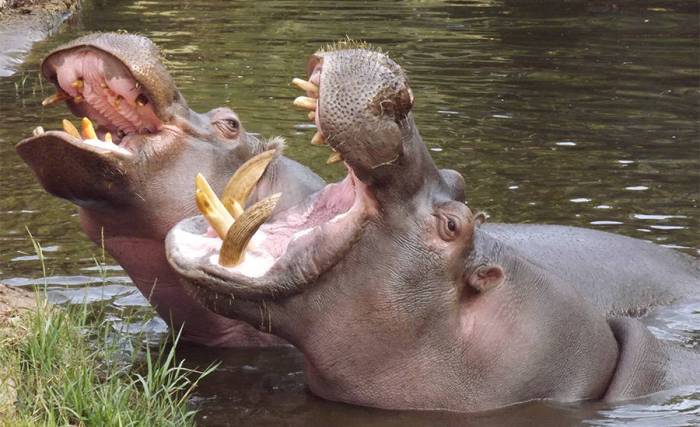
South America lost dozens of giant herbivore species in the last 20,000 years or so, including the somewhat hippo-esque toxodons, which may have been semi-aquatic, as well as water-loving tapirs. Although several tapir species remain today, all are declining. “Hippos could likely contribute a partial restoration of these effects, likely benefitting native biodiversity overall,” Svenning says. He’d let the hippos be for now, while monitoring the creatures to ensure they don’t become a problem.
Jonathan Shurin, an ecologist with University of California San Diego who studies the animals notes that the animals may be providing a valuable service for native plants that once relied on large, now-extinct mammals to disperse their seeds. “We’re planning to look at their poop and see what’s in there,” he says.
But while he says it’s possible they’re stepping into roles that have been vacant for millennia, that may not be something the humans in the area ultimately want. No one really knows how native wildlife like manatees, river turtles, and otters will be affected by that kind of rewilding, and more hippos may mean increased conflict with people.
“Right now, the people are just coexisting with them,” he says. But that could change if this population of notoriously disagreeable animals grows exponentially. “There’s concern about public safety.”
They also attract tourists and tourism dollars, which my help offset some concerns about the animals. Upwards of 50,000 tourists visit Hacienda Napoles every year, according to some estimates.
For now, without immediate plans to relocate or sterilize all the animals, the creatures will continue to fend for themselves and expand. Shurin looks forward to studying the long-term impacts of their residency, assuming they indeed remain. “It’s a big experiment,” says Shurin—and “we’re going to find out.”
National Geographic
Tornado safety measures. If you own a house and you are in the house. The ideas below could really help.


If there are marital problems, and there are no tornadoes happening, a guy could grab a little TV and some refreshments and head down into one of these and wait until peace terms are offered.
When I was growing up in a small prairie town as a little kid, one of my favourite things to do was to bicycle to the movie theatre and check out the movie posters on the front of the building. I would analyze every corner and detail of the poster. Horror and Science Fiction movie posters were some of my favourites.
The posters would make you imagine what the movie was about and what the visuals would instill in your head. The posters would create the curiosity that would motivate you to see the film or not.
Below are some of the more engaging posters.











 The MarkoZen Blog