10 best hangover cures I could find

Hangovers are a horrid part of existence.  They make you question your sanity as to why you indulged in that debauchery the night before.  But as social animals many people use booze, beer, liquor or any other type of alcoholic drink to let loose and relieve the stress.

That is the strange part about drinking.  You basically go from sweet ecstasy to the pits of hell in a 12 hour period.  The intermediate part is a deep comatose like sleep.  But when that alarm goes off in the morning the brain and body will let you know you acted very badly the night before.  And you will pay with great suffering.  Especially if you have to get into work. 

Easy tasks become confounding stress filled predicaments.  When you speak to co-workers you call them by the wrong names.  And the constant rush to the water cooler to fill the bottle up, which in turn leads to constant trips to the can.  And your work performance diminishes to that of an intelligent chimp.  The constant self-loathing, mumbling rabid insults about your own stupidity to yourself.

So we conclude that we will never do that again.  Until the emails start that the gang wants to get together to watch a big hockey game. And the sauce will be flowing hard again.


Here are some possible cures:


  • Sleep. Rest is your best friend at this point to give your body time to recover. It is best to stay in bed so call in to work if you have to, tell them you have the stomach flu. You will sound so horrible on the phone they may believe you (unless they saw you at the bar, not a good idea then).
  • Replenish your body with fruit juice and water.
  • Avoid caffeine. A weak cup of coffee may be okay but a lot of caffeine will continue to dehydrate you, the opposite of what you want right now.
  • Drink orange juice for Vitamin C.
  • Drink a sports drink like Gatorade or Powerade.
  • Eat mineral rich food like pickles or canned fish.
  • In Poland, drinking pickle juice is a common remedy.
  • Drink a Bloody Mary. While the popular phrase “hair of the dog that bit you” may sound logical with a shot of whiskey left in the bottle next to your bed, it’s only temporary. Try a Bloody Mary instead, while your blood is dealing with the new alcohol it is ignoring the old and in the mean time tomato juice and celery are full of vitamins. If you drank the last of the vodka make a Virgin Mary. Another spicy morning after drink option is Hair of the Dog, in which gin and hot sauce are sure to bite your hangover back.
  • Take a shower, switching between cold and hot water.
  • In Ireland it was said that the cure for a hangover is to bury the ailing person up to the neck in moist river sand.


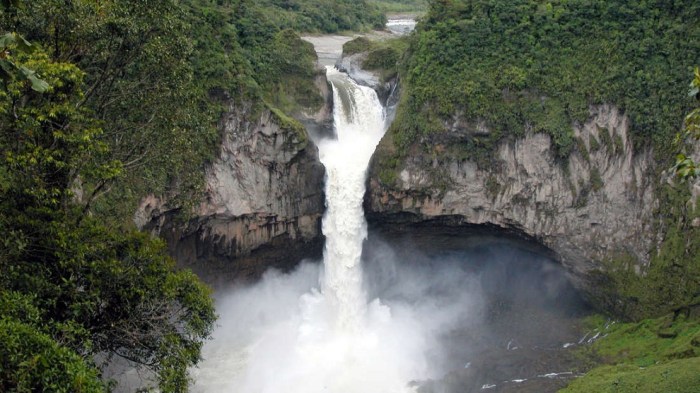
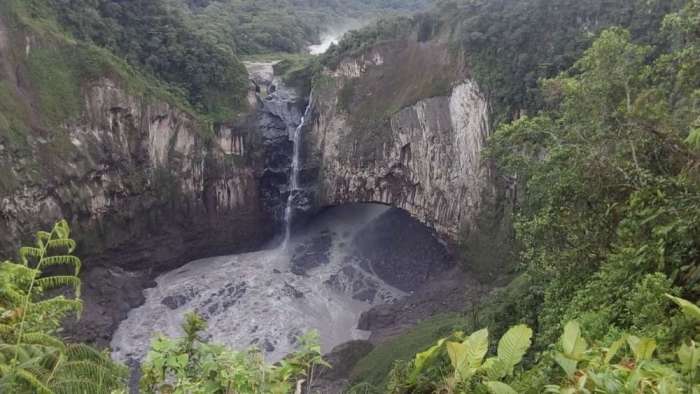
The Disappearance of Ecuador’s Tallest Waterfall

The Disappearance of Ecuador’s Tallest Waterfall

“Wreck of the Edmund Fitzgerald”


The legend lives on from the Chippewa on down
Of the big lake they call Gitche Gumee
The lake, it is said, never gives up her dead
When the skies of November turn gloomy
With a load of iron ore twenty-six thousand tons more
Than the Edmund Fitzgerald weighed empty
[Former version:] That good ship and true was a bone to be chewed
[Latter version:] That good ship and crew was a bone to be chewed
When the gales of November came early

The ship was the pride of the American side
Coming back from some mill in Wisconsin
As the big freighters go, it was bigger than most
With a crew and good captain well seasoned
Concluding some terms with a couple of steel firms
When they left fully loaded for Cleveland
Then later that night when the ship’s bell rang
Could it be the north wind they’d been feelin’?

The wind in the wires made a tattle-tale sound
When the wave broke over the railing
And every man knew, as the captain did too
‘Twas the witch of November come stealin’
The dawn came late and the breakfast had to wait
When the gales of November came slashin’
When afternoon came it was freezing rain
In the face of a hurricane west wind

When suppertime came, the old cook came on deck
Saying, “Fellas, it’s too rough to feed ya.”
[Former version:] At seven PM a main hatchway caved in
[Latter version:] At seven PM it grew dark, it was then
He said, “Fellas, it’s been good to know ya.”
The captain wired in he had water comin’ in
And the good ship and crew was in peril
And later that night when his lights went out of sight
Came the wreck of the Edmund Fitzgerald

Does anyone know where the love of God goes
When the waves turn the minutes to hours?
The searchers all say they’d have made Whitefish Bay
If they’d put fifteen more miles behind her
They might have split up or they might have capsized
They may have broke deep and took water
And all that remains is the faces and the names
Of the wives and the sons and the daughters

Lake Huron rolls, Superior sings
In the rooms of her ice-water mansion
Old Michigan steams like a young man’s dreams
The islands and bays are for sportsmen
And farther below, Lake Ontario
Takes in what Lake Erie can send her
And the iron boats go as the mariners all know
With the gales of November remembered

[Former version:] In a musty old hall in Detroit they prayed
[Latter version:] In a rustic old hall in Detroit they prayed
In the Maritime Sailors’ Cathedral
The church bell chimed ’til it rang twenty-nine times
For each man on the Edmund Fitzgerald
The legend lives on from the Chippewa on down
Of the big lake they call Gitche Gumee
Superior, they said, never gives up her dead
When the gales of November come early

The Dassault Falcon 900

The Dassault Falcon 900, commonly abbreviated as the F900, is a trijet French-built corporate jet aircraft made by Dassault Aviation.


General characteristics

Crew: 2
Capacity: 19 passengers
Length: 20.21 m (66 ft 4 in)
Wingspan: 19.33 m (63 ft 5 in)
Height: 1.87 m (6 ft 2 in)
Wing area: 49.0 m2 (527 sq ft)
Aspect ratio: 7.63:1
Empty weight: 10,255 kg (22,608 lb)
Max takeoff weight: 20,640 kg (45,503 lb)
Fuel capacity: 8,690 kg (19,160 lb)
Powerplant: 3 × AlliedSignal TFE731-5BR-1C turbofans, 21.13 kN (4,750 lbf) thrust each
Performance

Maximum speed: Mach 0.84–0.87
Cruise speed: 950 km/h (590 mph, 510 kn) ; Mach 0.85 (at 11,000 m (36,000 ft)
Stall speed: 158 km/h (98 mph, 85 kn) (wheels and flaps down)
Range: 7,400 km (4,600 mi, 4,000 nmi) with 8 passengers
Service ceiling: 15,500 m (50,900 ft)

Wild Goats Invade Welsh Town

A town in Wales on lockdown to prevent the spread of the coronavirus has been overrun by dozens of wild goats. The bizarre invasion has reportedly been unfolding in the community of Llandudno over the last few days. With residents largely stuck inside their homes waiting out the pandemic, the creatures have begun venturing down from the nearby Great Orme country park to explore the deserted streets of the town.

Although the goats have been known to visit the town on occasions when inclement weather strikes the Great Orme, this particular set of circumstances is understandably unique and had led to around 120 of the animals descending on the community en masse. “They are curious, goats are,” town councilor Carol Marubbi told the BBC, “and I think they are wondering what’s going on like everybody else.”

To that end, the goats have been spotted freely feasting on hedges and generally making themselves at home in the community. For their part, the residents of Llandudno have, for the most part, been amused by the interlopers, especially since they have been cooped up inside their homes for days and, as such, appreciate the unexpected entertainment.

Top Secret movie ”cow/bull scenes”

Top Secret is a relatively unknown comedy film made in 1984.  It stars Val Kilmer in his first feature role.  In my humble opinion it is one of the funniest movies I have ever watched.  The film was made by the ZAZ trio,  David Zucker, Jim Abrahams and Jerry Zucker.  These fellows made Airplane and the Naked Gun series. 

The humour in Top Secret is very much the same as in those other movies.  Cornball jokes, misinterpretation amongst characters and cockamamie situations.  But there is one scene in Top Secret that should go down as one of the greatest humour sequences in film.  The “Cow Scene.”

Then there is ‘Chocolate Mousse’

The Empire State Building was constructed incredibly fast

The speed with which they built the Empire State Building, 1931


empire_state_building_history


The idea for the Empire State Building is said to have been born of a competition between Walter Chrysler of the Chrysler Corporation and John Jakob Raskob of General Motors, to see who could erect the taller building. Chrysler had already begun work on the famous Chrysler Building, the gleaming 1,046-foot skyscraper in midtown Manhattan. Not to be bested, Raskob assembled a group of well-known investors, including former New York Governor Alfred E. Smith. The group chose the architecture firm Shreve, Lamb and Harmon Associates to design the building. The Art-Deco plans is said to have been based in large part on the look of a pencil.

Despite the colossal size of the project, the design, planning and construction of the Empire State Building took just 20 months from start to finish. After demolishing the Waldorf-Astoria hotel—the plot’s previous occupant—contractors Starrett Brothers and Eken used an assembly line process to erect the new skyscraper in a brisk 410 days. Using as many as 3,400 men each day, they assembled its skeleton at a record pace of four and a half stories per week—so fast that the first 30 stories were completed before certain details of the ground floor were finalized. The Empire State Building was eventually finished ahead of schedule and under budget, but it also came with a human cost: at least five workers were killed during the construction process.

The new building imbued New York City with a deep sense of pride, desperately needed in the depths of the Great Depression, when many city residents were unemployed and prospects looked bleak. The grip of the Depression on New York’s economy was still evident a year later, however, when only 25 percent of the Empire State’s offices had been rented.


empire_state_building_history_2

During certain periods of building, the frame grew an astonishing four-and-a-half stories a week.

Chrysler Building 1932

chrysler_building_midtown_manhattan_new_york_city_1932


The Broken Technology of Ghost Hunting

The Atlantic

The best tools for tracking down spirits have always been the ones fallible enough to find something.

The small, Syracuse, New York-based company K-II Enterprises makes a number of handheld electronic devices—including the Dog Dazer (a supposedly safe, humane device that deters aggressive dogs with high-pitched radio signals)—but it is best known for the Safe Range EMF. The size of a television remote, the Safe Range EMF detects electromagnetic fields, or EMF, measuring them with a bright LED array that moves from green to red depending on their strength. Designed to locate potentially harmful EMF radiation from nearby power lines or household appliances, the Safe Range has become popular for another use: detecting ghosts.

Since its appearance in the show Ghost Hunters, where the ghost hunter Grant Wilson claimed that it has been “specially calibrated for paranormal investigators,” the Safe Range (usually referred to as a K-II meter) has become ubiquitous among those looking for spirits. Search for it on Amazon, and many listings will refer to it as a “ghost meter,” an indispensable tool in the ghost hunter’s arsenal. It isn’t alone among EMF meters: Of the best-selling EMF meters on Amazon, two out of the top three are explicitly marketed as ghost meters.


ghosthunters-jason-grant-cartoon-390x220


Scanning the various product descriptions and reviews, though, what becomes clear is that the K-II Safe Range is a relatively unreliable electromagnetic field meter. It operates only on one axis (you have to wave it around to get a proper reading), and it’s unshielded, meaning that it can be set off by a cell phone, a two-way radio, or virtually any kind of electronic device that occasionally gives off electromagnetic waves. The reviewer Kenny Biddle found he could set it off with, among other things, a computer mouse and a camera battery pack.

Yet it’s precisely because it’s not particularly good at its primary purpose that makes it a popular device for ghost hunters. Erratic, prone to false positives, easily manipulated, its flashy LED display will light up any darkened room of a haunted hotel or castle. Which is to say, its popularity as a ghost hunting tool stems mainly from its fallibility.

The K-II isn’t the only consumer-electronic item used by ghost hunters. Often it’s sold in kits that contain other devices, such as a Couples Ghost Hunt Kit, with two of everything, so you can build “trust and lasting memories when the two of you, alone in some spooky stakeout, look to each other for confirmation of your findings and reassurance!” There are devices that have been engineered specifically for ghost hunters, like a ghost box, which works by randomly scanning through FM and AM frequencies to pick up spirits’ words in the white noise. But mostly, ghost hunters use pre-existing technology: not just EMF meters, but also run-of-the-mill digital recorders, used to capture electronic voice phenomena, or EVP. An investigator records her or himself asking questions in an empty room, with the hope that upon playback ghostly voices will appear.

All of this technology—both the custom and the repurposed—works along more or less the same principle: generating a lot of static and random effects, hoping to capture random noise and other ephemera. The ghost hunter, in turn, looks for patterns, momentary convergences, serendipity, meaningful coincidence. For the believer, this is where ghosts live: in static, in glitches and in blurs. 

ghost1


Electronic voice phenomena have continued to rank among the most prominent “evidence” offered of paranormal activity, it seems, precisely because humans are hardwired to dredge meaning out of chaos. Evolutionarily, we have long needed to discern the sight or sound of a predator despite its camouflage, which has led us to look for patterns where they might not be immediately evident. The quirks and shortcomings of technology plays directly into this biological need: throwing out random static and noise that is primed to be transmuted into meaningful signals. Ghost hunters work through confirmation bias. Looking for proof of the paranormal, they will find it in anything, but most readily in static, gibberish, and errata—technological noise in which we’re hardwired to find false positives.

The only thing that’s changed recently is the proliferation of consumer electronics associated with ghost hunting. In an age of iPhones and Fitbits, ghost hunters are just one more niche market, lapping up the latest and greatest gadgets for sale. But there’s one crucial difference: most purveyors of consumer electronics keep their consumers happy by constantly refining them until they’re free of bugs. Ghost tech works the other way, by actively engineering glitches—the more, the better.

Such seekers can easily be written off as kooks and outliers, but there’s something paradigmatic in their use of faulty devices. The rise of the internet and other new technologies promised a new Information Age, one in which data, truth, and knowledge were the new currency, where the future would be built on information itself. Twenty years on, there’s an endless labyrinth of conspiracy theories, fake memes, trumped up stats, and fabricated evidence. The world’s knowledge is just a Google search away, but it comes to us inextricably intertwined with the world’s bullshit.


ghost_hunters_cartoon_by_malevolentnate

The 21st-century media consumer is always working to sift through the noise in search of a signal. Whether it’s a cousin’s anti-vax Facebook post, the endless Farmville requests that have to be filtered out of a feed, or the colossal avalanche of half-truths and lies dumped during the last election, most people’s primary challenge online these days is blocking out the endless assault of static, trying to torture it into some kind of meaning.