
Month: October 2017

Classic and never-before-seen photos of Marilyn Monroe
Milton H Greene photographed some of the biggest movie stars in the world during the Golden Age of Hollywood: Cary Grant, Sophia Loren, Audrey Hepburn, Frank Sinatra, Ava Gardner, Marlene Dietrich.
But to this day, nothing sells like his iconic work with Marilyn Monroe.
“She’s lived on from generation to generation to generation,” said Milton’s son, Joshua, who has restored many of his late father’s photos for a new book, “The Essential Marilyn Monroe”.
The book is made up of 284 images, “of which 176 have never seen the light of day,” Joshua Greene said. Many of these photos were long thought to be lost for good.
The film had deteriorated over the years, Joshua Greene said, and his father “died believing all his work was ruined.” But with new technology, the photos were able to be salvaged — albeit with hours and hours of restoration work.

This photo of Marilyn Monroe, never published before, is the limited-edition cover of the new book “The Essential Marilyn Monroe.” It was taken in October 1953 during a shoot for Look magazine, but it was never used. “That was like a found diamond,” Joshua Greene said. “You’ve got to realize that all these pictures were in such bad condition. And It’s not until you really get down and work on them do they start coming back to life. It’s like restoring an old car.”
Milton Greene first met Monroe on an assignment for Look magazine in the fall of 1953. They struck an immediate friendship and later formed a business partnership when Greene helped Monroe get out of her studio contract with 20th Century Fox.
The two created Marilyn Monroe Productions, giving Monroe more say over what films she would do and what roles she would play. They produced two films — “Bus Stop” and “The Prince and the Showgirl” — and took thousands of photos together.
The images in the new book come from 50 different photo shoots — some of which are familiar to Monroe fans, and some that have never been seen before.

This photo, taken in September 1953, is the main cover of the book. Monroe is wearing a negligee adorned with fur and a diamond bracelet.
“Milton would do a lot of these sittings not particularly while under assignment, but more to explore her range and to give her a sense of confidence and also show how good she was as a chameleon, if you will, how good she was in creating characters,” Joshua Greene said. “So a lot of his focus was to make her look like a character.”
Some of the photos were taken on the set of Monroe’s films. Others were taken in a private studio session or on the back lots of a movie studio. Some were serious, maybe sensual — others were fun and playful.
“She had a great sense of humor. My father had a great sense of humor,” Greene said. “They enjoyed each other’s company and were able to really relax and explore and play and create these images that were all fantasy, you know?

Monroe is dressed as a palm reader after she and photographer Milton H. Green ransacked the 20th Century Fox costume department in April 1956.
“You put on an outfit that looks like a ballerina dress. You put on an outfit that you look like a peasant and you go shoot on the back lots of 20th Century Fox in an environment that looks like a town in the countryside in France, in Europe at the time of the war. So there’s these environments that they would use to play off of.”
Joshua Greene was just a few years old when he met Monroe, but he remembers her being like part of the family when she stayed at their Connecticut home after moving from Los Angeles.
“She would take care of me when my parents would go to the movies or give me bubble baths,” he said. He recalled jumping on her bed often, right into her arms. “She would tickle me and I’d get up and do it again over and over like a dog,” he laughed. “There are some fond memories.” It wasn’t until he got older when he became aware of just how famous she was.

Monroe wears her favorite outfit, a white terrycloth robe, just after finishing her makeup in March 1955.
Monroe’s business partnership with Milton Greene ended shortly after her marriage to playwright Arthur Miller, but Greene kept the film and the rights to all the photos they took together. And now, thanks to his son’s painstaking work, we are able to get a different look at one of the biggest icons in entertainment history.
“Her natural ability shows in the pictures,” Joshua Greene said. “And it’s not just with my dad. I mean, she’s a wonderful muse. …
“He loved photographing her. She was gifted, truly gifted in that way, and it shows.”

This photo of Monroe wearing a sweater coat was taken by Greene during their first sitting for Look magazine in September 1953. Many of the photos from the shoot were considered too risqué and weren’t published.

Monroe wears a jacket and matching trousers for a studio shoot in March 1955. This retro style became a signature look for her.

Monroe wears a red cashmere sweater in July 1955.

Monroe looks up at Laurence Olivier on the set of “The Prince and the Showgirl” in 1956

Monroe poses with Pekingese dogs that were part of a Look magazine shoot in February 1955.

Monroe wears a black cape in October 1955. Greene had selected two outfits from a fashion shoot and used Monroe as a model while setting up lights for two shooting environments to be used the following day. “She was a young woman that was a sponge who wanted life to come in and show her what she had to do,” Amy Greene, Milton’s wife, said in the book. “She was ready for anything. That’s why she had such a great sense of humor. And she lived every day in the present.”
Coca-Cola Toys
Coca-Cola is a world corporate behemoth with an unrelenting marketing campaign. Coca-Cola is sold in stores, restaurants, and vending machines in every country except Cuba and North Korea. Based on Interbrand’s best global brand 2016, Coca-Cola was the world’s most valuable brand. Being the world’s most valuable brand makes Coke recognizable everywhere. Pervasive merchandising also keeps the brand in the unconscious of the masses. And toys are a major part of this merchandising.
A few examples of the toys and games:


Ken and Barbie join the fun


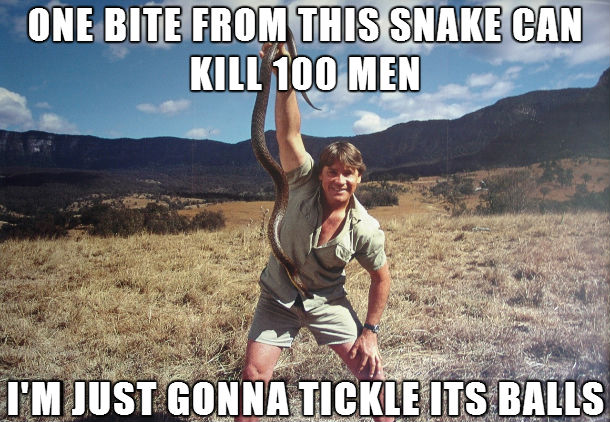
Steve Irwin’s Family Today

That Steve was a hell of a guy, especially with animals.
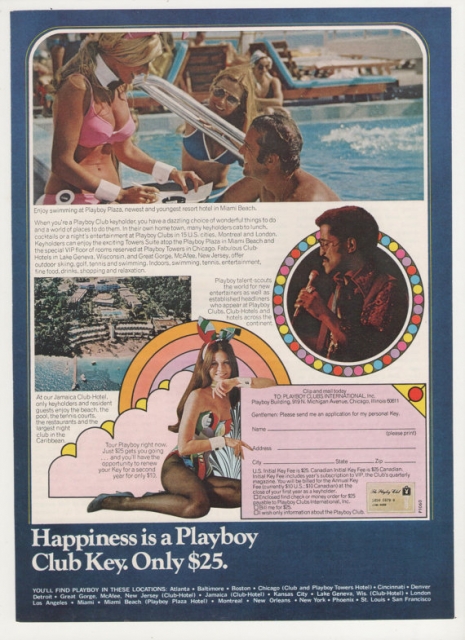
BUNNY HOP: PEEP INSIDE THE PLAYBOY CLUBS OF THE 60S, 70S & 80S
From Dangerousminds.net
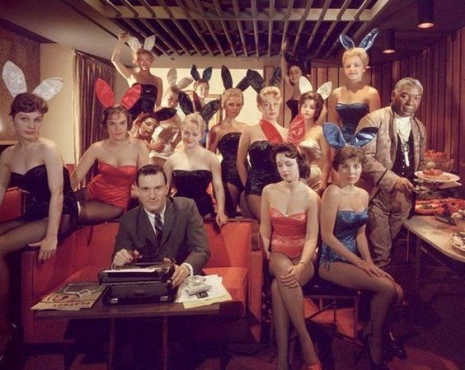
Hugh Hefner at the first Playboy Club in Chicago
The first Playboy magazine hit the shelves in 1953 and in 1960, the late Hugh Hefner opened what would be the very first Playboy Club in Chicago. Other clubs would quickly emerge in more than twenty locations including Boston, Wisconsin, and Los Angeles, as well as more elaborate Playboy Club Resorts which you could visit in Jamaica and Manila. Entrance into the various clubs would run a member $25 a year for which they would receive a special key that when presented to a designated “Door Bunny” would get them inside. The clubs were designed to emulate the “Playboy lifestyle” projected by Hefner, though that’s not what initially ignited the vast existence of Playboy Clubs. The actual inspiration for the clubs began with an article in Playboy published in 1959 that detailed the goings-on at the historic Gaslight Club in Chicago’s River North area. The club was the brainchild of Burton Browne who modeled the club around the “Gay 90s” (aka the “Naughty Nineties” or the decade beginning in 1890) a debaucherous period where creativity and libidos ran wild.
Like Hefner’s future Playboy Clubs, entrance to the Gaslight required a key. Naturally, Hef was already a member of the Gaslight Club as it featured his favorite thing—half-naked women with large breasts everywhere you looked. According to Victor Lownes III, the executive of HMH Publishing Company (which would later become Playboy Enterprises in 1955) he recalled that the article received over 3,000 letters from readers of Playboy inquiring as to how they too could join this exclusive club. This set the wheels in motion for Hefner who knew how to recognize an opportunity, though at the time his vision for his Playboy-themed clubs didn’t include expansion beyond Chicago. When the doors to the fledgling club opened, it employed approximately 30 girls between the ages of 18-23 who were said to be “single, beautiful, charming, and refined.” It also somehow qualifies the old saying that people really did read Playboy articles. At least they read one in 1957. And that’s a fact.
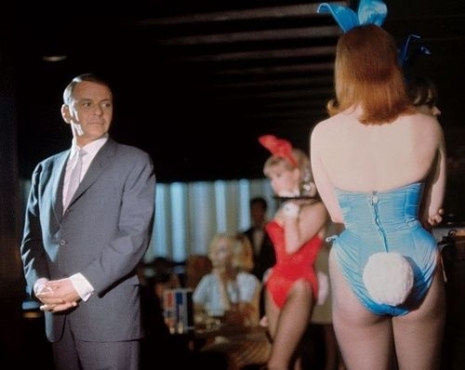
Frank Sinatra at the Las Vegas Club back in the day.
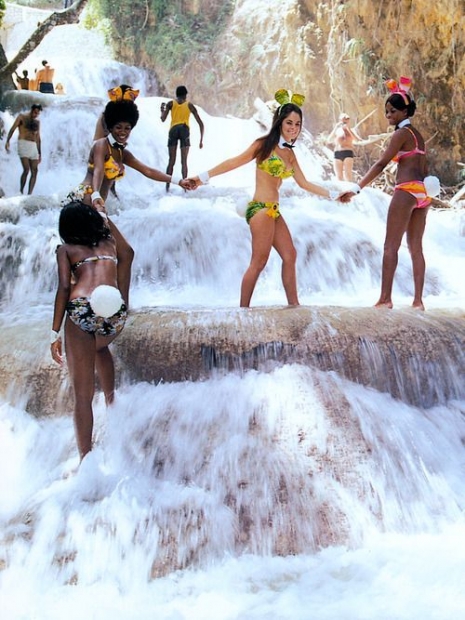
Jamaica Club

John Lennon at the London Club

Sammy
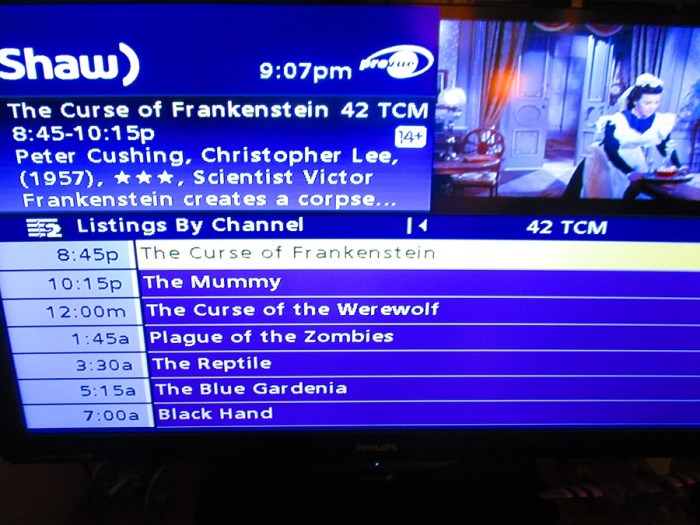
Halloween Monster Movie Marathons
With Halloween fast approaching many of the TV channels are advertising their Halloween Monster Movie Marathons. Each channel wants you glued to their channel throughout Halloween week. They want to scare the audience to the point where they wait for the commercials, so the viewers get a breather. All the ad companies will try to brainwash the audiences with the popcorn, hairspray, car and truck, make-up, fast-food joint etc. etc. commercials. So beware, beyond getting scared out of your pants, you may unconsciously radically change your shopping habits.

Zombies would be the worst competing in a monster marathon. Especially the slow variety.



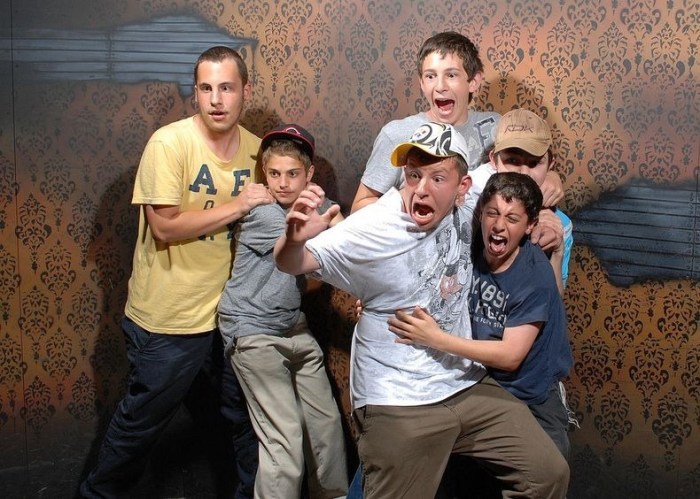
Oh God No! It’s a pack of werewolves!

WTF!!

I have to check this flick out, and soon!

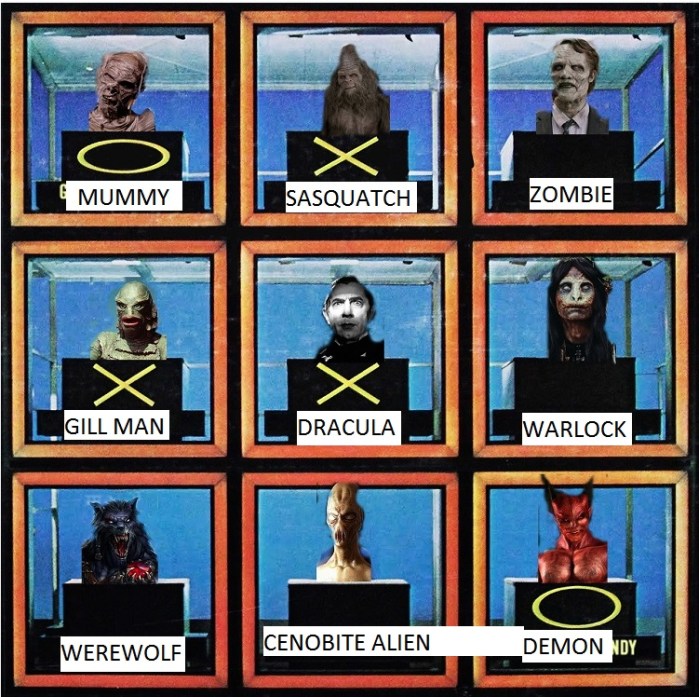
Hollywood Square Monsters
Some very bizarre aircraft that you may have not seen before

The Caspian Sea Monster, also known as the “Kaspian Monster”, was an experimental amphibious cargo plane, developed at the design bureau of Rostislav Alexeyev in 1966.
Stipa-Caproni

Stipa-Caproni, an experimental Italian aircraft with a barrel-shaped fuselage (1932). Didn’t the engineers have any sense of aesthetics?
Blohm & Voss BV 141

Blohm & Voss BV 141, a World War II German tactical reconnaissance aircraft, notable for its uncommon structural asymmetry.
This thing just looks terrible. A real mutant.
Libellula

Libellula, a tandem-winged and twin-engined British experimental plane which gives the pilot an excellent view for landing on aircraft carriers (1945).
Northrop XB-35

Northrop XB-35, an experimental flying wing heavy bomber developed for the United States Army Air Forces during and shortly after World War II. Let the imagination soar. Photo: U.S. Air Force
McDonnell XF-85 Goblin

McDonnell XF-85 Goblin, an American prototype jet fighter, intended to be deployed from the bomb bay of the Convair B-36 (1948). A real eye-catcher. Photo: U.S. Air Force
Lockheed XFV

Lockheed XFV, “The Salmon,” an experimental tailsitter prototype escort fighter aircraft (1953).
De Lackner HZ-1 Aerocycle flying platform

De Lackner HZ-1 Aerocycle flying platform, designed to carry one soldier to reconnaissance missions (1954).
I wouldn’t want to be on a recon mission standing on top of this thing. The guy would be a sitting duck.
Snecma Flying Coleoptere (C-450)

Snecma Flying Coleoptere (C-450), a French experimental, annular wing aeroplane, propulsed by a turbo-reactor, able to take off and land vertically (1958).
Avro Canada VZ-9 Avrocar

Avro Canada VZ-9 Avrocar, a VTOL disk-shaped aircraft developed as part of a secret U.S. military project (1959). This contraption had a hard time getting 2 feet (.7 meters) off the ground.
Vought V-173

Vought V-173, the “Flying Pancake”, an American experimental fighter aircraft for the United States Navy (1942). Terrible to look at.
Bartini Beriev VVA-14

Bartini Beriev VVA-14, a Soviet amphibious aircraft (1970s). This could be mistaken for a UFO.
Ames-Dryden (AD)-1 Oblique Wing, a research aircraft designed to investigate the concept of a pivoting wing (1979 – 1982).

X-36 Tailless Fighter Agility Research Aircraft, a subscale prototype jet built by McDonnell Douglas for NASA (1996 – 1997).

The Caproni Ca.60 Noviplano

The Caproni Ca.60 Noviplano was a nine-wing flying boat intended to be a prototype for a 100-passenger trans-atlantic airliner. It featured eight engines and three sets of triple wings. Two pontoons, mounted on each side, were intended to give the aircraft stability. Only one example of this aircraft was built by Caproni. The prototype only made one short flight on 4 March 1921 over Lake Maggiore in Italy. The aircraft attained an altitude of only 18 m (60 ft), then dived and crashed, breaking up on impact. The pilot escaped unscathed. Caproni had the wrecked airplane towed to shore, and announced that he would rebuild it, but that night it burned to ashes.
 The MarkoZen Blog