A Russian warship that was damaged by an explosion on Wednesday has sunk, Russia’s defence ministry has said.
Moskva, the flagship of Russia’s Black Sea fleet, was being towed to port when “stormy seas” caused it to sink, according to a ministry message.
The 510-crew vessel was an important symbolic and military target, and has led Russia’s naval assault on Ukraine.
Ukraine claims it struck the warship with its missiles, but Russia has made no mention of an attack.
Late on Thursday, however, Russian state media broke the news that the ship had been lost.
“While being towed … towards the destined port, the vessel lost its balance due to damage sustained in the hull as fire broke out after ammunition exploded. Given the choppy seas, the vessel sank,” state news agency Tass quoted the ministry as saying.
Earlier, Russia had said there was a fire on board after ammunition exploded.
Ukrainian military officials said they struck the Moskva with a Ukrainian-made Neptune missile – a weapon designed after Russia’s annexation of Crimea in 2014, and the naval threat to Ukraine in the Black Sea grew.
Earlier in the conflict the Moskva gained notoriety after calling on Ukrainian border troops defending Snake Island in the Black Sea to surrender – to which they memorably radioed a message of refusal which loosely translates as “go to hell”.
Originally built in Ukraine in the Soviet-era, the Moskva entered service in the early 1980s according to Russian media.
The missile cruiser was previously deployed by Moscow in the Syria conflict where it supplied Russian forces in the country with naval protection.
It carries over a dozen Vulkan anti-ship missiles and an array of anti-submarine and mine-torpedo weapons, the reports said.
The Moskva is the second major Russian ship known to have been severely damaged since the invasion began.
Namesake Glory (1979–2000), Moscow (2000–2022) Builder 61 Kommunara Shipbuilding Plant (SY 445), Nikolayev, Soviet Union Laid down 1976 Launched 1979 Commissioned 30 January 1983 Decommissioned September 1990 Reinstated April 2000 Identification 121 Fate Sunk on 14 April 2022, responsibility disputed[1] Notes Flagship of the Black Sea Fleet
Space Perspective’s planned $125,000-a-seat ride is heavy on the ambiance, if gazing down on Earth isn’t thrilling enough.
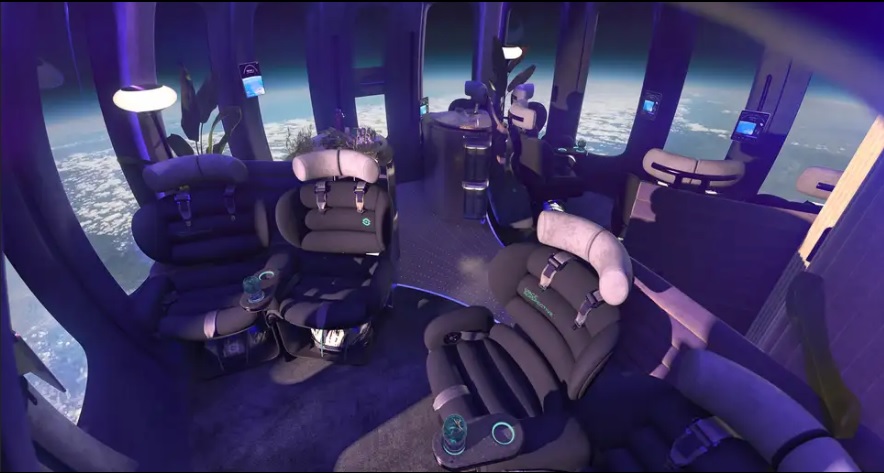
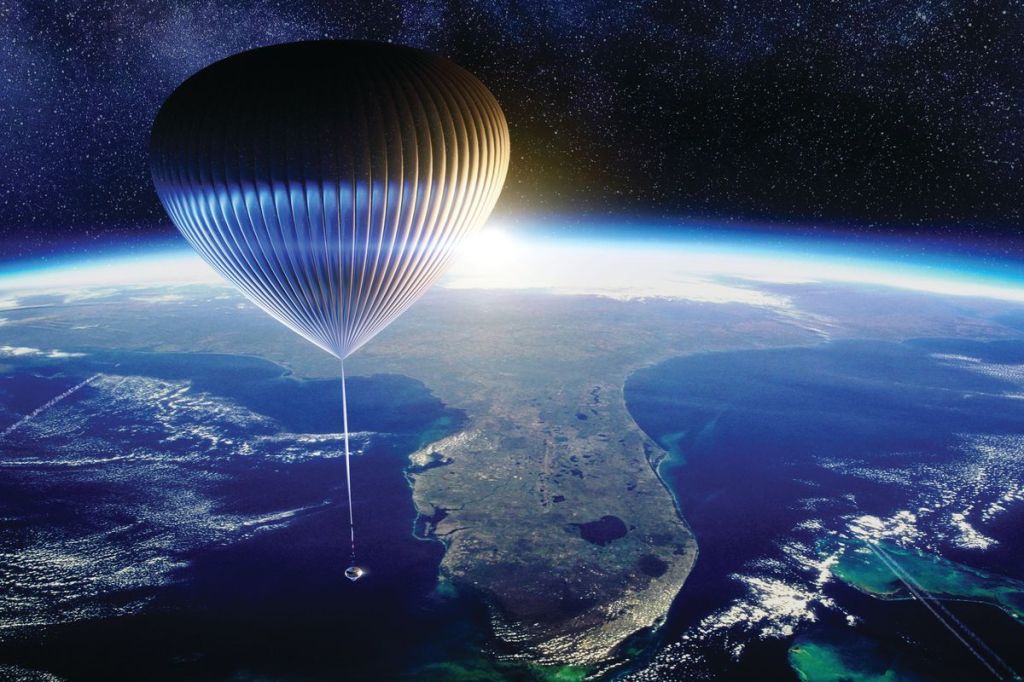
Space Perspective has revealed the cabin design for its upcoming Spaceship Neptune—a balloon-held capsule that, for the lofty price of $125,000, will take passengers to the edge of space.
Liftoffs aren’t slated to begin until late 2024, but newly released conceptual images of the Spaceship Neptune passenger cabin offer an early glimpse of what the experience could look like. But at $125,000 per seat, this is probably as close as any of us will ever get to actually stepping inside this thing.
The climate-controlled, pressurized interior cabin will be held aloft by a balloon as it rises to the stratosphere. Reaching a height of 20 miles (30 kilometers), passengers will have a 360-degree view of their surroundings, from which they’ll be able to see the curvature of Earth. The passengers will be able to see 450 miles (724 km) in any direction, as well as the blackness of space. By comparison, passenger jets fly at heights reaching 7.9 miles (12.7 km).
But as for actually being in space, well, that’s not going to happen. The Kármán Line—the internationally recognized boundary of space—is located 62 miles (100 km) above sea level, far from the maximum height obtainable by the disingenuously named Spaceship Neptune. That said, a refreshing cocktail or two will console you when you finally realize that you spent all that money to not go to space.
Still, the experience promises to be a good one, and at a fraction of the cost of going to bona fide space. A quick, suborbital trip on a Virgin Galactic spaceplane costs $450,000 while Axiom Space charges $55 million for a trek to low Earth orbit and a stint on the International Space Station.
For the interior design, Space Perspective aimed for a look that’s sleek and dynamic, as opposed to the “white, utilitarian environments you find in other spacecraft,” Jane Poynter, the founder, co-CEO and chief experience officer for Space Perspective, said in an emailed press release. And in keeping with its environmentally friendly message, the company plans to build the interior from sustainable and recycled materials.
Other features of the capsule include seats that can be reconfigured for intimate one-on-one dates, a spacious and unobstructed interior section (care for a dance?), floor lamps, and customizable mood lighting that includes low red LED lights to ensure that passengers “will absorb the dramatic sights of witnessing dawn, planet Earth, and stars above in space—while easily navigating their way around the Space Lounge,” according to the press release. An overhead “donut” scrolling display will convey important information as the journey progresses, and if the view isn’t satisfactory enough, passengers can peer into space or at Earth using a telescope.
Space Perspective has sold 600 tickets thus far, and the first year of service is already completely booked (in case you’re wondering, the company has approval from the U.S. Federal Aviation Administration to conduct these flights). The company is taking reservations for 2025 and beyond, but a refundable $1,000 deposit is required. The company says passengers can book the entire capsule for themselves, if they want.
Gilbert Jeremy Gottfried (February 28, 1955 – April 12, 2022) was an American actor and stand-up comedian. His persona as a comedian featured an exaggerated shrill voice and emphasis on crude humor. His numerous roles in film and television include voicing the parrot Iago in Disney’s Aladdin animated films and series, Digit LeBoid on PBS Kids’s long-running Cyberchase, and Kraang Subprime in Teenage Mutant Ninja Turtles. Gottfried was the voice of the Aflac Duck until 2011. He appeared in the critically panned but commercially successful Problem Child in 1990.
From 2014 until his death in 2022, Gottfried hosted a podcast, Gilbert Gottfried’s Amazing Colossal Podcast, which featured discussions of classic movies and celebrity interviews, most often with veteran actors, comedians, musicians, and comedy writers. Gilbert, a documentary film on Gottfried’s life and career, was released in 2017.
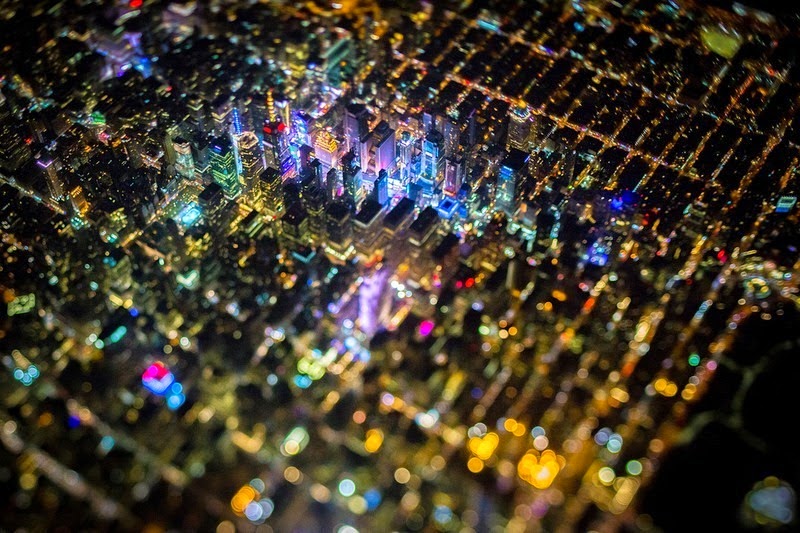
The photos almost look like a miniature Lego set was lit up.
Photographer Vincent Laforet captured these absolutely stunning high-altitude photos of New York City at night by hanging himself out of a helicopter hovering at a staggering 7,500 feet. Nobody has ever done this before from this altitude.
“It is both exhilarating and terrifying all at once,” Laforet told Gizmodo. “Let’s just start off by saying this was the scariest helicopter “photo mission” of my career. And the most beautiful.”
Indeed, one veteran pilot that Laforet often flew with refused to go up to the altitude they were at, saying that “helicopters are not meant to live in that realm”.
Laforet was on assignment for the Men’s Health Magazine and the photographer proposed shooting the city from an unusually high altitude so that they could capture the lines that are formed by the streets of New York at night. “It was an article about psychology and I’ve always thought that from a high altitude the streets looked like brain “synapses” – at least to me,” he said.
For the shoot, Laforet was armed with multiple Canon 1DX’s, a Mamiya Leaf Credo 50MP digital medium format system, and a huge array of glass for both Canon and Mamiya medium format system. Because helicopters vibrate pretty significantly, Mike had also brought a Kenyon 4×4 gyroscopic stabilizer, which provided stability for lower ISO, slower shutter night shots.
“I was finally able to capture some of the images that I’ve dreamed of capturing for decades,” said Laforet.
The Ubari Sand Sea is a vast area of towering sand dunes in the Fezzan region of south-western Libya. But 200,000 years ago, this was a wet and fertile region with plenty of rainfall and flowing rivers. These rivers fed a vast lake, the size of Czech Republic, in the Fezzan basin called Lake Megafezzan. During humid periods the lake reached a maximum size of 120,000 square kilometers. Climate change caused the region, a part of Sahara, to gradually dry up and between 3,000 to 5,000 years ago, the lake evaporated away into thin air. Traces of this great lake still exist today in the form of micro lakes scattered among the towering dunes like wet patches in the desert. Currently there are about 20 lakes in the Ubari Sand Sea – beautiful palm-fringed oases that appear like anomalies in the harsh desert environment.
Among the most picturesque of the lakes are Gaberoun and Umm al-Maa (the Mother of Water). Located besides the ruins of the old village, Gaberoun is the one tourists mostly visit. There is a rudimentary tourist camp on the shore, including an open patio, sleeping huts, and a souvenir shop. There are two more beautiful lakes – Umm al-H’isan (the Mother of the Horse), also spelt as Oum El Hassan, located north of Gaberoun; and another one at Tarhouna, about 11km from Umm al-H’isan. These are, however, rarely visited by tourists.
The Ubari lakes are very salty. This is due to the fact that these lakes are being continuously evaporated and have no rivers replenishing them (Libya has no perennial rivers that persist year-round). This has caused the dissolved minerals in the lake waters to become concentrated. Some of these lakes are nearly five times saltier than seawater. Some take on blood-red hue from the presence of salt-tolerant algae.
Although the Ubari Lakes are not exactly shallow, ranging from 7 to 32 meters in depth, they are at the risk of drying out. The waters in Sahara’s underground aquifers, that were deposited tens of thousands of years ago in much wetter times, is limited and this is already declining thanks to the increasing use of aquifer water by growing human populations. About three decades ago the Libyan government undertook an ambitious project called Great Man-Made River, aimed at drawing water from the aquifers beneath the Fezzan region via a network of underground pipes to make the desert bloom. The project, if successful, will drain these enormous reserve of fresh water in just 50 to 100 years.
Kirill Vselensky perches on a cornice in Moscow as Dima Balashov gets the shot. The 24-year-olds, risktakers known as rooftoppers, celebrate their feats on Instagram.
This photo was originally published in “Why Many Young Russians See a Hero in Putin,” in December 2016.
As an evening storm lights up the sky near Wood River, Nebraska, about 413,000 sandhill cranes arrive to roost in the shallows of the Platte River.
This photo was originally published in “What Happens to the U.S. Midwest When the Water’s Gone?,” in August 2016.
Ye Ye, a 16-year-old giant panda, lounges in a wild enclosure at a conservation center in China’s Wolong Nature Reserve.
This photo was originally published in “Pandas Get to Know Their Wild Side,” in August 2016.
Tempted by the fruit of a strangler fig, a Bornean orangutan climbs 100 feet into the canopy. With males weighing as much as 200 pounds, orangutans are the world’s largest tree-dwelling animals.
This photo was originally published in “Inside the Private Lives of Orangutans,” in December 2016.
In Flint, Michigan, siblings Julie, Antonio, and India Abram collect their daily allowance of bottled water from Fire Station #3, their local water resource site.
This photo was originally published in “Intimate Portraits of Flint Show Frustration, Fear, Perseverance,” in February 2016.
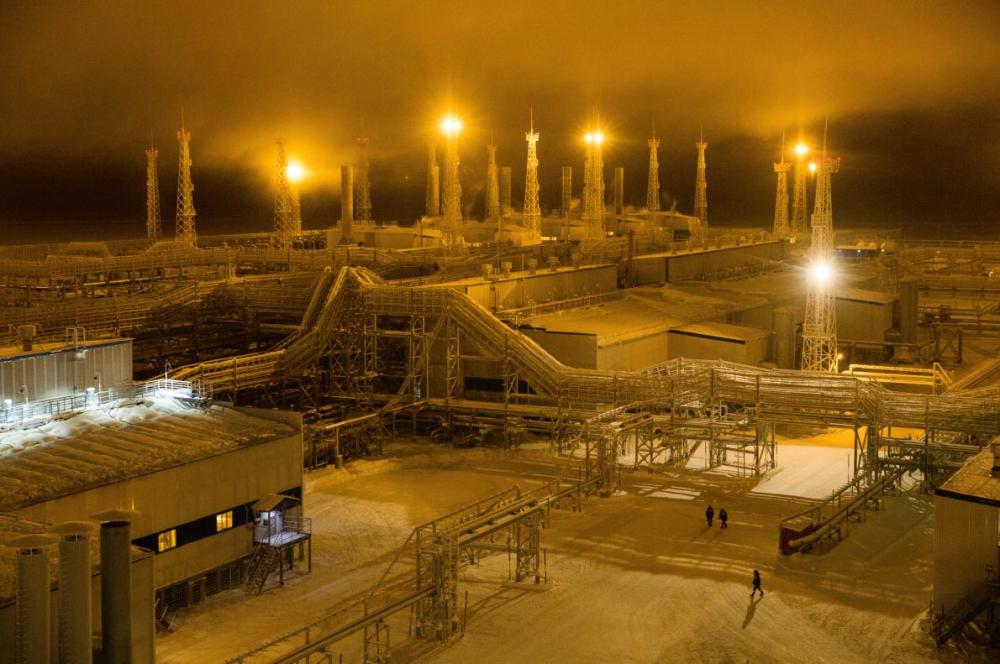
Russia’s Bovanenkovo natural gas field, on the Yamal Peninsula, was deemed too expensive to develop until President Vladimir Putin made it a priority.
This photo was originally published in “In the Arctic’s Cold Rush, There Are No Easy Profits,” in March 2016.
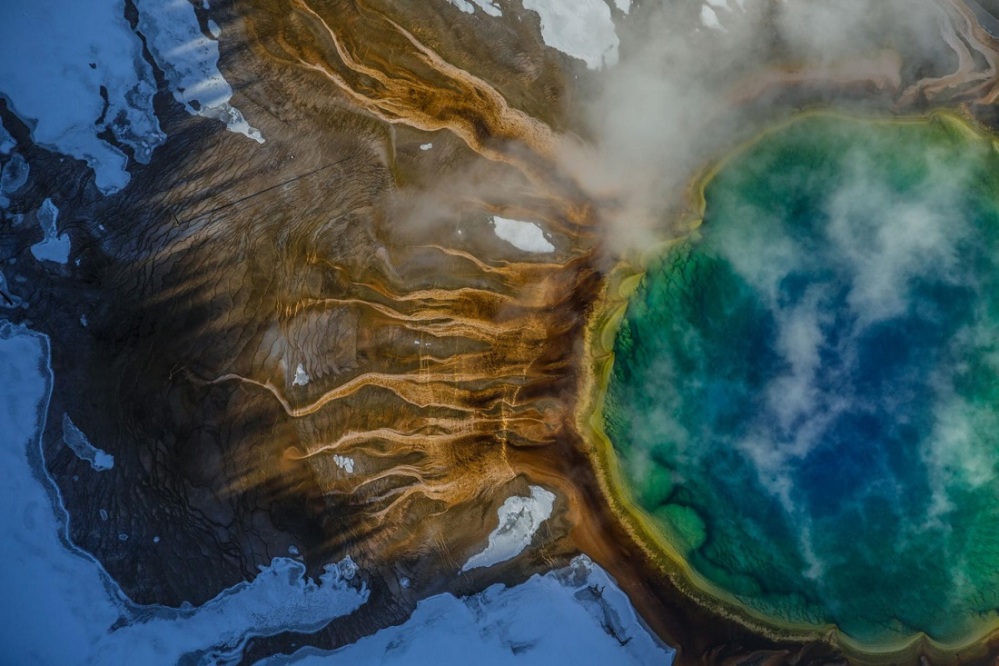
The colors of Grand Prismatic Spring in Yellowstone come from thermophiles: microbes that thrive in scalding water.
This photo was originally published in “Learning to Let the Wild Be Wild in Yellowstone,” in May 2016.
Steven Donovan, flipping into a pool, took a seasonal job at Glacier National Park to sharpen his photography skills.
This photo was originally published in “Can the Selfie Generation Unplug and Get Into Parks?” in October 2016.
Kirk Odom was convicted of rape after an expert testified that a hair on the victim’s nightgown matched his. He spent years in prison before DNA tests proved his innocence.
This photo was originally published in “How Science Is Putting a New Face on Crime Solving,” in July 2016.
In Alaska, a mother grizzly and her cubs cause a “bear jam” on Denali’s 92-mile-long Park Road, open to private vehicles only five days each summer.
This photo was originally published in “How Can 6 Million Acres at Denali Still Not Be Enough?” in February 2016.
On a mountainside in Yosemite National Park, photographer Stephen Wilkes took 1,036 images over 26 hours to create this day-to-night composite.
This photo was originally published in “How National Parks Tell Our Story—and Show Who We Are,” in January 2016.
Dressed for Mars, space engineer Pablo de León tests a prototype space suit at NASA’s Kennedy Space Center, where fine soil and fans simulate conditions on the red planet.
This photo was originally published in “Mars: Inside the High-Risk, High-Stakes Race to the Red Planet,” in November 2016.
Villagers in Bagaran, Armenia, sing of cultural endurance and survival while picnicking at night beneath apricot trees—and a giant cross that shines defiantly into Turkey.
This photo was originally published in “A Century Later, Slaughter Still Haunts Turkey and Armenia,” in April 2016.
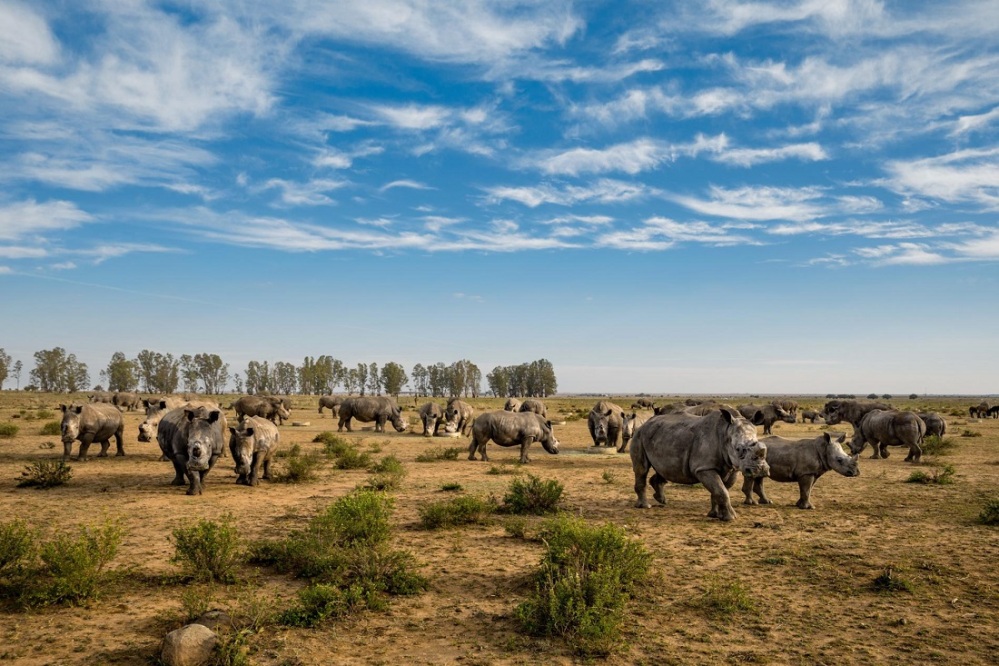
These rhinos on a South African ranch have recently had their horns trimmed. Unlike elephant ivory, rhino horn grows back when cut properly. The rancher is stockpiling the horn in hopes that selling it will soon be legal.
This photo was originally published in “Special Investigation: Inside the Deadly Rhino Horn Trade,” in October 2016.
On their first migration to their summer range in southeastern Yellowstone, three-week-old calves of the Cody elk herd follow their mothers up a 4,600-foot slope.
This photo was originally published in “The Yellowstone We Don’t See: A Struggle of Life and Death,” in May 2016.
Summer attracts sunbathers—clothed and otherwise—to the grassy banks of Munich’s Schwabinger Bach. The meadows here have been popular with nudists since the 1970s.
This photo was originally published in “How Urban Parks Are Bringing Nature Close to Home,” in April 2016.
A panda keeper in China uses a stuffed leopard to train young pandas to fear their biggest wild foe. A cub’s reactions help determine if the bear is ready to survive on its own.
This photo was originally published in “Pandas Get to Know Their Wild Side,” in August 2016.
Lounging in inches of warm water, blacktip reef sharks wait for the tide to refill the lagoon at Seychelles’ Aldabra Atoll.
This photo was originally published in “In the Seychelles, Taking Aim at Nature’s Bullies,” in March 2016.
They’re tall. They’re totally absurd. And they’re everywhere.
Over the past few decades, as cellphone networks have grown, thousands of antenna towers designed to look vaguely like trees have been built across the United States. Although these towers are intended to camouflage a tower’s aesthetic impact on the landscape, they typically do the opposite: most look like what an alien from a treeless planet might create if told to imagine a tree.
A “pine” in Colorado. (Brian Brainerd/the Denver Post via Getty Images)
In the 1980s, soon after cellphone companies started building antennas in the United States, they sought to hide them, as well, often in response to aesthetic complaints from local residents.
Initially, most concealed antennas were simply hidden on church steeples or water towers, but in 1992, a company called Larson Camouflage — which had previously made fake habitats for Disney World and museums — built a “pine” tower in Denver. The world was changed forever.
Soon afterward, companies in South Carolina and South Africa began building similar “trees.” In the US, the Telecommunications Act of 1996 restricted municipalities’ ability to block tower construction, so as demand for cell service spread, it meant that towers would inevitably be built in historic districts and other areas where locals might object.
A “tree” in Cambridge, Massachusetts. (Darren McCollester/Getty Images)
Still, municipalities have often tried to block construction, leading companies to offer “trees” instead of towers as a compromise. Some localities even require new towers be camouflaged as part of their zoning requirements.
There’s no good data on how many of these “trees” now exist, but in 2013, Mergen estimated there were between 1,000 and 2,000 nationwide. The company Stealth Concealment says it builds about 350 new “trees” per year. They’re most often built in suburbs, where residents have the time and urge to war with companies over new towers, and there’s enough incentive for carriers to invest in “trees.”
Why these “trees” look so ridiculous
There are actually good reasons why these towers seldom actually look like real trees.
One is height. Towers are built to hold antennas higher than surrounding structures to ensure good reception, so they have to be taller than what’s nearby. This is why you often see surreally tall “pines” or “palms” towering over normal trees.
Another is cost. These “trees” are normal cellphone towers, which are then sent to companies like Larson or Stealth Concealment for plastic, fiberglass, or acrylic “bark,” “branches,” and “needles” to be added. This process is customized and expensive: it can add $100,000 or so to the baseline $150,000 cost of a tower.
As Ryan McCarthy of Larson told Bernard Mergen, “A pine tree that has 200 branches will be more appealing than one of the same height that has 100. However, the customer will not only incur the cost of 100 extra branches, but the extra wind load from the branches will also require that the pole be designed more stoutly.”
This is also why you so seldom see towers designed as deciduous trees, even in areas where they’re much more common than pines — their branching structure makes them more complex and more expensive to build. Pines, palms, and cacti are much easier to approximate in plastic and fiberglass.
In terms of blending in, the most successful towers are probably “saguaros,” which can plausibly be built in deserts where there are no trees that they have to tower over — and don’t have expensive branches or needles that need to be attached.


















/cdn.vox-cdn.com/uploads/chorus_image/image/46154008/3098732719_b0d5d40125_o.0.0.jpg)
:no_upscale()/cdn.vox-cdn.com/uploads/chorus_asset/file/3618342/161320313.0.jpg)
:no_upscale()/cdn.vox-cdn.com/uploads/chorus_asset/file/3618364/1326219.0.jpg)
:no_upscale()/cdn.vox-cdn.com/uploads/chorus_asset/file/3618352/2263592418_d62d8c669b_o.0.jpg)
:no_upscale()/cdn.vox-cdn.com/uploads/chorus_asset/file/3618360/8576531832_70a13ceba8_o.0.jpg)
:no_upscale()/cdn.vox-cdn.com/uploads/chorus_asset/file/3618380/14298850772_97c14a3774_o.0.jpg)

 The MarkoZen Blog