Popular Science magazine had many articles devoted to automobile safety back in the 1930’s, 1940’s, 50’s and 60’s. The car explosion in those decades revealed many problems and concerns as cars became bigger and faster. Many of the tips Pop Sci brings up from back in the day could be utilized in today’s world of mass automobile use.
Keep your eyes on the road!
If this cover image doesn’t terrify you into driving safely, we don’t know what will. According to the illustrator, driving 30 miles and hour is as dangerous as driving on the roof of a building.
Manitoba Public Insurance should start preaching these same basic rules. I don’t know about the one of suspecting every pedestrian of suicide.
1. Learn to judge the conditions of the road and the drivers. 2. It isn’t how fast you can go, it’s how fast you can stop. 3. Keep one car length between you and the car in front of you for every 10 miles on your speedometer. 4. Suspect every pedestrian of suicide. 5. Every intersection is a crash point, so slow down. 6. Signal properly. 7. Expect the worst from the other car.
Get those brakes checked regularly
Speed limits in certain States back in 1960 was 30 mph. That would be about 52 kph.
Keep those tires up to date and checked out regularly
In 2020, Clarence Iron, Earl Wood, and John Chabot debuted calling for the NHL in Nêhiyawêwin (ᓀᐦᐃᔭᐍᐏᐣ; the Plains Cree language) during a Montreal Canadiens versus Carolina Hurricanes game. Building on their coverage beginning in 2019 of Rogers Hometown Hockey in Cree, APTN now hosts HNIC in Cree every Saturday night with announcer Clarence Iron calling alongside host Earl Wood and analysts John Chabot and Jason Chamakese. Although broadcasts in Nêhiyawêwin were postponed during the pandemic-shortened 2020-21 season, a large push for them to return ensured the return of consistent, weekly Plains Cree hockey coverage. The team behind Cree broadcasting is also working to translate hockey terms into the language, such as “slapshot” (ᓱᐦᑭᐸᑲᒥᐍᐸᐦᐍᐤ sohki-pakamiwepahwew), “faceoff” (ᓇᐸᑭᐘᓂᐢ napakiwanis), and “rink” (ᓱᓂᐢᑿᑕᐦᐃᑫᐏᑲᒥᐠ soniskwatahikewikamik).
Claim to fame: A 60-mile traffic jam on an expressway heading into Beijing lasted 13 days in 2015
Life in the slow lane: The 2015 jam on National Expressway 110, which links Beijing and North China’s Hebei province, caused by construction and a number of accidents, shocked the world. But Beijingers are used to epic-scale gridlock. Despite the city’s six surrounding ring roads, numerous expressways, and the government’s restrictions on car use, urban planners simply can’t keep up with the massive influx of new cars that many of Beijing’s approximately 20 million increasingly wealthy people (many of whom have never driven a car before) have recently bought. Some 248,000 new cars were registered in the first four months of 2010, according to the Beijing municipal tax office, a rate of 2,100 new cars per day.
Driving in Beijing, which came in first on IBM’s latest survey of “commuter pain” among major world cities, is a truly frustrating experience: 69 percent of Beijing motorists admitted that on occasion they have just given up and gone home, 84 percent claimed traffic affected work or school performance, and the average commuter suffers through almost an hour of traffic just commuting to work. The city is pinning its hopes on one out-of-the-box solution: an enormous, solar-powered bus that literally drives over traffic.
MOSCOW
Claim to fame: Muscovite drivers face the longest traffic delays in the world, with waits averaging about two and a half hours
Life in the slow lane: Drunk driving, bad weather, streets designed only for military marches and Communist officials in limousines, and well-connected individuals skipping traffic continue to make driving in this city an exasperating — not to mention costly and dangerous — experience. The Russian Transportation Ministry claims that $12.8 billion — more than the GDP of Iceland — is lost every year due to the miserable traffic conditions. Overall, Russia’s road-accident mortality rate is more than twice as high as some members of the European Union — despite the fact that Russians have about a third the amount of cars.
The Kremlin has addressed the traffic issue on numerous occasions, but with the country’s road infrastructure ranked 111th in the world and falling rates of public spending — despite the Transportation Ministry’s pleas to add almost 250 miles of road to ease congestion — Muscovites are not happy. One study showed that over the past three years, two in five residents of the capital have had to wait at least three hours for traffic to clear (an impressively low figure considering there are 650 traffic jams on average every day).
MEXICO CITY
Claim to fame: In 2006, a single political protest caused a backup of half a million cars
Life in the slow lane: Some might think that freeway-clogged Los Angeles is North America’s worst traffic nightmare, but according to IBM’s survey, Mexico City is almost four times as tough for commuters. The Mexican capital has become famous for Darwinian traffic habits (an average of 1,500 pedestrians are killed in accidents a year) and pollution so heavy that it likely shortens life spans. Despite city initiatives to decrease the heavy traffic congestion largely caused by simply too many people and too few roads, more than half of Mexico City drivers said that the traffic has negatively affected school or work while 62 percent said that traffic is getting worse in a city with streets first designed by the Aztecs.
One uniquely Mexican trait is definitely not helping matters: The city averages about eight and a half street protests per day, further clogging the streets with demonstrators from all over the country. The city even has a website specifically designed to note every protest and the likelihood of resulting traffic blockages.
SAO PAULO
Claim to fame: The city holds the world record for the world’s longest traffic jam at over 165 miles on May 9 in 2008
Life in the slow lane: A traveler to Sao Paulo might wonder why so many drivers can be seen doing such menial tasks as shaving, watching movies, or playing video games while at the wheel. Given that Paulistas regularly spend three- to four-hours each day in traffic jams that can be over 100 miles long, it should not be too surprising that motorists are making themselves feel at home. Not only do Sao Paulo roads handle the city’s more than 20 million people poorly, but the city has simply not done enough to fix matters. The fast-growing and sprawling, decentralized megalopolis –spread across more than 3,000 square miles — suffers from extra traffic due to its lack of any fully functional ring roads.
Designated bus lanes, subway additions, and a car-restriction system that allows only a limited number of drivers on the road each day have done little to lessen the massive traffic congestion that costs the city an estimated $2.3 billion a year. The gridlock has gotten so bad that Sao Paulo’s well-connected and wealthy have made the city home to the second-largest helicopter fleet in the world.
LAGOS
Claim to fame: Frequent massive car accidents cause fatalities in the dozens
Life in the slow lane:Driving in Lagos is characterized more by the act of sitting — the standstill nature of driving in this booming city is so ubiquitous that Lagosians have created their own term for their city’s traffic: “go-slow.” Near the top of many lists for fastest-growing city in the world, Lagos for many years lacked any overarching plans for infrastructure, as its infamous traffic attests.
Overcrowding is not the only problem afflicting Lagos’s roads, however– vehicle-wrecking potholes, few working traffic lights, carjacking, corrupt traffic police, and flooded roads are also common. Traffic in Lagos, a coastal city on the Atlantic Ocean, is plagued by the fact that drivers are often forced to take narrow bridges, causing bottlenecks. Worst yet, according to urban lore, it’s dangerous to try to buy any items from street vendors while stuck on a bridge because there is a good chance that they or others nearby — knowing you have nowhere to move — are armed and looking to steal all your belongings.
In Canada Toronto is by far the worst. An average of 80 minute commutes per day. Montreal is a close second. Bangkok and Cairo have notorious traffic.
In the U.S. it is Chicago, Washington, D.C., Los Angeles, Houston and Seattle.
Traffic on interstate outside New Orleans before Hurricane Rita. All the traffic is going in the same direction.
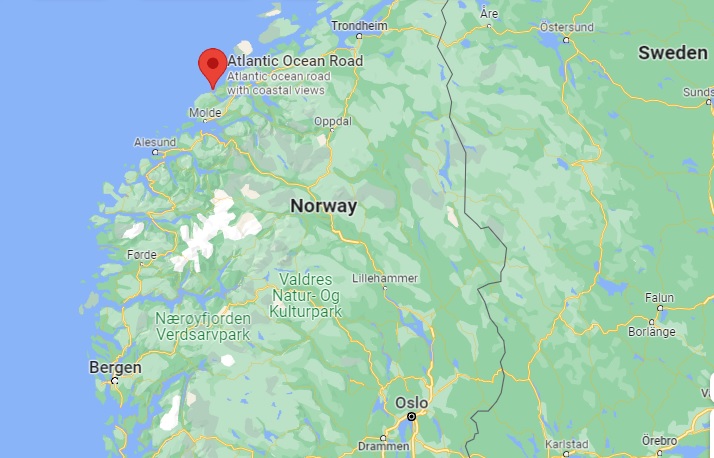
The Atlantic Ocean Road or the Atlantic Road is a 8.3-kilometer (5.2 mi) long section of County Road 64 that runs through an archipelago in Eide and Averøy in Norway.
Creature spotted on wing of 747 landing in Los Angeles
People love to believe in strange and unexplained phenomena, legends and the paranormal etc. And there is no shortage of authors, pseudo-scientists and charlatans who provide the stories. Unbelievable stories of the paranormal that would make a skeptical and rational person shake their heads in incredulous amazement. But these authors have tens of thousands of loyal followers who spend millions of dollars purchasing their hard-to-prove books, DVD’s and other products. Humans want to believe, and they strongly believe without any empirical evidence whatsoever. I don’t want to offend anybody, but does organized religions and cults come to mind?
The endless ghost hunting shows on TV that deliver no evidence, and when pseudo evidence is brought forth, it can always be debunked by any skeptic worth his salt. Monster stories like the Jersey Devil, werewolves in Wisconsin and underground space alien bases in Colorado, all have believers that are so convinced it is true they break into cold sweats when trying to sleep. Other monsters like lake creatures and Bigfoot are a different story, there are many witnesses, some video footage and in the case of Bigfoot, very hard to disprove footprint evidence. UFO’s are also a mysterious phenomenon that has some very compelling evidence associated with it. IE. radar images.
The radio program Coast to Coast with George Noory covers every corner of the paranormal universe. From time to time the show brings on real investigators that are looking for the truth. However, most of the time the ‘experts’ brought on the air have fantastical and outrageous propositions with no proof whatsoever. And they all have books and DVD’s to sell. Below are blurbs from the show describing the subject matter that will be discussed that night and from past shows.
In the first half, scientist and researcher Michael Tellinger discussed evidence for the Anunnaki, an ancient ET race he believes created humanity through genetic tinkering to serve as slaves for their gold mining operations. As evidence for the Annunaki’s presence, he cited the massive number of ancient stone circles found in South Africa, and Zimbabwe, which date back at least 300,000 years. The circles vary in size from 15 feet across to 450 ft. and Tellinger believes they originally functioned as energy generating devices, though in more recent times some of them have been converted into dwellings.
Why hasn’t National Geographic or Archeological Digest reported on this?
Professional game tester and proprietary software trainer Mark K. Sargent will discuss his breakthrough work on the Enclosed Earth Theory. He’ll outline the visible physical clues that point to the idea that Earth is actually a “Truman Show” type contained system stretching thousands of miles wide. He’ll also share data from Admiral Byrd’s expeditions which reveal evidence that Byrd discovered a hollow Earth which is actually a giant dome-like structure.
Wow!
In the first half, emotional clearing expert, practicing exorcist, and professional psychic Jeffrey Seelman discussed his work with negative and demonic spirits, how they manifest destructive forces and take residence in individuals and dwellings, and what it takes to purge them. Lately, he’s been focusing on teaching people to protect themselves from unseen accumulated negative energies which can be present in such places as homes, schools, and work environments. Negative energies are not alive in the way that spirits are, but they can still cast a dampening affect, he explained.
Retired U.S. Air Force pilot Donald M. Ware spoke about the shadow world government, Inner Earth, ET agendas, Atlantis, and secret histories. He cited that the NRO (National Reconnaissance Office) among other agencies is behind the shadow government, and that they control and manage much that the public is unaware of such as bases on the moon, and Mars, as well as undersea and underground facilities here on Earth, that are inhabited by a hidden advanced society. 50,000 Germans escaped at the end of the WWII and many of them went to South America and hidden facilities, Ware contended.
In the latter half, psychic medium, teacher, and motivational speaker Sunny Dawn Johnston talked about her communications with angels, guides, and loved ones who have crossed over, and outlined the various ways to make contact with the Other Side including seances. Seance comes from a French word meaning to sit. The idea behind a seance is to call in or invite the energy of the spirit world, and receive messages in order to provide closure or understanding for the living, she detailed. Deceased spirits can make contact regardless of whether they’ve “crossed over,” as aspects of their soul do not dissipate, she added.
Erich von Däniken cited ancient texts from India that referred to three gigantic “cities” that surrounded our planet like stars. A war in the heavens took place and two of the cities were destroyed by massive weapons, he recounted. Regarding the ancient Nazca Lines in Peru– massive drawings whose designs can only be discerned by air, he pointed out that satellite technology has revealed other huge pictographs around the globe, in such locations as northeast Jordan, South Africa, and Russia.
John Herlosky defined remote viewing as a scientifically validated form of ESP which allows a viewer to extend his consciousness in space and time to observe persons, places, and events outside of normal modes of perception and undiminished by shielding or distance. Herlosky traced a brief history of how the CIA became involved in psychic spying. “They found after experimentation that there was something to this, that it could actually be used as an intelligence asset,” he explained. According to Herlosky, although no one knows why or how it works, remote viewing is a real human ability innate to everyone.
In the first half, guest host Dave Schrader welcomed voice natural direct sensitive, Joe Who, for a discussion on his lifelong ability to hear people’s voices, and see inside their lives and past history. According to Who, all that’s required to connect with a person is to hear his or her first name and birth month. “When I hear a person’s voice I start to see things behind my eyes… it’s kind of like reading a teleprompter [that shows words and colors],” he explained.
Who’s off first on this one, he’s out to left field.
In the first half, constitutional attorney and president of The Rutherford Institute, John Whitehead, talked about the rise of the police state in the United States. America has become plagued by bureaucracy, secrecy, perpetual wars, militarization, and surveillance, he declared. Essentially, we’ve become a nation of suspects, and the citizenry has very little recourse against any kind of action by the police, he said. By “police” he includes various kinds of law enforcement such as Homeland Security and FBI agents, who have SWAT teams, and use hollow point bullets (which explode on contact).
Appearing during the third hour, researcher Richard Sauder spoke about underwater bases associated with UFOs, as well as the secret government, and a coming economic implosion. The late investigator and cryptozoologist Ivan T. Sanderson concluded that underwater UFOs were real and operated by undersea inhabitants, said Sauder, who added that Lake Erie is a hotspot for such activity. There are underground salt deposits in the lake area, which are easier to drill into and create caverns than regular rock, he explained. Intriguingly, he also suggested that the underground bases may be connected with time travel, as water has many unusual properties and it may somehow facilitate the malleability of time.
Underwater UFO bases and time travel! Sign me up!!
Mixing together an examination of legends and fairy tales, as well as modern sightings, author and researcher Steve Quayle discussed his latest work on little people or elves, as well as giants. “It’s my contention that truly the gates of Hell are opening now, or have opened, and the supernatural phenomena that people are experiencing is only getting worse,” he commented, adding that he connected creatures such as the giants and little people to demonic sexualized entities such as the incubus and succubus. “Whether you’re dealing with the little creatures, or the tricksters, or the goblins… or the djinn, you’re dealing with some of the most malevolent entities,” and some very well-known authors have believed in them such as Arthur Conan Doyle and Robert Louis Stevenson, he cited.











 The MarkoZen Blog