Heavy Lift Ships and their Incredibly Massive Cargoes

Markozen.com's avatarThe MarkoZen Blog

When you need to transport large cargo, goods, and materials from one place to another, the ship is the ideal choice even though they are extremely slow. Thousands of cargo carriers ply the world’s seas and oceans each year, and they handle the bulk of international trade. Then there are heavy lift ships that are designed to carry excessively large loads that even cargo ships cannot bear, such as other ships, drilling rigs or anything else too large or heavy to be easily transported on a conventional ship.

Heavy lift ships are of two types: semi-submerging capable of lifting another ship out of the water and transporting it; and vessels that augment unloading facilities at inadequately equipped ports. Semi-submerging are more commonly known as a “flo/flo” for float-on/float-off. These vessels have a long and low well deck that can go down under water allowing oil platforms, other vessels, or other…

View original post 398 more words

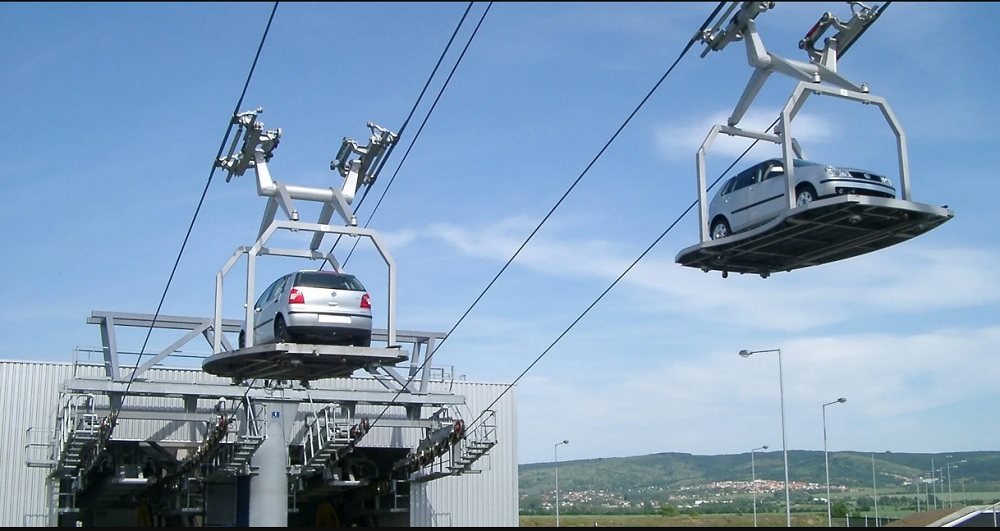
Unique aerial cable car in Bratislava

A unique aerial cable car, constructed specifically for the Volkswagen Slovakia (VW SK) car manufacturing plant in Bratislava keeps on moving. This one-of-a-kind aerial lift, which transports cars between the assembly hall and the test track, dominates the silhouette of the plant.

The lift is unique even within the entire Volkswagen operation; it was designed and constructed in connection with the arrival of the Volkswagen Touareg, for the purpose of transporting large numbers of vehicles from the assembly hall to the test track. A lot of innovation went into the project, as no similar cable car existed before it, VW SK wrote in a press release.

The aerial cable car war designed as a new transport carriage prototype on which the cars are transported to other loading stations. It is 455 metres in length, and runs 99.5 percent of the time that the factory is in operation. The trip from one station to the next lasts about 4.5 minutes, with a maximum speed of three metres per second. The steel cable on which the gondolas hang is 8-stranded and anticlockwise, and was used on this cable car for the very first time. Eight transport carriages are hung, each weighing 2.5 tons and bear a load capacity of an additional 2.5 tons.

Is Saskatchewan named after Sasquatches?  

Saskatchewan not named after sasquatches, residents insist

bigfoot1 (2)

CTV

Saskatchewanians are eager to correct the record after an NBA announcer insisted Wednesday that their province is named for its abundance of sasquatches.

The Fox Sports announcer made the comment while pointing out that Utah Jazz forward Trey Lyles is the first person from the province to play in the NBA.

“That region’s known for being home to a lot of sasquatches,” the announcer said, adding, “that’s what it’s named after.”

For the record, Saskatchewan comes from a Cree word for “swift flowing river.”

And as Manitoba sasquatch expert Chris Rutkowski points out, there are far fewer bigfoot sightings in the Land of the Living Skies than other regions like the Pacific Northwest.

Washington has had the most of any state or province, with 617, according to the Bigfoot Field Researchers Association. British Columbia has had the most in Canada, 130. Saskatchewan has had a mere seven.

Saskatchewan Premier Brad Wall laughed when he heard the news. “We might have more Elvis sightings,” he said.

Regina Mayor Michael Fougere also found it amusing, but saw an upside: “Now we’re going have a bunch of people that are going to come here wanting to see the sasquatch.”

Saskatchewan Tourism’s Aviva Kohen seemed more annoyed by the other things the Fox Sports announcer rattled off about her province, including that it’s cold and flat.

“That’s a myth I run into quite a bit in marketing and a myth I try to dispel.”

Sasquatch sightings in Canada

bigfoot

Sasquatch caught on video near Craven, Saskatchewan.

Saskatchewan plumb out of Exorcists  

CBC story believe it or not!

Exorcist expertise sought after Saskatoon ‘possession’

Bishop looks for inspiration from Calgary diocese

A case of what is being called possible demonic possession in Saskatoon has prompted local church officials to consider the need for an exorcist.

CBC News spoke with a Catholic priest involved in the case, which arose in March, and agreed not to identify participants in order to protect their privacy.

‘There are perhaps more stories about exorcisms in Hollywood than there are on the ground.’—Bishop Don Bolen

According to church officials, a priest was called to a Saskatoon home by a woman who said her uncle showed signs of being possessed by the devil. The woman believed a priest’s blessing could help the distraught man.

At the home, the priest encountered a shirtless middle-aged man, slouched on a couch and holding his head in his hands.

The man had used a sharp instrument to carve the word Hell on his chest.

When the priest entered the room, the man spoke in the third person, saying “He belongs to me. Get out of here,” using a strange voice.

The priest told CBC News that he had never seen anything like this and was concerned enough to call police, for safety reasons.

He said he then blessed the man, saying he belonged to the good side, to Jesus. With that, the man’s voice returned to normal for a short time.

Not a formal exorcism

The unusual voice returned when police arrived, and the priest continued to bless the man until he resumed a more normal composure.

CBC News followed up on the incident to learn if an exorcism had been performed, but church officials said a formal exorcism did not happen.

Bishop Don Bolen explained that the ritual of exorcism is a very structured exercise. He said it was not clear if the Saskatoon man was possessed or experiencing a mental breakdown.

“I would think there are perhaps more stories about exorcisms in Hollywood than there are on the ground,” Bolen said. “But the Catholic Church teaches that there is a force of darkness, and that God is stronger than that darkness.”

Church leaders in Saskatoon have been considering whether Saskatoon needs a trained exorcist.

The last person in the city with formal training, Rev. Joseph Bisztyo, retired in 2003.

Nor does the Regina archdiocese have an exorcist, so Bolen said they are looking to other locations.

“We’re kind of looking at what the diocese of Calgary does — they have a special commission for spiritual discernment,” Bolen said.

He explained that the commission meets with people connected to a possible possession, “to ask whether there’s some kind of psychological or psychiatric explanation to a situation,” he said, adding the commission is also open to the possibility of demonic possession.”

Catholics are not the only ones examining what to do when presented with possible cases of possession.

The ‘work of the devil’

Anglican priest Colin Clay, who has worked with Bisztyo, told CBC News the topic of exorcism touches on questions that go back centuries.

The issues revolve around the nature of evil and how to respond to people who claim they have the devil in them.

“The churches have to respond,” Clay said. “And they’ll either do it by saying — some churches will say — ‘Well that’s the devil, and the devil is at work in the world and we’ve got to deal with it,’ or the churches will say, ‘Well there’s certainly evil in the world, whether there’s an actual Satan or devil, there’s certainly evil in the world, and it has a terrible effect on people’s lives,’ and so we’ve got to respond to it.”

Clay said he does not dismiss how evil can affect people.

“I take evil very, very seriously,” Clay said. “I take the effect that it has on people very seriously, but I don’t think that there’s any quick fix. The word exorcism worries me a little bit, because it’s been given a Hollywood sort of flavour to it, and it’s not as simple as that. You don’t just say you’ve got the devil, I’m going to drive it out.”

Like the bishop, Clay advocates a measured approach to dealing with claims of possession.

I think what we have here is an over eager priest who takes his job too seriously.  Or a more conspiratorial angle.  The Catholic church is losing adherents in droves these days.  The churches are becoming empty, therefore less cash in the baskets.  So the church decides to fall back on a true but trusted technique, fear.  Make it look like some poor pion is possessed and scare the bejesus out of some people.  The people that fall for this will be high-tailing it back to church lickity split.

More returnees and recruits and the donation baskets will be full again.  More revenue for the church.  Bible sales go up and there is a frenzied demand for crucifixes, not to mention holy water.  The church coffers will be back to pre-war levels.

But when it is finally determined that the poor soul in Saskatoon was actually having a bad acid trip everything will calm down.  But then again the intense fear instilled in borderline believers by this story may linger for years to come.  And holy water sales will stay hot.

Just in case there is something to this story.  The Catholic church in Saskatchewan has to open the purse strings and send a recruitment team to the Vatican and bring back a take no prisoners, no holds barred Exorcist.

Catholic Church’s Former Top Exorcist Claims He Rid World of 160,000 Demons

The Reverend Gabriele Amorth, SSP (1 May 1925 – 16 September 2016) was an Italian Roman Catholic Priest and an exorcist of the Diocese of Rome who claimed to have performed tens of thousands of exorcisms over his half a dozen plus decades as a Catholic Priest. He never served as “the Vatican’s chief exorcist” or any similar role, despite popular media headlines.

No wonder he had no hair

father

 Amorth, who headed the International Association of Exorcists, told The Sunday Times back in 2013 that he asked Pope Francis to allow all priests the right to do exorcisms without the church’s approval.  According to the report, priests currently need special approval from their bishop to perform the rite and it is rarely granted.

“I will ask the pope to give all priests the power to carry out exorcisms,  and to ensure priests are properly trained for these starting with the seminary.  There’s a huge demand for them,” said Father Amorth.

He explained that he was inspired to make the request after watching Pope  Francis perform what he insists was an exorcism on a man “possessed by four demons” in St.  Peter’s Square.

“The pope is also the Bishop of Rome, and like any bishop he is also an exorcist,” Amorth reportedly told La Repubblica newspaper. “It was a real exorcism. If the Vatican has denied this, it shows that they understand nothing.”

“There was now, more than ever, a need for exorcists to combat people possessed by ‘sorcerers’ and ‘Satanists,’” he noted in that report.

An 84-page update of exorcism rites compiled in 1614 and drawn up in 1998 stipulates how Catholic priests trained as exorcists should operate. According to the guidelines established by the church, they have to follow a ritual known as “De exorcismis et supplicationibus quibusdam,” or “Of exorcisms and certain supplications.”

Amorth explained that Pope Francis’ exorcism on May 19 helped to balance the growing atheism in the world where people don’t believe in the Devil anymore.

“We live in an age in which God has been forgotten. And wherever God is not present, the Devil rules,” said Amorth.

Amorth claimed to have sent 160,000 demons back to hell, that’s why he wanted Pope Francis to allow all priests to start performing the ritual to deal with a rising demand for exorcisms from the faithful.

Good luck!!