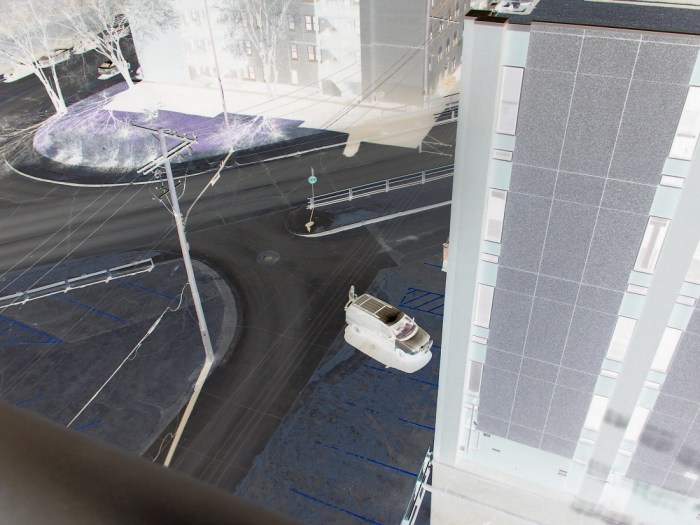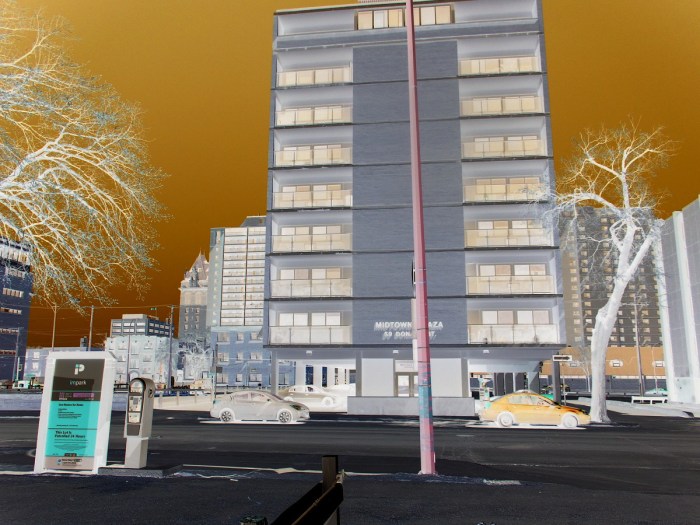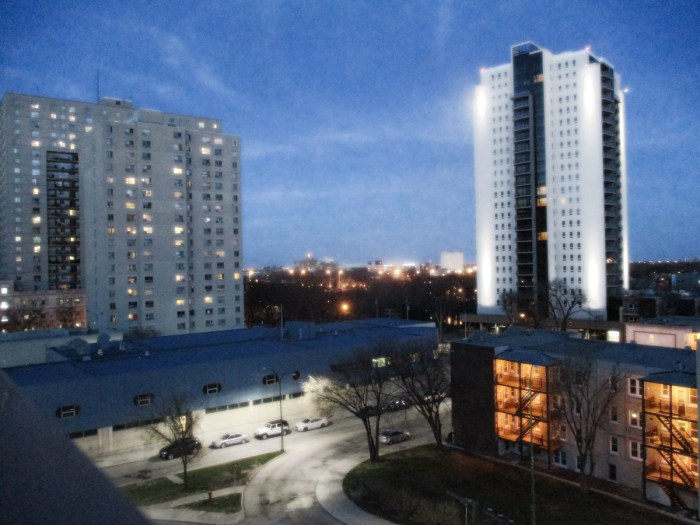












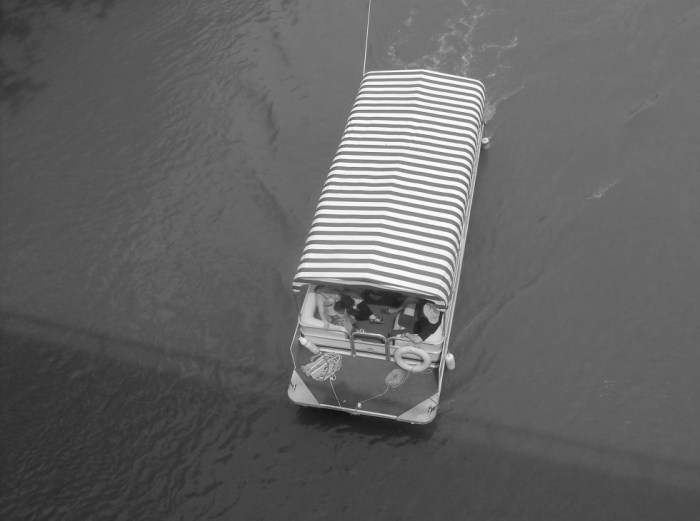
They are independent apartments situated a few feet apart in a group of around 20 structures. They are roughly the size of a medium size trailer home. But the interesting aspect of the buildings is the thick stucco on the outside walls. The flat roofs are also somewhat different. The thick stucco gives the buildings the distinct appearance of being adobe.
An adobe structure is usually defined as being made out of natural building material made from sand, clay, water, and some kind of fibrous or organic material (sticks, straw, and/or manure). These buildings look very adobe indeed. The big concrete stucco walls also add to the adobe quality.
The buildings do look old. They must have been built in the fifties or sixties. Maybe earlier. It would be a great place to live if the rent wouldn’t be too high (maybe they are condos), because you would never hear your neighbour banging things or playing loud music.
Some pictures:



Here is a list of some of the top Aerobatic Jet Teams in the world. Most of these teams are military jet teams, but there are also a few civilian teams.
These teams perform high-speed intricate manoeuvres often involving extremely close precision formations. It is very dangerous stuff. The pilots have to know exactly what the other members are doing and where they are at all times. Accidents have happened with loss of life, but it is very rare.
I have included 10 military teams and 2 civilian teams. There is no rating as the criteria would not be uniform throughout all the teams. Some teams, especially the Russian and United States teams, fly top of the line high performance fighters. While other teams use advanced trainers.
Lets get this list airborne.
Blue Impulse. Japan.
Aircraft: 9 Kawasaki T-4’s, Trainer


Turkish Stars. Turkey.
Aircraft: 10 NF-5A Freedom Fighters. Fighter.


Patrouille de France
Aircraft: 8 Alpha Jets. Trainer.


August 1 (aerobatic team). China.
Aircraft: 6 Chengdu J-10. Fighter.


Russian Knights
Aircraft: 6 SU-27’s. Fighter.


Royal Air Force Red Arrows. United Kingdom.
Aircraft: 9 Hawk T1A’s. Trainer.


Snowbirds. Canada.
Aircraft: 11 CT-114 Tutors. Trainer.


Blue Angels. United States.
Aircraft: 10 F/A-18 Hornets. Fighter.


Russian Swifts
Aircraft: 6 Mig-29’s. Fighter.


Thunderbirds. United States.
Aircraft: 8 F-16 Fighting Falcons. Fighter.


Jet aerobatic teams are not exclusive to militaries. They are several civilian teams from around the world. Below are two of the most prominent.
Team Breitling. France.
Aircraft: 5 L-39 Albatross.


Patriots Jet Team. United States.
Aircraft: 4 L-39 Albatross.

Donald Jay “Don” Rickles (May 8, 1926 – April 6, 2017) was an American stand-up comedian, actor and author. Although he became well known as an insult comic, his pudgy, balding appearance and pugnacious style led to few leading roles in film or television; his prominent film roles included Run Silent, Run Deep (1958) and Kelly’s Heroes (1970).
He made famous the term “hockey puck” as a derogatory slant towards anybody.

While working in the “Murray Franklin’s” nightclub in Miami Beach, Florida, early in his career, Rickles spotted Frank Sinatra and remarked to him, “I just saw your movie The Pride and the Passion and I want to tell you, the cannon’s acting was great.” He added, “Make yourself at home, Frank. Hit somebody!” Sinatra, whose pet name for Rickles was “bullet-head”, enjoyed him so much that he encouraged other celebrities to see Rickles’ act and be insulted by him. Sinatra’s support helped Rickles become a popular headline performer in Las Vegas. During a Dean Martin Celebrity Roast special, Rickles was among those who took part in roasting Sinatra, although Rickles himself was also roasted during another show in the series.
A CubeSat is a type of miniaturized satellite for space research that usually has a volume of exactly one liter (10 cm cube), has a mass of no more than 1.33 kilograms, and typically uses commercial off-the-shelf components for its electronics.
Beginning in 1999, California Polytechnic State University (Cal Poly) and Stanford University developed the CubeSat specifications to help universities worldwide to perform space science and exploration.

The CubeSat specification accomplishes several high-level goals. Simplification of the satellite’s infrastructure makes it possible to design and produce a workable satellite at low cost. Encapsulation of the launcher–payload interface takes away the prohibitive amount of managerial work that would previously be required for mating a piggyback satellite with its launcher. Unification among payloads and launchers enables quick exchanges of payloads and utilization of launch opportunities on short notice.


Since CubeSats are all 10×10 cm (regardless of length) they can all be launched and deployed using a common deployment system. CubeSats are typically launched and deployed from a mechanism called a Poly-PicoSatellite Orbital Deployer (P-POD), also developed and built by Cal Poly. P-PODs are mounted to a launch vehicle and carry CubeSats into orbit and deploy them once the proper signal is received from the launch vehicle. P-PODs have deployed over 90% of all CubeSats launched to date (including un-successful launches), and 100% of all CubeSats launched since 2006. The P-POD Mk III has capacity for three 1U CubeSats, or other 1U, 2U, or 3U CubeSats combination up to a maximum volume of 3U.


QB50 is a proposed international network of 50 CubeSats for multi-point, in-situ measurements in the lower thermosphere (90–350 km) and re-entry research. QB50 is an initiative of the Von Karman Institute and is funded by the European Commission as part of the 7th Framework Programme (FP7). Double-unit (2U) CubeSats (10×10×20 cm) are developed, with one unit (the ‘functional’ unit) providing the usual satellite functions and the other unit (the ‘science’ unit) accommodating a set of standardised sensors for lower thermosphere and re-entry research. 35 CubeSats are envisaged to be provided by universities in 19 European countries, 10 by universities in the US, 2 by universities in Canada, 3 by Japanese universities, 1 by an institute in Brazil, and others. Ten 2U or 3U CubeSats are foreseen to serve for in-orbit technology demonstration of new space technologies.
The Request for Proposals (RFP) for the QB50 CubeSat was released on February 15, 2012. Two “precursor” QB50 satellites were launched aboard a Dnepr rocket on June 19, 2014. All 50 CubeSats were supposed to be launched together on a single Cyclone-4 launch vehicle in February 2016, but due to the unavailability of the launch vehicle, 40 satellites are now planned to be launched aboard Cygnus CRS OA-7 in March 2017 and subsequently deployed from the ISS. Eight other cubesats have been manifested on two further Dnepr flights but the availability of this launcher has been in doubt since its last flight in 2015.
2018 InSight mission: MarCO CubeSats
The May 2018 launch, of the InSight stationary lander to Mars, will include two CubeSats to flyby Mars to provide additional relay communications from InSight to Earth during entry and landing. This will be the first flight of CubeSats in deep space. The mission CubeSat technology is called Mars Cube One (MarCO), a six-unit CubeSat, 14.4 inches (36.6 centimeters) by 9.5 inches (24.3 centimeters) by 4.6 inches (11.8 centimeters). MarCo is an experiment, but not necessary for the InSight mission, to add relay communications to space missions in important time durations, in this landing from the time of InSight atmospheric entry and landing.
MarCO will launch in May 2018 with the InSight lander and will separate after launch and then travel in their own trajectories to Mars. After separation, MarCO will deploy two radio antennas and two solar panels. The high-gain, X-band antenna is a flat panel to direct radio waves. MarCO will navigate to Mars independently from the InSight lander, making their own course adjustments on the flight.
During InSight’s planned entry, descent and landing (EDL) in November 2018, the lander will transmit information in the UHF radio band to NASA’s Mars Reconnaissance Orbiter (MRO) flying overhead. MRO will forward EDL information to Earth using a radio frequency in the X band, but cannot simultaneously receive information in one band if transmitting on another. Confirmation of a successful landing could be received on Earth several hours after, so MarCO would be a technology demonstration of real-time telemetry during the landing.

InSight lander with labeled instruments
Donald Trump is the by far the most unpredictable President ever. You never know where he is going to go. These two have great haircuts.

US President Donald Trump has said he would be “honoured” to meet North Korean leader Kim Jong-un, in the right circumstances.
“If it would be appropriate for me to meet with him, I would – absolutely. I would be honoured to do it,” he told news organisation Bloomberg on Monday.
The previous day he described Mr Kim as a “pretty smart cookie”.
The comments come amid escalating tensions over North Korea’s nuclear programme.
The White House issued a statement following Mr Trump’s remarks, saying North Korea would need to meet many conditions before any meeting between the two leaders could take place.
Spokesman Sean Spicer said Washington wanted to see the North end its provocative behaviour immediately.
“Clearly conditions are not there right now,” he added.
In Sunday’s interview with CBS, President Trump noted Mr Kim had assumed power at a young age, despite dealing with “some very tough people”.
He said he had “no idea” whether Mr Kim was sane.
The North Korean leader had his uncle executed two years after he came to power, and is suspected of ordering the recent killing of his half-brother.
President Trump, asked what he made of the North Korean leader, told CBS: “People are saying: ‘Is he sane?’ I have no idea… but he was a young man of 26 or 27… when his father died. He’s dealing with obviously very tough people, in particular the generals and others.
“And at a very young age, he was able to assume power. A lot of people, I’m sure, tried to take that power away, whether it was his uncle or anybody else. And he was able to do it. So obviously, he’s a pretty smart cookie.”

‘The Donald’ seems to have an innate empathy towards cutthroat dictators and strongmen. He recently telephoned and congratulated Turkey thug leader Erdogan, and he said he wants to meet with psycho Philippines leader Rodrigo Duterte. And we all know about his admiration for Vlady Putin.
Brave tourists have been trying out Chicago’s newest attraction – a 1000ft-high viewing platform that offers spectacular downward facing views over the city.
TILT is housed in 360 CHICAGO on the 94th floor of the John Hancock Tower and, as the name suggests, the enclosed glass and steel platform tilts visitors forward for a unique perspective of the city’s The Magnificent Mile.


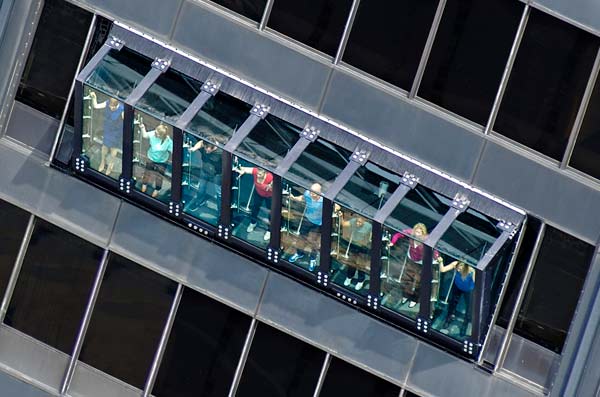

Give me a bloody parachute in case the unexpected happens.
The CN Tower in Toronto opened a bizarre and frightening attraction back in 2011, a chance to show you are brave.
The tower’s EdgeWalk allows thrill-seekers to stroll outside on the world-famous tower on a 1.5 metre ledge that rings the main pod 356 metres (1,168 feet) above the ground.
Opened in August 2011, this walk of wobbly knees sends groups of six to eight people out on the ledge where they walk hands-free while attached to an overhead safety harness.
During the walk, specially trained guides will encourage visitors to push their personal limits, even allowing them to lean out 116 storeys above the city.

The EdgeWalk costs $175. While that may be pricey, CN Tower staff say it doesn’t cost walkers their lives.
“Our facilities and engineering team supervised the EdgeWalk project design and build to ensure that it is both exciting and safe,” said CN Tower chief operating officer Jack Robinson in a news release.
“EdgeWalk is both thrilling and unique and pushes visitors to their limits — literally and figuratively,” said Mark Laroche, president and CEO of Canada Lands Company, which owns and operates the CN Tower. The entire EdgeWalk experience takes about 90 minutes, with the walk itself lasting between 20 to 30 minutes.


They give you a breathalyzer before the walk to make sure you are not under the influence of alcohol. Well there goes my opportunity, I would not touch this Edgewalk unless I had gulped down at least 10 ounces of Canadian rye whiskey.
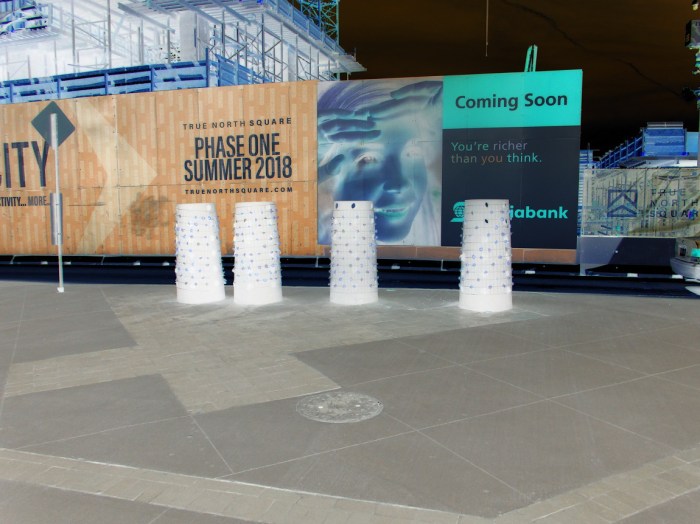
The rivers are going down and the True North Square buildings project is going up. Another few weeks and the river walks should be above water.

Top 2 weeks ago, bottom today.





True North Square construction site.




What it will look like upon completion.