I’d Like to Report a Small Accident

The ONE Apus is a 14,000 TEU container ship. In 2020, it lost approximately 1,816 containers overboard in the Pacific Ocean, the largest loss of containers in transport since 2013.

The ONE Apus is a 14,000 TEU container ship built in 2019 measuring 364-meters in length and sailing under the Japanese flag. The vessel is one of a series of 15 Bird-class container ships, operated by Japan’s Ocean Network Express, sailing under the Japanese flag.

On 30 November 2020 the ONE Apus was sailing from Yantian, China, to Long Beach, California, when it encountered severe weather approximately 1,600 nautical miles north-west of Hawaii. Heavy rolling caused the loss overboard of approximately 1,816 containers including 64 with dangerous goods. The ship arrived at Kobe, Japan, on 8 December, where it offloaded nearly 1000 damaged containers, and resumed its voyage on 16 March 2021. The weather at the time of the accident was reported as Beaufort force 4 with north-westerly seas of 5 to 6 meters and a “long high swell”. Weather maps show significant wave heights of up to 16 meters associated with the weather system encountered by the vessel.

The cause of the accident is being investigated but probably involves a combination of factors, including the weather conditions, the ship’s rolling behaviour and the inherent hazards of eight-high on-deck container stowage. One contributor to the accident could be parametric roll resonance, a hazard known to affect container ships.

The ONE Apus incident was the largest loss of containers in transport since the sinking of the MOL Comfort in 2013. The cargo loss cost is estimated as $90 million. The ship was delayed for approximately 3 months, and the cost of supply chain disruption for US manufacturers and retailers is not yet quantified. Insurance claims could exceed $200 million.
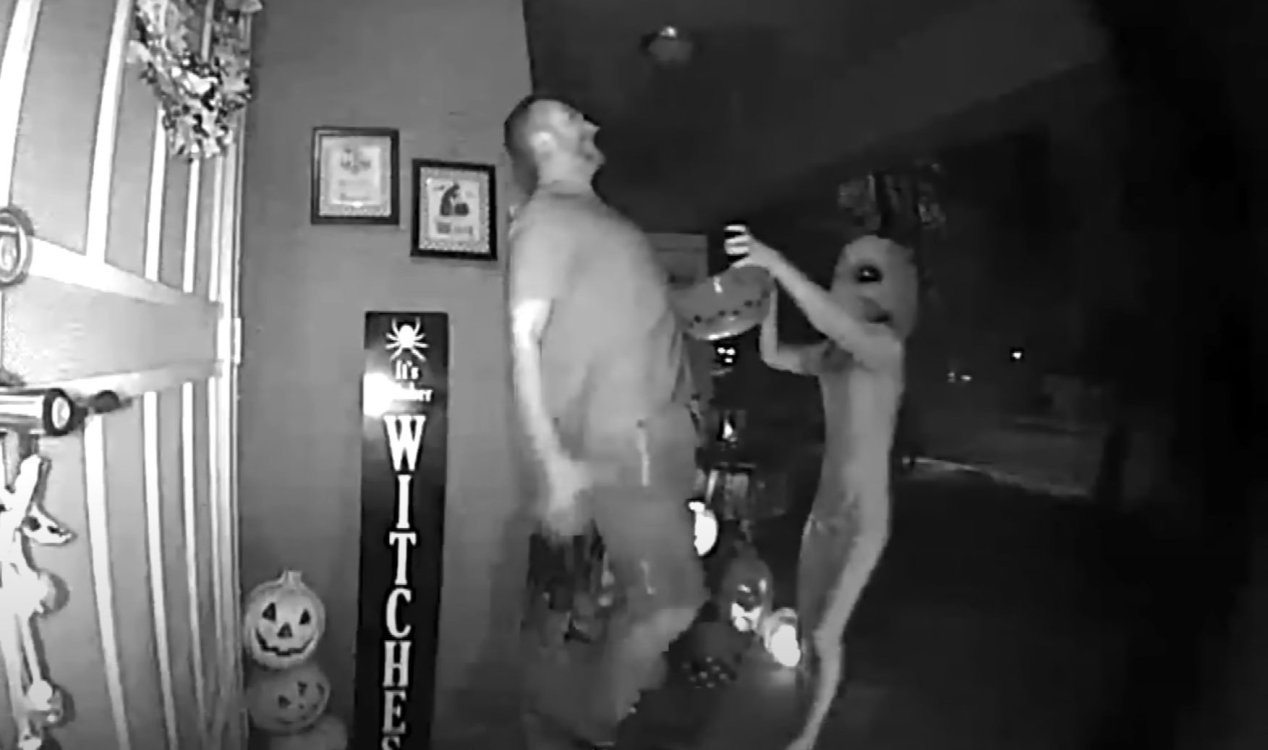
Weird and hilarious submissions to Ring’s $1M alien contest revealed

Fake alien doorbell camera footage.

Some of the submissions were highly creative.

People across the country wasted no time in producing some weird, wacky and downright hilarious video clips.Launched back in October as part of the firm’s Halloween celebrations, the competition – which offered a grand prize of $1 million – required participants to capture ‘scientific evidence of extraterrestrials’.

Suffice to say, the ‘evidence’ captured by those taking part was anything but scientific, instead utilizing puppets, silly costumes and crude special effects to entertain and amuse.

Some of the entries looked like they had been put together in around five minutes, while others were quite elaborate and could certainly be in with a shot of winning the prize.

One video showed someone simply hold up two alien toy figures in front of the camera while another saw someone in a costume take control of the house’s owner and use his treat-or-treat bowl as a hat.

“There are so many that I’ve seen that have just been incredibly creative and fun,” said Ring’s chief revenue officer, Mimi Swain.

As for the winning entry – we may have to wait a little longer to see that.

“We have gotten a number of submissions that our expert is reviewing,” said Swain.

You can check out some of the entries below.

Possum Dashes Onto the Field During College Football Game

A Big 12 Conference game in Lubbock, TX saw an unusual participant bound onto the field this past Thursday night. It was none other than a possum, romping on the gridiron at Jones AT&T Stadium in the first quarter of a match-up between Texas Tech and TCU.

Yet, the marsupial’s dash in the spotlight was short-lived, as it was unceremoniously yanked away with an animal catch pole, scowling all the way. Moments later, Texas Tech president Lawrence Schovanec was seen petting the creature, before it was turned over to animal control services.

Though it was not adopted as the team’s new mascot, things ended happily enough for the wayward critter, as it was reportedly released back into the wild by the Lubbock Animal Shelter Adoption Center on Friday morning.

Top Ten James Bond Escapes 

007 agent James Bond often gets trapped, but he always finds a way to squirm his way out. Ingenious with a lot of gumption the British super secret agent (that everybody has heard about and recognizes) has many tricks up his sleeve. The evil madmen of the planet just cannot put an end to this white knight crusader of the western world, even when he has been snared and cornered.

bond1

bond

bond2

Mount Thor Steep Galore 

thor

Mount Thor, officially gazetted as Thor Peak, is a mountain with an elevation of 1,675 metres (5,495 ft) located in Auyuittuq National Park, on Baffin Island, Nunavut, Canada. The mountain is located 46 km (29 mi) northeast of Pangnirtung and features Earth’s greatest vertical drop of 1,250 m (4,101 ft), with the cliff overhanging at an average angle of 15 degrees from vertical. Despite its remoteness, this feature makes the mountain a popular rock climbing site. Camping is allowed, with the only official site being at the entrance to the Akshayuk Valley near Overlord Peak.

I don’t know about climbing it, maybe a parachute jump from the top.

thor1

thor2

thor3

thor4

Underground Lizard Being Bases! Anything’s Possible?

The UFO researcher known as the “Crypto Hunter,” John Rhodes discusses Reptilian humanoids and the secret underworld empire, which consists of alien cultures and lost civilizations. Rhodes reported on an extensive network of underground bases constructed by various nations, emphasizing their use for safety and security in case of cosmic disasters or other threats. He believes these bases are inhabited by small groups of advanced cultures, both human and non-human, living underground to preserve themselves.

Rhodes delved into the concept of reptilian beings, describing their physical attributes as approximately 6.5 to 8 feet tall, muscular, with scales covering their bodies. These beings have a large head, almond-shaped eyes with vertical slit pupils, three fingers with an opposing thumb on their hands, and no lips or ears. He suggested these beings have evolved differently from humans, with distinct brain types and different ways of perceiving science and learning. Rhodes mentioned that reptilian beings might be coexisting with humanity underground, possibly for their own safety and to monitor human activities.

He shared the story of the Lizard Man of Bishopville, South Carolina, as an example of encounters with reptilian creatures. This story involved a young boy’s encounter with a creature that matches the physical description of reptilian beings. “When he got back home, he was so scared he couldn’t talk… he started going into a fit,” Rhodes said. The local sheriff, a who investigated the case, emphasized that the swamps in the area are difficult to access, making it possible for unknown creatures to reside there.

Here is a very big one attacking the capital of Manitoba in Winnipeg.

Addressing Trump supporters in Sioux City, Iowa.

Massive Dolphin Megapod Caught on Camera

Rare footage captured one of the largest groups of spinner dolphins ever filmed, known as a megapod, hunting flying fish in the Pacific Ocean off Costa Rica as part of PBS’s “Spy in the Ocean” nature miniseries. The team used a “spy dolphin” equipped with a camera and an animatronic bird drone to infiltrate and observe the dolphins. Known as the acrobats of the dolphin world, spinner dolphins can leap over 10 feet high out of the water and spin seven times in a single jump. The megapod communicated through clicks and whistles, and the gathering covered an extensive area both on the surface and underwater, consisting of thousands of dolphins at its peak. The use of spy cameras on animatronic animals provided a unique perspective on the dolphins’ behavior without disrupting them with large, obtrusive cameras.

New App to help prevent people who are texting from walking into things  

Avoiding the pitfalls of texting and walking

BBC Health Check

text

Walking and texting is leading to a spate of collision-related injuries. Could a new app be the answer?

We’ve all done it. You’re walking down the street and the familiar beep of an incoming text becomes too tempting to resist. As you start to fire off a quick reply – bam! You clash shoulders with a fellow pedestrian doing exactly the same.

Alex Stoker is a Clinical Fellow in Emergency Medicine at Frimley Park Hospital, Surrey. “If it’s a tall object like a wall or a lamp-post that someone walks into, then one might expect facial injuries such as a broken nose or fractured cheekbone,” he told the BBC.

“If on the other hand the collision results in falling over, then they’re much more liable to things like hand injuries and broken wrists. There’s a complete spectrum but it is possible to sustain a really serious injury.”

Man hole avoidance

A new app called CrashAlert aims to help save people from themselves. It involves using a distance-sensing camera to scan the path ahead and alert users to approaching obstacles.

The camera acts like a second pair of eyes – looking forward while the user is looking down.

CrashAlert

CrashAlert is at prototype stage

Just as a Nintendo Wii or Xbox can detect where and how a player is moving, CrashAlert’s camera can interpret the location of objects on the street.

When it senses something approaching, it flashes up a red square in a bar on top of the phone or tablet. The position of the square shows the direction of the obstacle – giving the user a chance to dodge out of the way.

“What we observed in our experiments is that in 60% of cases, people avoided obstacles in a safer way. That’s up from 20% [without CrashAlert],” says CrashAlert’s inventor Dr Juan David Hincapié-Ramos from the University of Manitoba.

What’s more, the device doesn’t distract the user from what they’re doing. Hincapié-Ramos’s tests showed it can be used alongside gaming or texting without any cost to performance.

Despite designing CrashAlert, Hincapié-Ramos accepts that the best solution of all is for people to stop checking their phones in the first place.

“We should encourage people to text less while they’re walking because it isolates them from their environment. However people are doing it and there are situations where you have to do it. It’s for situations like this that CrashAlert can have a positive impact.”

But Dr Joe Marshall, a specialist in Human-Computer Interaction from the University of Nottingham, says that it’s not necessarily people who are to blame – but the phones themselves.

“The problem with mobile technology is that it’s not designed to be used while you’re actually mobile. It involves you stopping, looking at a screen and tapping away.”

Dr Marshall believes that if we want to stop people being distracted by their phones, then designers need to completely rethink how we interact with them. But so far, there is no completely satisfactory alternative.

“Google glass solves the problem of looking down by allowing you to look ahead. But you still have to pay attention to a visual display,” he told the BBC.

So for now at least, it seems vigilance is the key to avoiding lamp-posts and unexpected manholes.

But as mobile technology continues to dominate everyday life, it might not be too ludicrous to expect to rely on smart cameras to steer us in the right direction.