





Here is a song with consistent rhyming. It gives a whole new meaning to the word alliteration. The lyrics would also appeal to people who have the sky is the limit dreams. Video below lyrics.
Big Time Operator by Keith Hampshire.
I started off a newsboy on a paper
For a time I worked in an elevator
But all the time I knew that later I would be a higher rater Finally, a big time operator
For a while I drove an excavator (yes I did)
Then I became a wine and brandy waiter
A builder, then a decorator
Later on, an estimator
I’m gonna be a big time operator
(Oh ya got to believe in me)
I took a job as an airline navigator
Then I became a crime investigator (yes I did)
For a time, a commentator
Then I was an administrator
I’m gonna be a big time operator (yeah yeah yeah yeah)
Well dont you know I’m gonna be in the big time baby
A big time operator
I’ll have a whole lotta people workin’ for me
Gonna have a chauffeur
An upstairs maid
Big limousine
Racing sports car
50 foot yacht
Race horses
I’m gonna give new meaning to the word ‘big’ A big time operator now now
Traffic collisions in India are a major source of deaths, injuries and property damage every year. The National Crime Records Bureau (NCRB) 2021 report states that there were 155,622 fatalities, highest since 2014, out of which 69,240 deaths were due to two-wheelers. A study by Insurance Institute for Highway Safety, U.S. shows that the use of seat belts significantly reduces the risks and injuries from road accidents, and yet there is no enforcement on use of seat belts in cars. A study by IIT (Indian Institute of Technology) Delhi points out that the national highways constitute only 2% of the length of roads in India, but they account for 30.3% of total road accidents and 36% of deaths.

According to the 2013 global survey of traffic collisions by the UN World Health Organization, India suffered a road fatality rate of 16.6 per 100,000 people in 2013. India’s average traffic collision fatality rate was similar to the world average rate of 17.4 deaths per 100,000 people, less than the low-income countries which averaged 24.1 deaths per 100,000, and higher than the high-income countries which reported the lowest average rate of 9.2 deaths per 100,000 in 2013.
Traffic in India consists of almost every conceivable type of motor vehicle, cars, trucks, buses, auto rickshaws, scooters and motorcycles. Add to this crazy eclectic mix bicycles, pedestrians and the odd cow the chaos becomes mind-boggling.
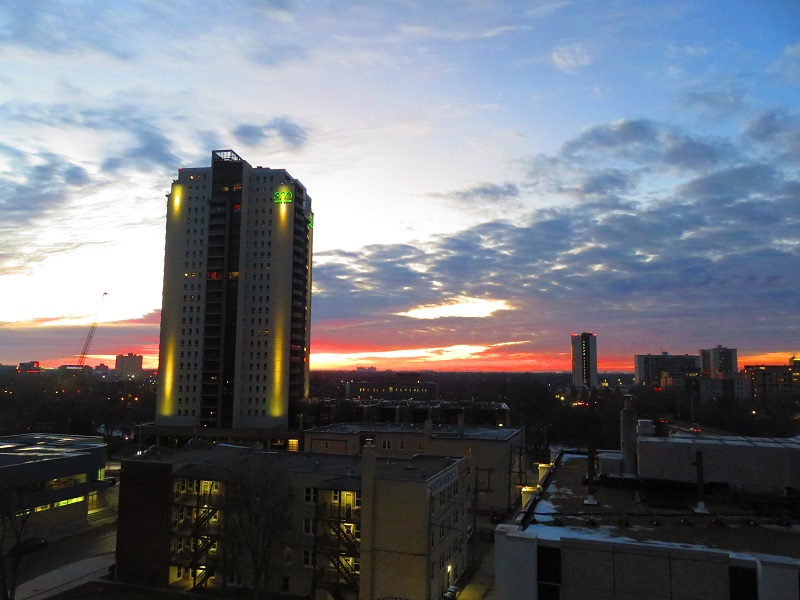
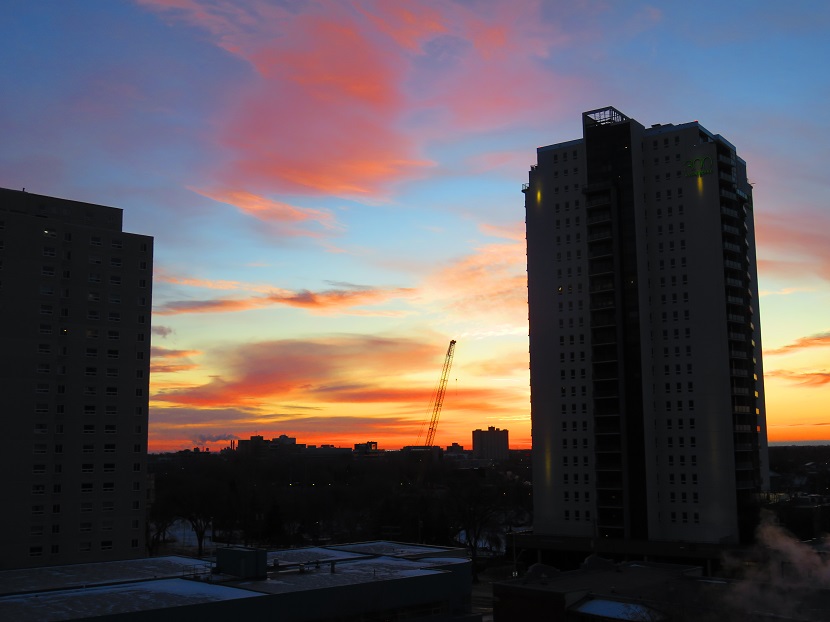
111 West 57th Street, also known as Steinway Tower, is a supertall residential skyscraper in the Midtown Manhattan neighborhood of New York City. Developed by JDS Development Group and Property Markets Group, it is situated along Billionaires’ Row on the north side of 57th Street near Sixth Avenue. The main portion of the building is an 84-story, 1,428-foot (435-meter) tower designed by SHoP Architects and completed in 2021. Preserved at the base is the 16-story Steinway Building (also Steinway Hall), a former Steinway & Sons store designed by Warren and Wetmore and completed in 1925, which originally carried the address 111 West 57th Street.

111 West 57th Street contains 60 luxury condominiums: 14 in Steinway Hall and 46 in the tower. The residential tower has a glass facade with piers made of terracotta; its pinnacle contains setbacks on the southern side. The tower is the fourth-tallest building in the United States as of November 2022, as well as the thinnest skyscraper in the world with a width-to-height ratio of about 1:24.
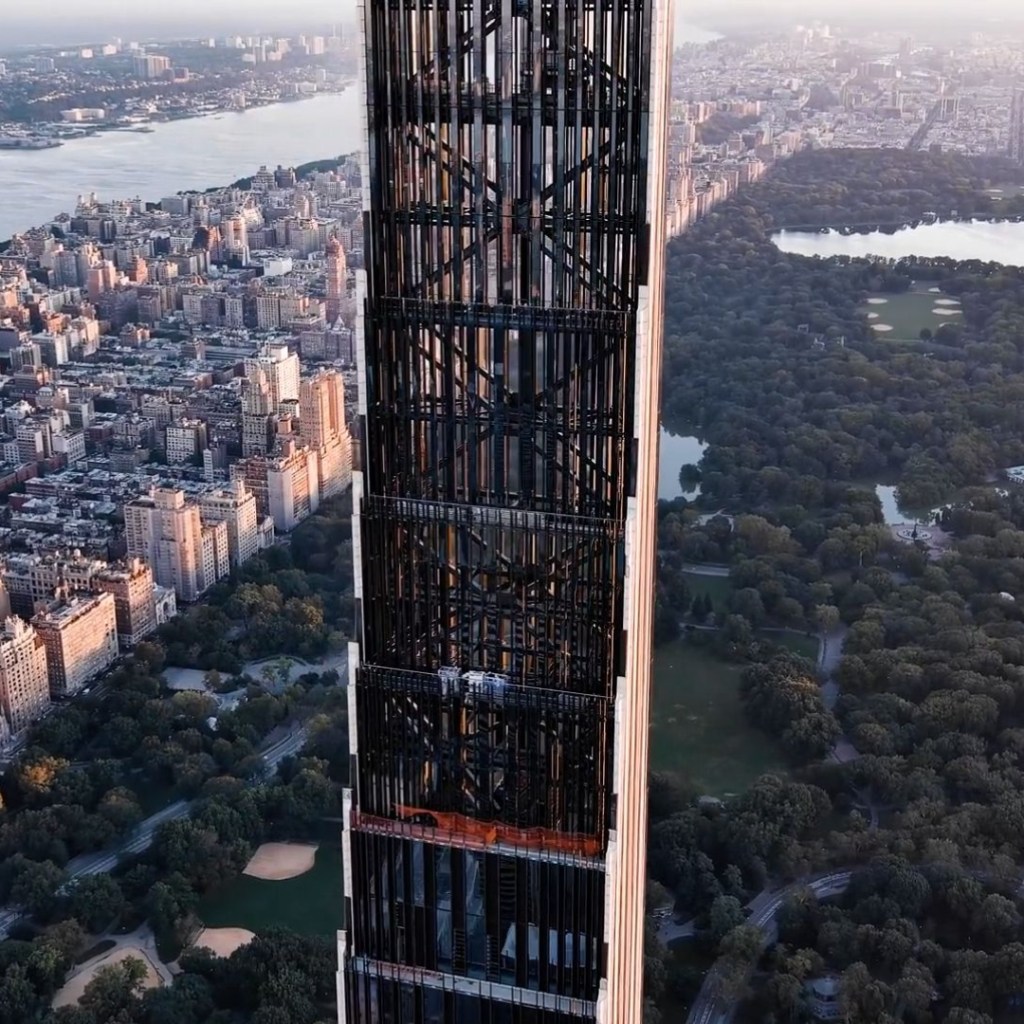
The residential tower atop Steinway Hall is one of the tallest buildings in the United States, as well as the thinnest skyscraper in the world with a width-to-height ratio of about 1:24. Due to its slenderness, the top stories sway several feet during high winds. The building has been characterized as part of a new breed of New York City “pencil towers”. The tower’s northern elevation rises directly up to the pinnacle, and the southern elevation contains several setbacks as the tower rises, thinning the tower’s footprint on higher floors. The pinnacle’s lighting pattern was commissioned by L’Observatoire International. Because of the shape of the tower’s pinnacle, 111 West 57th Street is nicknamed “Stairway to Heaven”.
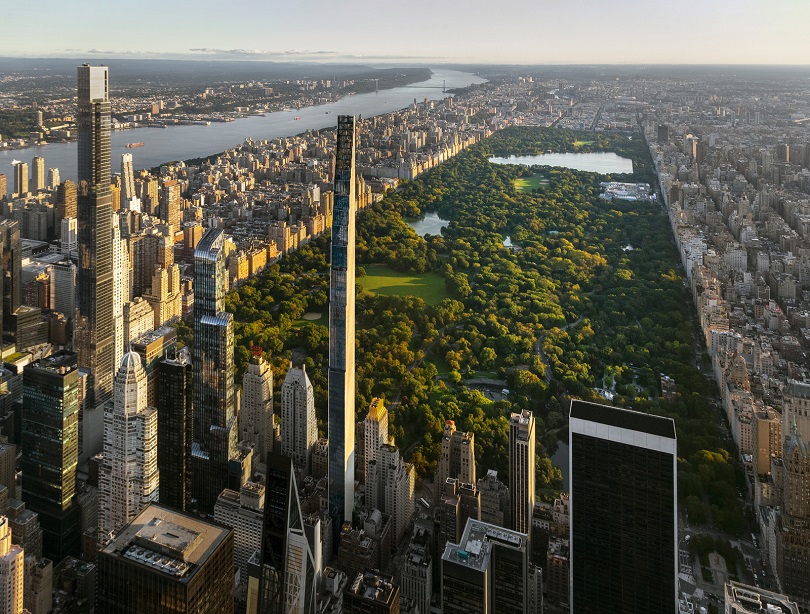
111 West 57th Street’s interior spaces were designed by Studio Sofield, though the interior of the original Steinway Hall was planned by Walter L. Hopkins. There are 60 apartments in total: 46 in the tower and 14 in Steinway Hall. According to the New York City Department of City Planning, the building has a gross floor area of 303,225 square feet (28,170.5 m2).
The 46 condominiums in the building’s tower range from 3,873 to 7,128 square feet (359.8 to 662.2 m2). The apartments start above the 17th story, numbered as floor 20, because the views of Central Park from the lower floors are obstructed by neighboring buildings. The units are mostly three-bedroom apartments each occupying one full floor, except for seven duplex units on floors 60–61 and 72–83, which each have between two and four bedrooms. Many of the stories are open in plan and have 14-foot (4.3 m) ceilings. As of 2018, prices ranged from $16 million for a studio apartment to over $66 million for the triplex penthouse.

The crown at the top of the building.

‘People refer to them as Stonehenge’: Abandoned concrete plant in Manitoba turns into photo destination
Video at the bottom.
Four small hills covered with geometrically spaced concrete spires on the outskirts of Winnipeg has been attracting visitors for years.
Speculation on what they are has given rise to radical theories of aliens and occult worship, but in reality they are the remnants of a industrial endeavor that fell victim in what could be called Winnipeg’s cement wars of the 1960s.
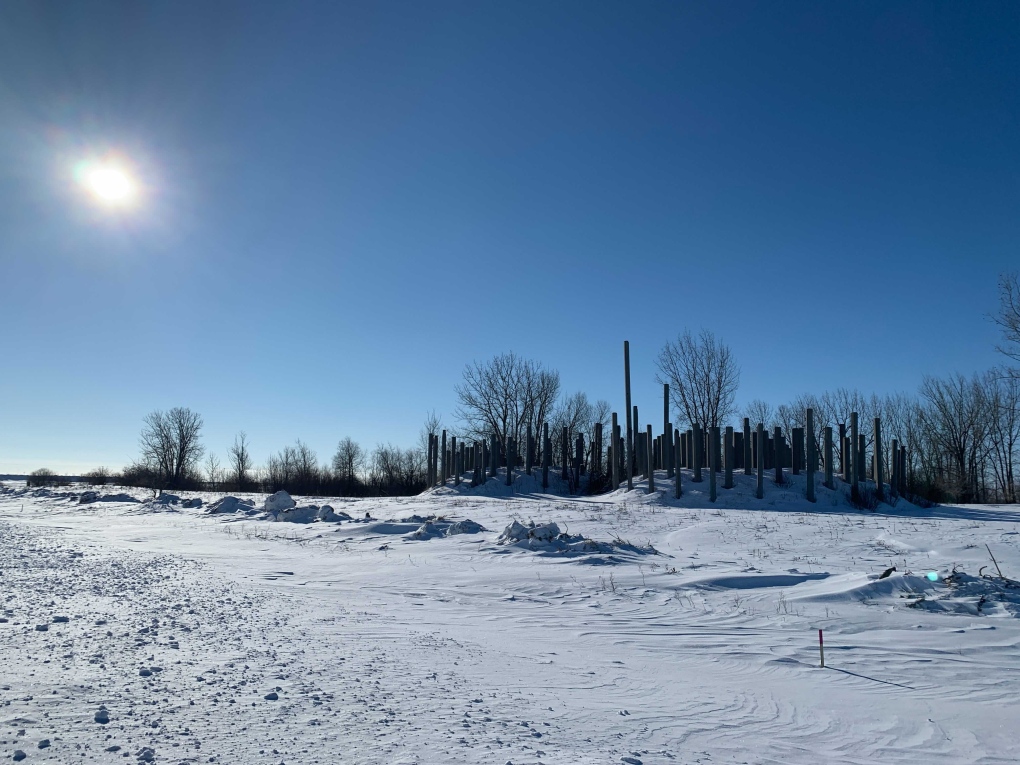
“People refer to them as Stonehenge or things like that,” said Kelvin Stewart, Ward 4 Councillor for the RM of Rosser where the concrete graveyard is located. “People don’t understand what it was, but the piles from the cement plant have nothing to do with cold or sun worship, or whatever Stonehenge is used for.”
On the site four mounds, each at least eight feet tall and in pairs with diameters of 50 and 70 feet, house multiple concrete piles spaced in a set pattern.
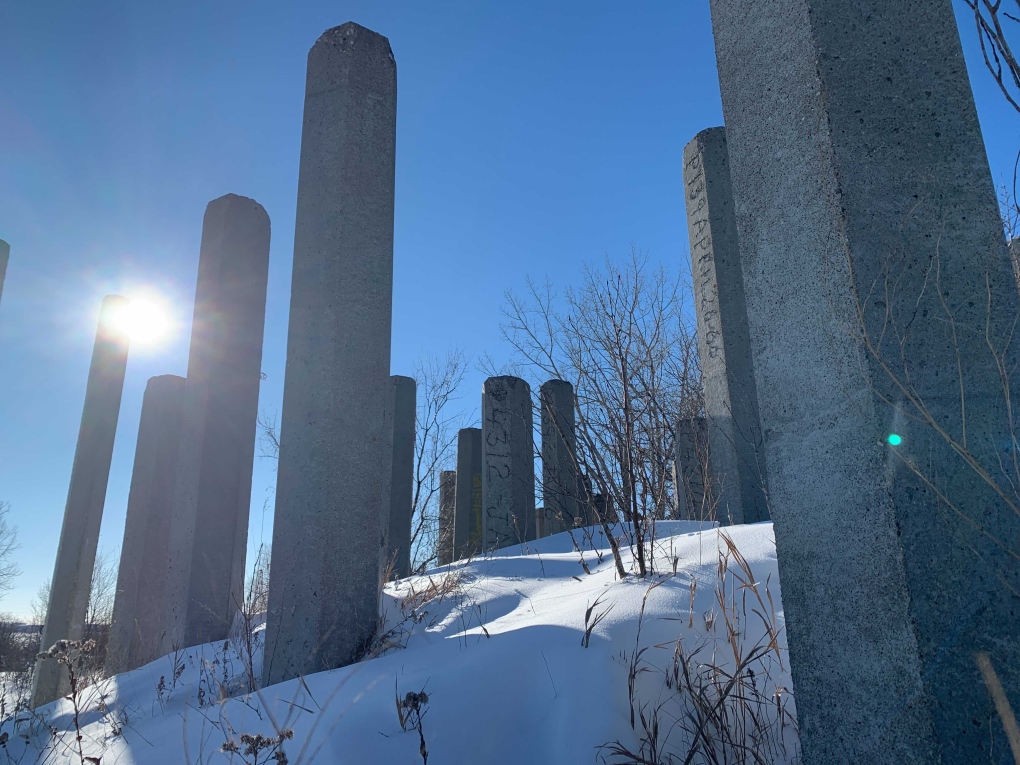
On each pile are dates and numbers, which the Manitoba Historical Society said would let workers know when it was strong enough to withstand the stresses of being pounded into the ground. Other numbers revealed pile lengths. They vary from 50 to 60 feet.
There was also a railway connection that has since been removed.
“There was a spur line previously that went off into the site so they had big plans for it,” said Stewart.
Those plans came from a company called BACM, which stands for British-American Construction and Materials Limited. According to the Historical Society, it was founded in 1961 by four brothers and based in Winnipeg.
The business was focused on building supplies, land and property development and construction. Its building supplies division made concrete products, including piles.
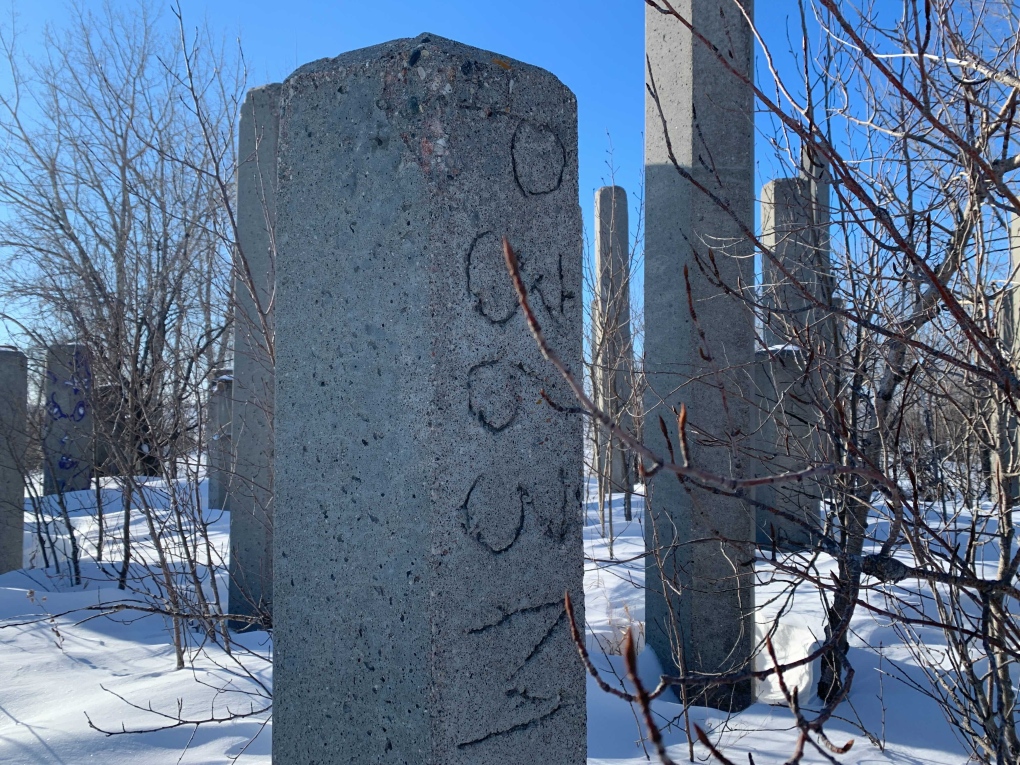
The historical society said a new subsidiary company was formed called the British-American Cement Company to operate a new $8.5 million cement factory out of the RM of Rosser location. The company drove its first pile into the ground in November of 1963.
The venture was ill fated as it faced competition from two other cement companies, including a planned new operation from Inland Cement in Winnipeg. According to the Manitoba Historical Society, industry analysts at the time said if the two new plants were built, they would produce triple the amount of concrete needed by Manitoba’s entire building industry.
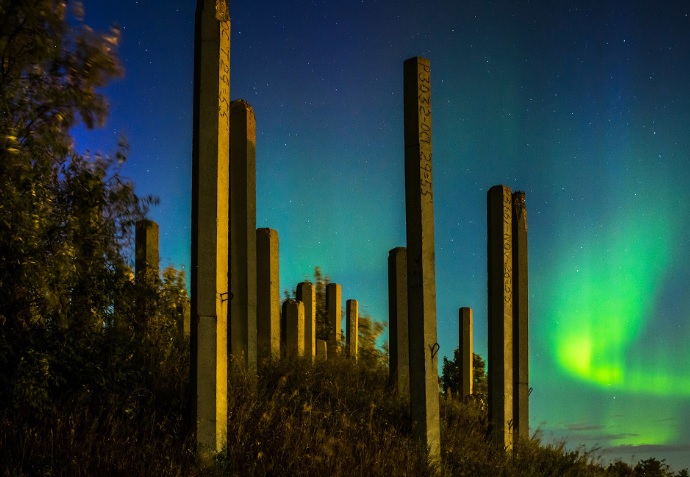
Inland Cement bought the site from BACM in 1964 following a decision by Winnipeg City Council to give all of their business to Inland, despite operating their cement plant out of Saskatchewan. Inland eventually built its concrete plant in Winnipeg and the old BACM site went dormant.
What’s been dubbed the concrete graveyard has sat empty for years despite several attempts at development.
“I was just a kid at the time with my father who was a councillor. It was going to be a western themed park because it’s not a small thing with the remnants of a cement plant but 240 acres,” said Stewart.
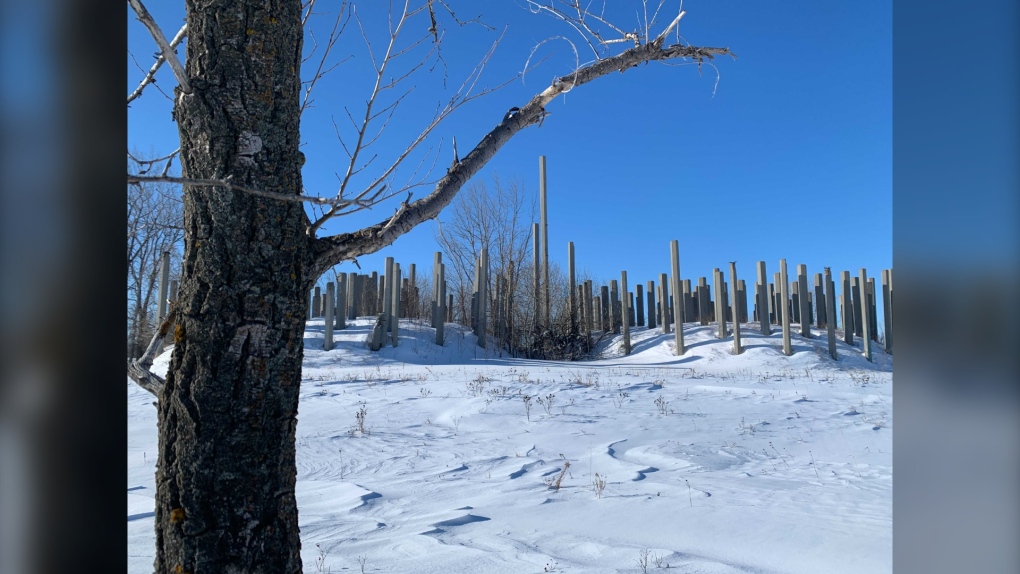
More recently plans have come forward for industrial lots or development because of its location within the CentrePort area. The issue, according to Stewart, is the site’s lack of services.
“It’s not contiguous to current development. There’s no sewer and water,” Stewart said. “That’s kind of problematic.
Stewart said it does get a lot of visitors who often brave the cold winter weather to snap a great shot for their social media feed with hashtags like #pilehenge or #concretegraveyard.
A pic taken off Google Maps. Not sure what the hell the thing in the top right corner could be. No Space Aliens involved here, are you sure?
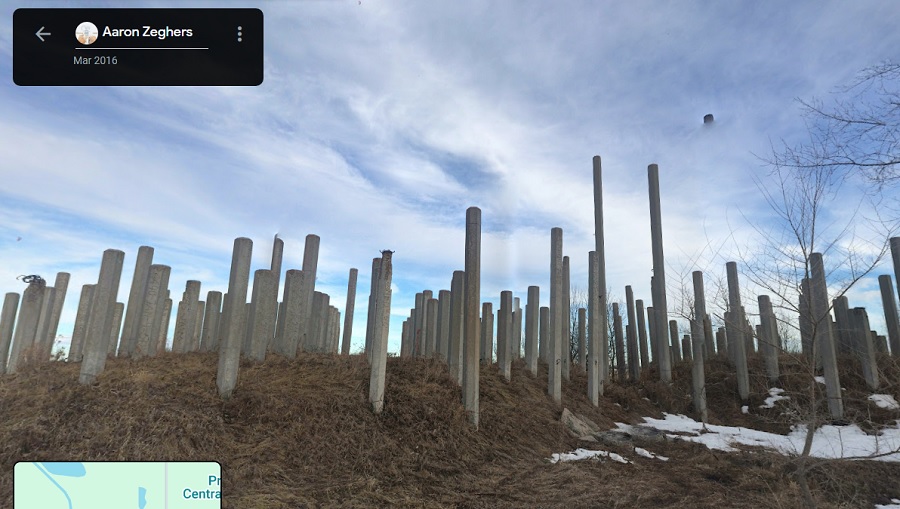
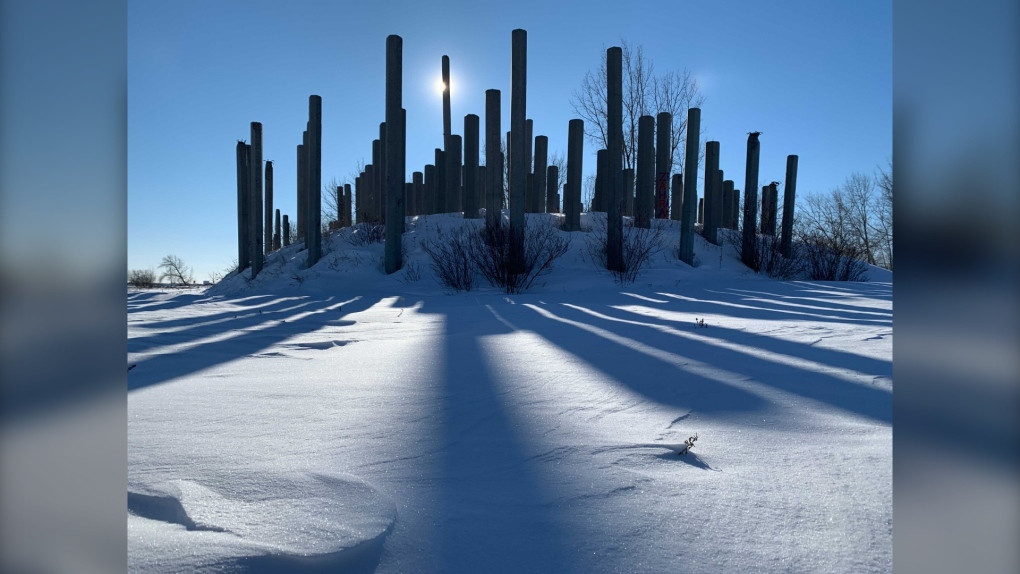
There was an Alternative Winnipeg pop/rock band back in the eighties that named themselves Monuments Galore. I think their first album had a picture of the site on the cover.





 The MarkoZen Blog