A Complete Catalog Of Every Time Someone Cursed Or Bled Out In A Quentin Tarantino Movie

By Oliver Roeder

From the minute the multiplex curtains pulled back on his first feature, director Quentin Tarantino has ignited the interest, and occasional ire, of critics for his films’ strong language and frequent violence. The New York Times called his first film, “Reservoir Dogs,” “aggressively brutal.” About his next film, “Pulp Fiction,” the Los Angeles Times wrote that there was “something wearing and repetitive about the film’s reliance on shock value and bad-boy posturing to maintain our attention.”

Tarantino’s eighth feature film, “The Hateful Eight,”, is the story of bounty hunters seeking refuge from a Wyoming blizzard after the Civil War — so basically “The Good, the Bad and the Ugly” meets “Frozen.” To get ready, I spent a week on the couch with Tarantino’s oeuvre, watching people die and swear a blue streak. When someone was killed by a gun or a sword or a venomous snake, or someone was called a “motherfucker” or a “cocksucker,” I made a note of the event and the time. Then I did it all over again a few seconds later. What resulted was hard-won data that showed me the essential tempos of Tarantino’s films, and how they’ve changed over time. The guy’s getting bloodier in his old age.


tarantino1

Some mild assumptions were necessary for this project. For one, I’m not a medical doctor, but I assumed that if, say, someone had numerous limbs cut off or took a direct blade to the torso in a samurai sword battle, that person would indeed bleed out and die.  And for profanity in foreign languages — mainly in Chinese and Japanese in the “Kill Bill” films and French in “Inglourious Basterds” — I relied on the theatrical subtitles.

Also, it’s occasionally difficult to make out the profane language precisely. If you recently had your one remaining eyeball plucked out, for example, I may not have understood every word you screamed in horror. But I did my best to count all the curses, from the mild hells and damns and asses to the more potent shits, fucks and n-words.


FILM CURSES DEATHS CURSE/DEATH RATIO
Jackie Brown 368 4 92.0
Pulp Fiction 469 7 67.0
Reservoir Dogs 421 10 42.1
Kill Bill: Vol. 2 69 11 6.3
Django Unchained 262 47 5.6
Inglourious Basterds 58 48 1.2
Kill Bill: Vol. 1 57 63 0.9
Total 1704 190 9.0

1983 Soviet nuclear false alarm incident

A very close call indeed.

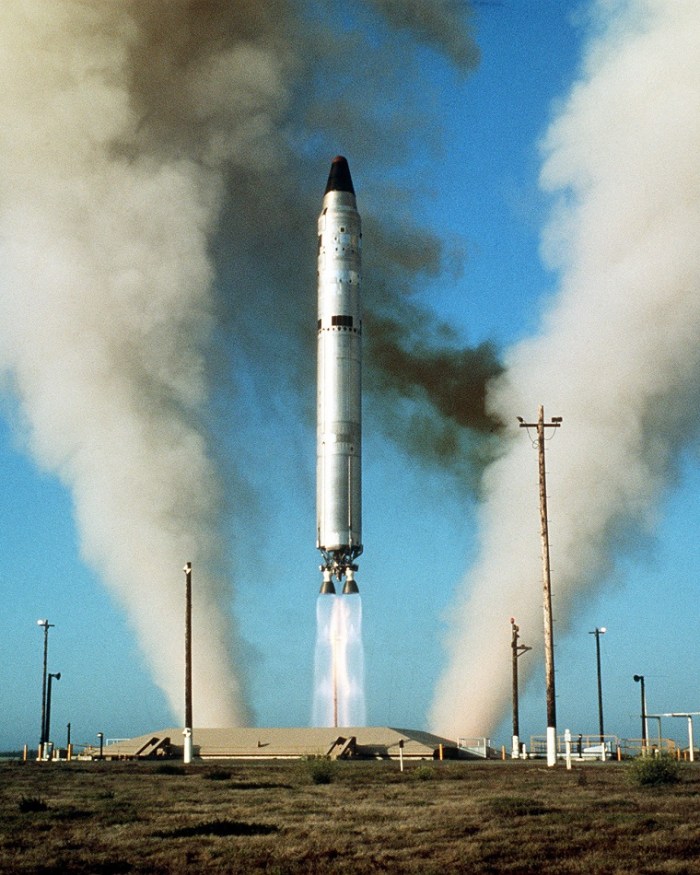
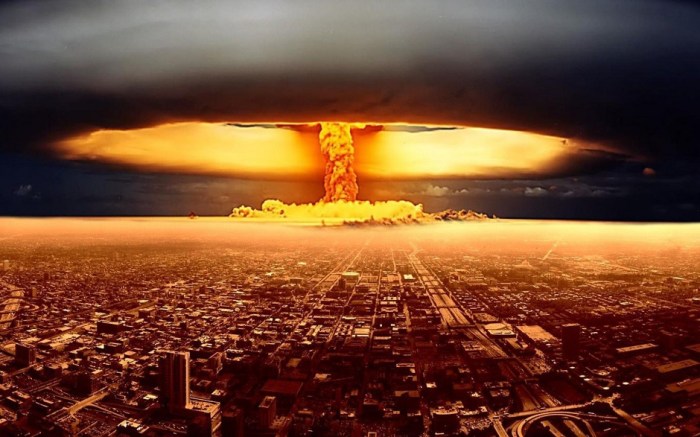
On 26 September 1983, the nuclear early-warning system of the Soviet Union reported the launch of multiple intercontinental ballistic missiles from bases in the United States. These missile attack warnings were felt to be false alarms by Stanislav Petrov, an officer of the Soviet Air Defence Forces. This decision is seen as having prevented a retaliatory nuclear attack against the United States and its NATO allies, which would have resulted in an immediate and irrevocable escalation to a full-scale nuclear war. Investigation of the satellite warning system later determined that the system had indeed malfunctioned.
Background
The incident occurred at a time of severely strained relations between the United States and the Soviet Union. Responding to the Soviet Union’s deployment of fourteen SS-20/RSD-10 theatre nuclear missiles, the NATO Double-Track Decision was taken in December 1979 by the military commander of NATO to deploy 108 Pershing II nuclear missiles in Western Europe with the ability to hit targets in eastern Ukraine, Belarus or Lithuania within 10 minutes and the longer range, but slower BGM-109G Ground Launched Cruise Missile (GLCM) to strike potential targets farther to the east. In mid-February 1981, and continuing until 1983, psychological operations by the United States began. These were designed to test Soviet radar vulnerability and to demonstrate US nuclear capabilities. They included clandestine naval operations, in the Barents, Norwegian, Black, and Baltic seas and near the Greenland-Iceland-United Kingdom (GIUK) gap, as well as flights by American bombers, occasionally several times per week, directly toward Soviet airspace that turned away only at the last moment.

“It really got to them,” recalls Dr. William Schneider, [former] undersecretary of state for military assistance and technology, who saw classified “after-action reports” that indicated U.S. flight activity. “They didn’t know what it all meant. A squadron would fly straight at Soviet airspace, and other radars would light up and units would go on alert. Then at the last minute the squadron would peel off and return home.”

From the accounts of CIA and senior KGB officers, by May 1981, obsessed with historical parallels with 1941 and Reaganite rhetoric, and with no defensive capability against the Pershing IIs, Soviet leaders believed the United States was preparing a secret nuclear attack on the USSR and initiated Operation RYaN. Under this, agents abroad monitored service and technical personnel who would implement a nuclear attack so as to be able either to preempt it or have mutually assured destruction.

On 1 September 1983, the Soviet military shot down a South Korean passenger jet, Korean Air Lines Flight 007, that had strayed into Soviet airspace. All 269 people aboard the aircraft were killed, including U.S. Congressman Larry McDonald and many other Americans. The first Pershing II missiles were reportedly deployed in late November 1983.

Bruce Blair, an expert on Cold War nuclear strategies and former president of the World Security Institute in Washington, D.C., says the American–Soviet relationship at that time

had deteriorated to the point where the Soviet Union as a system—not just the Kremlin, not just Soviet leader Yuri Andropov, not just the KGB—but as a system, was geared to expect an attack and to retaliate very quickly to it. It was on hair-trigger alert. It was very nervous and prone to mistakes and accidents. The false alarm that happened on Petrov’s watch could not have come at a more dangerous, intense phase in U.S.–Soviet relations.

In an interview aired on American television, Blair said, “The Russians (Soviets) saw a U.S. government preparing for a first strike, headed by a President Ronald Reagan capable of ordering a first strike.” Regarding the incident involving Petrov, he said, “I think that this is the closest our country has come to accidental nuclear war.”
 

Incident
On 26 September 1983, Stanislav Petrov, a lieutenant colonel in the Soviet Air Defense Forces, was the officer on duty at the Serpukhov-15 bunker near Moscow which housed the command center of the Soviet early warning satellites, code-named Oko. Petrov’s responsibilities included observing the satellite early warning network and notifying his superiors of any impending nuclear missile attack against the Soviet Union. If notification was received from the early warning systems that inbound missiles had been detected, the Soviet Union’s strategy was an immediate and compulsory nuclear counter-attack against the United States (launch on warning), specified in the doctrine of mutual assured destruction.

Shortly after midnight, the bunker’s computers reported that one intercontinental ballistic missile was heading toward the Soviet Union from the United States. Petrov considered the detection a computer error, since a first-strike nuclear attack by the United States was likely to involve hundreds of simultaneous missile launches in order to disable any Soviet means of a counterattack. Furthermore, the satellite system’s reliability had been questioned in the past. Petrov dismissed the warning as a false alarm, though accounts of the event differ as to whether he notified his superiors or not after he concluded that the computer detections were false and that no missile had been launched. Petrov’s suspicion that the warning system was malfunctioning was confirmed when no missile in fact arrived. Later, the computers identified four additional missiles in the air, all directed towards the Soviet Union. Petrov suspected that the computer system was malfunctioning again, despite having no direct means to confirm this. The Soviet Union’s land radar was incapable of detecting missiles beyond the horizon.

It was subsequently determined that the false alarms were caused by a rare alignment of sunlight on high-altitude clouds and the satellites’ Molniya orbits, an error later corrected by cross-referencing a geostationary satellite.

In explaining the factors leading to his decision, Petrov cited his belief and training that any U.S. first strike would be massive, so five missiles seemed an illogical start. In addition, the launch detection system was new and in his view not yet wholly trustworthy, while ground radar had failed to pick up corroborative evidence even after several minutes of the false alarm.

Petrov underwent intense questioning by his superiors about his actions. Initially, he was praised for his decision. General Yury Votintsev, then commander of the Soviet Air Defense’s Missile Defense Units, who was the first to hear Petrov’s report of the incident (and the first to reveal it to the public in 1998), stated that Petrov’s “correct actions” were “duly noted.” Petrov himself stated he was initially praised by Votintsev and was promised a reward, but recalled that he was also reprimanded for improper filing of paperwork with the pretext that he had not described the incident in the military diary.

He received no reward. According to Petrov, this was because the incident and other bugs found in the missile detection system embarrassed his superiors and the influential scientists who were responsible for it, so that if he had been officially rewarded, they would have had to be punished. He was reassigned to a less sensitive post, took early retirement (although he emphasized that he was not “forced out” of the army, as is sometimes claimed by Western sources), and suffered a nervous breakdown.

Oleg Kalugin, a former KGB chief of foreign counter-intelligence who knew Soviet chairman Andropov well, says that Andropov’s distrust of American leaders was profound. It is conceivable that if Petrov had declared the satellite warnings valid, such an erroneous report could have provoked the Soviet leadership into becoming bellicose. Kalugin said, “The danger was in the Soviet leadership thinking, ‘The Americans may attack, so we better attack first.'”

Ominous Sandstorm Sweeps Over Niger Capital City

An enormous sandstorm swept over the capital city of Niger earlier this week and briefly turned the sky an unsettling blood red color. The eerie incident reportedly occurred on Monday afternoon in Niamey when an enormous wall of sand, dust and other debris slowly crept across the community. Although such events are not altogether unusual in the region around this time of year, this storm was particularly sizeable to the point that one person described the experience as “utterly terrifying.”

Several residents of the city captured the event on film as it unfolded and subsequently posted the footage to social media, providing some truly breathtaking perspectives on the storm. At one point, when it had fully engulfed the area, the sky turned an unnerving red color for a few minutes before rain eventually arrived and dissipated the cloud.


Ohio

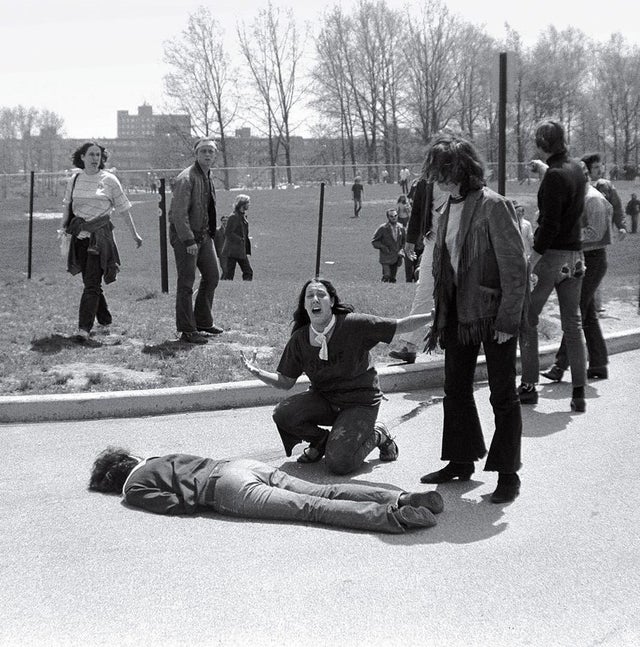
The Kent State shootings (also known as the May 4 massacre or the Kent State massacre), were the shootings on May 4, 1970, of unarmed college students by the Ohio National Guard at Kent State University in Kent, Ohio, during a mass protest against the bombing in neutral Cambodia by United States military forces. Twenty-eight National Guard soldiers fired approximately 67 rounds over a period of 13 seconds, killing four students and wounding nine others, one of whom suffered permanent paralysis.

Tin soldiers and Nixon’s coming
We’re finally on our own
This summer I hear the drumming
Four dead in Ohio

Gotta get down to it
Soldiers are gunning us down
Should have been done long ago
What if you knew her and
Found her dead on the ground
How can you run when you know

Ah, la la la la…

Gotta get down to it
Soldiers are gunning us down
Should have been done long ago
What if you knew her and
Found her dead on the ground
How can you run when you know

Tin soldiers and Nixon’s coming
We’re finally on our own
This summer I hear the drumming
Four dead in Ohio
Four dead in Ohio

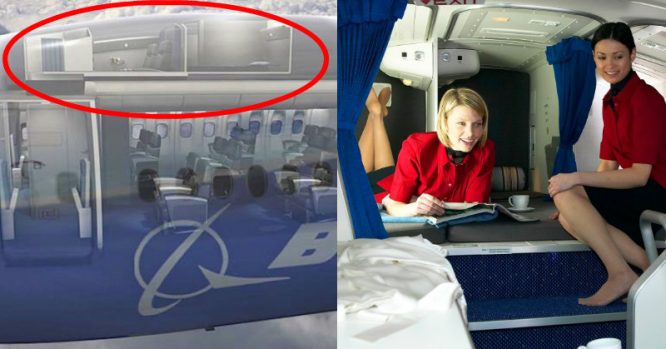
Hidden Crew Rest Compartments on Airliners

A crew rest compartment (crew rest) is a section of an airliner dedicated for breaks and sleeping by crew members, usually located above or adjacent to the passenger compartment. Crew rest compartments are normally segregated, with separate compartments for the flight crew and the cabin crew.

On long flights, crew members may sleep in crew rest compartments during off-duty periods. Federal Aviation Regulations have provisions requiring crew rest areas be provided in order to operate a long flight by using multiple crew shifts.

Passengers are restricted from accessing crew rest compartments by regulations, additionally their entrances may be secured by locks and may require ascending a ladder for access.

Barbara Lynn

Barbara Lynn (born Barbara Lynn Ozen, later Barbara Lynn Cumby, January 16, 1942) is an American rhythm and blues and electric blues guitarist, singer and songwriter. She is best known for her R&B chart-topping hit, “You’ll Lose a Good Thing” (1962). In 2018, Lynn received the National Heritage Fellowship.

She was born in Beaumont, Texas, and attended Hebert High School. She played piano as a child, but switched to guitar, which she plays left-handed. Inspired by blues artists Guitar Slim and Jimmy Reed, and pop acts Elvis Presley and Brenda Lee, and winning several local talent shows, she created an all-female band, Bobbie Lynn and Her Idols.

She began performing in local clubs in Texas. Singer Joe Barry saw her and introduced Lynn to producer Huey P. Meaux, who ran SugarHill Recording Studios and several record labels in New Orleans. Her first single, “You’ll Lose A Good Thing”, co-written by her and Meaux, was recorded at Cosimo Matassa’s J&M studio with session musicians including Mac Rebennack (Dr. John). Released by Jamie Records, it was a number 1 US Billboard R&B chart hit and Top 10 Billboard Hot 100 hit in 1962. The song was later recorded by Aretha Franklin and became a country hit record for Freddy Fender. Reggae artist Mikey Dread also based the melody of his 1989 single “Choose Me” on this song. Lynn also released an album, also titled You’ll Lose A Good Thing, which featured ten of her compositions.

The ‘Can-Opener’ bridge in Durham, North Carolina


11-foot


At 11 foot 8 inches, the Norfolk Southern–Gregson Street Overpass, located in Durham, North Carolina, United States, is a bit too short. The federal government recommends that bridges on public roads should have a clearance of at least 14 feet. But when this railroad trestle was built in the 1940s, there were no standards for minimum clearance. As a result, trucks would frequently hit the bridge and get its roof scrapped off.

Durham resident Jürgen Henn has been witnessing these crashes for years from across the street where he worked. Wishing to share these hilarious mishaps with the rest of the world, Henn set up a video camera in April 2008 and began recording them for his ever popular website 11foot8.com. By the end of 2015, more than one hundred trucks had their tops violently ripped off. These scalping videos, which are also available on his Youtube channel, have racked up millions of views bringing this particular bridge —nicknamed ‘the can opener’— a fair amount of international fame.


11foot8-bridge-durham-12


As Jürgen Henn explains in his website, the bridge cannot be raised because doing so would require the tracks to be raised for several miles to adjust the incline. North Carolina Railroad doesn’t want to pay for the enormous expense it would entail. The bridge cannot be lowered either because there is a major sewer line running only four feet under the street.

Instead, the city authorities installed an alert system that detects when an over-height truck tries to pass under and flashes yellow warning lights several feet ahead of the bridge. But many drivers either do not pay attention or fail to heed the warning, and crash into the bridge. The railroad department, who owns the bridge, installed a heavy steel crash beam in front of the bridge that takes most of the impact, protecting the actual structure of the train trestle. This crash beam is hit so often that it had to be replaced at least once.

As far as both parties are concerned —the city of Durham and North Carolina Railroad— adequate steps have been taken to solve the problem. The railroad authorities’ concern is with the bridge and the rails above, not the trucks. Hence, the beam. The city, on the other hand, has posted prominent “low clearance” signs from 3 blocks away leading up to the trestle, over and above the automatic warning system that is triggered by vehicles that are too tall.

Apparently, these measures are not enough to prevent accidents. On average there is one crash every month.

When Henn interviewed a few drivers as they deflated their tires to lower their vehicles enough to free them, some told him that they didn’t know their trucks’ heights, while others insisted they didn’t see the signs.

Durham officials are now trying out a new tactic. A few months ago, they installed a traffic signal at the intersection before the bridge, and hooked up the height sensor to it. When an over-height truck approaches the intersection, the light turns red, and stays red for a long time. The light eventually turns green, but the city hopes that the long delay will give the drivers enough time to realize their truck will not fit under the bridge. Unfortunately for the drivers, and to the delight of the rest, the bridge continues to shave the tops of over-height vehicles.


11foot8-bridge-durham-52