
The Battle of Aleppo was a major military confrontation in Aleppo, the largest city in Syria, between the Syrian opposition (including the Free Syrian Army (FSA) and other largely-Sunni groups, such as the Levant Front and the al-Qaeda-affiliated al-Nusra Front) against the Syrian government, supported by Hezbollah, Shia militias and Russia, and against the Kurdish-led People’s Protection Units (YPG). The battle began on 19 July 2012 and was part of the ongoing Syrian Civil War. A stalemate that had been in place for four years finally ended in July 2016, when Syrian government troops closed the rebels’ last supply line into Aleppo with the support of Russian airstrikes. In response, rebel forces launched unsuccessful counteroffensives in September and October that failed to break the siege; in November, government forces embarked on a decisive campaign that resulted in the recapture of all of Aleppo by December 2016. The Syrian government victory was widely seen as a potential turning point in Syria’s civil war.
The large-scale devastation of the battle and its importance led combatants to name it the “mother of battles” or “Syria’s Stalingrad”. The battle was marked by widespread violence against civilians, alleged repeated targeting of hospitals and schools (mostly by pro-government Air Forces and to a lesser extent by the rebels), and indiscriminate aerial strikes and shelling against civilian areas. It was also marked by the inability of the international community to resolve the conflict peacefully. The UN special envoy to Syria proposed to end the battle by giving East Aleppo autonomy, but the idea was rejected by the Syrian government. Hundreds of thousands of residents were displaced by the fighting and efforts to provide aid to civilians or facilitate evacuation were routinely disrupted by continued combat and mistrust between the opposing sides.


In late September 2016, Russia and Syria began performing nightly air raids on rebel-held parts of the city. Russian and Syrian forces were also accused of conducting “double tap” airstrikes which purposefully targeted rescue workers and first responders at hospitals and other civilian structures that they had already bombed, however this is disputed by government and Russian sources. To prevent civilian casualties, Syrian and Russian forces opened up humanitarian corridors to allow the civilian population of Aleppo to evacuate, away from the fighting. During evacuation, several East Aleppo residents reported that evacuating civilians were shelled by rebels. During the 2016 Syrian government offensive, the Office of the United Nations High Commissioner for Human Rights warned that “crimes of historic proportions” were being committed in Aleppo.


The battle caused catastrophic destruction to the Old City of Aleppo, a UNESCO World Heritage site. With over four years of fighting, it represents one of the longest sieges in modern warfare and one of the bloodiest battles of the Syrian Civil War, which left an estimated 31,000 people dead, almost a tenth of the overall war casualties.


Sammy Davis, Jr. was an American singer, entertainer and actor. He was a diminutive little fella who had the energy of a frantic. He was part of the famous “Rat Pack” which included Frank Sinatra and Dean Martin. His big hit was “Candy Man”.
Last night I checked out a movie titled Salt & Pepper starring Sammy and another rat packer Peter Lawford. A comedy with lots of tunes involving murder and espionage, it was somewhat enjoyable. The best part was Sammy doing a slam bam pop cut with sexy dancers on the stage of his club.
The flick is so 1960’s. With all the groove and crazy clothes. Everybody in the movie smokes cigarettes.




.
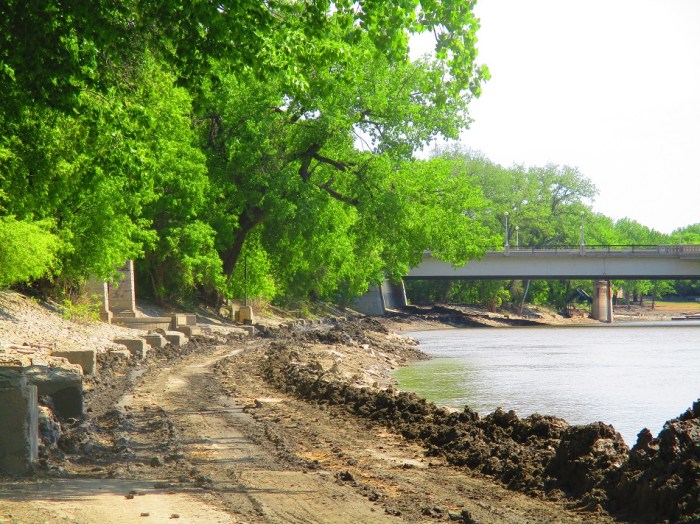
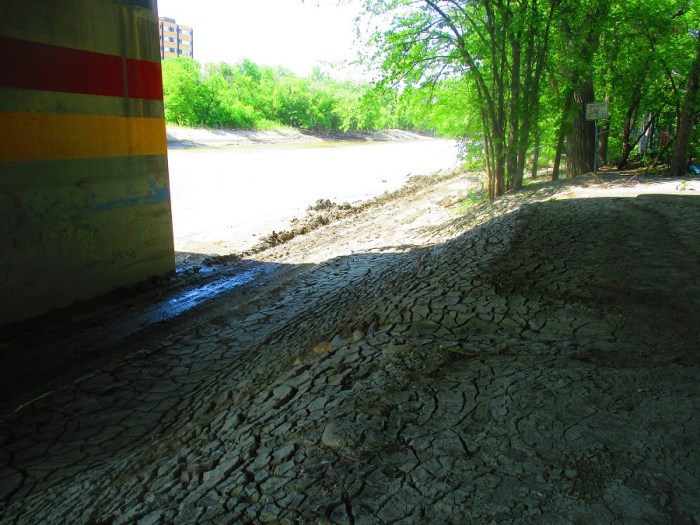
In the annual post-flood days along the Assiniboine River in Winnipeg it is time for the cleanup. Almost every year the river floods in the spring. Water inundates the scenic river walk leaving mud and debris. But the cleanup crews are diligent and it will be user friendly very soon.



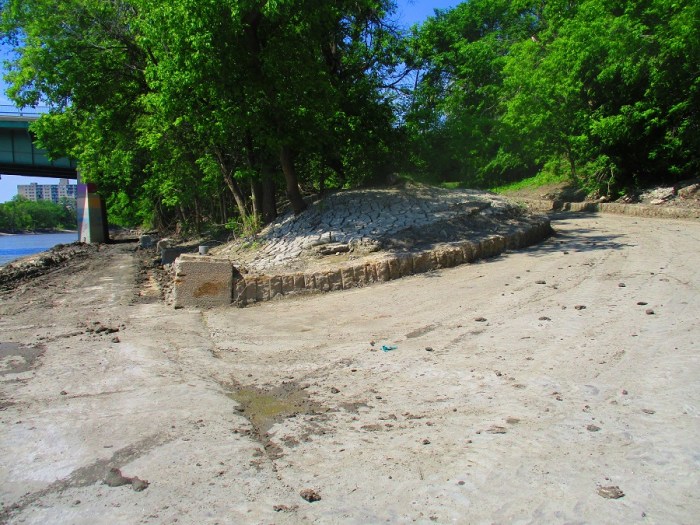

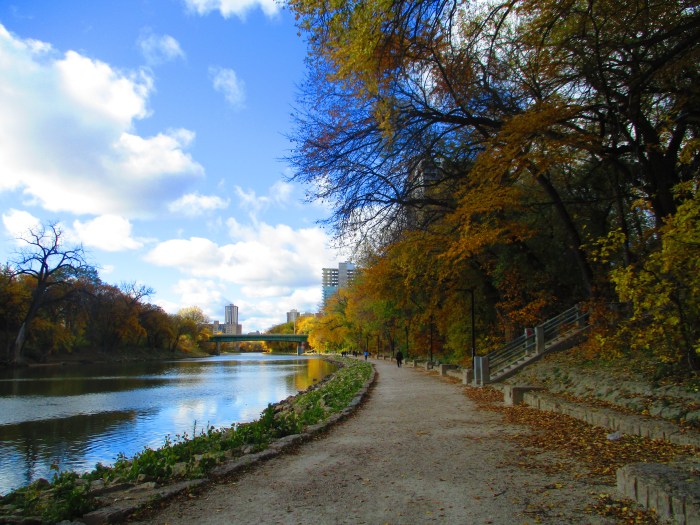
Soon it will look like this.

When televisions were still a luxury, high-tech item, designers wanted to make them look as crazily futuristic and beautiful as possible. Here are some of the most bizarre and breathtaking television sets that ever existed.


The sailboat-like ultra-heavy (it was 289 lb. or 130 kg) home entertainment system of its time had a 23″ black and white television, eight speakers, a Telefunken phonographs and a multi-band radio receiver. The Komet cost more than a year’s average wage.


∑
This is a very subjective list as I am not a movie aficionado and there are dozens of great horror movies that I have not seen. But here it is.
Number 1
The Exorcist

I saw this movie when I was 14 years old. Not a good idea. I was an altar boy at the time and therefore still believed in Angels and Demons. This movie so terrified me that I almost went to see a priest to discuss my possible possession by a demon.
This movie takes horror to a whole new level. There is the blatant visceral demonic possession scenes, but at the same time subtle underlying terrifying messages that come at you from all angles.
Number 2
Hellraiser

The Cenobite Demons in this movie are radical. The torture chambers and dark cenobite world is shocking. Pinhead causes cold streams of angst to penetrate your very soul. The Uncle Frank character is a classic. Clive Barker creates a brand new world of horror like nothing that came before.
Number 3
The Shining


Jack Nicholson at his creepy best. What you don’t see in this movie is scarier than what you do see. The Overlook Hotel is the perfect haunted mansion. The horrific history of the hotel is something that the moviegoer will ponder for weeks after seeing this movie.
Number 4
Alien

Great monster, great spaceship, great planet scene, great story and great crew on the ship. Enough said.
Number 5
Black Christmas

Very creepy psycho in the attic murdering sorority girls. A young Andrea Martin is worth revisiting this classic. The strange sounds and noises that the thing in the attic makes is enough to make your hair stand on end.
Number 6
Dawn of the Dead

Zombies run amuck in a shopping mall. Lots of gore which is typical of Zombie movies. After seeing this movie you will never look at a shopping mall the same way again.
Number 7
The Texas Chainsaw Massacre 1974

Very disturbing hillbilly killers who also double as cannibals. These gruesome psychos are on a mission from the Devil himself. Sticking innocent victims on a meat hook is just one of their nefarious techniques. The old grandpa killer is an island of hilarity in this dark tale.
Number 8
The Silence of the Lambs


The Antagonist in this movie is one of the best of all time. Hannibal the Cannibal Lecter is a genius killer and cannibal. His dispatch of the 2 policeman is done with such cunning and precision that it makes your head spin. Great story combined with amazing characters. A classic.
Number 9
The Thing 1982

One of the most innovative monsters in movie history. This Thing can copy and replicate any biological form. You never know who the enemy is. Your best buddy or pet could be an evil alien life form that wants to eat you whole. Set in the Antarctic on an isolated base this movie leaves you with a very cold chill indeed.
Number 10
The Hills Have Eyes

Grotesque mutants that prey on unsuspecting travellers. This movie has enough blood, guck and gore to nauseate the toughest horror fan. The mutants got this way from exposure to radiation from atomic bomb tests in the desert. They are seeking revenge on the normal folk. And pity the poor normal folk that wander into mutant territory.
Moon

Mercury

Venus

Mars

Jupiter

Saturn

Uranus

Neptune


If you were to tally every planet ever mentioned in Star Wars—we’re talking movies, comics, video games, and animated series—you’d end up with a number north of 300. That Star Wars became the cultural phenomenon we know today is no doubt the result of its dedication to truly thorough world-building. Every planet in the universe comes with its own history, culture, and landscape. And now, they have flags, too.
Scott Kelly is an art director from New Zealand who’s spent the last year designing flags for more than 100 planets in the Star Wars galaxy. As a self-professed Star Wars and flag-design nerd, Kelly drew on information from Wookieepedia to craft the brilliantly detailed emblems. He followed vexillological traditions to design his flags—think cantons, chevron patterns, and the classic 2:3 aspect ratio—and combined it with graphics that duly represented the otherworldliness of the series. “I tried to walk the line between traditional flag design and these far-off alien planets,” he explains.

Every flag in the series is inspired by the culture, economy, history, and natural landscape of the fictional world it stands for. Tatooine’s flag, for example, is a deep red and yellow, which references the fact that travelers had long mistaken the planet for a sun because of its desert landscape (the two circles, of course, represent the two suns around which Tatooine orbits); while that of Thule, a planet in the outer rim territories known for its semi-arid savannah and rocks charred from lightening strikes, is more graphically aggressive. “It needed to have a quite masculine feel to it,” he explains. “Almost oppressive.”

Naturally, Kelly took some creative liberties. For instance, he deciding that planets associated with the Galactic Republic would be colored royal blue. Other flags were simply Kelly’s interpretation of specific traditions and histories. He figures not everyone will agree with his vision (Star Wars fans are a tough crowd!), but regardless, you have to applaud his dedication. “There’s been a series of emails and replies that have said, ‘Oh I bet that guy doesn’t have a girlfriend,’” he laughs.


Dracaena cinnabari, the Socotra dragon tree or dragon blood tree, is a dragon tree native to the Socotra archipelago in the Arabian Sea. It is so called due to the red sap that the trees produce.

The dragon blood tree has a unique and strange appearance, with an “upturned, densely packed crown having the shape of an uprightly held umbrella”. This evergreen species is named after its dark red resin, which is known as “dragon’s blood”. Unlike most monocot plants, Dracaena displays secondary growth, D. cinnabari even has growth zones resembling tree rings found in dicot tree species. Along with other arborescent Dracaena species it has a distinctive growth habit called “dracoid habitus”. Its leaves are found only at the end of its youngest branches; its leaves are all shed every 3 or 4 years before new leaves simultaneously mature. Branching tends to occur when the growth of the terminal bud is stopped, due to either flowering or traumatic events (e.g. herbivory).

Socotra, also spelled Soqotra, is an island and a small archipelago of four islands in the Arabian Sea. Socotra is part of Yemen. It had long been a part of the Aden Governorate. In 2004 it became attached to the Hadhramaut Governorate, which is much closer to the island than Aden (although the nearest governorate was the Al Mahrah Governorate). In 2013, the archipelago became its own governorate.


 The MarkoZen Blog