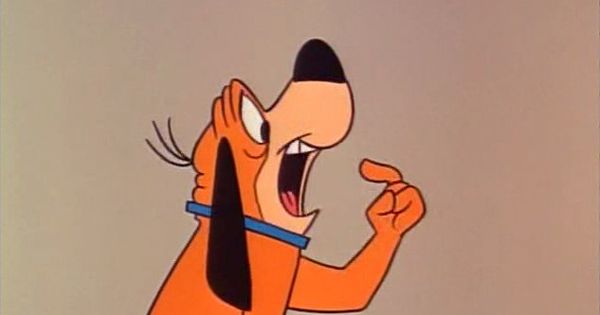
There are radio and TV commercials going around where pizza restaurants have satisfied customers moaning and groaning when they taste the delicious pizza pies. Oomm, ahh this is so good. Obviously the commercials are bias and the actor customers are over doing it. But when it comes to enjoying a tasty morsel, nothing beats Snuffle the Floating Dog.
Snuffles is an anthropomorphic cartoon dog appearing in animated television shorts produced by Hanna-Barbera beginning in 1959 on The Quick Draw McGraw Show.
Snuffles is a bloodhound used by Quick Draw McGraw to ferret out bad guys in the old West but needed to be bribed with a dog biscuit before performing his task. Upon chomping on one, he would hug himself in ecstasy, jump into the air and float back down, sighing. Occasionally, Snuffles would demand more than one biscuit, and was willing to accept them from bad guys as well. In several cases when Quick Draw did not have a dog biscuit to offer due to being out of them or if he tried to give Snuffles the reward cash for capturing an outlaw, Snuffles would either shake his head and say “Uh-uh” or grunt to himself and mumble “Darn cheapskate!” as well as sometimes throwing the reward money back in Quick Draw’s face.
For some reason the dialogue in the video above was in something that sounds like Russian.
Hansel and Gretel have over reactive taste buds as well.
RCMP explosives experts are on their way to a remote Manitoba First Nation community to deal with a dangerous situation that prompted the evacuation of more than a dozen trailers.
A man in the community of Pukatawagan on Tuesday evening found a box full of blasting caps while cleaning out an old business that had been owned by a construction company and took them home.
He left the box in his yard, near a playground.
RCMP spokeswoman Const. Line Karpish said when police were alerted to the explosives they evacuated 20 trailers in the area.
A blasting cap is a small explosive device generally used to detonate a larger, more powerful secondary explosive such as TNT or dynamite.
Those larger explosive compounds require a certain amount of energy to detonate. Blasting caps, which are much more sensitive and easy to detonate, provide that.
However, they can go off unexpectedly and are hazardous for untrained personnel to handle.
“It wouldn’t be like a huge bang but for all intents and purposes, you know, it could certainly hurt someone’s hand and then, you know, you put 20, 30 together it definitely has potential for harm,” said Karpish.
Karpish warns anyone who may find old explosive materials to just leave them alone and call authorities.
Pukatawagan is located more than 800 kilometres north of Winnipeg, near the Saskatchewan border.
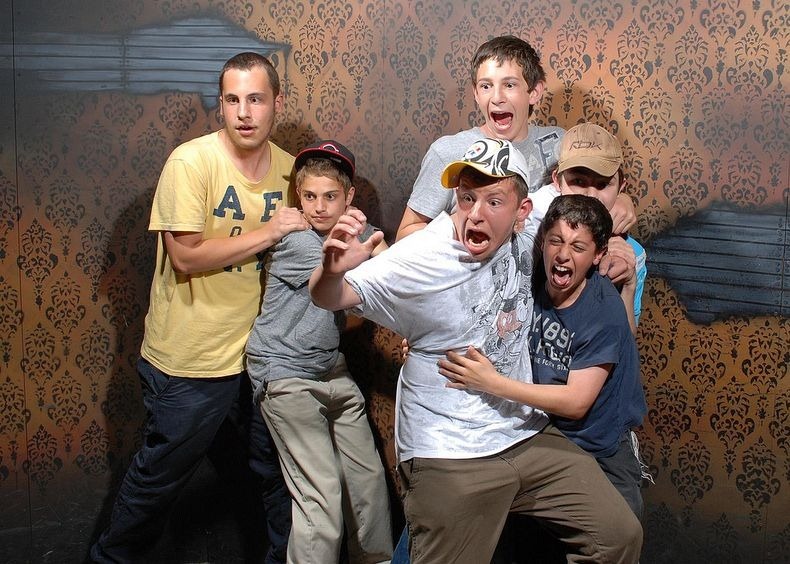
The Nightmare’s Fear Factory is a haunted house attraction in Niagara Falls, Canada, and one of the oldest running haunted house in North America. The house has been described as the “scariest and best haunted house attraction” and in case you don’t believe them, the owners of the 30-year old establishment publishes a regularly updated stream of pictures showing terrified visitors shrieking and grimacing with genuine fear. The photos became an internet sensation after they went viral in social media websites.
The house is so frightening that visitors have a ‘safety word’ – Nightmares – which they can utter at any time if they wish to be escorted out. In the last 30 years, about a half-million people have gone through, and many have opted out part-way and had their names added to a public “chicken list”. Over 110,000 people have elected to use the ‘chicken exit’ during the 15-minute tour.
The tour takes from 10 to 15 minutes and is in total darkness, except for small red lights on the floors, walls and ceiling that patrons must follow in order to get through the haunted house. Unlike conventional haunted houses, the Nightmares Fear Factory doesn’t rely primarily on blood and gore in order to induce fear. Rather, there are live actors in scary costumes that come at the patrons out of the darkness and taunt them, scream at them, speak in creepy voices, etc. They have been known to grab, push and pull patrons in order to get a reaction. There are also scary sounds like growls, eerie music, spooky voices, yelling, and so forth.
Highlights of the tour include a shaky drawbridge, a claustrophobic tunnel that visitors must crawl through, and a place where it appears that the walls are closing in on the visitors.
The most notable part of the tour is when the visitors, walking in complete darkness (often holding on to each other) suddenly see a sign that reminds them that they are going to die. At this point their pictures are taken and sometimes posted on the Fear Factory’s Flickr account.
After doing some research on what exactly is making these people shit their pants I think I discovered what it is. It is a hologram type image of a screaming demon that comes out of nowhere.
Aussies slur their words and use only two-thirds of their mouth to speak because early settlers spent most of their days DRUNK, academic says
The Australian language developed because early settlers were often drunk
Academic claims the constant slurring of words distorted the accent
The average Australian speaks to just two thirds capacity
The drunken speech has been passed down from generation to generation
The Australian accent developed because so many early settlers were drunk and slurring, an Australian academic has claimed.
The first British arrivals to the country were such big drinkers that the distortion to their speech caused a verbal hangover that persists to this day, according to Dean Frenkel, a communications expert at Victoria University in Melbourne.
Proud Australians may be offended by the claim, which comes on top of the unavoidable truth that Australia began its modern life as a penal colony for our criminals.
But academic Mr Frenkel unashamedly wrote in Australian newspaper The Age: ‘Let’s get things straight about the origins of the Australian accent.
‘The Australian alphabet cocktail was spiked by alcohol.
‘Our forefathers regularly got drunk together and through their frequent interactions unknowingly added an alcoholic slur to our national speech patterns.
‘For the past two centuries, from generation to generation, drunken Aussie-speak continues to be taught by sober parents to their children.’
Bemoaning the still ‘slurred’ Australian accent, Mr Frenkel continued: ‘The average Australian speaks to just two thirds capacity – with one third of our articulator muscles always sedentary as if lying on the couch; and that’s just concerning articulation.
‘Missing consonants can include missing “t”s (Impordant), “l”s (Austraya) and “s”s (yesh), while many of our vowels are lazily transformed into other vowels, especially “a”s to “e”s (stending) and “i”s (New South Wyles) and “i”s to “oi”s (noight).’
Concluding with a call for Australians to improve their diction, the academic added: ‘It is time to take our beer goggles off.
‘Australia, it is no longer acceptable to be smarter than we sound.’
The Australian alphabet that ‘was spiked by alcohol’ and that the distortion to their speech caused a verbal hangover that persists to this day
HISTORY OF THE AUSSIE ACCENT
1788 – Colonial settlement established. A new dialect of English begins to take shape
1830 – By the end of the early Colonial settlement era major features of the accent, called ‘General Australian’, had developed, the country’s love of abbreviated words became part of everyday language
1850 – The Gold Rush leads to internal migration, spreading the general dialect around the continent
1880 – Extensive migration from England led to an emphasis on elocution and British vowels, which formed the Broad Australian dialect
1914 to 1918 – Australia’s national identity was galvanized during WWI with the creation of terms like Anzac and digger. Australians start to become proud of their accent.
1950 – In the second half of the 20th century, any emphasis on Broad Australian dwindled because of weakening ties with Britain and the General Australian accent became widely accepted as the national norm
1964 – The term Strine was coined to describe the country’s accent, which the majority of people continue to speak today
Information from Macquarie University and Oxford English Dictionary
Previous accent theories have included suggestions that the Australian accent is a true reflection of the 18th and 19th century accents of British arrivals, while the American accent reflects the way 17th century early settlers from Britain spoke.
The suggestion has been that it is native English accents which have changed, while former colonies have clung to old ways of speaking.
Winston Churchill described the Australian accent as ‘the most brutal maltreatment ever inflicted upon the mother tongue.’
Aussie Drinking Slang
Words for “beer”:
grog (can mean any alcohol)
piss
Words for “drunk”:
legless
off one’s face
maggot (really drunk)
pissed
Different sized drinks:
schooner – 425ml glass of beer, except in SA where it is a 285ml glass
middy – half-pint of beer / same as a pot
pot – 285ml glass of beer in QLD or VIC
pint – 570ml glass of beer
long-neck – 750ml bottle of beer
tinnie – can of beer
stubby – bottle of beer
slab – 24 pack of beer
More drinking terms:
esky – a cooler
goon – cask or box wine
shout – to buy someone a drink
bottle shop / bottle-o – a liquor store
chunder – vomit
drink with the flies – drink alone
rage – party
skull/skol a beer – drink a whole beer without stopping
A flight helmet, sometimes nicknamed a “bone dome”, is a special type of helmet primarily worn by military aircrew.
A flight helmet can provide:
Impact protection to reduce the risk of head injury (e.g. in the event of a parachute landing) and protection from wind blast (e.g. in the event of ejection).
A visor to shield the eyes from sunlight, flash and laser beams.
Noise attenuation, headphones and a microphone (except when included in a mask).
A helmet mounted display, mounting for night vision goggles and/or a helmet tracking system (so the aircraft knows where the pilot is looking).
SR-71 Blackbird pilot helmet. The plane flew so fast and high that the helmet resembles a space helmet.
The Soviet (Russian) MIG-25 Foxbat also flew very high and fast.
Chinese helmet variations
U.S. Navy helmet
F/A-18 Super Hornet carrier pilots
F-22 Raptor pilot helmet
U.S. Marine Corp Harrier pilots always wear camo helmets
U.S. Air Force Thunderbirds demo team
Royal Canadian Air Force
F-35 Lightning II
Each helmet costs $400,000!
Vision Systems International (VSI; the Elbit Systems/Rockwell Collins joint venture) along with Helmet Integrated Systems, Ltd. developed the Helmet-Mounted Display System (HMDS) for the F-35 Joint Strike Fighter aircraft. In addition to standard Helmet Mounted Display (HMD) capabilities offered by other systems, HMDS fully utilizes the advanced avionics architecture of the F-35 and provides the pilot video with imagery in day or night conditions. Consequently, the F-35 is the first tactical fighter jet in 50 years to fly without a HUD. A BAE Systems helmet was considered when HMDS development was experiencing significant problems, but these issues were eventually worked out. The Helmet-Mounted Display System was fully operational and ready for delivery in July 2014.
The F-35 does not need to be physically pointing at its target for weapons to be successful. Sensors can track and target a nearby aircraft from any orientation, provide the information to the pilot through their helmet (and therefore visible no matter which way the pilot is looking), and provide the seeker-head of a missile with sufficient information. Recent missile types provide a much greater ability to pursue a target regardless of the launch orientation, called “High Off-Boresight” capability. Sensors use combined radio frequency and infra red (SAIRST) to continually track nearby aircraft while the pilot’s helmet-mounted display system (HMDS) displays and selects targets; the helmet system replaces the display-suite-mounted head-up display used in earlier fighters. Each helmet costs $400,000.
The F-35’s systems provide the edge in the “observe, orient, decide, and act” OODA loop; stealth and advanced sensors aid in observation (while being difficult to observe), automated target tracking helps in orientation, sensor fusion simplifies decision making, and the aircraft’s controls allow the pilot to keep their focus on the targets, rather than the controls of their aircraft.
For five centuries, the inhabitants of Nuanquan village in Yu County, in the northwestern reaches of Hebei province, China, have marked the Lunar New Year with a remarkable pyrotechnic tradition. Adorned in wide-brimmed straw hats and sheepskin jackets, local blacksmiths engage in a mesmerizing spectacle, flinging ladle after ladle of molten iron against a towering brick wall. Upon impact, the molten metal erupts into a spectacular cascade of sparks, reminiscent of a dazzling fireworks display.











 The MarkoZen Blog