Hurling is an outdoor team game of ancient Gaelic and Irish origin, administered by the Gaelic Athletic Association (GAA). The game has prehistoric origins, has been played for over 3,000 years. One of Ireland’s native Gaelic games, it shares a number of features with Gaelic football, such as the field and goals, the number of players, and much terminology.
The objective of the game is for players to use a wooden stick called a hurley to hit a small ball called a sliotar between the opponents’ goalposts either over the crossbar for one point, or under the crossbar into a net guarded by a goalkeeper for one goal, which is equivalent to three points. The sliotar can be caught in the hand and carried for not more than four steps, struck in the air, or struck on the ground with the hurley. It can be kicked or slapped with an open hand (the hand pass) for short-range passing. A player who wants to carry the ball for more than four steps has to bounce or balance the sliotar on the end of the stick and the ball can only be handled twice while in his possession.
No protective padding is worn by players. A plastic protective helmet with a faceguard is mandatory for all age groups, including senior level, as of 2010. The game has been described as “a bastion of humility”, with player names absent from jerseys and a player’s number decided by his position on the field.
Hurling is played throughout the world, and is popular among members of the Irish diaspora in North America, Europe, Australia, New Zealand, South Africa and Argentina, and South Korea. In many parts of Ireland, however, hurling is a fixture of life.
Every so often the Hurley gets misdirected.
Heads collide. Every player decides on the colour of the helmet they wear. No matter if it matches the uniform or not.
Hurley to helmet. Makes a Canadian hockey fan excited.
Seen out of context, it looks like a ship silently slinking under the waves, like the final scene in a disaster movie.
But have no fear, this is simply a very special U.S Navy ship, taking a ‘flip’ as it celebrates 50 years of cartwheels.
With an ability to drift over the ocean like a ship – yet transform into a vertical buoy in pursuit of scientific research – the Navy’s Floating Instrument Platform (FLIP) is one of the most unique ships on (or under) the water.
Ready to flip: This ship looks fairly conventional at this point – but see what happens next..
Up and away: The Floating Instrument Platform begins to rise out of the water
Lifting… Lifting… If you look closely, you can see crewmembers leaning back on the top of the ship
…And vertical: The ship stands tall in the water, looking like a ship that is about to slip under the waves
The ship conducts investigations in a number of fields, including acoustics, oceanography, meteorology and marine mammal observation.
Dr Frank Herr, head of ONR’s Ocean Battlespace Sensing Department, said: ‘FLIP’s unique characteristic of a low-profile, stable observational platform has proven particularly useful over the years.
‘It will continue to be a research vessel of choice for our naval scientists.’
What makes the vessel so special is that it can partially submerge like a sinking ship by filling ballast tanks in its stern with water.
When in its vertical position, FLIP’s visible floating platform extends 55 feet above the ocean surface while the rest of the hull reaches 300 feet below the water.
Because so much of the vessel is submerged when it sits upright, the platform is impervious to the ocean waves, providing a stable environment for researchers to do their work.
‘I’m so thankful that ONR and Scripps have been able to maintain FLIP as an active platform,’ said Dr. C. Linwood Vincent, a recently retired ONR division director who managed a number of projects that employed the vessel.
Now on the faculty at the University of Miami, Vincent added, ‘It would be very difficult to conduct these studies on a rocking ship.’
Built in 1962, the steel-hulled platform accommodates 11 researchers and a crew of five for up to 30 days.
It does not have its own propulsion and must be towed to research locations in the ocean, where it ‘flips’ into vertical position in approximately 20 minutes.
FLIP, designed by Scripps scientists Fred Spiess and Fred Fisher, operates in two modes, drifting with the currents or moored to the sea floor, and supports the deployment of a variety of sensors and instruments.
‘FLIP was originally designed to study underwater acoustics – the bending of sound,’ said William Gaines, the program manager at Scripps.
‘In recent times, we’ve done a lot of the marine mammal research because FLIP has the ability to be very quiet in the vertical position. We can place hydrophone arrays far below the surface and put marine mammal observers up top to correlate the signals from the animals to the visual observations.’
In 2010, researchers used FLIP for a set of experiments called High Resolution Air-Sea Interaction project, which measured wind and swell conditions. That data is helping to improve weather models and other ocean-atmosphere databases.
‘FLIP was the pivotal platform for that project, which also included research done by traditional research ships and remotely piloted aircraft,’ said Tim Schnoor, the program officer who oversees ONR’s research vessel programs.
Naval Research Laboratory scientists recently employed FLIP for oceanographic work using lasers. Additional studies are in the works, and FLIP will continue to support scientists in their research endeavors.
‘It’s in good material condition,’ said Schnoor. ‘We’ve continued to invest in maintenance and preservation of the platform, including taking hull thickness measurements to ensure hull integrity. There’s no reason it can’t continue to serve research needs as long as we have users to exploit her unique capabilities.’
No detail overlooked: Naturally, if you need a toilet break when the ship is vertical, you will need a different sink – and be careful to pack your toiletries up properly
When UFOs fly over a farm, it always seems that the first thing they do is to beam up the farmer’s cows with their Tractor Beam. Alien abduction accounts being what they are, you’d think they’d be more interested in the farmer, but where else would you test a tractor beam but on a farm?
The entry portal has to be quite large for a 900 pound bovine to make it through.
What do they want with the cattle? They like the taste of beef or cow milk?
Do they probe the cows cavities and orifices? If so, do they use an anesthetic?
The rest of the herd here looks totally oblivious to the tractor beam abduction. Wouldn’t they be spooked?
The other cows just continue grazing, as if nothing is happening. Could it be that the other cows are being communicated to telepathically by the Aliens to Stay Calm and Carry On?
Those cows will not be going up that chute without being nudged along by an electric cattle prod. This race of Space Aliens obviously haven’t figured out how to build a tractor beam.
Not only has this race of Aliens figured out how to build a tractor beam, they have mastered the art of camouflage.
Here the Alien has left the UFO. It appears to be beating on the unsuspecting bovine! This Alien is looking to get a good kicking.
Another milking dairy cow. Why the persistent interest in cows that need to be milked by suction devices?
This cow looks pissed. The Aliens better be prepared for some agitation up in the spacecraft.
The Aliens obviously didn’t perform proper reconnaissance on this bovine. The poor thing is chained to the ground! Great way to test the strength of the tractor beam.
It is not always a sad ending. Not all the cows are mutilated and have their sexual organs, eyeballs and brains removed. Some are returned to their relieved and exhilarated farmers.
Ultimately, why, why? Are those dirty little Gray Aliens into bovine bestiality? Or could it be honest to goodness veterinarian research. If only the NSA and CIA would disclose the truth! They know, oh yes they do! They listen in to everything. They have operators hiding in those corn fields and paddy saturated pastures pointing intercept signals dishes at the whole damn situation. Why won’t they tell us what the hell is going on?!!
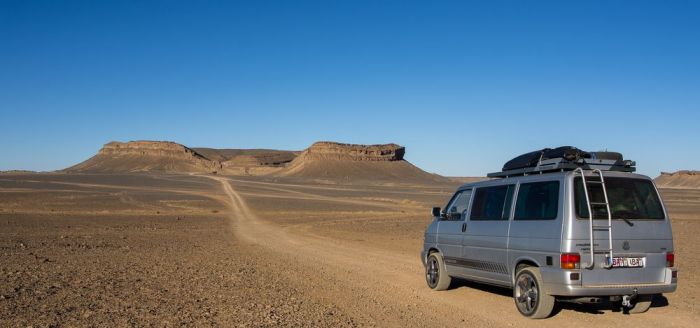
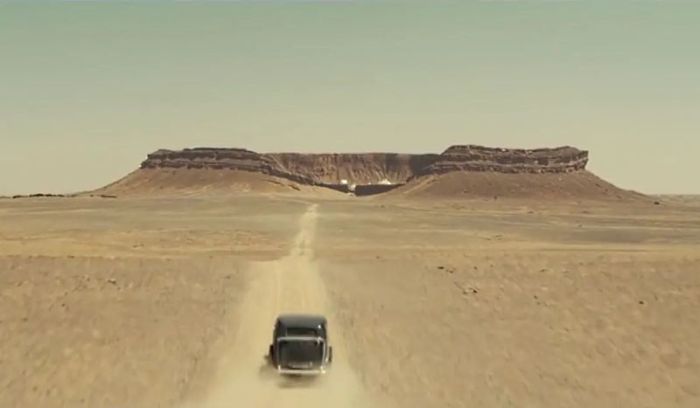
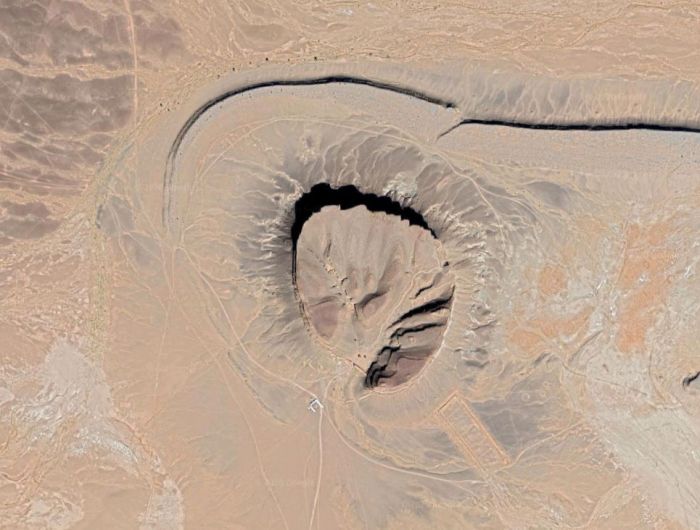
The 1999 Hollywood movie The Mummy is set in Egypt, but was filmed largely in Morocco. Marrakech became the Cairo of 1926, the year the story takes place, and the lost city of “Hamunaptra” was set inside a vast horseshoe-shaped geological feature called Jebel Mudawwa, or Gara Medouar, located near Sijilmasa, in the southeast of the country. Gara Medouar appeared again in the sequel The Mummy Returns in 2001. The exotic location then became the evil lair of the Bond villain Franz Oberhauser in the 2015 movie Spectre. Although Oberhauser describes his den as being located inside a meteorite crater, in reality Gara Medouar is an erosional crater.
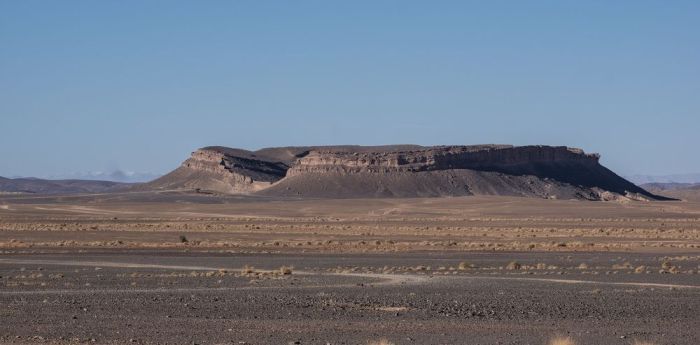
Gara Medouar, literally “the round mountain”, is the eroded remains of a large limestone massif that, at its current state, rises 50 meters above the desert and encompasses an area of about 50 hectares. But there is no plateau. Instead, the central region is collapsed to form a valley, and the resulting circular formation is broken by a ravine that provides entrance into the heart of the massif. The interior is flat and any loose material has long been washed away, presumably by water, although there is no source of water nearby in the desert today. Most of the perimeter consists of vertical rocks with loose gravel at the bottom.
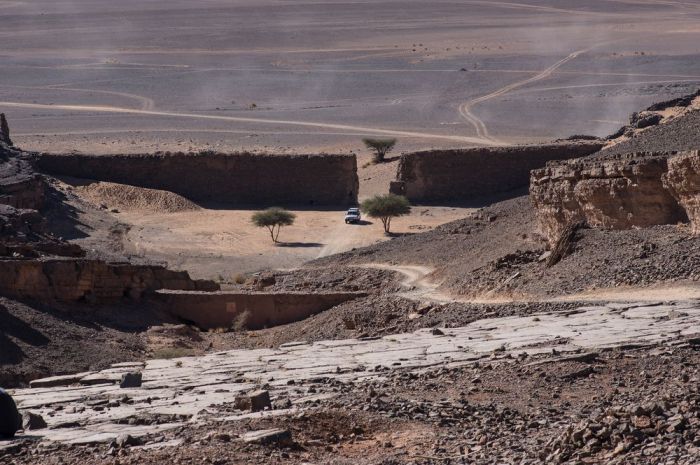
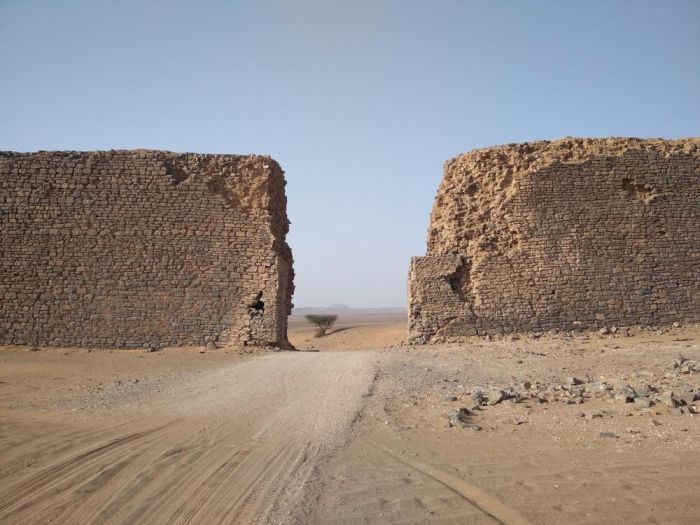
Gara Medouar’s unusual topography makes it a naturally protected site, once providing caravans with shelter during sandstorms. Later, Gara Medouar was developed into a full fortress, and at one point it became a temporary holding area for slaves being sold from Africa to Portugal. Remains of the fortress is still visible today in the form of a defensive wall built around a third of the natural perimeter of the mountain. But the most impressive is the curtain wall that goes straight across the large ravine blocking the only entrance to the massif. This wall, which is exceptionally preserved over its entire height, is 8 meters tall but at places rises to 12 meters. It is 80 meters long and 4 meters thick and has an extremely solid constitution made of limestone blocks held together with lime mortar.
Blofeld’s lair in “Spectre”
The fortress was built during the 11th-12th century by Almoravid rulers, possibly to defend the trade route that pass through the area, and also to defend the city of Sijilmasa, which was an important trade center throughout the Middle Ages. This well-protected fort with its high ground also offers far-reaching control over the surrounding area—from the heights of Gara Medouar, one can survey an area with a radius of about 50 km.
After Gara Medouar appeared in The Mummy, site became popular among tourists and off roaders, whose activities have disrupted the area and hampered recent archeological investigations.
American Samoa is an unincorporated territory of the United States located in the South Pacific Ocean, southeast of (the independent nation of) Samoa. Its location is centered on WikiMiniAtlas 14.3°S 170.7°W. It is east of the International Date Line, while Samoa is west of the Line.
American Samoa consists of five main islands and two coral atolls. The largest and most populous island is Tutuila, with the Manuʻa Islands, Rose Atoll, and Swains Island also included in the territory. All islands except for Swains Island are part of the Samoan Islands, west of the Cook Islands, north of Tonga, and some 300 miles (500 km) south of Tokelau. To the west are the islands of the Wallis and Futuna group.
As of 2020 the population of American Samoa is approximately 55,212 people. Most American Samoans are bilingual and can speak English and Samoan fluently.
American Samoa is the place to be.
Island livin’ is the life for me.
Ocean spreadin’ out so far and wide
Keep Winnipeg, just give me that oceanside.
Win the lottery and I’ll be free
To jet to Samoa by the sea
Trade in the Winnipeg cold, for an island with ocean gold
Islander woman with grass skirt
And coconut from the tree with juice to squirt
Come on lotto gods be kind to me
So I can jet off to American Samoa by the sea
American Samoa and Pago Pago International Airport had historic significance with the Apollo Program. The astronaut crews of Apollo 10, 12, 13, 14, and 17 were retrieved a few hundred miles from Pago Pago and transported by helicopter to the airport prior to being flown to Honolulu on C-141 Starlifter military aircraft.
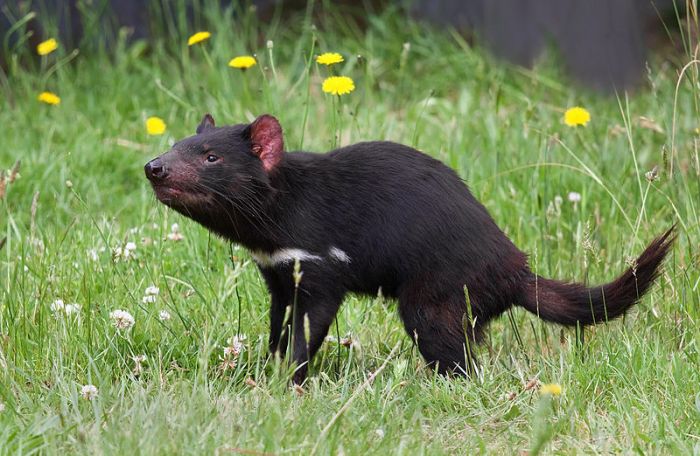
The Tasmanian devil (Sarcophilus harrisii) is a carnivorous marsupial of the family Dasyuridae. It was once native to mainland Australia and was found in the wild only on the island state of Tasmania. It has now been reintroduced to New South Wales with a small breeding population. The size of a small dog, the Tasmanian devil became the largest carnivorous marsupial in the world, following the extinction of the thylacine in 1936. It is related to quolls, and distantly related to the thylacine. It is characterised by its stocky and muscular build, black fur, pungent odour, extremely loud and disturbing screech, keen sense of smell, and ferocity when feeding. The Tasmanian devil’s large head and neck allow it to generate among the strongest bites per unit body mass of any extant predatory land mammal. It hunts prey and scavenges carrion, as well as eating household products if humans are living nearby.
I always thought the Tasmanian devil looked like this:

















 The MarkoZen Blog