
Animals of the World Map
The aviation industry’s transition from propellers to jet engines saw the emergence of a new kind of engine called the turboprop. A turboprop engine is a turbine engine but instead of generating thrust from exhaust, the engine drives a propeller.
In 1955, the US Air Force developed an experimental aircraft called the XF-84H, manufactured by Republic Aviation. The purpose of the XF-84H was to determine whether it was possible for a fighter airplane to ditch the catapult and takeoff from a carrier on its own accord. A turboprop engine was chosen to power the aircraft, because such an engine uses big fans to move large volumes of air, which enables the aircraft to produce greater thrust at lower speeds. Bigger thrust means faster acceleration, which translates to shorter takeoffs.
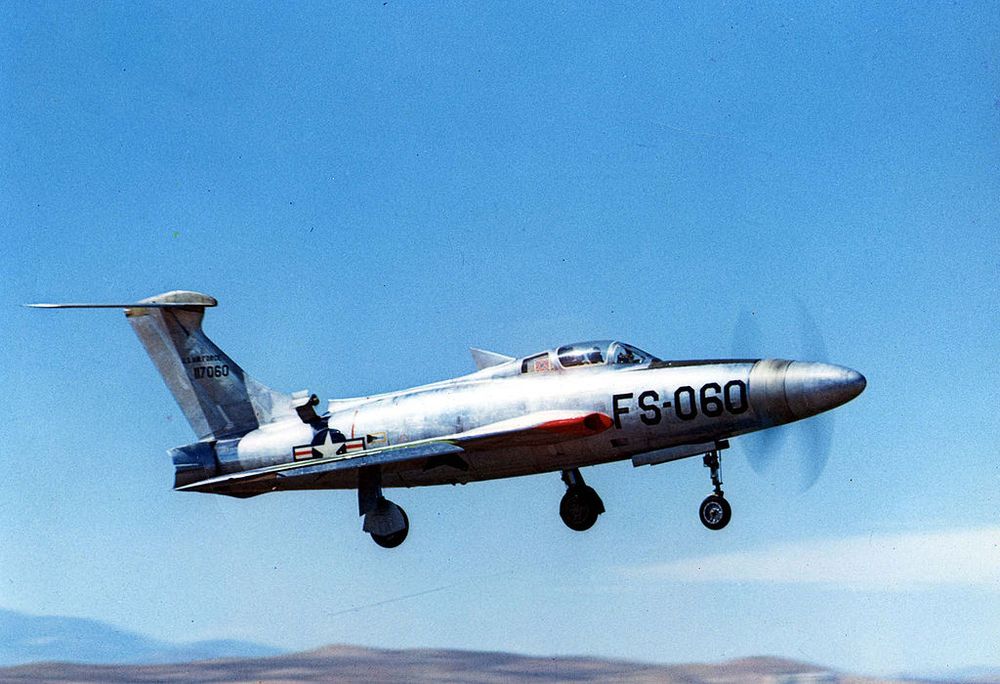
The XF-84H was based on the well-known swept-winged F-84 Thunderstreak, but instead of a jet engine, the XF-84H was fitted with 5,850 hp Allison XT40-A-1 turboprop engine that turned three steel blades. With a sweep of 12 feet, the blades were so long that even at idling thrust the tip of the blades moved at supersonic speeds producing a continuous visible sonic boom that could be heard from 40 km away. The shockwaves were so powerful it could knock a full grown man down.
From Air&Space Magazine:
“One day, the crew took it out to an isolated test area [at Edwards Air Force Base in California] to run it up,” recalls Henry Beaird, a Republic test pilot at the time and one of only two men ever to fly the -84H. “They tied it down on a taxiway next to what they assumed was an empty C-47, but that airplane’s crew chief was inside, sweeping it out. Well, they cranked that -84H up, made about a 30-minute run, and shut it down. As they were getting ready to tow it back to the ramp, they heard this banging in the back of the C-47.” It was the crew chief, Beaird relates, knocked silly by the high-intensity noise and on his back on the floor of the –47, flailing his limbs. “He eventually came out of it,” Beaird recalls.
“As long as you stood ahead of or behind the airplane,” says Beaird, now 78 and flying Learjets, “it really wasn’t so bad, but if you got in the plane of the prop, it’d knock you down.” Really? “Really.”
The XF-84H’s horrendous noise earned the aircraft the nickname “Thunderscreech”.
The Thunderscreech’s engine ran at full speed all the time, and the propeller rotated at 2,100 rpm from startup until shutdown. Thrust was obtained and adjusted by changing the pitch of the blades. The response from the propellers was instantaneous. But the noise was terrible.
Edward von Wolffersdorff, Beaird’s crew chief, recalls:
I remember making my first ground runs with the thing, down on the main base, and I was wondering Why are they flashing that red light at me over on the control tower? It turned out they couldn’t hear a damn thing over their radios, so they kicked us out and sent us over to the north base.
Edwards feared that the shockwave from the propellers would break the windows in the control tower, located about a mile away from the runway. To prevent injury from a blown in window, whenever the XF-84H was flying, the traffic controllers would get under their desks with their radios and cover themselves with blankets.
“Nobody ever actually recorded the decibels,” recalls Beaird. “I think they were afraid the measuring device might get broken.”
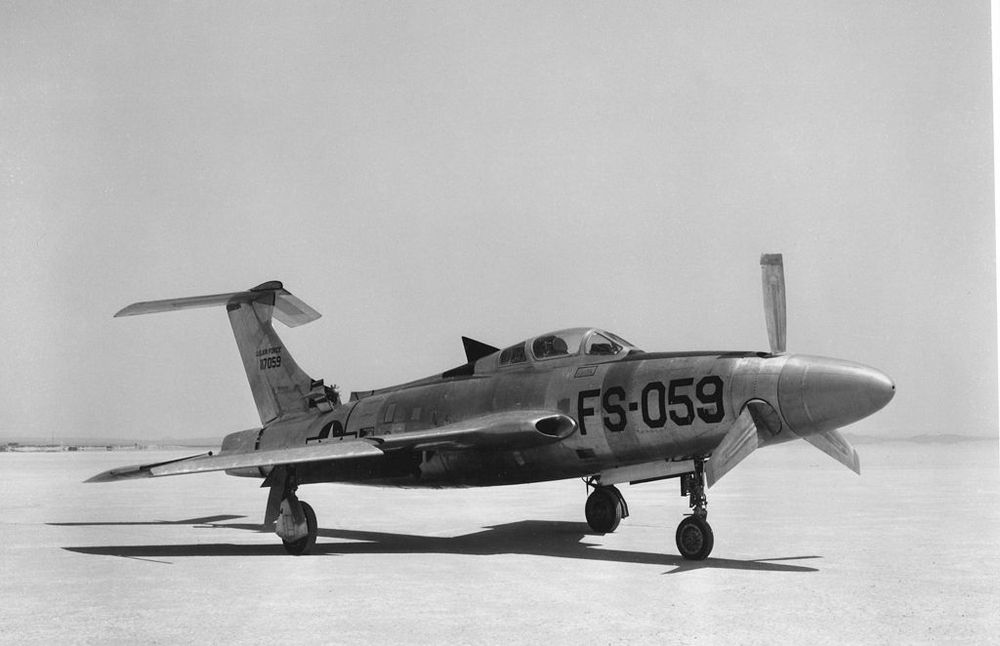
Photo: US Air Force
The XF-84H was never well-liked at the Edwards Air Force Base, and it wasn’t solely for the noise. The XF-84H was an impractical machine that took half an hour just to warm up and be cleared for takeoff which made it clearly unsuited for combat. More than noise or delays, it was mechanical problems that led to its undoing.
The T40 turboprop engine was—in the words of the company’s own authorized history, Power of Excellence by William A. Schoneberger and Paul Sonnenburg—“a monstrosity, a mechanical nightmare.” The XF-84H suffered from vibrations that originated from the supersonic propellers and the powerful torque the engine produced. Lin Hendrix, one of the Republic test pilots assigned to the program, flew the aircraft once and refused to ever fly it again. “You aren’t big enough and there aren’t enough of you to get me in that thing again,” he told the formidable Republic project engineer.
The fearless Hank Beaird flew eleven times in that machine, and ten of those flights ended in forced landing. “By jingo, that airplane is going to hurt somebody!” Beaird once said after an emergency landing.
In the end, nobody wanted anything to do with the aircraft. First the Navy backed out and then the Air Force canceled the project after only two XF-84Hs was built with a total flight time of less than 10 hours between them.
The XF-84H was widely believed to be the fastest propeller-driven aircraft ever built, with an official top speed of 670 mph, as predicted by Republic, although neither of the two planes ever made it past 450 mph.
Well you're dirty and sweet
Clad in black don't look back and I love you
You're dirty and sweet, oh yeah
Well you're slim and you're weak
You've got the teeth of the hydra upon you
You're dirty, sweet and you're my girl

Get it on, bang a gong, get it on
Get it on, bang a gong, get it on

Well you're built like a car
You've got a hubcap diamond star halo
You're built like a car, oh yeah
Well you're an untamed youth
That's the truth with your cloak full of eagles
You're dirty, sweet and you're my girl

Get it on, bang a gong, get it on
Get it on, bang a gong, get it on (oh)

Well you're windy and wild
You've got the blues in your shoes and your stockings
You're windy and wild, oh yeah
Well you're built like a car
You've got a hubcap diamond star halo
You're dirty, sweet and you're my girl

Get it on, bang a gong, get it on
Get it on, bang a gong, get it on

Well you're dirty and sweet
Clad in black, don't look back and I love you
You're dirty and sweet, oh yeah
Well you dance when you walk
So let's dance, take a chance, understand me
You're dirty, sweet and you're my girl

Get it on, bang a gong, get it on
Get it on, bang a gong, get it on (ow)
Get it on, bang a gong, get it on (ow)
(Get it on)

Get it on, bang a gong, get it on
Get it on, bang a gong, get it on
Get it on, bang a gong, get it on
Get it on, bang a gong, get it on

Take me
For a meanwhile I'm still thinking


In aviation, a tailstrike is an event in which the rear empennage of an aircraft strikes the runway. This can happen during takeoff of a fixed-wing aircraft if the pilot pulls up too rapidly, leading to the rear end of the fuselage touching the runway. It can also occur during landing if the pilot raises the nose too aggressively. This is often the result of an attempt to land nearer to the runway threshold.
Tailstrike incidents are rarely dangerous in themselves but the aircraft must be thoroughly inspected and repairs may be difficult and expensive if the pressure hull is involved. Inadequate inspections and improper repairs to damaged airframes after a tailstrike have been known to cause catastrophic structural failure long after the tailstrike incident following multiple pressurization cycles .


Military is not exempt from the phenomena


From the Monty Python movie ‘Life of Brian.’
Some things in life are bad
They can really make you mad
Other things just make you swear and curse
When you’re chewing on life’s gristle
Don’t grumble, give a whistle
And this’ll help things turn out for the best
And
Always look on the bright side of life
Always look on the light side of life
If life seems jolly rotten
There’s something you’ve forgotten
And that’s to laugh and smile and dance and sing
When you’re feeling in the dumps
Don’t be silly chumps
Just purse your lips and whistle, that’s the thing
And
Always look on the bright side of life
(Come on)
Always look on the right side of life
For life is quite absurd
And death’s the final word
You must always face the curtain with a bow
Forget about your sin
Give the audience a grin
Enjoy it, it’s your last chance anyhow
So always look on the bright side of death
A just before you draw your terminal breath
Life’s a piece of shit
When you look at it
Life’s a laugh and death’s a joke, it’s true
You’ll see it’s all a show
Keep ’em laughin’ as you go
Just remember that the last laugh is on you
And
Always look on the bright side of life
Always look on the right side of life
(C’mon Brian, cheer up)
Always look on the bright side of life
Always look on the bright side of life
(Worse things happen at sea you know)
Always look on the bright side of life
I mean, what have you got to lose?
You know, you come from nothing
You’re going back to nothing
What have you lost? Nothing
Always look on the right side of life
Nothing will come from nothing, ya know what they say
Cheer up ya old bugga c’mon give us a grin (Always look on the right side of life)
There ya are, see
It’s the end of the film
Incidentally this record’s available in the foyer (Always look on the right side of life)
Some of us got to live as well, you know
(Always look on the right side of life)
Who do you think pays for all this rubbish
(Always look on the right side of life)
They’re not gonna make their money back, you know
I told them, I said to him, Bernie, I said they’ll never make their money back
(Always look on the right side of life)

The Black Knight is a fictional character who appears in a scene of the feature film Monty Python and the Holy Grail. As his name suggests, he is a knight dressed in black and behaves similarly to the standard character, a black knight. He guards a “bridge” (in reality a short plank of wood) over a small stream—which could have been easily stepped over by King Arthur but, for unknown reasons, he does not. Although supremely skilled in swordplay, the Black Knight suffers from unchecked overconfidence and a staunch refusal ever to give up.
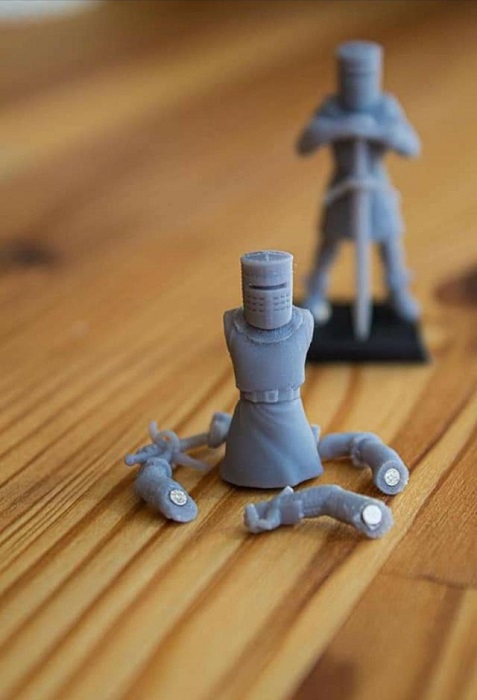
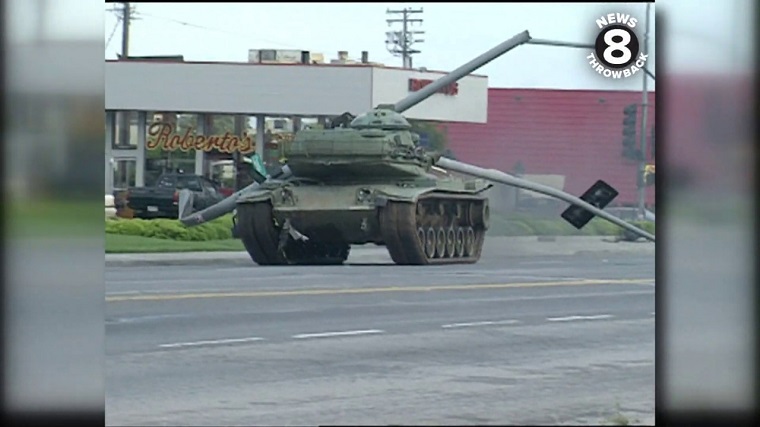
Crazy news story from the past revisited.
Shawn Timothy Nelson (August 21, 1959 – May 17, 1995) was an American plumber and U.S. Army veteran who stole an M60A3 Patton tank from a U.S. National Guard armory in San Diego, California and went on a rampage on May 17, 1995; he destroyed numerous cars, fire hydrants and an RV before being shot and killed by a policeman.
According to San Diego police, in the week before his tank rampage, Nelson told a friend that he was thinking of committing suicide, and the following weekend, told a friend that “Oklahoma was good stuff,” in apparent reference to the Oklahoma City bombing which happened about a month before. Whether Nelson condoned the attack or simply meant that he enjoyed the drama was not clear. Police did not believe that Nelson had any connection with the bombing or with a terrorist group.
At dusk, approximately 6:30 p.m. on Wednesday, May 17, 1995, Nelson drove his Chevrolet van to the California Army National Guard Armory on Mesa College Boulevard in the Kearny Mesa neighborhood of San Diego. Employees at the armory were working late and the gate to the vehicle yard, which was completely deserted, was left open.

The tanks at the armory started with a push button and did not require an ignition key. The first two tanks Nelson broke into would not start. As he lowered himself into the third tank, a 57-ton M60A3 Patton, he was finally noticed by a guardsman, who approached the tank. Nelson started the vehicle, and with little chance of stopping him, the guardsman rushed to a phone and called the police. As ammunition was kept in another building, none of the vehicle’s weapons could be loaded or used by Nelson.
Nelson led police on a 23-minute, televised chase through the streets of Clairemont. Police agencies involved in the chase included the San Diego police, the San Diego County Sheriff’s Department, the California Highway Patrol, and due to the tank being stolen from the armory, possibly military police as well. The tank had a top speed of 30 miles per hour (48 km/h), making the chase slow compared to police chases involving automobiles. The 57-ton tank easily plowed through road signs, traffic lights, utility poles, and fire hydrants, and crushed approximately forty parked vehicles, including an RV. The damage to utility poles knocked out power to at least 5,100 San Diego Gas & Electric customers in the Linda Vista neighborhood.
From the armory, Nelson traveled along neighborhood streets, eventually turning north on Convoy Street, west on to Balboa Avenue (then signed as State Route 274), and entered Interstate 805 heading south. While on I-805, he attempted to knock down a pedestrian bridge by running into the pillars, but failed after a few hits, and decided to continue onto the freeway. Nelson then drove the tank onto the State Route 163 freeway heading southbound, resulting in the freeway being closed and thousands of motorists being stuck. At least one news article speculated that he may have been headed to Sharp Memorial Hospital, which he had unsuccessfully sued in 1990 and partially blamed for his mother’s death. After Nelson attempted to cross into the northbound lanes of State Route 163, the tank became caught on the concrete median barrier and lost one track.
After the tank was immobilized, four policemen climbed onto the tank. San Diego Police officer Paul Paxton, a gunnery sergeant at the time with the Marine Corps Reserve, opened the hatch using bolt cutters. They ordered Nelson to surrender, but he said nothing and began rocking the tank back and forth in an attempt to free it from the median. Paxton’s partner, Officer Richard Piner, leaned in and shot Nelson. The bullet entered through Nelson’s neck.
Nelson later died at the Sharp Memorial Hospital. Despite the widespread property destruction, he was the only fatality reported during the rampage.
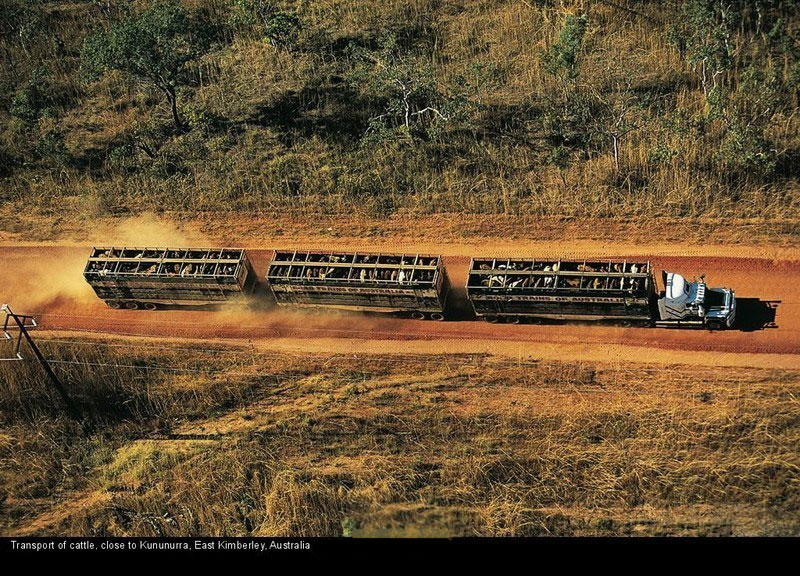
A road train or land train is a trucking vehicle of a type used in remote areas of Argentina, Australia, Mexico, the United States, and Canada to move freight efficiently. The term road train is most often used in Australia. In the United States, the terms triples, turnpike doubles, and Rocky Mountain doubles are commonly used for longer combination vehicles (LCVs). A road train has a relatively normal tractor unit, but instead of towing one trailer or semi-trailer, it pulls two or more of them.
Australia has the largest and heaviest road-legal vehicles in the world, with some configurations topping out at close to 200 tonnes (197 long tons; 220 short tons). The majority are between 80 and 120 t (79 and 118 long tons; 88 and 132 short tons).
Double (two-trailer) road train combinations are allowed in most areas of Australia, and within the environs (albeit limited) of Adelaide, South Australia and Perth, Western Australia. A double road train should not be confused with a B-double, which is allowed access to most of the country and in all major cities.
Here is one rolling through a flooded road

Triple (three-trailer) road trains operate in western New South Wales, western Queensland, South Australia, Western Australia and the Northern Territory, with the last three states also allowing AB-quads (B double with two additional trailers coupled behind). Darwin is the only capital city in the world where triples and quads are allowed to within 1 km (0.62 mi) of the central business district (CBD). Tasmania and Victoria do not allow the operation of road trains on any of their roads. Victoria had previously allowed double road trains to operate around Mildura for the vintage grape harvest.
Strict regulations regarding licensing, registration, weights, and experience apply to all operators of road trains throughout Australia.
Road trains are used for transporting all manner of materials: common examples are livestock, fuel, mineral ores, and general freight. Their cost-effective transport has played a significant part in the economic development of remote areas; some communities are totally reliant on regular service.
The multiple dog-trailers are unhooked, the dollys removed and then connected individually to multiple trucks at “assembly” yards when the road train gets close to populated areas.
When the flat-top trailers of a road train need to be transported empty, it is common practice to stack them. This is commonly referred to as “doubled-up” or “doubling-up”. See illustration. Sometimes, if many trailers are required to be moved at one time, they will be triple-stacked, or “tripled-up”.
Higher Mass Limits (HML) Schemes are now piloting in all jurisdictions in Australia, allowing trucks to carry additional weight.

Road trains arrives at Helen Springs Cattle Station, north of Tennant Creek NT.

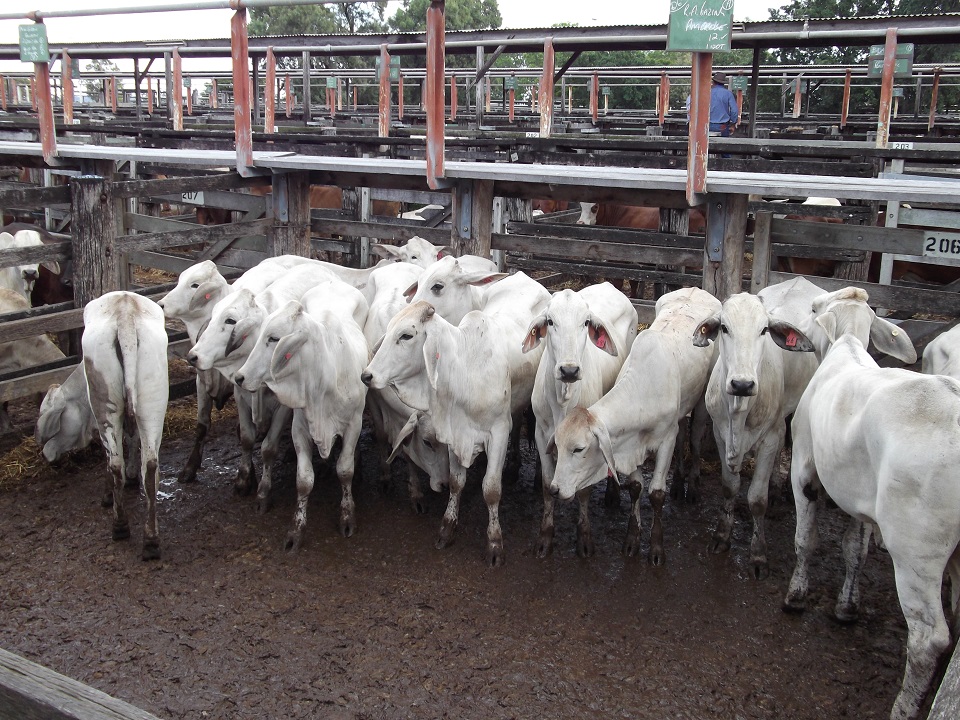
The cattle are loaded onto the road train for their journey to Longreach QLD.

The Road Train then leaves on its long trip.
Interesting statistics.
*There are 17 trucks with 3 trailers and 2 decks per trailer; that’s 102 decks of cattle.
*Approximately 28 cattle per deck; A total of 2,856 head of cattle.
*The cattle will weigh approximately 500kg each (1102.3 lbs.)
*The sale price for cattle at Longreach is approx. 165c/kg (75c/lb.)
*Each animal will therefore be sold at $825.
*Total revenue from this analysis is $2.356.200
*TYRES; Each truck has 2 front and 8 rear tyres, first trailer has 12 tyres and is dollied to the truck.
*2nd & 3rd trailers have 8 tyres at the front and 12 at the rear, that’s 20 tyres each.
*Each truck has 62 tyres, that’s a total of 1.054 on the road. A lot of tyres!!!




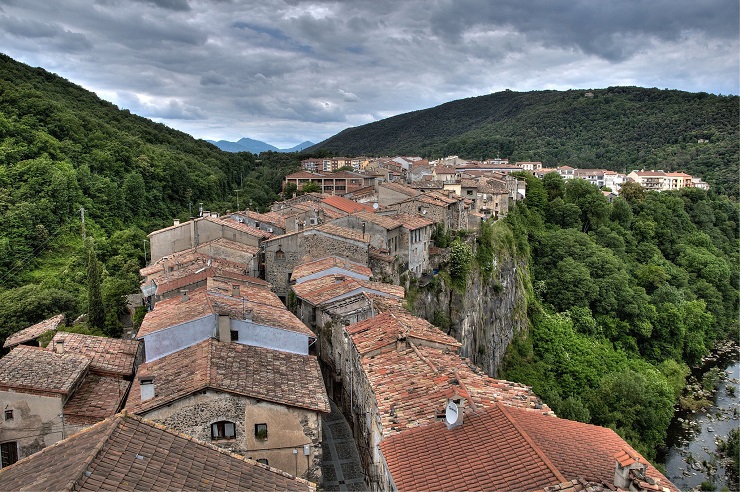
Castellfollit de la Roca is a municipality in the comarca of Garrotxa, in the Province of Girona, Catalonia, Spain. The urban area is bordered by the confluence of the Fluvià and Toronell rivers, between which the town’s basalt cliff rises.
The basalt cliff
The basalt crag where the town is situated is over 50 meters (160 feet) high and almost a kilometer long. It was formed by the overlaying of two lava flows.

Hopefully there is no earthquake faultline in the immediate area.








 The MarkoZen Blog
