BBC
A selection of the best photos from the African continent and beyond.



















BBC
A selection of the best photos from the African continent and beyond.





Encore post.
The Japanese rail network is known throughout the world for its superiority and punctuality. In the capital city Tokyo, nearly 40 million passengers ride the rail every day, heavily outweighing other modes of transport like buses and private cars. Of these, 22% or 8.7 million take the subway.
The Tokyo subway network is a transportation marvel. On most lines, trains come every 5 minutes apart, on average, and during peak times, they tend to run every 2-3 minutes. That’s about 24 trains per hour going in one direction. Despite so many trains, the subway is extremely overcrowded, especially during rush hour. This page from the Ministry of Land, Infrastructure and Transport has data (from 2007) detailing the level of congestion at different stations of Tokyo’s subway. As you can see, nearly all of them run at over capacity with a few running at 200% over rated capacity.

“Oshiya” or “pushers” at Tokyo’s Shinjuku station trying to pack as many passengers as possible into the carriages during rush hour in 1967. Photo credit: CNN
Just like sardines.
In order to fit twice the number of passengers into a subway carriage, the stations employ uniformed staff known as oshiya or “pusher”, whose goal is to cram as many people as possible into the subway tram. These white glove-wearing personal actually pushes people into the train, so the doors can be shut. This is so surreal, it has to be seen to be believed.

When pushers were first brought in at Tokyo’s Shinjuku Station, they were called “passenger arrangement staff” and were largely made up of students working part-time. Nowadays, there are no dedicated “pushers”. The station staff and part-time workers fill these roles during rush hours.
Although a Japanese phenomenon now, subway pushers were an American invention and originated in New York City, nearly a century ago. They were not very well-liked because they were known to push and shove passengers with hostility. The vigor with which the guards often did their job earned them the reputation as “sardine packers”. Their brutality sometimes made national headlines. “The Anxious Subway Guard Who Guillotines His Passengers” —screamed a headline, and “Long Suffering New York Subway Riders Cheer Man Who Hit Guards” —reported another.
Pushers became out of fashion with the introduction of automatic door controls and automatic turnstiles. As the sadistic sardine packers began to lose their job in the 1920s, their demise were mourned briefly. Several movies about subway workers came out during this period including Subway Sadie (1926), Wolf’s Clothing (1927), The Big Noise (1928), Love Over Night (1928) and so on. Subway pushers were also depicted in a 1941 biographical movie called Pusher — the story takes place during World War 1.
More recently, in 2012, Hong Kong- based photographer Michael Wolf created a photo series named Tokyo Compression, where he captured the traumatized and pained expression of commuters as their faces were crushed against the windows. These pictures show how horrible and shameful the situation inside the subway is. Bodies are squished so tightly against one another that most people can’t physically move. Short persons suffer the risk of getting smothered against the coat of their fellow passenger. Getting off at the right station require strength and determination, and fire hazards and emergency evacuation are serious issues. The subways are also fertile grounds for pickpockets and gropers.


Japanese commuters wait in line for the next train, while people pushers push passengers onto the Yamanote line subway train during the morning rush hour at Shinjuku station in Tokyo, Japan. The daily ritual is performed to maximize the number of commuters on trains.





The United States has, by far, the most horses in the world — approximately 9.5 million, according to the 2006 Global Horse Population report from the Food and Agriculture Organization of the United Nations. It shows 58,372,106 horses in the world.
Nine other countries have horse populations of more than a million. They are: China (7,402,450), Mexico (6,260,000), Brazil (5,787,249), Argentina (3,655,000), Colombia (2,533,621), Mongolia (2,029,100), Ethiopia (1,655,383) Russian Federation (1,319,358) and Kazakhstsan (1,163,500). Guam (20) and Grenada (30) had the lowest totals.
Two countries, Rwanda and St. Helena, reported no horses.
A separate independent study by the American Horse Council (AHC) in 2005 (based on 2004 statistics) showed a U.S. horse population of 9,223,000, which would indicate that U.S. equine numbers rose by nearly 300,000 in just over a year.
Among U. S. states, the AHC report puts Texas in the lead with 978,822 horses, followed by California with 698,345, Florida with 500,124, Oklahoma with 326,134, Kentucky with 320,173, Ohio with 306,898 and Missouri with 281,255.
Rhode Island had the fewest horses, with 3,059, followed by the District of Columbia, reporting a fluctuating total of about 33.
The AHC says the horse industry has a direct impact of $39 billion on the U. S. economy and an overall impact of $102 billion when factoring in indirect and induced spending.


TwitterEmail
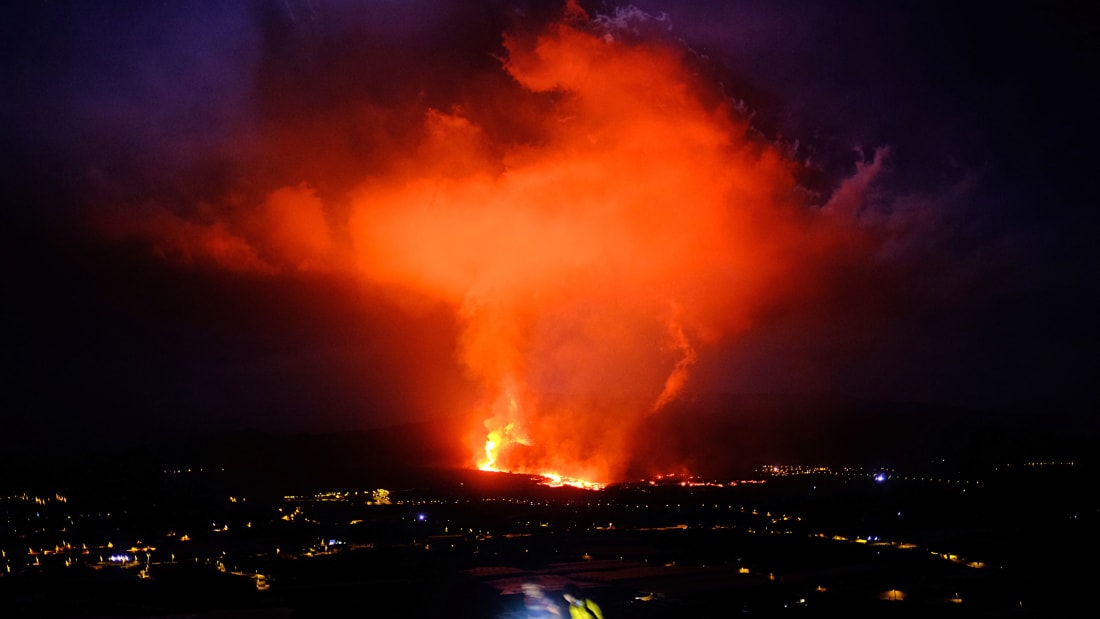
(CNN) — Eruptions from the Cumbre Vieja volcano on the Canary Island of La Palma have intensified, as flights are suspended and officials ordered additional evacuations — bringing the total number of evacuees to almost 6,000 people.”According to the records of the volcanic surveillance that has been carried out since the beginning of the eruption, this afternoon the most energetic moment of the eruptive process took place,” according to a statement from the regional Canary Island government on Friday evening.The latest 160 people evacuated were removed from three more towns and would not be allowed to return to their homes to retrieve their belongings because of the “evolution of the volcanic emergency,” officials added.La Palma’s airport was “inoperative” on Saturday, after several flights to and from La Palma were canceled on Friday afternoon, due to “ash accumulation” from the recent volcano activity in the region, Spain’s airport operator AENA tweeted on Saturday.AENA, a state-owned company that manages airports and heliports in Spain, went on to add that “cleaning tasks have started, but the situation may change at any time.””The priority is to guarantee the safety of operations,” AENA added.”The rest of the Canarias airports are operational. However, if you are going to fly, check with your airline about the status of your flight,” AENA concluded.
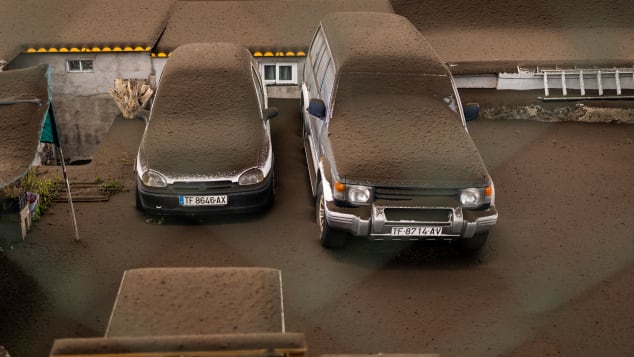
Vehicles are covered by ash from the volcanic eruption on La Palma.Emilio Morenatti/APBinter, an airline serving the Canary Islands, also confirmed via a tweet on Saturday, that it would not fly in and out of La Palma due to the presence of volcanic ash. The airline, however, has said it had resumed other flights to La Gomera island and to Tenerife island, due to improving conditions.Saturday marks the seventh straight day of volcanic eruptions on La Palma, one of the smallest islands in Spain’s Canary Islands archipelago in the Atlantic Ocean.Spanish Prime Minister Pedro Sanchez remained on the island Friday morning, where he’s been most of the week since eruptions started last Sunday.Sanchez told reporters on Friday that the Spanish government has approved “immediate financial aid for housing” for displaced people as well as financial aid for those affected to purchase household goods.Angel Victor Torres, president of the Canary Islands, said on Thursday that some 400 homes and buildings had already been destroyed by the lava, according to reports in Spanish media.Spain’s King and Queen on Thursday traveled from Madrid to La Palma and met evacuees as well as emergency personnel.

MahaNakhon is a luxury mixed-use skyscraper currently under final stages of completion prior to the grand opening in late August 2016, located in the Silom/Sathon central business area of Bangkok, Thailand. Designed to fit into the Thai landscape with a unique pixelated facade, it features the unconventional appearance of a glass curtain walled square tower with a cuboid-surfaced spiral cut into the side of the building. Following transfer of the first residential units in April 2016, it has been recognized as the tallest building in Thailand on 4 May at 314.2 metres (1,031 ft), with 77 floors. Featuring hotel, retail and residences, 200 units of The Ritz-Carlton Residences, Bangkok inside the building are priced between around US$1,100,000 to US$17,000,000, making it one of the most expensive condominiums in Bangkok.






Boldly going where no 90-year-old has gone before. Image Credit: Twitter / William Shatner
The legendary Star Trek actor is set to become the oldest person ever to venture into space next month.According to reports, Captain Kirk himself – William Shatner – will be one of the passengers aboard the next civilian flight of Jeff Bezos’ New Shepard spacecraft when it launches in October.
Like the previous flight in July of which Bezos himself was a part, the launch will see Shatner and his fellow passengers reach the edge of space on a trip that will last only around 15 minutes.
If he does go, the Star Trek veteran will become the oldest person in history to venture into space.
There are rumors that a documentary will be filmed of the event, however Discovery allegedly rejected the concept and Shatner’s team is now looking for an alternative channel to pick up the project.
While neither Bezos or Shatner have officially confirmed the flight, Shatner had previously mentioned it during a San Diego ComicCon panel earlier this year.
“There’s a possibility that I’m going to go up for a brief moment and come back down,” he said.
The current record holder for oldest person in space is 82-year-old aviation pioneer Wally Funk who joined Bezos during Blue Origin’s previous flight in July.
If Shatner’s flight does go ahead, Funk’s record will have been broken within a matter of months.


A curious chasm in Yemen, dubbed the ‘Well from Hell,’ has finally been explored by cavers in what is thought to be the first documented expedition down into the centuries-old hole in the desert. Although the location had something of a fearsome reputation among local inhabitants of the area, due to longstanding legends suggesting that the puzzling pit was home to the infamous djinn, it largely came to the attention of the world at large back in June by way of media coverage detailing how authorities in the country were baffled by the strange site and that previous attempts to get to the bottom of the pit had failed. It would seem that those headlines caught the attention of a group of cavers who set about conquering the chasm once and for all.
Last week, eight members of the Oman Cave Exploration Team (OCET) reportedly descended into the ‘Well from Hell’ and captured breathtaking never-before-seen footage from inside the ominous pit. According to geology professor Mohammed al-Kindi, who participated in the investigation, at the bottom of the cavern they spotted snakes that were largely harmless as well as dead birds and formations known as cave pearls. “Passion drove us to do this,” he explained, “and we felt that this is something that will reveal a new wonder and part of Yemeni history.” While down in the pit, the cavers collected samples of the water, rocks, and the downed birds that will later be analyzed by scientists.
A wild video from Zambia shows the terrifying moment when an ornery hippo set about chasing after a group of tourists on a sightseeing boat. The jaw-dropping footage, which came to light this week, was reportedly captured earlier this year on the Zambezi River in the town of Livingstone. In the video, a group of what may be juvenile hippos can be seen a short distance away from the boat in what initially seems like a rather serene glimpse of the majestic creatures.
However, the scene takes a troubling turn when the camera quickly pans a few feet away where a massive hippo has emerged from the water in hot pursuit of the vessel. The aggressive animal seemingly surprised the people on board as it was initially shockingly close to the boat. Fortunately, the person driving the boat smartly slams on the gas and keeps the hippo a relatively safe distance away, although the monstrous creature continues it chase the group for several seconds before finally throwing in the towel.
 The MarkoZen Blog