Always the cows getting abducted by the Space Aliens. What do those sneaky Aliens want with the bovine? They sometimes seem to release the cows, sometimes not.
Some entrepreneur has come up with a really cool idea. An abduction lamp.
Why always dairy cows? This could be more about milk than beef.
Dairy cow and the farmer inside the alien spacecraft. They even abducted the milking stool and bucket.
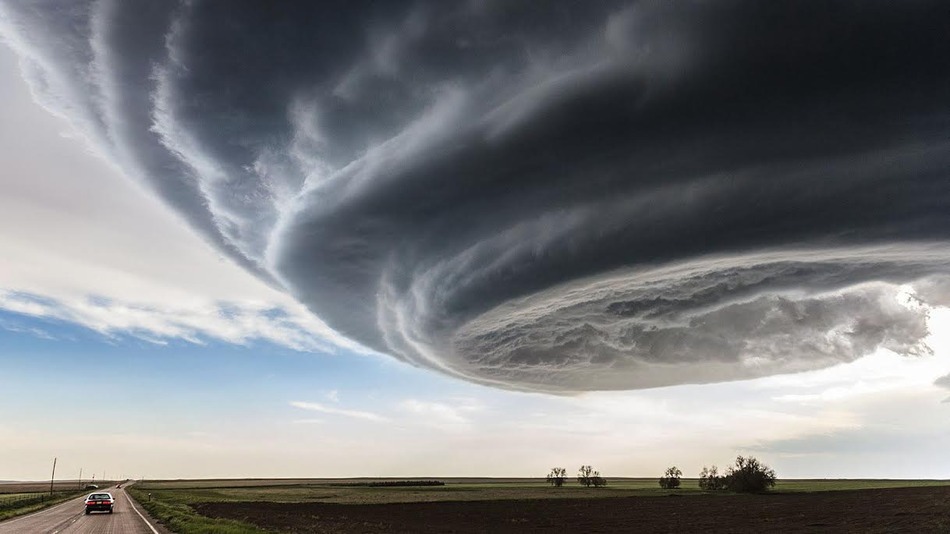
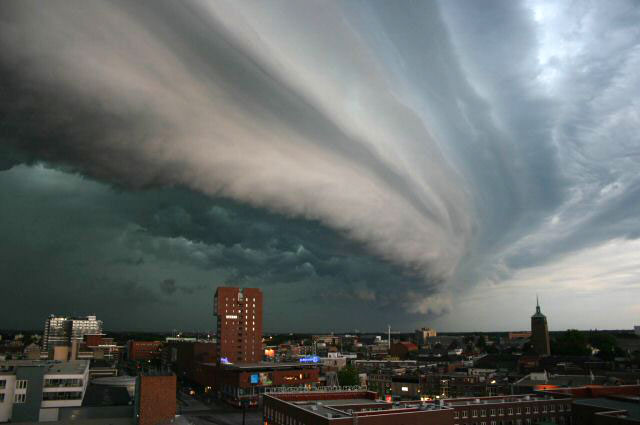
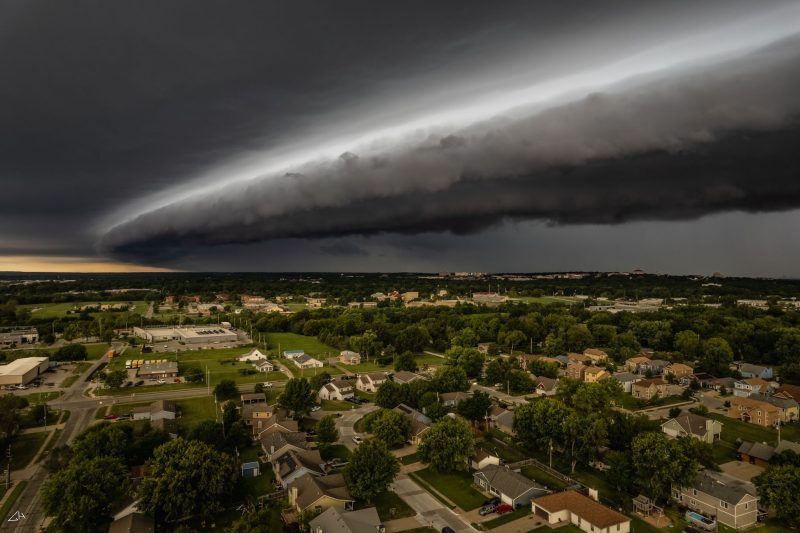
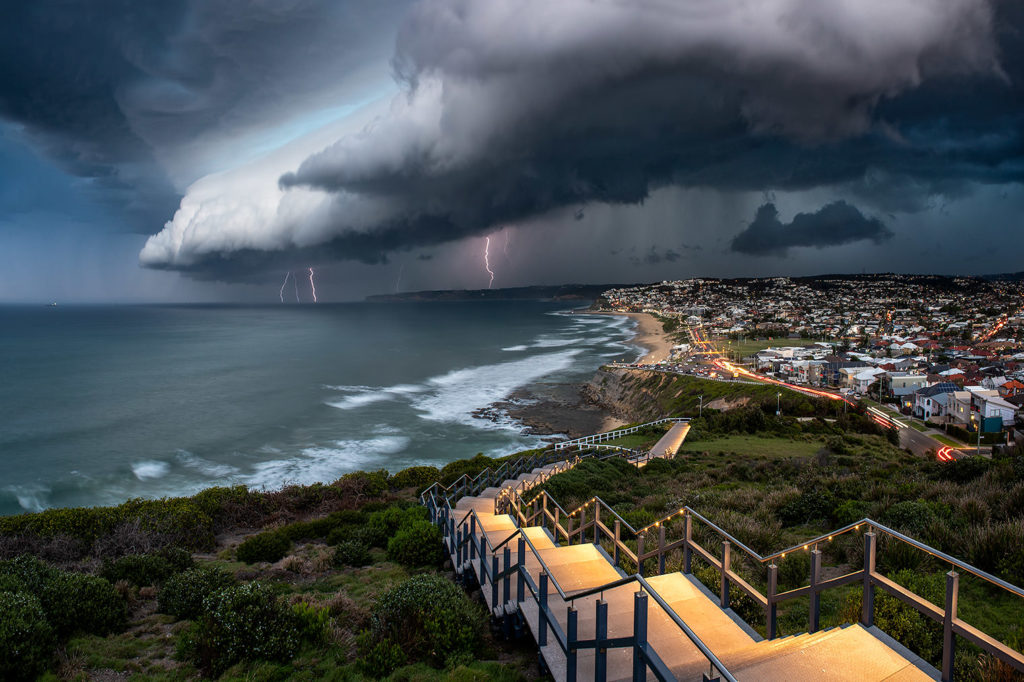
Mothership cloud is a nickname used by storm chasers for a type of Arcus clouds known as Shelf clouds.
A shelf cloud is a low, horizontal, wedge-shaped arcus cloud. A shelf cloud is attached to the base of the parent cloud, which is usually a thunderstorm cumulonimbus, but could form on any type of convective clouds. Rising cloud motion can often be seen in the leading (outer) part of the shelf cloud, while the underside often appears turbulent and wind-torn. Cool, sinking air from a storm cloud’s downdraft spreads out across the land surface, with the leading edge called a gust front. This outflow cuts under warm air being drawn into the storm’s updraft. As the lower and cooler air lifts the warm moist air, its water condenses, creating a cloud which often rolls with the different winds above and below (wind shear).
People seeing a shelf cloud may believe they have seen a wall cloud. This is likely to be a mistake, since an approaching shelf cloud appears to form a wall made of cloud. Shelf clouds usually appear on the leading edge of a storm, while wall clouds are usually at the rear of the storm.
A sharp, strong gust front will cause the lowest part of the leading edge of a shelf cloud to be ragged and lined with rising fractus clouds. In a severe case there will be vortices along the edge, with twisting masses of scud that may reach to the ground or be accompanied by rising dust. A very low shelf cloud accompanied by these signs is the best indicator that a potentially violent wind squall is approaching. An extreme example of this phenomenon looks almost like a tornado and is known as a gustnado.
The incident took place in Rajasthan’s Churu where a bull was found to have climbed right on top of a water tank.
The incident took place in Rajasthan’s Churu where a bull was found to have climbed right on top of a water tank. The Bull had climbed right to the top and it threw the city authorities in a fix as they were wondering how to bring the animal down. Even the police did not believe the callers when they called in to report the bull on top of the tower. But then soon, as similar calls began coming in from many different people, the police decided to investigate. Initially, they thought of calling for a crane but that did not look feasible. Also, it was already evening when the bull was spotted and the army officials said that they couldn’t begin an operation at that time as the sun was close to setting. The bull was then shown delicacies and people tried luring it too the ground but the bull, clearly enamoured by the view, did not budge!
Many people tried climbing the tower and bringing the bull down. It loudly moo-ed everyone away! Finally, they found one solution and decided to tie up the bull and rappel it down the tank. A doctor was called and the bull was injected with sedatives. Once it lost consciousness, a double rope and safety belt was tied around the bull before it was rappelled down from the tank and brought safely down. The bull also wrapped in thick blankets so it would not hurt itself in any way during the descent. Well, quite a trip for a bull!
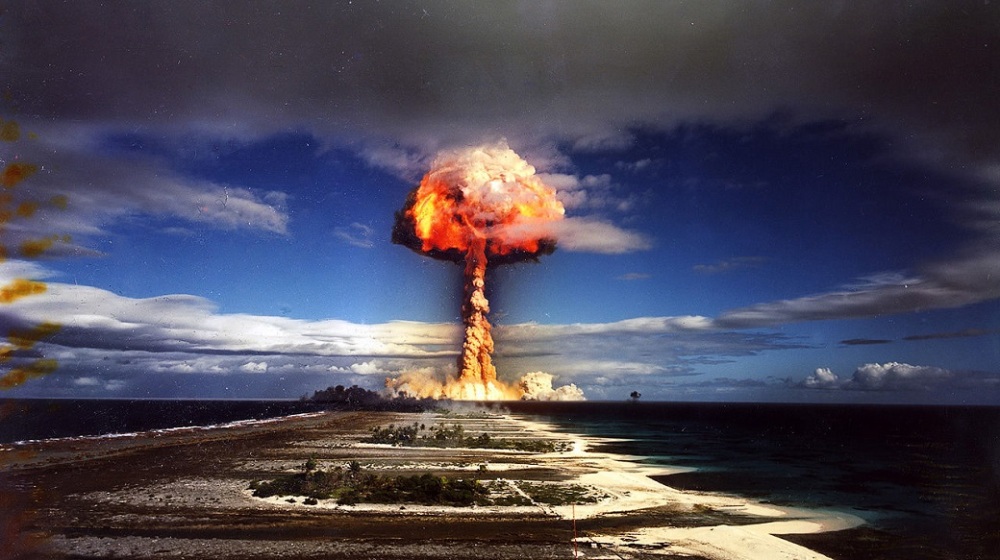
Nine countries together possess more than 15,000 nuclear weapons. The United States and Russia maintain roughly 1,800 of their nuclear weapons on high-alert status – ready to be launched within minutes of a warning. Most are many times more powerful than the atomic bombs dropped on Japan in 1945. A single nuclear warhead, if detonated on a large city, could kill millions of people, with the effects persisting for decades.
Size comparison of nuclear explosions
The failure of the nuclear powers to disarm has heightened the risk that other countries will acquire nuclear weapons. The only guarantee against the spread and use of nuclear weapons is to eliminate them without delay. Although the leaders of some nuclear-armed nations have expressed their vision for a nuclear-weapon-free world, they have failed to develop any detailed plans to eliminate their arsenals and are modernizing them.
COUNTRY
NUCLEAR PROGRAMME
SIZE OF ARSENAL
United States
The first country to develop nuclear weapons and the only country to have used them in war. It spends more on its nuclear arsenal than all other countries combined.
6,970 warheads
Russia
The second country to develop nuclear weapons. It has the largest arsenal of any country and is investing heavily in the modernization of its warheads and delivery systems.
7,300 warheads
United Kingdom
It maintains a fleet of four nuclear-armed submarines in Scotland, each carrying 16 Trident missiles. It is considering whether to overhaul its nuclear forces or disarm.
215 warheads
France
Most of its nuclear warheads are deployed on submarines equipped with M45 and M51 missiles. One boat is on patrol at all times. Some warheads are also deliverable by aircraft.
300 warheads
China
It has a much smaller arsenal than the US and Russia. Its warheads are deliverable by air, land and sea. It appears to be increasing the size of its arsenal at a slow pace.
260 warheads
India
It developed nuclear weapons in breach of non-proliferation commitments. It is increasing the size of its nuclear arsenal and enhancing its delivery capabilities.
100–120 warheads
Pakistan
It is making substantial improvements to its nuclear arsenal and associated infrastructure. It has increased the size of its nuclear arsenal in recent years.
110–130 warheads
Israel
It has a policy of ambiguity in relation to its nuclear arsenal, neither confirming nor denying its existence. As a result, there is little public information or debate about it.
80 warheads
North Korea
It has a fledgling nuclear weapons programme. Its arsenal probably comprises fewer than 10 warheads. It is not clear whether it has the capability to deliver them.
<10 warheads
Total
15,350 warheads
I came across a British tabloid site that had an article on where is the best places on the planet to survive a nuclear war. The list is funny, to say the least.
Kansas City! Kansas City is a major American population center. It undoubtedly would be targeted by the Russians.
The island of Guam in the eastern Pacific is a United States territory. It hosts a major American nuclear submarine base and thousands of Marines. Without a doubt, it is targeted.
Cape Town and Antarctica would possibly be safe places. But after the world economy and infrastructure is destroyed. Who do the residents of these places deal with? Tristan Da Cunha would be the safest place on the list.
Isle of Lewis, Iceland, Bern and the Yukon: These places wouldn’t be targets, but they would have to contend with a 5 year nuclear winter of 24 hour dark skies and intense fallout radiation. Not good places.
The key here is that these horrible weapons are built for deterrent. Nobody wants to use them, there would be no winner. And with the safeguards in place it is highly unlikely responsible nations would accidently launch a nuclear attack. However, there is rogue countries with the bomb like North Korea, and to a lesser extent Pakistan. Kim Jong-Um is a very deranged and scary individual. He could do anything. Another concern is if terrorists would get their hands on a weapon. There would not be any second thoughts by those radical extremists to try and use a bomb.
Buying or selling a haunted doll is not mere child’s play.CRISTI CROITORU/ISTOCK VIA GETTY IMAGES
Is this the world’s most elaborate dollhouse?PauseNext video0:15 / 1:51VoltaxFull-screen
There’s something unsettling about dolls. Even before Chucky and Annabelle made them part of the Hollywood horror canon, their glassy, unseeing stares and too-symmetrical features, locked in an unshifting perma-pout, were plenty unnerving.
But not all dolls are created equal: Some are kinda creepy, some are hella creepy, and some are haunted. Or at least, they’re said to be.
THE RISE OF THE HAUNTED DOLL MARKET There’s a thriving online market for haunted dolls, a relatively recent phenomenon thought to have taken off in the last decade and largely based around Etsy, eBay, and Instagram. A quick online search reveals thousands for sale (along with accessories and dolls intended to be scary, but not purported to be haunted). Most prices hover around $150, though some haunted dolls sell for over $1000.
A typical listing will include a lengthy, detailed backstory both about how the doll was acquired—often ending up with the seller after changing hands multiple times after spooking owner after owner—and what has supposedly been gleaned about the spirits inhabiting them. Demands the spirit has made, things known to have angered it, and details about both its former life and what it understands about its current existence inhabiting a doll all make for a pretty compelling read, especially alongside a disconcerting glassy stare complete with disturbing cracks.
Certain types of dolls are more popular than others, such as antique models, Wanda the Walking Doll, and Raggedy Ann. (The latter was the type of allegedly demonically possessed doll the “real” Annabelle—made famous by paranormal investigators Ed and Lorraine Warren—was).
Given how scary even non-haunted dolls can be, the idea of specifically seeking out and paying $150 for a potentially possessed toy can seem odd. But according to Kathryn Blowers-McNamara—who runs FugitiveKatCreations, which sells vintage and upcycled items but specializes in antique and haunted dolls—people seek them out for various reasons. Some buyers are looking for the fun of ghost-hunting, while others have more emotional motivations.
“I get a lot of customers who have lost someone and are trying to figure out how to communicate with them,” she tells Mental Floss in an email. “I get a lot of mothers who have lost a child.”
Some dolls just want to be friends ’til the end.LUCOP/ISTOCK VIA GETTY IMAGES
Declaring an item haunted is not as simple as just whacking the listing up and waiting for a buyer. “Evaluations are a long process,” Blowers-McNamara says. “It takes months sometimes, with a group of us all comparing notes. We start with the vibe, the energy, our gut feeling. If we sense something there, we pull out the tools.” Said tools include electromagnetic frequency readers, dowsing rods, and a pendulum. The pendulum is often used to try to communicate with spirits. The user holds it out and asks questions, then interprets changes in how it swings as answers.
The doll is then placed in a soundproof box, where recordings are made and scoured for electric voice phenomena, or EVP. These are sounds found on recordings with no explanation behind them. To look for them, people often make recordings of extended periods of what should be silence. They then filter the recording’s sounds, words, or fragments of speech.
“After about a week of EVP recordings, we all spend time with the doll, sometimes up to a month each,” she says. “We use meditational telepathy, ESP, lucid dreaming techniques—every method we have as individuals to try to reach the spirit. And, finally, we use a Ouija.”
Blowers-McNamara only sells a doll as haunted if the notes she and her group make all line up with any information they get from the Ouija—otherwise it’s just sold as a vintage doll with “possibly haunted” included in the description.
On 4 August 2020, a large amount of ammonium nitrate stored at the Port of Beirut in the capital city of Lebanon exploded, causing at least 218 deaths, 7,000 injuries, and US$15 billion in property damage, and leaving an estimated 300,000 people homeless. A cargo of 2,750 tonnes of the substance (equivalent to around 1.1 kilotons of TNT) had been stored in a warehouse without proper safety measures for the previous six years, after having been confiscated by the Lebanese authorities from the abandoned ship MV Rhosus. The explosion was preceded by a fire in the same warehouse, but as of September 2021, the exact cause of the detonation is still under investigation.
The blast shook the whole country of Lebanon. It was felt in Turkey, Syria, Palestine, Israel as well as parts of Europe, and was heard in Cyprus, more than 240 km (150 mi) away. It was detected by the United States Geological Survey as a seismic event of magnitude 3.3, and is considered one of the most powerful artificial non-nuclear explosions in history.
The Lebanese government declared a two-week state of emergency in response to the disaster. In its aftermath, protests erupted across Lebanon against the government for their failure to prevent the disaster, joining a larger series of protests which have been taking place across the country since 2019.
At least six people have been killed and 32 others injured by gunfire in the Lebanese capital, Beirut.
It began during a protest by the Shia Muslim groups Hezbollah and Amal against the judge investigating last year’s huge blast at the city’s port.
They said Christian snipers from the Lebanese Forces (LF) faction fired at the crowd to drag Lebanon into strife – a claim denied by the LF.
Huge tension surrounds the probe into the port explosion that killed 219.
Hezbollah and its allies claim the judge is biased, but the victims’ families support his work.
No-one has yet been held accountable for the August 2020 disaster, in which swathes of the city were devastated.
In response to Thursday’s shooting, some of Lebanon’s worst violence in years, Prime Minister Najib Mikati announced a day of mourning on Friday.
Meanwhile, President Michel Aoun said: “We will not allow anyone to take the country hostage to their own interests.”

















 The MarkoZen Blog