

There is a dog park in downtown Winnipeg that dogs love. It’s intimate allowing the canines to intermingle and have a jolly frolocking good time.
The hounds are so eager to get to the park they practically pull their owners on the way there.

Some are a little more laid back.

Let the fun begin.


Khao Phing Kan or Ko Khao Phing Kan is an island in Thailand, in Phang Nga Bay northeast of Phuket. The islands are limestone karst towers and are a part of Ao Phang Nga National Park.
About 40 metres (130 ft) from the shores of Khao Phing Kan lies a 20-metre (66 ft) tall islet called Ko Ta Po or Ko Tapu. Since 1974, when they were featured in the James Bond movie The Man with the Golden Gun, Khao Phing Kan and Ko Ta Pu have been popularly called James Bond Island.



The Man with the Golden Gun is a 1974 spy film and the ninth in the James Bond series produced by Eon Productions, and the second to star Roger Moore as the fictional MI6 agent James Bond. A loose adaptation of Ian Fleming’s novel of the same name, the film has Bond sent after the Solex Agitator…
View original post 65 more words
The Chilean Army comes by its German influences and traditions honestly, from a decent-sized influx of German immigrants during the second half of the 19th century, most of whom settled in the southern part of the country, centered around Puerto Montt, where the weather is cooler and wetter, and where dairy farms and breweries now abound. But it didn’t end with Chile. Bolivia, Columbia and Argentina all used German advisors, techniques and uniforms. Right up to the present day.

(Bolivian soldiers with stahlhelm M35 helmets and M16 assault rifles.)

(Argentine soldiers with Casco M38 helmets in the mid-1940s.)

Former US Joint Chiefs of Staff Chairman general Mike Mullen with Chilean honour guard 2012.

Chilean army 2014

German Waffen SS troops 1944

Chile

Chile

(Colombian troops on the streets of Bogota in the 1948-1949 time frame.)
Traditions are hard to break, especially military tradition.
Not to be left out of the equation, the U.S. changed their military helmets in the early 1980’s. The Advanced Combat Helmet (ACH) is the United States Army’s current combat helmet. Although very different from the German helmets, the U.S. helmet does have a similar look.

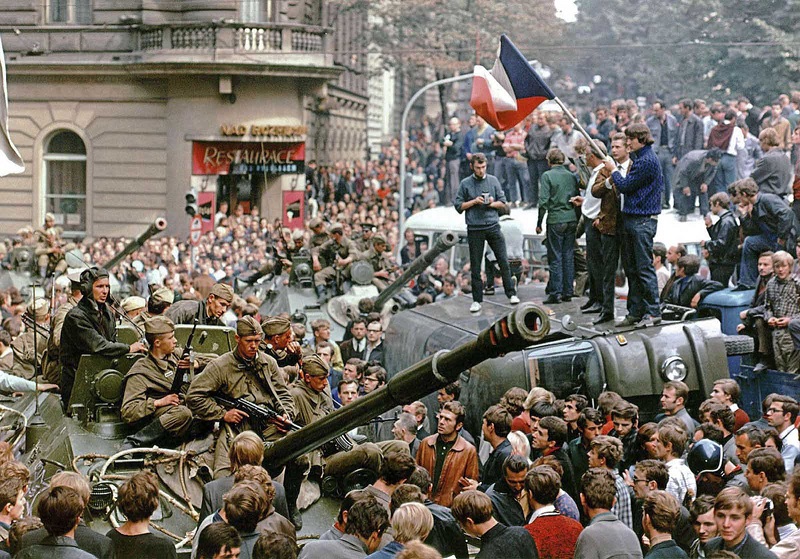
On 20–21 August 1968, Czechoslovakia was jointly invaded by four Warsaw Pact countries: the Soviet Union, Poland, Bulgaria and Hungary. About 250,000 Warsaw Pact troops (afterwards rising to about 500,000), supported by thousands of tanks and hundreds of aircraft, participated in the overnight operation, which was code-named Operation Danube. Romania and Albania refused to participate, while East German forces, except for a small number of specialists, were ordered by Moscow not to cross the Czechoslovak border just hours before the invasion. 137 Czechoslovak civilians were killed and 500 seriously wounded during the occupation.
The invasion stopped Alexander Dubček’s Prague Spring liberalisation reforms and strengthened the authoritarian wing of the Communist Party of Czechoslovakia (KSČ). The foreign policy of the Soviet Union during this era was known as the Brezhnev Doctrine.
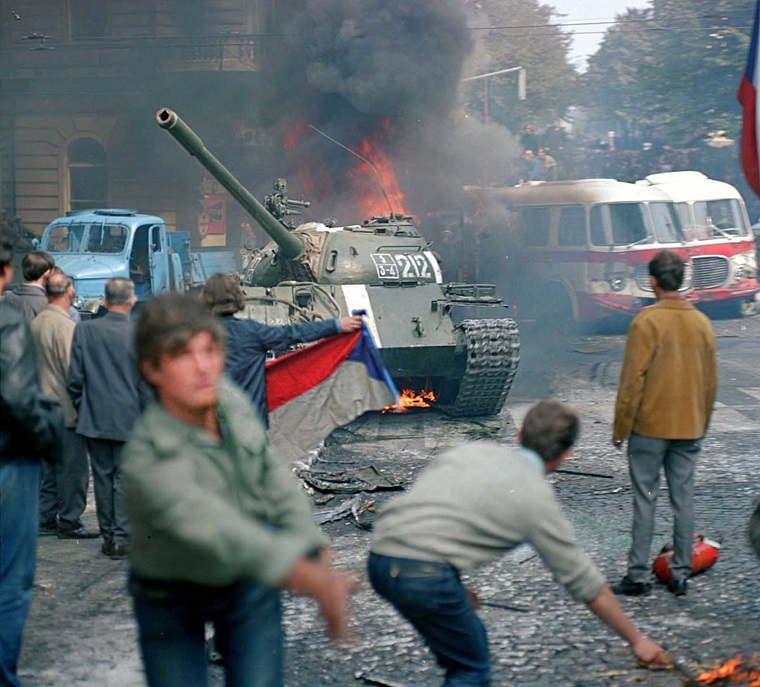
Public reaction to the invasion was widespread and divided. Although the majority of the Warsaw Pact supported the invasion along with several other communist parties worldwide, Western nations, along with Albania, Romania, and particularly China condemned the attack. Many other communist parties lost influence, denounced the USSR, or split up or dissolved due to conflicting opinions. The invasion started a series of events that would ultimately see Brezhnev establish peace with U.S. Richard Nixon in 1972 after the latter’s historic visit to China.
The legacy of the invasion of Czechoslovakia remains widely discussed among historians and has been seen as an important moment in the Cold War. Analysts believe that the invasion caused the worldwide communist movement to fracture, ultimately leading to the Revolutions of 1989, and the dissolution of the Soviet Union in 1991.
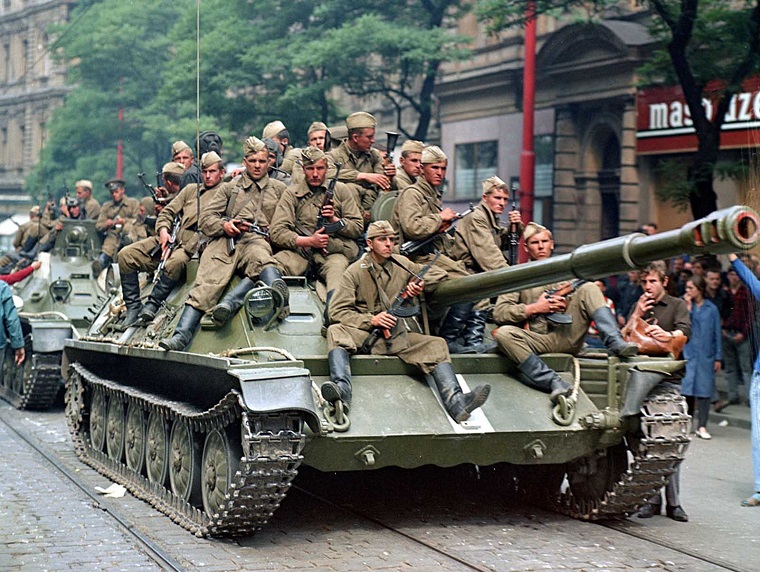

History continuously repeats itself.
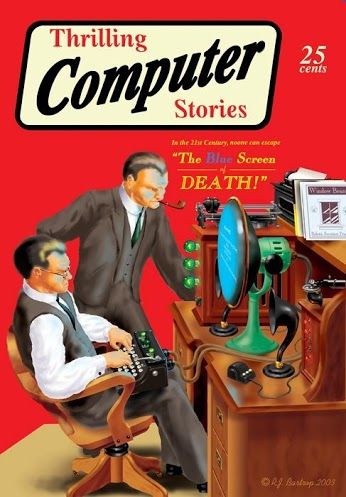


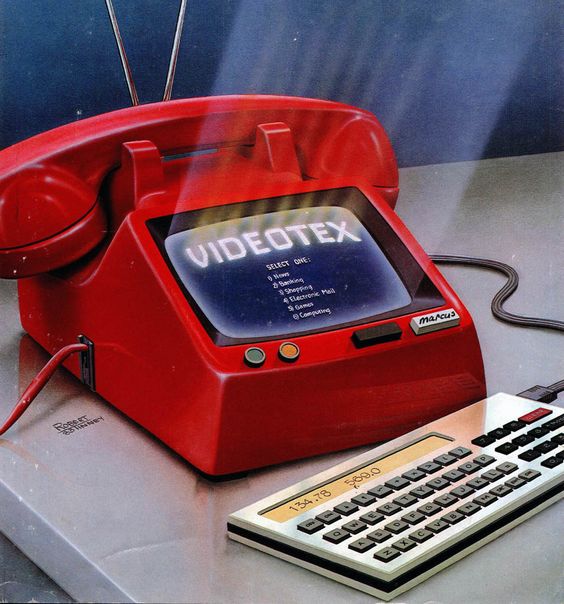

This was an actual whiskey company ad from the 1940’s. They were spot on.






CN’s Rail Inspection Portals near Winnipeg, Manitoba
In May 2018, CN awarded a contract to Duos Technologies to provide four Rail Inspection Portals (rip®) around Winnipeg, Manitoba to perform automated inspection of passing trains. These portals incorporate high speed cameras and thermal imaging to inspect rail cars at speeds up to 70 MPH (110 km/hr).
These portals are now in operation, and CN is clearly happy enough with them that it placed an order for three additional portals in November 2018. Two of these portals will be built in the US and one in Canada, I believe near Toronto.

The portal has high speed cameras mounted on the sides, top and bottom of a frame that encloses a track. These cameras basically take a series of thin, very tall “slice” photos that are stitched together by the system’s software into a complete picture of a rail car.
The portals are equipped with banks of LEDs to light up the train as it passes through, so they can be used at any time of day.

Rail portal under construction in Winnipeg

The rail car inspection portal at Vivian, Manitoba

The portal did not light up as the train went through, so I don’t think it was quite in service yet. Before the train arrived, I did hear some fans or something like that, so I think it had heaters running. Still, it was pretty neat to see a train go through it.


CN 2314 entering the rail inspection portal

Here’s a closeup of the train rolling through. The train is lit and photographed on both sides, top and underside.

Closeup of the rail portal in action
Depictions of Russia in American propaganda had some wild vacillation before the Cold War. The first Red Scare followed the Russian Revolution, and anti-communist sentiment really found purchase around 1919. Leftists in the US (many of them immigrants) became a force to be reckoned with, and bitter labor conflicts (plus some radical terrorism) seemed to suggest a Bolshevik revolution was imminent in the Americas. There’s the period however, during World War II, before Truman decided to wave his nuclear dick at Stalin, when Russians were still our Nazi-fighting Allies, and 1944’s Merrie Melodies production “Russian Rhapsody” is a fascinating artifact of that ambivalence America had towards the Soviets.

Of course, the cartoon doesn’t quite portray Russians as “dignified.” Rather than some cartoon-friendly version of Red Army soldiers fighting Nazis in the snow, they’re literal “gremlins”—tiny things that are only really capable of sabotaging a plane. (The title was originally “Gremlins from the Kremlin,” but Disney was developing an animated version of Roald Dahl’s The Gremlins at the time and Roy Disney pressured Warner Brothers to change the name.) Regardless, the gremlins are clearly the good guys, whipping out a mask of Stalin to frighten Der Führer.
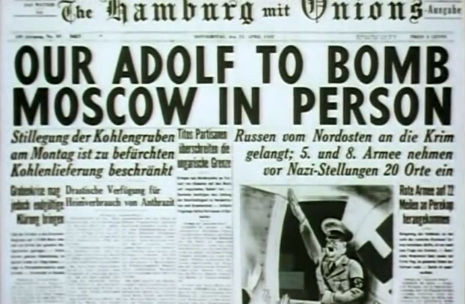
In addition to being a really beautiful (and profoundly weird) piece of animation, “Russian Rhapsody” has some great dog whistles. The cartoon starts out with Hitler delivering a speech that’s a direct reference to a scene from Leni Riefenstahl’s Triumph of the Will. As an inside joke, some of the gibberish German Hitler spouts is actually the names of animators and studio staff. The gremlin faces are actually based on caricatures of Warner Brothers legends like Chuck Jones, Robert Clampett, Friz Freleng, and Leon Schlesinger. The berserk musical score was provided by the great cartoon composer Carl Stalling.








 The MarkoZen Blog