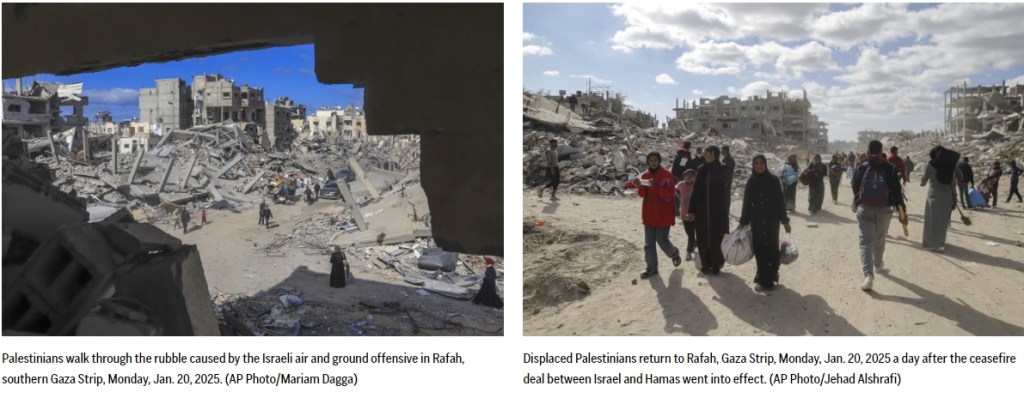
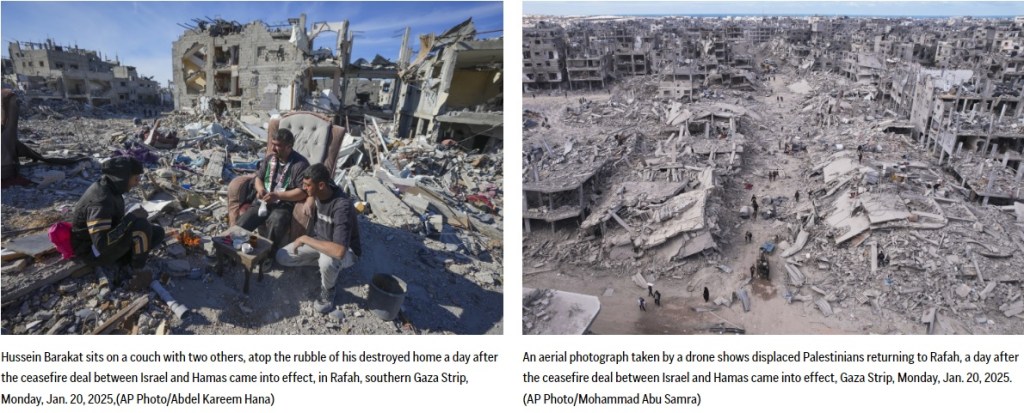
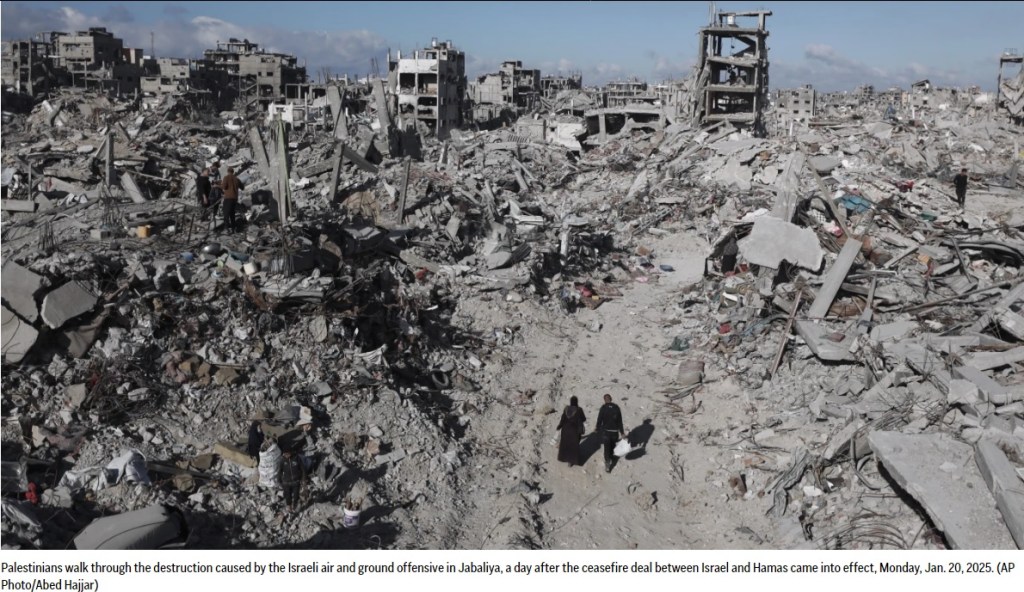
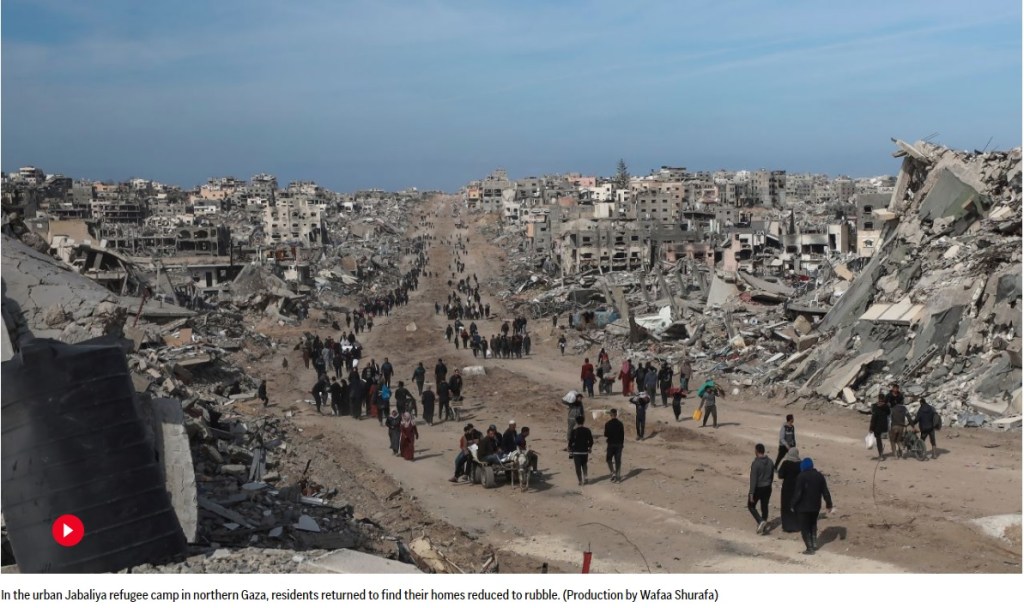
RAFAH, Gaza Strip (AP) — Palestinians in Gaza are confronting an apocalyptic landscape of devastation after a ceasefire paused more than 15 months of fighting between Israel and Hamas.
Across the tiny coastal enclave, where built-up refugee camps are interspersed between cities, drone footage captured by The Associated Press shows mounds of rubble stretching as far as the eye can see — remnants of the longest and deadliest war between Israel and Hamas in their blood-ridden history.
“As you can see, it became a ghost town,” said Hussein Barakat, 38, whose home in the southern city of Rafah was flattened. “There is nothing,” he said, as he sat drinking coffee on a brown armchair perched on the rubble of his three-story home, in a surreal scene.
Critics say Israel has waged a campaign of scorched earth to destroy the fabric of life in Gaza, accusations that are being considered in two global courts, including the crime of genocide. Israel denies those charges and says its military has been fighting a complex battle in dense urban areas and that it tries to avoid causing undue harm to civilians and their infrastructure.
However, estimates put the civilian deaths at over 45,000. Possibly as high as 70,000!
Military experts say the reality is complicated.
“For a campaign of this duration, which is a year’s worth of fighting in a heavily urban environment where you have an adversary that is hiding in amongst that environment, then you would expect an extremely high level of damage,” said Matthew Savill, director of military sciences at the Royal United Services Institute, a British think-tank.
Savill said that it was difficult to draw a broad conclusion about the nature of Israel’s campaign. To do so, he said, would require each strike and operation to be assessed to determine whether they adhered to the laws of armed conflict and whether all were proportional, but he did not think the scorched earth description was accurate.
International rights groups. including Amnesty International and Human Rights Watch, view the vast destruction as part of a broader pattern of extermination and genocide directed at Palestinians in Gaza, a charge Israel denies. The groups dispute Israel’s stance that the destruction was a result of military activity.
Airstrikes throughout the war toppled buildings and other structures said to be housing militants. But the destruction intensified with the ground forces, who fought Hamas fighters in close combat in dense areas.
If militants were seen firing from an apartment building near a troop maneuver, forces might take the entire building down to thwart the threat. Tank tracks chewed up paved roads, leaving dusty stretches of earth in their wake.
The military’s engineering corps was tasked with using bulldozers to clear routes, downing buildings seen as threats, and blowing up Hamas’ underground tunnel network.
Experts say the operations to neutralize tunnels were extremely destructive to surface infrastructure. For example, if a 1.5-kilometer (1-mile) long tunnel was blown up by Israeli forces, it would not spare homes or buildings above, said Michael Milshtein, a former Israeli army intelligence officer.
“If (the tunnel) passes under an urban area, it all gets destroyed,” he said. “There’s no other way to destroy a tunnel.”
A UFO whistleblower, Charles McNeal, has made some startling claims about a significant event in human history set to occur in the coming months.
A UFO whistleblower, Charles McNeal, has made some startling claims about a significant event in human history set to occur in the coming months. He alleges that he was part of a top-secret US Air Force intelligence unit responsible for upholding a 70-year truce between the American government and an alien civilization.
According to McNeal, who offers no proof of his credentials on his YouTube channel, this truce is due to expire at the end of September 2024. He suggests that a series of planned events will follow, including the partial or total destruction of Israel, a brief global conflict, and a staged alien invasion using reverse-engineered UFO technology.
McNeal further claims that one of the initial steps in this grand plan will be the announcement of an alliance between the US and Afghanistan’s Taliban government.
He also suggests that a gradual release of information through news outlets and fictional portrayals of extraterrestrial contact in films and TV has been part of a campaign to ready the world population for the shock of encountering an alien species. “This is known as the Public Acclimation Program,” he oddly states.
“For decades you have been force-fed fictionalized version of the truth via TV, movies, and books,” reports the Mirror. He details the entire shocking plan on his “Acclimate Now” website, which includes a planned third world war designed to scare the public and reduce the civilian population. This war, he alleges, will be interrupted by an “alien invasion” that has been in the works for decades.
Many of the “alien craft” seen during this period, he suggests, will actually be a secret USAF project he refers to as the TR3-B Alien Reproduction Vehicle (ARV).
But soon, McNeal predicts, we will meet a range of real aliens, including cybernetically enhanced humanoids from a planet in the Rigel star system: “Type A-C have a grey or greyish pigmentation that can sometimes appear chalky,” he explains. “They have four fingers with small suction cups at the end of each finger and some have webbing between their fingers and toes. Type D have a brownish pigmentation and five fingers and five toes.”
“This species was originally fully biological until they explored the cosmos and encountered what they now obey, something known as “The Keeper”. They now revere technology and began integrating mechanics into their biological makeup thousands of years ago.”
He also claims that after first encountering these beings in the late 1940s, the US government has been in contact with various alien species over the years. According to him, information about these extraterrestrial civilizations will be made public in the next few years.
However, he warns that even this public disclosure will not reveal the entire truth. “Unfortunately,” McNeal states, “the disclosure process is not intended to be 100 percent honest or transparent. It’s merely a tool for a very dangerous plan to unite the world.”
McNeal asserts that one of the primary goals of this conspiracy is to establish a “New World Order” global government, controlled by the US, which would then form a worldwide alliance with these extraterrestrial visitors.
Although McNeal has provided no concrete evidence to support his claims, apart from a few brief videos of the alleged USAF “Alien Reproduction Vehicle,” he suggests that the global realignment is set to begin at the end of September. If this is the case, we won’t have to wait long to find out if there’s any truth to his allegations.
Bad Aliens!!
Not sure what this clown is drinking, smoking or injecting. Pretty far out. But just in case, hold on to your hats!!
Spanish songs in Andalucía The shooting sites in the days of ’39 Oh, please, leave the vendanna open Federico Lorca is dead and gone Bullet holes in the cemetery walls The black cars of the Guardia Civil Spanish bombs on the Costa Rica I’m flying in a DC 10 tonight
Spanish bombs, yo te quiero infinito Yo te quiero, oh mi corazón Spanish bombs, yo te quiero infinito Yo te quiero, oh mi corazón
Spanish weeks in my disco casino The freedom fighters died upon the hill They sang the red flag They wore the black one But after they died it was Mockingbird Hill Back home the buses went up in flashes The Irish tomb was drenched in blood Spanish bombs shatter the hotels My senorita’s rose was nipped in the bud
Spanish bombs, yo te quiero infinito Yo te quiero, oh mi corazón Spanish bombs, yo te quiero infinito Yo te quiero, oh mi corazón
The hillsides ring with “Free the people” Or can I hear the echo from the days of ’39? With trenches full of poets The ragged army, fixin’ bayonets to fight the other line Spanish bombs rock the province I’m hearing music from another time Spanish bombs on the Costa Brava I’m flying in on a DC 10 tonight
Spanish bombs, yo te quiero infinito Yo te quiero, oh mi corazón Spanish bombs, yo te quiero infinito Yo te quiero, oh mi corazón Oh mi corazón, oh mi corazón
Spanish songs in Andalucía, Mandolina, oh mi corazón Spanish songs in Granada, oh mi corazón Oh mi corazón, oh mi corazón Oh mi corazón
Canadian soldiers playing hockey on a rink they built in Korea, 1952
Canadians’ enthusiasm for hockey was in evidence during the Korean War, in which 27,000 Canadian troops participated in defense of freedom.
The winter of 1952 was bone-chilling enough for the Imjingang River to freeze over, a river in northern Gyeonggi-do Province that flows down and across the middle of the Korean Peninsula. At the time, the peninsula was still at war, as the Korean War had broken out in late June 1950.
Among the U.N. forces defending the South Korean side against the North were many Canadian soldiers. They were stationed along the western front abutting the Imjingang River and they were on their guard against any intrusion from the north. A biting wind howled across the riverside, however, and almost froze the gun-toting soldiers as well as the river. The winter weather turned the river itself into a great field of ice. Even amid the tense situation, with battle happening at any time, the young soldiers felt the urge to take part in their traditional winter sport: ice hockey.
They couldn’t suppress their desire for the sport, so at last members of two Canadian battalions: the Princess Patricia’s Canadian Light Infantry (PPCLI) and the Royal 22nd Regiment (R22R) turned the frozen river into an ice rink for a hockey match. The glacial winter air didn’t stop the soldiers’ passion for their sport. The match took place “in the sound of the heavy guns of nearby U.S. Army artillery”, just a short distance from the front lines of the struggle against Communist forces, recalled Korean War veteran Vince Courtenay.
Although the exact origins of ice hockey are much disputed, ice hockey is thought to have first developed in the 19th century in Canada. Scholars agree that the rules for ice hockey were first codified at McGill University in Montreal, in 1879. Since then, Canada has been synonymous with the sport.
During this game, the 3rd Battalion Princess Patricia’s won 4-2 against the 1st Battalion of the Royal 22e Regiment.
Brigadier John Rockingham drops the puck for a match between 1st Battalion, Princess Patricia’s Canadian Light Infantry (left) and 2nd Battalion, Royal 22e Regiment “Vandoos” (right) during the Korean War. Playing for the Patricias was Private W. Wolfe. For the Royal 22e Regiment, Private R. Halley.
Many of these troops were surprised to find in Korea a climate not much different from that which they had left in Canada, with cold winters meaning frozen rivers where they could play their favorite sport.
The matches took place “in the sound of the heavy guns of nearby U.S. Army artillery,” just a short distance from the front lines of the struggle against Communist forces, said Korean War veteran Vince Courtenay.
It would have been a startling sight for enemy soldiers from the hills above the Imjin River in the winters of 1952 and 1953 — Canadians fighting for the puck on shimmering ice between deadly battles for precious terrain on the Korean Peninsula at the height of the Cold War conflict.
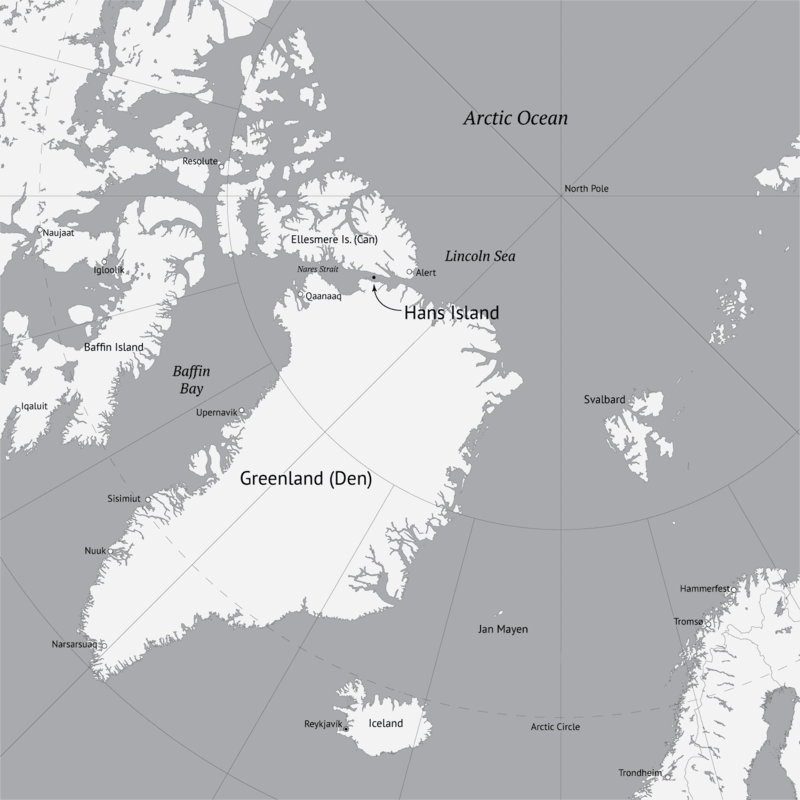
The Whisky War (also known as Liquor wars) is a pseudo-confrontation and border conflict between Denmark and Canada over Hans Island. Since the 1930s, Hans Island has been in the middle of a disagreement between the two nations.
Background
Hans Island is in the middle of the Kennedy Channel between Greenland and Ellesmere Island. A theoretical line in the middle of the strait goes through the island. Canada and Denmark could not come to terms on Hans Island in 1973 when a border treaty was signed, leaving a gap in its border description.
Conflict
In 1984, Canada provoked Denmark by planting its flag on the island and leaving a bottle of Canadian whisky. The Danish Minister of Greenland Affairs came to the island himself the same year with the Danish flag and a bottle of Snaps and a letter stating “Velkommen til den danske ø” (English: ‘Welcome to the Danish Island’).
Resolution efforts
Both countries agreed on a process in 2005 to resolve the issue.
Timeline
1980–1983 – Canadian firm Dome Petroleum did research on and around the island.
1984 – Tom Høyem, Danish Minister for Greenland, chartered a helicopter to the island, placing a flag and a bottle there.
1988 – The Danish Arctic Ocean patrol cutter HDMS Tulugaq arrived at the island, built a cairn and placed a flagpole and Danish flag on the island.
1995 – The Danish liaison officer and geodesists flew in and placed another flagpole and flag. Late August 1997 – The Danish Arctic/Ocean patrol cutter HDMS Agpa tried to reach the island, but was forced to turn around 241 km (150 mi) from the Island, owing to extreme ice.
2001 – Keith Dewing and Chris Harrison, geologists with the Geological Survey of Canada who were mapping northern Ellesmere Island, flew by helicopter to the island.
August 13, 2002 – The Danish inspection ship HDMS Vædderen arrived and erected a new cairn, flagpole and flag, finding the 1988 flag missing and the 1995 flag in pieces.
August 1, 2003 – The crew of the Danish frigate HDMS Triton landed on the island and replaced the Danish flag again.
July 13, 2005 – Canadian soldiers land on the Island, placing a traditional Inuit stone marker (Inukshuk) with a plaque and a Canadian flag.
July 20, 2005 – As a symbolic move, Canadian Defence Minister Bill Graham set foot on the island.
July 25, 2005 – A Danish government official announced Denmark would issue a letter of protest to Canada.
July 25, 2005 – Deputy premier of Greenland, Josef Motzfeldt, stated the island had been occupied by Canada, stating experts should determine which country the island belongs to.
July 28, 2005 – The Danish Ambassador to Canada published an article in the Ottawa Citizen newspaper regarding the Danish view on the Hans Island issue.
August 4, 2005 – The Danish Arctic/Ocean patrol cutter HDMS Tulugaq was sent from Naval Station Grønnedal to Hans Island to assert Danish sovereignty. The cutter was expected to arrive in three weeks’ time.
August 8, 2005 – Danish newspapers reported Canada wished to open negotiations regarding the future of Hans Island. The news was welcomed by Danish Prime Minister Anders Fogh Rasmussen who stated “It is time to stop the flag war. It has no place in a modern, international world. Countries like Denmark and Canada must be able to find a peaceful solution in a case such as this.”
August 16, 2005 – According to Danish Foreign Minister Per Stig Møller, Denmark and Canada agreed to reopen negotiations regarding the future of Hans Island. Denmark would immediately begin geological surveys in the area, and Per Stig Møller would meet his Canadian counterpart Pierre Pettigrew in New York City in the middle of September. Should they fail to reach an agreement, both governments have agreed to submit the dispute to the International Court of Justice in The Hague. The government of Greenland agreed to this course of action. Regarding the Danish patrol cutter HDMS Tulugaq then en route to Hans Island, the minister stated “I have instructed the ship to sail there, but they will not go ashore tearing down [the Canadian] flag and replacing it with a new one. It would be a somewhat childish [behaviour] between two NATO allies.”
August 20, 2005 – Canada’s Foreign Affairs Minister, Pierre Pettigrew, stated Canada’s claim to the island had a firm basis in international law and would likely not end up before a world court. “Our sovereignty over the island has a very strong foundation,” the minister said in a telephone interview with a Canadian Press journalist.
September 19, 2005 – According to Canada’s Foreign Affairs Minister, Pierre Pettigrew, Canada and Denmark have agreed on a process to resolve the dispute over the island. Pettigrew and his Danish counterpart, Per Stig Møller, met in New York on this day. Pettigrew said the two countries would work together “to put this issue behind us.” However Pettigrew reiterated Canada has sovereignty over the island.
August 16, 2006 – A Vancouver geologist receives a prospecting permit for Hans Island from the Canadian government.
March 17, 2007 – Scientists from the University of Toronto and the Technical University of Denmark announced plans to install an automated weather station on the island, some time in the summer of 2007.
July, 2007 – Canada updates satellite photos and recognizes its line constructed for the earlier maritime agreement would have run roughly through the middle of the island; negotiations continue with Denmark over establishing an international land boundary or island sovereignty.
May 4, 2008 – An international group of scientists from Australia, Canada, Denmark, and the UK installed an automated weather station on Hans Island.
April 11, 2012 – Proposal for Canada and Denmark to split Hans Island.
November 29, 2012 – Canada and Denmark settle an agreement on the exact border between them, though without defining the border near Hans Island.
May 23, 2018 – Canada and Denmark announce a Joint Task Force to settle the dispute over Hans Island.
February 2019 – Canadian geologist John Robins is granted a minerals exploration claim for Hans Island by the Canadian government as part of efforts to help the cause of Canada’s sovereignty claim.
September 12, 2019 – The Government of Greenland decided to approve a temporary closure of Hans Island for the application for mineral exploration permits. This approval was based on an agreement between the Government of Canada and the Kingdom of Denmark. The Canadian geologist John Robins therefore also had his minerals exploration claim for Hans Island suspended by the Canadian government. The Dane Andreas G. Jensen also had his application for mineral exploration permit rejected by the Kingdom of Denmark, because of this closure agreement.
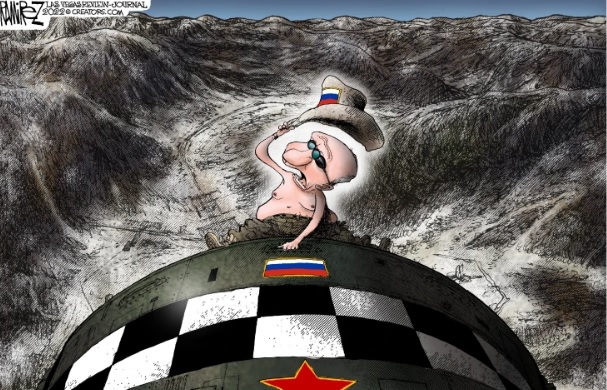
Russia’s President Vladimir Putin has said he’s ready to use nuclear weapons to defend Russian territory, raising the fear he might use a small, or “tactical” nuclear weapon in Ukraine.
US President Joe Biden has warned him that doing so would be the most serious military escalation since World War II.
What are tactical nuclear weapons?
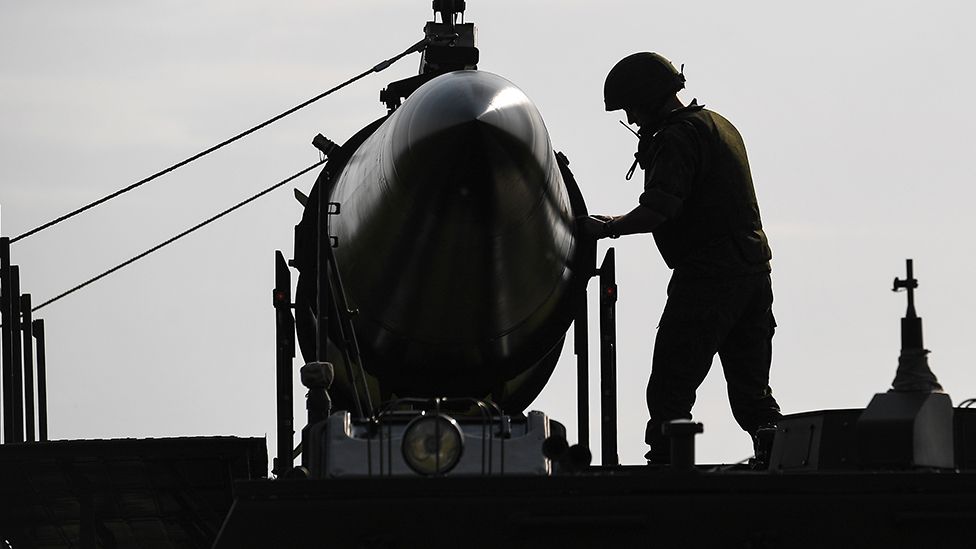
Tactical nuclear weapons are small nuclear warheads and delivery systems intended for use on the battlefield, or for a limited strike.
They are designed to destroy enemy targets in a specific area without causing widespread radioactive fallout.
The smallest tactical nuclear weapons can be one kiloton or less (producing the equivalent to a thousand tonnes of the explosive TNT). The largest ones can be as big as 100 kilotons.
Strategic nuclear weapons are larger (up to 1,000 kilotons) and are launched from longer range.
By comparison, the atomic bomb the US dropped on Hiroshima in 1945 was 15 kilotons.
What tactical nuclear weapons does Russia have?
According to US intelligence, Russia has about about 2,000 tactical nuclear weapons.
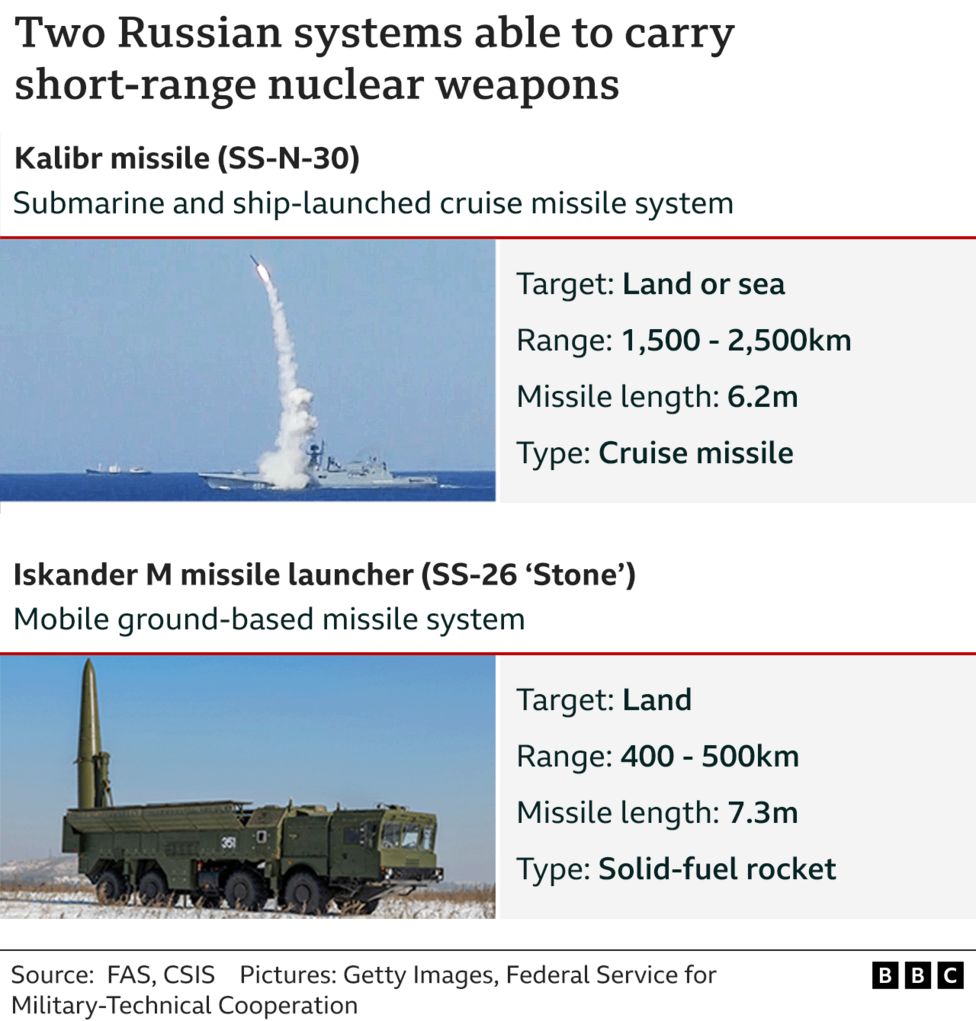
Its tactical nuclear warheads can be placed on various types of missiles which are normally used to deliver conventional explosives, such as cruise missiles and artillery shells.
Tactical nuclear weapons can also be fired from aircraft and ships – as anti-ship missiles, torpedoes and depth charges.
The US says Russia has recently been investing heavily in these weapons to improve their range and accuracy.
Have tactical nuclear weapons ever been used before?
Tactical nuclear weapons have never been used in conflict.
Nuclear powers such as the US and Russia have found it equally effective to destroy targets on the battlefield by using modern conventional munitions.
In addition, no nuclear-armed country has so far been willing to risk unleashing all-out nuclear war by employing tactical nuclear weapons.
However, Russia might be more willing to use smaller tactical weapons than larger strategic missiles.
“They might not see it as crossing this big nuclear threshold,” says Dr Patricia Lewis, head of the international security programme at the Chatham House think tank.
“They could see it as part of their conventional forces.”
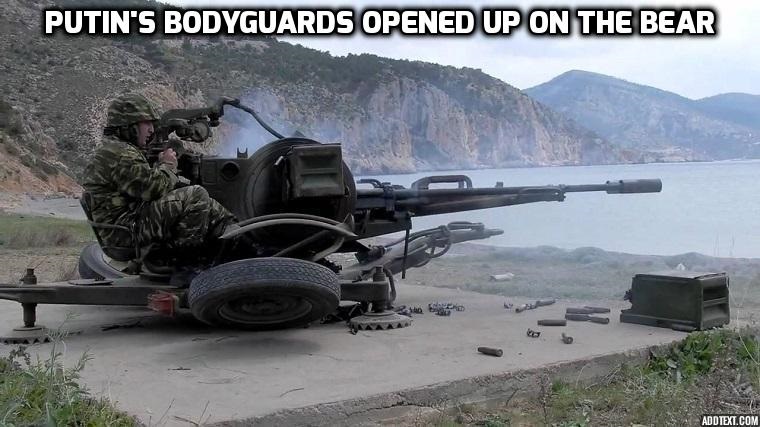
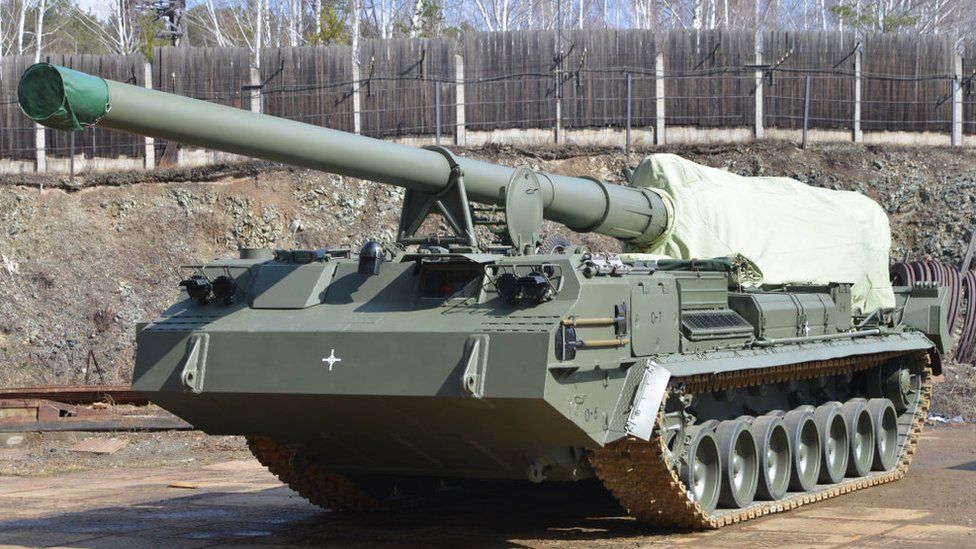
Russian forces can fire small nuclear warheads using conventional artillery, such as the “Malka” self-propelled gun
Are Putin’s nuclear threats a real cause to worry?
In February 2022, shortly before invading Ukraine, President Putin placed Russia’s nuclear forces at “special combat readiness” and held high-profile nuclear drills.
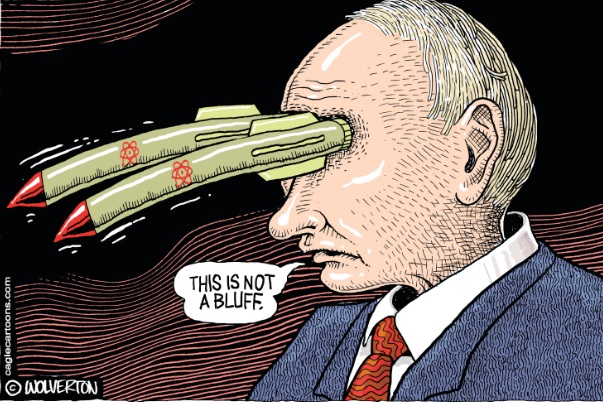
More recently, he said: “If the territorial integrity of our country is threatened, we will without a doubt use all available means to protect Russia and our people. This is not a bluff.”
Russia is planning to annex the regions of southern and eastern Ukraine it has occupied after holding self-styled referendums. President Putin says he is ready to defend the “territorial integrity” of the regions “by all means.”
US intelligence see this as a threat to the West not to help Ukraine try and retake these territories, rather than as a sign that he is planning a nuclear war.
But others worry that Russia, if it suffers further setbacks, might be tempted to use a smaller tactical weapon in Ukraine as a “game changer”, to break a stalemate or avoid defeat.
James Acton, a nuclear expert at the Carnegie Endowment for International Pace in Washington DC, says: “I am legitimately worried that in that circumstance, Putin might use a nuclear weapon – most likely on the ground in Ukraine to terrify everyone and get his way. We are not at that point yet.”
How has the US responded?
US President Joe Biden has warned Russia not to use nuclear weapons in the war in Ukraine.
Speaking during an interview with CBS News, Mr Biden said such action would “change the face of war unlike anything since World War Two,” adding: “It’ll be consequential.”
How the US and Nato would respond to any nuclear use is hard to predict. They may not want to escalate the situation further and risk all-out nuclear war but they also might want to draw a line.
However, Russia might also be deterred from using tactical nuclear weapons by another power – China.
“Russia is heavily dependent on Chinese support,” says Dr Heather Williams, nuclear expert at Kings College London.
“But China has a ‘no first use’ nuclear doctrine. So if Putin did use them, it would be incredibly difficult for China to stand by him.
















 The MarkoZen Blog