The Big Glorious Steamers

full size

I heard the sounds of locomotion
and a whistle’s plaintive cry
of weakness, but the wheels were turning.
Steel on steel the sole reply.

The sounds of force accelerating
rhythmically as drums would play
recalled a light and tender time,
though made of steel the permanent way,

when near a depot long abandoned,
waiting for a passing train,
a child would sit alone for hours
just to hear the steel refrain.

I heard the sounds of locomotion
carrying a longing man
with freight and cargo to a place that
rails of steel alone could span.

train2

train3

train4

“I looked out of the train,
And I suddenly saw the empty station
As we hurtled through, with a hollow roar . . .
‘Harviston End’ . . . It was dark and dead”

A quiet hymn to all that we’ve lost. It’s all here, the sights, sounds and smells of a country station about to close. I’ve searched my railway book shelves to see if Harviston End existed, but it appears not. But the word ‘end’ in the title goes much further than the white-pebbled station name.

train5

train6

train7

Lost Tracks of Time

train9

I took a freight train to be my friend, O lord,
You know I hoboed, hoboed, hoboed,
Hoboed a long long way from home, O lord,

train10

train11

train12 The Cincinnatian Baltimore and Ohio steam locomotive 1956

The Cincinnatian, Baltimore and Ohio steam locomotive 1956.

train13

train14 Belgian “Atlantic” class steam locomotive, built in 1939 for the Brussels-to- Ostend run

Belgium Atlantic Class steam locomotive, built 1939 Brussels to Ostend run.

train15 Mallard. The worlds fastest steam locomotive, at 125.88mph. Not the prettiest steam engine I've ever seen, but its wonderful that we can make a kettle go that fast... england

The Mallard. World’s fastest steam locomotive timed at 125 miles per hour, Doncaster, England.

train16

train17

Cass Shay #5, #11, #6 running full throttle

Virginia coal train

trainDurango Silverton Line, North of Durango, CO

Durango Silverton line Colorado

Ice Road Truckers: Behind the Scenes 

Ice Road Truckers is a reality television series that premiered on History on June 17, 2007. It features the activities of drivers who operate trucks on seasonal routes crossing frozen lakes and rivers in remote frozen territories in Canada and Alaska. In the first few seasons the long haul semi trucks operated mainly in Alaska and the Canadian Northwest Territories.  But in the last few seasons the truckers have discovered the area of North America with the most ice roads and also the most treacherous. The Canadian province of Manitoba.

Many of Manitoba’s isolated Native communities in the central and northern part of the province do not have access to year round roads or rail lines. The Native reserves are located in areas of thick forest and thousands of lakes. Therefore the winter roads are the only way to get supplies up to those communities.  Thousands of tons of freight is hauled to the communities during the short winter road season, usually January, February and the first half of March. Once the melt starts, the roads disintegrate. Hundreds of kilometres of the ice roads are just that, roads running on frozen lakes. When the lake ice starts to melt it can be quite hazardous.
Manitoba Winter Road Map

ice map

I have always wondered what kind of support the truckers receive when they are out in the bush hundreds of miles from nowhere.  When old grizzled God-fearing trucker Alex Debogorski is hauling across a frozen lake what back-up does he have when the ice starts cracking?  While Alex is praying to the heavens to keep him dry there is always cameras shooting his movement from many different angles, some from outside his semi truck.

And when foul mouthed trucker Art Burke is swearing like a drunken sailor because he took a wrong turn and is 300 miles in the opposite direction of where he should be, a helicopter is filming his semi’s movement from a thousand feet up.  When Art starts getting bleeped out by the program censors because of his obscene and indescribably vulgar diatribes he is talking to somebody who is riding with him.  And when Art runs out of fuel and he is pacing around in the snow there are two different cameras capturing his every lewd gesture.

How isolated and in potential peril are the Ice Road Truckers?  A recent photo seems to shed some light on this question.

ice11

The back-up and support package that shadows the Ice Trucks is extensive. Middle: Polar Industries truck driven by swear-master Art Burke; middle left: two F-350 Ford pick-ups providing mobile camera footage from different angles outside the truck; top left: Jet ranger helicopter that doubles as a camera platform and air ambulance; bottom left: the main satellite receiving central processing television truck; bottom right; 4-wheel drive ambulance with defibrillators, body thaw-out receptacles and neuro-cryogenicist surgeons; middle right: super-heavy X-1000 Mack telescopic arm tow recovery vehicle, and for good measure, a high-speed all-terrain mobile crane. Just in case a semi needs to be plucked out of a very deep lake.

In my opinion I’d say the Ice Truckers are covered pretty good for any contingency.

Train Through a Football Stadium

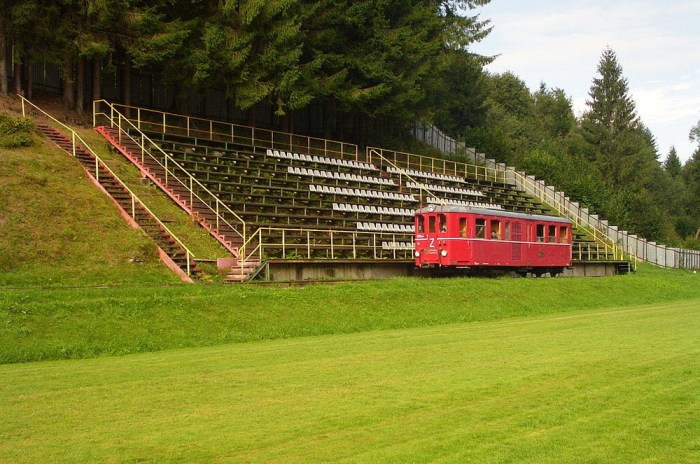
Going to any sporting event to watch your favorite teams play, as opposed to staying at home and watching the live broadcast, has its perks. Stadium is all about the experience—the noise, the crowd, the shouting, the occasional disruption—it all adds to the thrill. So imagine how thrilling the experience must be for spectators watching the TJ Tatran Čierny Balog club play against visiting teams, when the game is disrupted by an old steam train chugging right through the stadium between the stands and the pitch. This municipal stadium in Čierny Balog in Slovakia is the only stadium in the world with a pair of live railway tracks cutting across it.

Čierny Balog Stadium

Čierny Balog is a large municipality, a conglomeration of thirteen villages, which was one of the centers of the anti-Nazi Slovak National Uprising during the Second World War. The historical narrow gauge railway was built in the early 1900s, originally to transport wood between Čierny Balog and Hronec. Later, the network was extended to transport wood from the forests and by the middle of the 20th century the railway had a total length of nearly 132,000 kilometers, and was the most extensive forestry railway network in Czechoslovakia.

When the railway was laid in 1914 there was no football pitch. That was built later, as the village grew. In 1982 the the railway stopped operating, but ten years later, it started running again as a heritage railway for tourists.

The Čierny Hron railway track is now 17 kilometers long.

The football stadium belongs to the local TJ Tatran Čierny Balog club. It’s a small stadium with only two stands on one side, and open on the rest. The tracks pass directly in front of the stands.

cierny-balog-stadium-1

Chinese Elevated Bus to Travel over Vehicles 

bus

Engineers in China have designed a novel new transportation method in the form of an enormous elevated bus which may make traffic jams a thing of the past.

The innovative vehicle, dubbed the ‘Transit Elevated Bus,’ would cruise along Chinese highways passing over cars and trucks that are driving below it.

Propelled via rails embedded in the road, the giant bus is designed to seat an incredible 1,200 passengers in its three massive carriages.

The engineer tasked with implementing the project contends that construction of the bus should cost a fraction of what it would take to build a new subway and accrue considerably less maintenance costs as well.

And, despite its futuristic appearance, the jaw dropping vehicle looks to be comparatively easy to construct as Chinese officials expect to begin testing the first ‘mega bus’ later this year.

Provided the trial period goes well, the Transit Elevated Bus could be in widespread use throughout Chinese cities sometime in the next year or two.

Whether the unique vehicle makes it way over to America in the future remains to be seen, but we’re hopeful that it does, because it looks like an incredibly fun way to travel and an awesome way to beat the traffic.

Traffic in India: be careful out there

Traffic collisions in India are a major source of deaths, injuries and property damage every year. The National Crime Records Bureau (NCRB) 2021 report states that there were 155,622 fatalities, highest since 2014, out of which 69,240 deaths were due to two-wheelers. A study by Insurance Institute for Highway Safety, U.S. shows that the use of seat belts significantly reduces the risks and injuries from road accidents, and yet there is no enforcement on use of seat belts in cars. A study by IIT (Indian Institute of Technology) Delhi points out that the national highways constitute only 2% of the length of roads in India, but they account for 30.3% of total road accidents and 36% of deaths.

According to the 2013 global survey of traffic collisions by the UN World Health Organization, India suffered a road fatality rate of 16.6 per 100,000 people in 2013. India’s average traffic collision fatality rate was similar to the world average rate of 17.4 deaths per 100,000 people, less than the low-income countries which averaged 24.1 deaths per 100,000, and higher than the high-income countries which reported the lowest average rate of 9.2 deaths per 100,000 in 2013.

Traffic in India consists of almost every conceivable type of motor vehicle, cars, trucks, buses, auto rickshaws, scooters and motorcycles. Add to this crazy eclectic mix bicycles, pedestrians and the odd cow the chaos becomes mind-boggling.

The Widest Freeway in the World 

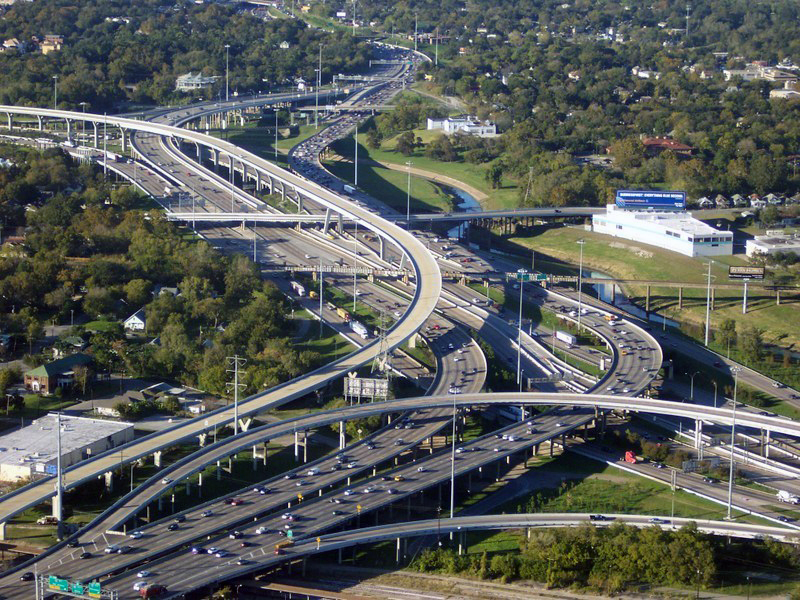
Where else? Houston, Texas of course.

katy1

When constructed during the 1960s, the I-10 Katy from Houston, known as the Katy Freeway, was built with six to eight lanes wide barring side lanes, being modest by Houston standards because existing traffic demand to the farming area of West Houston was relatively low. As the population and economic activity increased in the area vehicular traffic increased, reaching an annual average daily traffic (AADT) of 238,000 vehicles just west of the West Loop in 2001.

In 2000 increased traffic levels and congestion led to plans being approved for widening of the freeway to 16 lanes with a capacity for 200,000 cars per day. An old railway running along the north side of the freeway was demolished in 2002 in preparation for construction which began in 2004. The interior two lanes in each direction between SH 6 and west I-610, the Katy Freeway Managed Lanes or Katy Tollway, were built as high-occupancy toll lanes and are managed by the Harris County Toll Road Authority. The section just west of SH 6 to the Fort Bend–Harris county line opened in late June 2006. Two intersections were rebuilt (Beltway 8 and I-610), toll booths were added, together with landscaping as part of Houston’s Highway Beautification Project. Most of the section between Beltway 8 and SH 6 had been laid by September 2006 and work was completed in October 2008.

Tolls on the managed lanes vary by vehicle occupancy, axle count and time of day. High occupancy vehicles may travel for free at certain times.

Katy-Freeway

katy4

Interstate 10 (I-10) is the major east–west Interstate Highway in the Southern United States. In the U.S. state of Texas, it runs east from Anthony, at the border with New Mexico, through El Paso, San Antonio and Houston to the border with Louisiana in Orange, Texas. At just under 880 miles (1,420 km), the Texas segment of I-10, maintained by the Texas Department of Transportation, is the longest continuous untolled freeway in North America that is operated by a single authority, a title formerly held by Ontario Highway 401. 

katy2

katy3

OLYMPUS DIGITAL CAMERA

katy interstate-10-map

Winnipeg Summer Road Construction Mayhem

In Winnipeg the bitterly cold winters are not conducive for road construction. It gets so cold that the ground freezes up to 5-6 feet below the surface. The ground is so frozen equipment cannot penetrate through. And cement cannot be poured in those brutal temps. Therefore, all road and highway construction has to be done during the late spring, summer and early fall.

It creates such chaos that many streets are closed or down to 1 lane. Makes it an obstacle course to get around. Regular 20 minute commutes turn into 50 minute marathons. Such is existence in the Great White North.

Summer street in Winnipeg

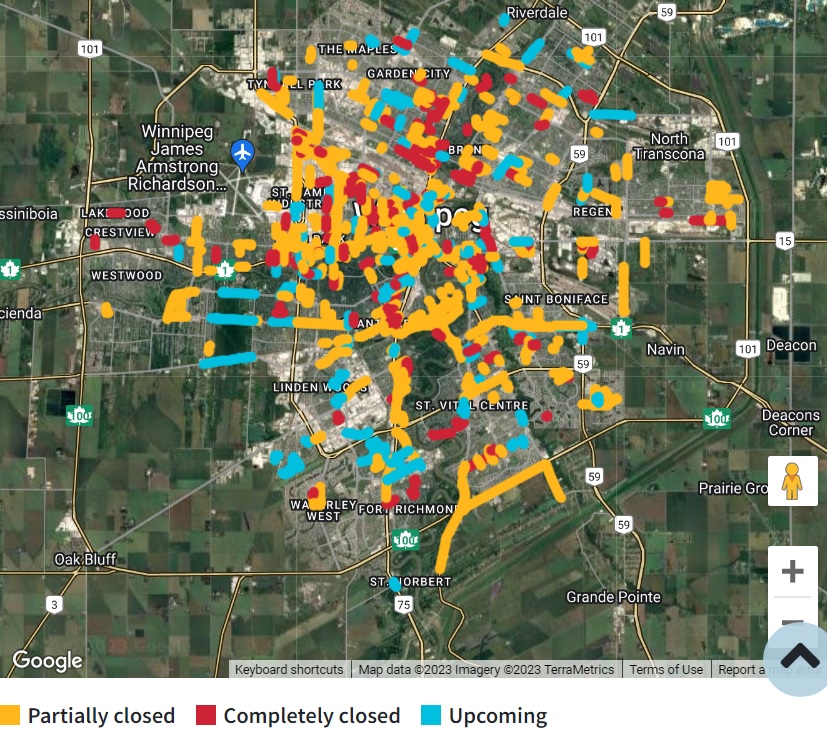
Today’s Winnipeg street construction map.

Looks like this craziness happens in other jurisdictions: