Ice Road Truckers: Behind the Scenes 

Ice Road Truckers is a reality television series that premiered on History on June 17, 2007. It features the activities of drivers who operate trucks on seasonal routes crossing frozen lakes and rivers in remote frozen territories in Canada and Alaska. In the first few seasons the long haul semi trucks operated mainly in Alaska and the Canadian Northwest Territories.  But in the last few seasons the truckers have discovered the area of North America with the most ice roads and also the most treacherous. The Canadian province of Manitoba.

Many of Manitoba’s isolated Native communities in the central and northern part of the province do not have access to year round roads or rail lines. The Native reserves are located in areas of thick forest and thousands of lakes. Therefore the winter roads are the only way to get supplies up to those communities.  Thousands of tons of freight is hauled to the communities during the short winter road season, usually January, February and the first half of March. Once the melt starts, the roads disintegrate. Hundreds of kilometres of the ice roads are just that, roads running on frozen lakes. When the lake ice starts to melt it can be quite hazardous.

Manitoba Winter Road Map

ice map

I have always wondered what kind of support the truckers receive when they are out in the bush hundreds of miles from nowhere.  When old grizzled God-fearing trucker Alex Debogorski is hauling across a frozen lake what back-up does he have when the ice starts cracking?  While Alex is praying to the heavens to keep him dry there is always cameras shooting his movement from many different angles, some from outside his semi truck.

And when foul mouthed trucker Art Burke is swearing like a drunken sailor because he took a wrong turn and is 300 miles in the opposite direction of where he should be, a helicopter is filming his semi’s movement from a thousand feet up.  When Art starts getting bleeped out by the program censors because of his obscene and indescribably vulgar diatribes he is talking to somebody who is riding with him.  And when Art runs out of fuel and he is pacing around in the snow there are two different cameras capturing his every lewd gesture.

How isolated and in potential peril are the Ice Road Truckers?  A recent photo seems to shed some light on this question.

ice11

The back-up and support package that shadows the Ice Trucks is extensive. Middle: Polar Industries truck driven by swear-master Art Burke; middle left: two F-350 Ford pick-ups providing mobile camera footage from different angles outside the truck; top left: Jet ranger helicopter that doubles as a camera platform and air ambulance; bottom left: the main satellite receiving central processing television truck; bottom right; 4-wheel drive ambulance with defibrillators, body thaw-out receptacles and neuro-cryogenicist surgeons; middle right: super-heavy X-1000 Mack telescopic arm tow recovery vehicle, and for good measure, a high-speed all-terrain mobile crane. Just in case a semi needs to be plucked out of a very deep lake.

In my opinion I’d say the Ice Truckers are covered pretty good for any contingency.

Magnum P.I. Theme song

I was watching Magnum P.I. TV show reruns from the early 1980’s the other day and realized how great that theme song is.

The original theme music for the opening credits of the pilot episode was a mid-tempo jazzy piece by Ian Freebairn-Smith. This music was also used for the next nine regular episodes.

Beginning in Episode 12, it was replaced by a more up tempo theme typical of 1980s action series by Mike Post and Pete Carpenter with guitar by Larry Carlton. This theme had been used during the show and over the closing credits from Episode 8. A longer version of this second theme (“Theme from Magnum P.I.”, 3:25 in duration) credited to Post was released as a single by Elektra Records in 1982 and featured on the Billboard Hot 100 chart that same year, peaking at No. 25 on May 8, 1982. This version also appeared on Post’s 1982 album Television Theme Songs.

Extended version:

If it wasn’t for Lucille Ball, there wouldn’t be any Trekkies

The ultimate decision to put the original Star Trek series on the air back in 1966 fell into the hands of Lucille Ball. She was a studio executive (Desilu) who wielded power over decisions like which shows will move forward and which shouldn’t. She took the Star Trek plunge, the rest is mega science fiction franchise history.

Lucille Désirée Ball (August 6, 1911 – April 26, 1989) was an American actress, comedienne, model, film studio executive, and TV producer. She was the star of the sitcoms I Love LucyThe Lucy–Desi Comedy HourThe Lucy ShowHere’s Lucy, and Life with Lucy.

How Star Trek was launched:

In April 1964, Roddenberry presented the Star Trek draft to Desilu Productions, a leading independent television production company. He met with Herb Solow, Desilu’s Director of Production. Solow saw promise in the idea and signed a three-year program-development contract with Roddenberry.

The idea was extensively revised and fleshed out during this time – ‘The Cage’ pilot filmed in late 1964 differs in many respects from the March 1964 treatment. Solow, for example, added the Star Date concept.

Desilu Productions had a first-look deal with CBS. Oscar Katz, Desilu’s Vice President of Production, went with Roddenberry to pitch the series to the network. They refused to purchase the show, as they already had a similar show in development, the 1965 Irwin Allen series Lost in Space.

In May 1964, Solow, who previously worked at NBC, met with Grant Tinker, then head of the network’s West Coast programming department. Tinker commissioned the first pilot – which became ‘The Cage’. NBC turned down the resulting pilot, stating that it was ‘too cerebral.’ However, the NBC executives were still impressed with the concept, and they understood that its perceived faults had been partly because of the script that they had selected themselves.

NBC made the unusual decision to pay for a second pilot, using the script called “Where No Man Has Gone Before”. Only the character of Spock, played by Leonard Nimoy, was retained from the first pilot, and only two cast members, Majel Barrett and Nimoy, were carried forward into the series. This second pilot proved to be satisfactory to NBC, and the network selected Star Trek to be in its upcoming television schedule for the fall of 1966.

The second pilot introduced most of the other main characters: Captain Kirk (William Shatner), chief engineer Lt. Commander Scott (James Doohan) and Lt. Sulu (George Takei), who served as a physicist on the ship in the second pilot but subsequently became a helmsman throughout the rest of the series. Paul Fix played Dr. Mark Piper in the second pilot; ship’s doctor Leonard McCoy (DeForest Kelley) joined the cast when filming began for the first season, and he remained for the rest of the series, achieving billing as the third star of the series. Also joining the ship’s permanent crew during the first season were the communications officer, Lt. Nyota Uhura (Nichelle Nichols), the first African-American woman to hold such an important role in an American television series; the captain’s yeoman, Janice Rand (Grace Lee Whitney), who departed midway through the first season; and Christine Chapel (Majel Barrett), head nurse and assistant to McCoy. Walter Koenig joined the cast as Ensign Pavel Chekov in the series’ second season.

In February 1966, Star Trek was nearly killed by Desilu Productions, before airing the first episode. Desilu had gone from making just one half-hour show (The Lucy Show), to deficit financing a portion of two expensive hour-long shows, Mission: Impossible and Star Trek. Solow was able to convince LUCILLE BALL that both shows should continue.

ballx3

Imagine the world without Trekkies.

trekx

trekkies

Jerry Springer R.I.P.

Gerald Norman Springer (February 13, 1944 – April 27, 2023) was an American broadcaster, journalist, actor, producer, lawyer, and politician. Born in London, England, during World War II to refugees escaping the Holocaust, Springer was raised in Queens, New York City.

Jerry Springer (talk show) debuted on September 30, 1991. It started as a politically oriented talk show, a longer version of Springer’s commentaries. Guests included Oliver North and Jesse Jackson, and topics included homelessness and gun politics.

In early 1994, Springer and his new producer, Richard Dominick, revamped the show’s format in order to garner higher ratings. The show became more successful as it became targeted toward tabloidish sensationalism. Guests were everyday people confronted on a television stage by a spouse or family member’s adultery, homosexuality, transsexuality, prostitution, transvestism, hate group membership, or other controversial situations. These confrontations were often promoted by scripted shouting or violence on stage. The show received substantial ratings and much attention. By 1998, it was beating The Oprah Winfrey Show in many cities, and was reaching more than 6.7 million viewers.

The Old Weather Channel on Cable

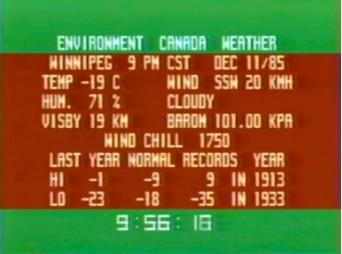
This may surprise younger readers, but there was once a time when the reality programming on The Weather Channel was simply, you know, weather. It used to be no more than a ten-minute wait to “Local on the Eights”, with simple text crawls of local conditions and forecasts that looked like they were taken straight from the National Weather Service feed. Those were the days, and sadly they seem to be gone forever.

Cindy Williams Gone

Cynthia Jane Williams (August 22, 1947 – January 25, 2023) was an American actress and producer, known for her role as Shirley Feeney on the television sitcoms Happy Days (1975–1979), and Laverne & Shirley (1976–1982). She also appeared in American Graffiti (1973) and The Conversation (1974).

Early life
Williams was born in the Van Nuys district of Los Angeles, California, on August 22, 1947. She was Italian on her mother’s side, Francesca Bellini. The family moved to Dallas, Texas when she was a year old and returned to Los Angeles when she was ten years old. She had one sibling, a sister named Carol Ann.

Williams wrote and acted during childhood at a church and later acted at Birmingham High School, graduating in 1965. She attended Los Angeles City College where she majored in theater .