A viral video said to show the examination of a crashed UFO in Arizona is actually a fantastic and somewhat troubling creation of artificial intelligence. The remarkable scene, which features people in hazmat suits studying the craft as a group of military personnel watch from a distance, was crafted by a digital artist dubbed SYBERvisions using the image generative program Midjourney. Posted online last week with the purpose of showcasing the awesome ability of AI, the production has since been repurposed and spread on social media by unscrupulous individuals and pranksters claiming that it is genuine footage of a downed UFO.
While, of course, that is not the case, one can be forgiven if they were initially fooled by the ‘footage’ considering how real it appears. To that end, the video is a rather worrisome testament to how far artificial intelligence has advanced as differentiating between genuine media and fabulous fabrications has become an increasingly difficult task that will only become even more challenging in the future. That said, perhaps the skeptical approach to paranormal videos will wind up applying to similarly wondrous scenes created by AI in that if it is too good to be true, it probably isn’t.
Hubot is 44-inch tall, 110 pound battery- operated personal robot and when programmed, Hubot will remember how to get around the house without bumping into walls. Hubot includes a complete mobile work station, an Entertainment package and robotic functions. The entertainment package included a voice synthesizer with a 1200-word vocabulary, a 12″ black and white television, and AM/FM stereo cassette player, an Atari 2600 video game set and a digital clock that displayed time and temperature. Inside is a complete proprietary SysCon computer with B&W monitor, Detachable keyboard and optional printer which is used to do computing task and control the robotic functions. There was an optional voice command module that included a microphone to command Hubot verbally. Hubot could be preprogrammed to follow a programmed path or driven with a joystick. Once taught a path, Hubot could be command to follow it again with the touch of a button.
Features: full-featured computer “brain” with CP/M 2.212-inch combination TV/monitor64-key detachable ASCII keyboard5¼” DS/DD floppy disk drivesonic and infrared obstacle avoidancebuilt-in Atari video game systembuilt-in AM/FM stereo w/ cassette, equalizer and speakersphonetic voice synthesizer for unlimited vocabularyfull-direction movement
Options: removable serving tray40 column dot matrix printer ($300)additional 5¼” floppy disk drive ($395)plastic “home base” (similar to Omnibot 2000) for programming referencevoice recognition for vocal command controlfully articulated arm ($700)heat/smoke/intrusion sentry package (< $300)automatic battery recharge with charger locatorvacuum cleaner attachment ($300)remote control300 baud modem
Okay, so maybe this isn’t a real thing yet… but, c’mon, you know it’s coming! With the tagline “Bringing eye contact back to the 21st century” the Texting Hat is here to solve all your phone zombie problems. What a great invention. You look like you actually care when in reality who gives a f#@k!
Right now they’re not for sale, but the Texting Hat website encourages you to just make your own goddamned hat:
Not only is having this idea over 50 years ago amazing, but also the fact that they managed to recreate it on film. This must have been difficult without the easy access of video technology.
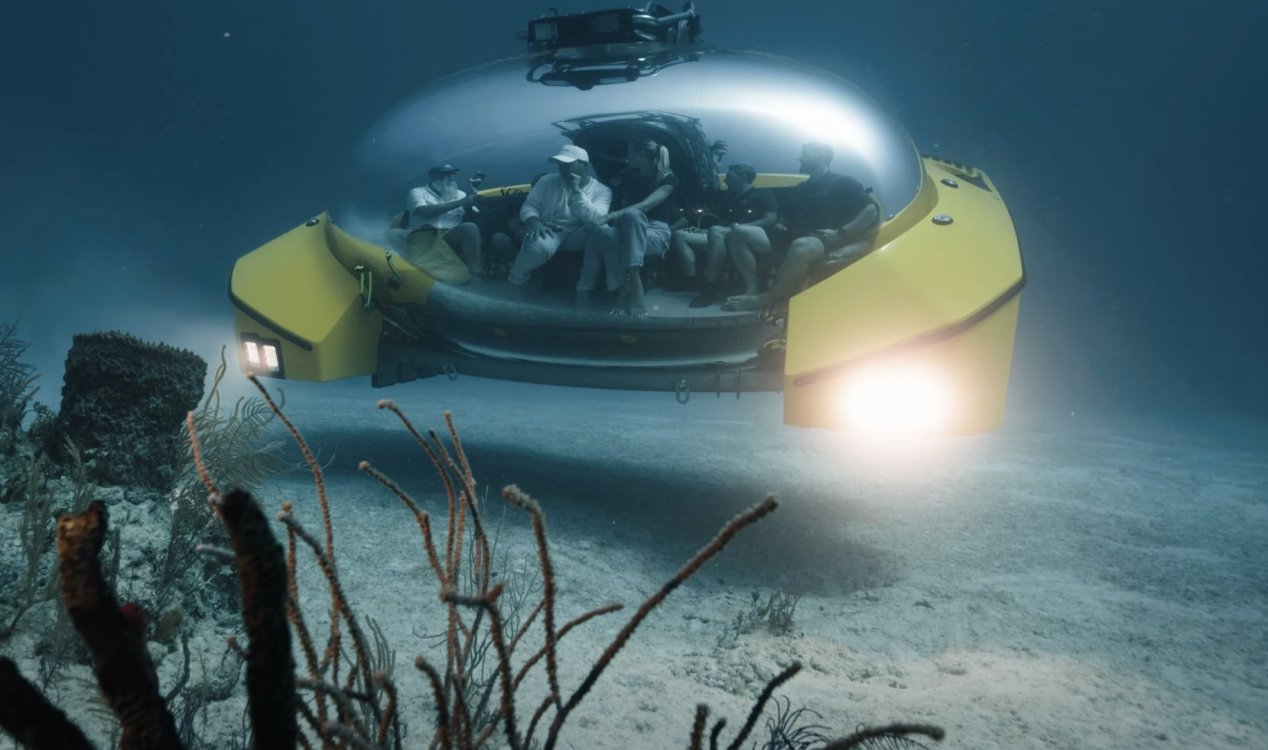
Would you venture into the depths in this ? Image Credit: YouTube / Triton Submarines
With its free-form acrylic pressure hull, the Triton 660 AVA aims to provide ‘entertainment-focused underwater experiences’.
After the catastrophic implosion of the Titan submersible during an underwater mission to the wreck of the Titanic last year, attitudes towards undersea exploration have been understandably tepid of late.
One company looking to change all that, however, is Triton Submarines – a US-based luxury submarine developer and manufacturer which is all about quality and comfort.
Its latest creation is quite the sight to behold – a futuristic underwater exploratory vehicle with a free-form acrylic pressure hull which enables its passengers to get a wide view of the ocean floor.
Known as the Triton 660 AVA, the new submarine almost looks like a UFO thanks to its unique shape.
Capable of diving around 200 meters below the ocean’s surface, it certainly won’t be going anywhere near the Titanic anytime soon, but it should provide an underwater experience like no other.
Only the super-rich need apply, however, given the hefty price tag of $6.3 million.
You can check out the sub in action in the video below.
Walking and texting is leading to a spate of collision-related injuries. Could a new app be the answer?
We’ve all done it. You’re walking down the street and the familiar beep of an incoming text becomes too tempting to resist. As you start to fire off a quick reply – bam! You clash shoulders with a fellow pedestrian doing exactly the same.
Alex Stoker is a Clinical Fellow in Emergency Medicine at Frimley Park Hospital, Surrey. “If it’s a tall object like a wall or a lamp-post that someone walks into, then one might expect facial injuries such as a broken nose or fractured cheekbone,” he told the BBC.
“If on the other hand the collision results in falling over, then they’re much more liable to things like hand injuries and broken wrists. There’s a complete spectrum but it is possible to sustain a really serious injury.”
Man hole avoidance
A new app called CrashAlert aims to help save people from themselves. It involves using a distance-sensing camera to scan the path ahead and alert users to approaching obstacles.
The camera acts like a second pair of eyes – looking forward while the user is looking down.
CrashAlert is at prototype stage
Just as a Nintendo Wii or Xbox can detect where and how a player is moving, CrashAlert’s camera can interpret the location of objects on the street.
When it senses something approaching, it flashes up a red square in a bar on top of the phone or tablet. The position of the square shows the direction of the obstacle – giving the user a chance to dodge out of the way.
“What we observed in our experiments is that in 60% of cases, people avoided obstacles in a safer way. That’s up from 20% [without CrashAlert],” says CrashAlert’s inventor Dr Juan David Hincapié-Ramos from the University of Manitoba.
What’s more, the device doesn’t distract the user from what they’re doing. Hincapié-Ramos’s tests showed it can be used alongside gaming or texting without any cost to performance.
Despite designing CrashAlert, Hincapié-Ramos accepts that the best solution of all is for people to stop checking their phones in the first place.
“We should encourage people to text less while they’re walking because it isolates them from their environment. However people are doing it and there are situations where you have to do it. It’s for situations like this that CrashAlert can have a positive impact.”
But Dr Joe Marshall, a specialist in Human-Computer Interaction from the University of Nottingham, says that it’s not necessarily people who are to blame – but the phones themselves.
“The problem with mobile technology is that it’s not designed to be used while you’re actually mobile. It involves you stopping, looking at a screen and tapping away.”
Dr Marshall believes that if we want to stop people being distracted by their phones, then designers need to completely rethink how we interact with them. But so far, there is no completely satisfactory alternative.
“Google glass solves the problem of looking down by allowing you to look ahead. But you still have to pay attention to a visual display,” he told the BBC.
So for now at least, it seems vigilance is the key to avoiding lamp-posts and unexpected manholes.
But as mobile technology continues to dominate everyday life, it might not be too ludicrous to expect to rely on smart cameras to steer us in the right direction.











 The MarkoZen Blog
