
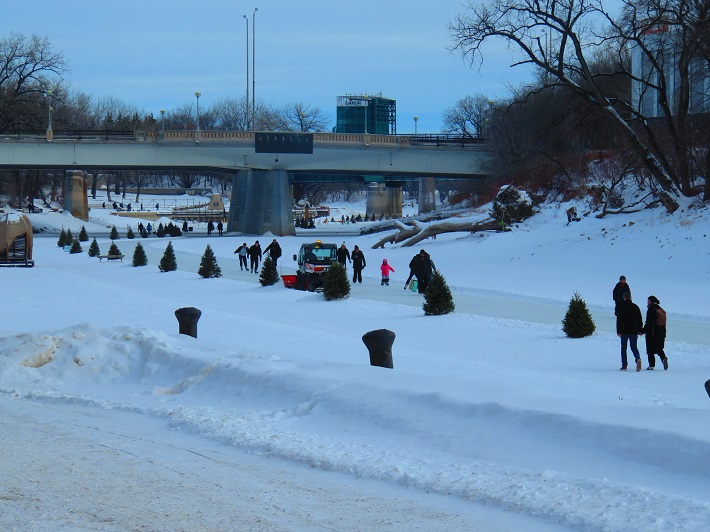
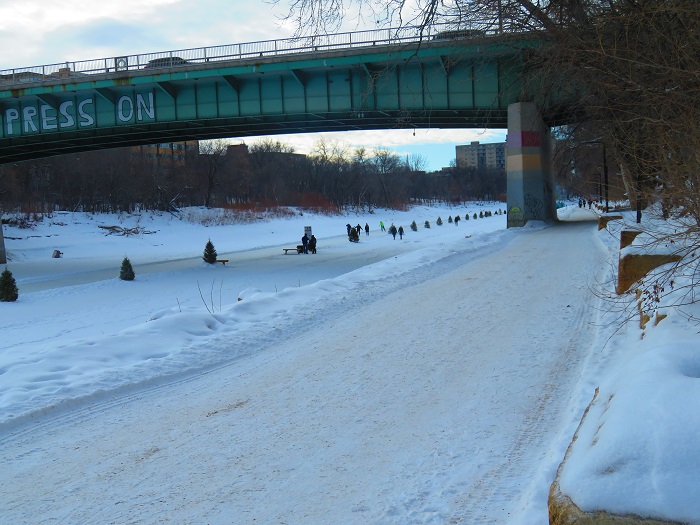
Downtown Winnipeg. A new apartment building going up and the skating trail on the Assiniboine River.


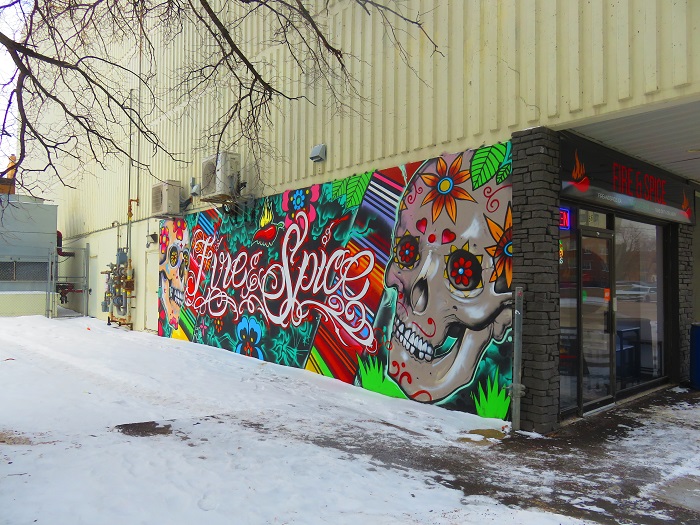
A cool mural painted on the wall of a restaurant called Fire & Spice.

Downtown Winnipeg. A new apartment building going up and the skating trail on the Assiniboine River.
A cool mural painted on the wall of a restaurant called Fire & Spice.
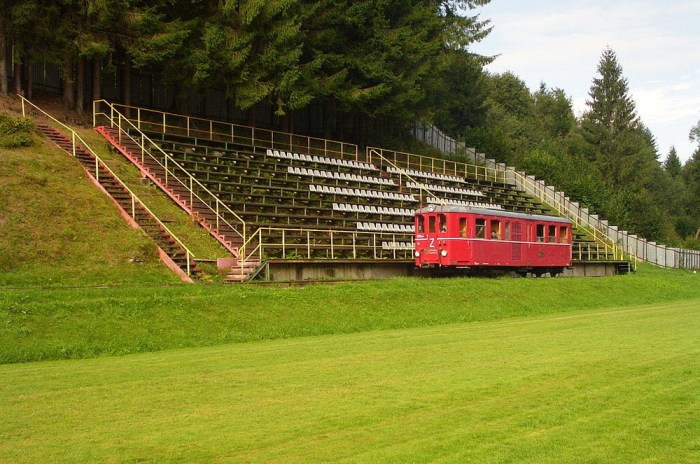
Going to any sporting event to watch your favorite teams play, as opposed to staying at home and watching the live broadcast, has its perks. Stadium is all about the experience—the noise, the crowd, the shouting, the occasional disruption—it all adds to the thrill. So imagine how thrilling the experience must be for spectators watching the TJ Tatran Čierny Balog club play against visiting teams, when the game is disrupted by an old steam train chugging right through the stadium between the stands and the pitch. This municipal stadium in Čierny Balog in Slovakia is the only stadium in the world with a pair of live railway tracks cutting across it.

Čierny Balog is a large municipality, a conglomeration of thirteen villages, which was one of the centers of the anti-Nazi Slovak National Uprising during the Second World War. The historical narrow gauge railway was built in the early 1900s, originally to transport wood between Čierny Balog and Hronec. Later, the network was extended to transport wood from the forests and by the middle of the 20th century the railway had a total length of nearly 132,000 kilometers, and was the most extensive forestry railway network in Czechoslovakia.
When the railway was laid in 1914 there was no football pitch. That was built later, as the village grew. In 1982 the the railway stopped operating, but ten years later, it started running again as a heritage railway for tourists.
The Čierny Hron railway track is now 17 kilometers long.
The football stadium belongs to the local TJ Tatran Čierny Balog club. It’s a small stadium with only two stands on one side, and open on the rest. The tracks pass directly in front of the stands.

A forthcoming professional soccer team in Texas is the latest to take inspiration from the world of cryptozoology as the club has been dubbed the Chupacabras. The monstrous moniker for the group that will play in the community of McKinney was reportedly the overwhelming winner of a fan vote wherein the blood-thirsty beast received more support than the combined total of the two closest runners-up. Set to start playing in a soon-to-be-announced lower division soccer league in 2025, the McKinney Chupacabras FC has smartly already rolled out a bevy of merchandise featuring their fearsome logo. The team joins a growing list of sports organizations with cryptid names, including the NHL’s Seattle Kraken and New Jersey Devils.
Seattle Kraken fighting Winnipeg Jets.


Joshua, a goat who lives at Taylor’s Pumpkin Patch in Conception Bay South, N.L., in a Sept. 29 handout photo.
He may not have logged the fastest time or even gone the full distance, but residents of a Newfoundland town agree the goat who unexpectedly joined the local weekend half marathon was the event’s undisputed champion.
Partway through Sunday’s T’Railway Trek half marathon in Conception Bay South, N.L., an eager 68-kilogram (150 pound) goat named Joshua broke free from his collar and joined the runners on the route.
He kept pace for nearly a quarter of the race before being rounded up by his owners and now even has a medal to show for his efforts.
Joshua’s half-marathon debut surprised no one more than Heidi Taylor, who woke up Sunday morning to find social media awash in photos of her goat mingling with fellow runners.
“We take Joshua for walks, he listens very well and will follow you,” she said in an interview Sunday.
“So when he’s seeing all the people running, he must have thought: ’I’m going to go too.’ ”
Joshua lives at Taylor’s Pumpkin Patch, the business Ms. Taylor co-owns. Ms. Taylor doesn’t know what time he managed to ditch his collar but estimates he ran about five kilometres of the 21-kilometre race.
She got wind of his unexpected participation at around 9:30 p.m. when she opened her Facebook and recognized him from the photos filling her feed.
Ms. Taylor and her fiancé used the Facebook posts to figure out Joshua’s whereabouts along the race route, and they “took another collar and leash along with a bag of cheezies” – his favourite snack – and went off to find him.
They have rodeos in Massachusetts!!??
Sept. 24 (UPI) — The last of eight bulls that escaped Sunday from a rodeo in Massachusetts was recaptured near the place where the saga began, firefighters said.
The North Attleboro Fire Department said on social media that the bull, one of eight to escape a rodeo at the Emerald Square Mall in North Attleboro, was captured late Monday night.
The bull had been located near the town’s Walmart in the evening Monday, sparking a chase involving the fire department, North Attleboro Police, Attleboro Police, Massachusetts State Police Air Wing, Mass Environmental Police, the New England Rodeo, animal rescue groups and volunteers.
“I have to say I’ve never went out looking for a lost bull. This is one for the books,” Samantha Beckman with Wandering Paws K9 told WBZ-TV.
The bovine took off running from Walmart, leading pursuers on a chase that came to an end on Route 1, near the Emerald Square Mall, where the bull was lassoed and loaded onto a trailer.
The circumstances of the eight bulls’ escape remain under investigation.

Canadians’ enthusiasm for hockey was in evidence during the Korean War, in which 27,000 Canadian troops participated in defense of freedom.
The winter of 1952 was bone-chilling enough for the Imjingang River to freeze over, a river in northern Gyeonggi-do Province that flows down and across the middle of the Korean Peninsula. At the time, the peninsula was still at war, as the Korean War had broken out in late June 1950.
Among the U.N. forces defending the South Korean side against the North were many Canadian soldiers. They were stationed along the western front abutting the Imjingang River and they were on their guard against any intrusion from the north. A biting wind howled across the riverside, however, and almost froze the gun-toting soldiers as well as the river. The winter weather turned the river itself into a great field of ice. Even amid the tense situation, with battle happening at any time, the young soldiers felt the urge to take part in their traditional winter sport: ice hockey.
They couldn’t suppress their desire for the sport, so at last members of two Canadian battalions: the Princess Patricia’s Canadian Light Infantry (PPCLI) and the Royal 22nd Regiment (R22R) turned the frozen river into an ice rink for a hockey match. The glacial winter air didn’t stop the soldiers’ passion for their sport. The match took place “in the sound of the heavy guns of nearby U.S. Army artillery”, just a short distance from the front lines of the struggle against Communist forces, recalled Korean War veteran Vince Courtenay.
Although the exact origins of ice hockey are much disputed, ice hockey is thought to have first developed in the 19th century in Canada. Scholars agree that the rules for ice hockey were first codified at McGill University in Montreal, in 1879. Since then, Canada has been synonymous with the sport.

During this game, the 3rd Battalion Princess Patricia’s won 4-2 against the 1st Battalion of the Royal 22e Regiment.

Brigadier John Rockingham drops the puck for a match between 1st Battalion, Princess Patricia’s Canadian Light Infantry (left) and 2nd Battalion, Royal 22e Regiment “Vandoos” (right) during the Korean War. Playing for the Patricias was Private W. Wolfe. For the Royal 22e Regiment, Private R. Halley.

Many of these troops were surprised to find in Korea a climate not much different from that which they had left in Canada, with cold winters meaning frozen rivers where they could play their favorite sport.

The matches took place “in the sound of the heavy guns of nearby U.S. Army artillery,” just a short distance from the front lines of the struggle against Communist forces, said Korean War veteran Vince Courtenay.

It would have been a startling sight for enemy soldiers from the hills above the Imjin River in the winters of 1952 and 1953 — Canadians fighting for the puck on shimmering ice between deadly battles for precious terrain on the Korean Peninsula at the height of the Cold War conflict.
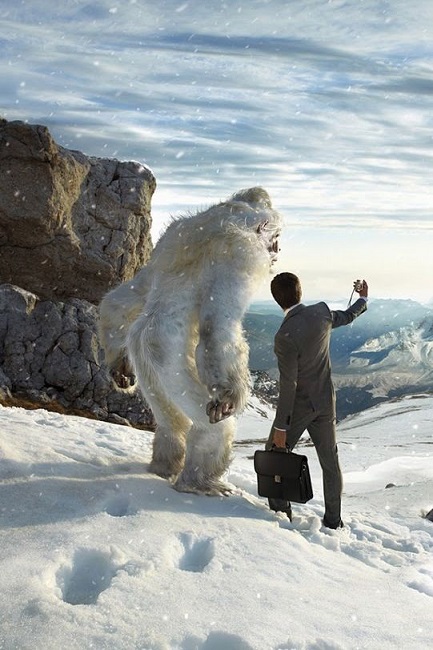
The NHL may soon have a rather sizeable cryptozoological presence on the ice as ‘Yeti’ has emerged as a possible name of a forthcoming franchise based in Utah. Team owners Smith Entertainment Group announced on Thursday that the proverbial abominable moniker was among the six finalists alongside the Utah Hockey Club, Mammoth, Outlaws, Blizzard, and Venom. For those who would like to see the legendary beast of the Himalayas come to the NHL, they can help make it happen as the ultimate decision on the new team’s name has been left up to the public with an online vote that ends on June 20th. Should ‘Yeti’ come out on top, it will actually be the second NHL team to be named after a cryptid as the Seattle franchise adopted the moniker ‘Kraken’ back in 2020.
Abbott and Costello Meet the Invisible Man is a 1951 American science fiction comedy film.

In the scene below Lou is faking practicing on the punching pear. The Invisible Man – a boxer – is actually doing the real punching.
Football teams with W as the logo on their helmets. Top left clockwise: Washington Commanders, Winnipeg Blue Bombers, Wisconsin Badgers and Washington Huskies.

 The MarkoZen Blog