Douglas Rain, Voice of HAL in 2001: A Space Odyssey, Dies at 90

Douglas Rain, voice of the computer HAL 9000 in the movie 2001: A Space Odyssey, died on Sunday morning. He was 90 years old.

Born in Canada, Rain started on the stage and was known in both the Canadian and British theater communities for his roles in William Shakespeare’s classics like Othello and Twelfth Night. But Rain is best known in the sci-fi community as the voice of HAL—a cold, monotone voice that immediately evokes fear in anyone who hears it.

Even if you’ve never seen Stanley Kubrick’s classic 1967 movie, you know the famous exchange between the astronaut David Bowman and HAL. “Open the pod bay doors, HAL,” Dr. Bowman says. “I’m sorry Dave, I’m afraid I can’t do that,” the HAL computer replies.

From NBC News:

Rain was born in Winnipeg, Manitoba, and trained at the Old Vic Theatre in London. In 1972, he was nominated for the Tony Award for Best Supporting or Featured Actor in a Drama for his performance as William Cecil in “Vivat! Vivat Regina!” on Broadway.

In 1953, he became a member of the first repertory cast of the Stratford Festival and performed in 32 seasons with the company.

According to Vincent Lobrutto’s 1997 study “Stanley Kubrick: A Biography,” Rain was initially contracted to narrate “2001″ after Kubrick heard his narration of the short documentary “Universe,” which was released by the National Film Board of Canada in 1960.

“Today we lost Douglas Rain, a member of our founding company and a hugely esteemed presence on our stages for 32 seasons. He will be greatly missed. Our thoughts and prayers are with his family,” the Stratford Festival in Ontario tweeted yesterday.

RIP Douglas Rain. You gave life to a character that will live on for generations to come; a character that served as a warning to those of us living in “the future.” Sadly, we didn’t listen. Or, if we did listen, we just didn’t care. Because HAL is now becoming real. The HAL of today just goes by a different name: Sometimes Siri, sometimes Alexa. And for those with a truly dark sense of humor, just HAL.

Chinese City May Get Fake Moon

amoon

An aerospace executive in China has announced plans to launch a satellite which would serve as an artificial moon designed to illuminate a city at night. The unorthodox idea was reportedly revealed by Wu Chunfeng, who heads one of the main contractors for the Chinese space agency, at a conference last week. According to him, the faux moon will hover over the city of Chengdu emitting a “dusk-like glow” which would eliminate the need for street lights.

The illumination from the satellite, he said, will be adjustable and could cover an area of land ranging from five to fifty miles in diameter. While the idea may sound fanciful to some, Chungfeng appears to be quite serious about the endeavor, explaining that the concept has been tested extensively for the last few years and now looks to be almost fully feasible. With that in mind, the executive is eying a 2020 launch for the fake moon.

Lest one have concerns about how the illumination will impact wildlife in the area, an aerospace professor was quick to assure Chinese media that it will not be a problem thanks to its similarity in intensity to twilight. Be that as it may, whether the residents of Chengdu want another moon is another matter altogether. Alas, they probably won’t have much of a say in the decision, so hopefully they won’t mind living under the light of a fake moon.

NASA contest finalists show off their Mars habitat models

They’ll now have to build a one-third-scale version of their designs.

mars1

Yes, we’ve yet to successfully send humans to Mars, but we already need to start thinking how we can stay there for long stretches of time — or even for good. NASA launched the 3D-Printed Habitat Challenge back in 2015 to find a suitable artificial housing for the first wave of Martian residents, and now the agency has narrowed the contestants down to five after seeing the realistic virtual models they created. The agency and its project partner, Illinois’ Bradley University, judged 18 teams’ models created using a specialized software.

According to TechCrunch, the software requires various details about the structures creators are designing. In other words, the teams couldn’t just come up with a concept that looks good — they had to make sure their habitats’ wall thickness, heating, pressure sealing and other elements can actually withstand harsh Martian conditions.

The five teams split a $100,000 cash pot earmarked for this stage of the competition, with the two top teams taking home $20,957.95 each. One of the top teams, Zopherus from Arkansas, has envisioned a habitat built by moving 3D printers that can deploy rovers to retrieve local materials for construction.

AI. SpaceFactory of New York designed a cylindrical habitat for max space usage.

Team Kahn-Yates of Jackson, Mississippi, which got third place, features a design with translucent dots to let the light in. It was also created to withstand Mars’ massive dust storms.

SEArch+/Apis Cor from New York prioritized creating a habitat that lets the light in but can provide strong radiation shielding.

Finally, Team Northwestern University from Illinois has conjured up a design that features a spherical shell with an outer parabolic dome. They also want to make building one as easy as possible by using an inflatable vessel as base for a 3D printer, so it can quickly print out a dome with cross beams.

The five teams now have to prove their ideas are feasible by 3D printing — autonomously, that is — part of their structures and to create a one-third-scale version of their design. Monsi Roman, NASA’s Centennial Challenges program manager, said: “We are thrilled to see the success of this diverse group of teams that have approached this competition in their own unique styles. They are not just designing structures, they are designing habitats that will allow our space explorers to live and work on other planets.”

Engadget.com


This luxury space hotel could be up and running in four years

NBC

hotelx

If road trips, theme parks, and beach resorts just don’t do it for you, how about a stay in a swanky space hotel?

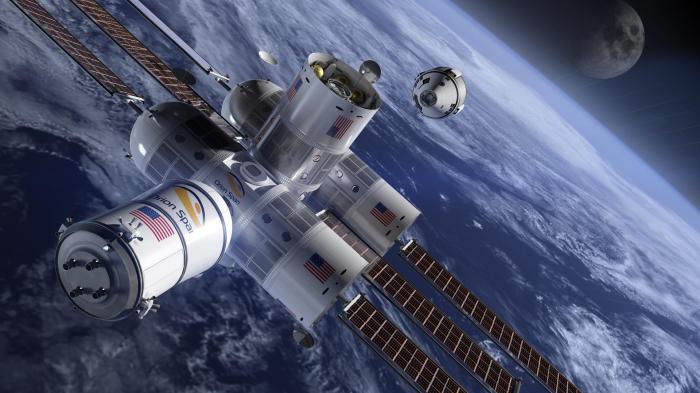
A Silicon Valley startup called Orion Span yesterday announced plans to open a luxury hotel in low-Earth orbit by 2022, and you can reserve a room for $80,000. Just be aware that that figure is only a down payment for a 12-day stay, which runs a stratospheric $9.5 million per person.

hotelx1

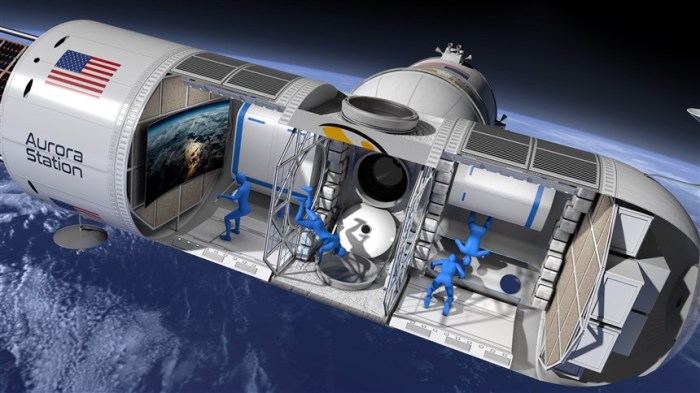
Dubbed Aurora Station, the orbiting inn will offer space tourists with deep pockets a chance to experience life like an astronaut. “That experience entails…growing food in space, running science experiments, doing astronaut certification,” said Orion Span CEO Frank Bunger. “At the end of the trip, we’re going to give them a hero’s welcome back home as well.”

But it won’t all be hard work. In addition to witnessing luminous auroras against the blackness of space and gazing down on Earth as it passes below at a distance of 200 miles, guests will be able to enjoy an onboard “holodeck” inspired by the one known to fans of “Star Trek.” And if you like sunrises and sunsets, you’re in luck: Guests will be able to see more than a dozen of each every day.

Orion Span said Aurora Station will be able to accommodate four guests at a time, plus two crew members to make sure things go smoothly. The company provided scant details about how guests will get to and from the hotel, but said they are evaluating potential partners now.

hotelx2


An amateur rocket-maker finally launched himself off Earth. Now to prove it’s flat …

Washington Post

Mike Hughes, a California man who is most known for his belief that the Earth is shaped like a Frisbee, finally blasted off into the sky in a steam-powered rocket he had built himself.

The 61-year-old limo driver and daredevil-turned-rocket-maker soared about 1,875 feet above the Mojave Desert on Saturday afternoon, the Associated Press reported. Hughes’s white-and-green rocket, bearing the words “FLAT EARTH,” propelled vertically about 3 p.m. Pacific time and reached a speed of about 350 mph, Waldo Stakes, who has been helping Hughes, told the AP. Hughes deployed two parachutes while landing, the second one just moments before he plopped down not far from his launching point.

A video shows that the whole endeavor, from the moment his rocket went up to the moment he landed, lasted about a minute.

flat2

The vertical launch, which happened without a countdown more than 200 miles east of Los Angeles, came amid growing skepticism that Hughes would ever lift himself off. The launch had been postponed multiple times, partly because Hughes said he couldn’t get permission from a federal agency to conduct it on public land.

After he landed Saturday, Hughes told the AP that he was “relieved” but that he expected to feel the physical toll of it all the next day.

“Am I glad I did it? Yeah. I guess. I’ll feel it in the morning. I won’t be able to get out of bed,” he said. “At least I can go home and have dinner and see my cats tonight.”

He also said he’d been frustrated with assumptions that he “chickened out,” so he “manned up and did it.”

Hughes had been on a mission to prove that the Earth is flat and that NASA astronauts such as John Glenn and Neil Armstrong were merely paid actors performing in front of a computer-generated image of a round globe. His previous failed attempts, as well as the successful one on Saturday, are all part of his ultimate goal to propel himself at least 52 miles above Earth by the end of the year — and to prove once and for all that the planet is flat.

flat

According to the AP, Hughes’s hard landing on Saturday left him injured, though it is unclear what type of injuries he suffered. Photos show paramedics carrying Hughes on a stretcher and into an ambulance.

Also among Hughes’s plans — aside from trying to get to space — is to run for governor.

“This is no joke,” he told the AP. “I want to do it.”

flat1

Got to admit, the guy’s got balls.


Asteroid-Sampling Spacecraft Captures Haunting View of Earth in Space

Earth and Moon seen from 3 million miles away on October 2, 2017. (NASA/OSIRIS-REx team and the University of Arizona)

Smithsonianmag.com

OSIRIS-REx tested its cameras by taking a gorgeous photo of its home planet

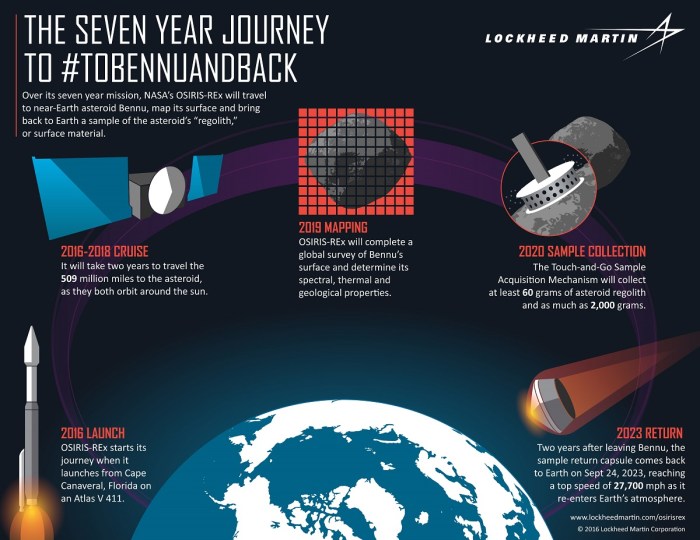
The image comes from spacecraft OSIRIS-REx—an acronym for Origins, Spectral Interpretation, Resource Identification, and Security-Regolith Explorer—which is on a mission to study the asteroid Bennu. When it arrives in December 2018, it will map the space rock, then capture a sample to return to Earth by 2023. The mission will help scientists better understand asteroids, which can provide clues into the formation of our solar system. But the study is also a stepping-stone on NASA’s longer journey to develop the skills and technology to mine asteroids in space.

OSIRIS-REx launched in September 2016, using Earth as a slingshot the following year for help redirecting its path to Bennu. During the maneuver, it turned its mid-range scientific camera MapCam towards the Earth, snapping some pics of our planet in space.

The above image is a composite of photographs captured on October 2, 2017. The images were taken using three color filters, then the contrast on the moon was stretched to make it brighter and more visible. Although pretty, the true purpose of the photograph was pragmatic, reports Emily Lakdawalla for The Planetary Society: to test the instruments, and to train them on Earth data to help calibrate them in advance of the spacecraft’s arrival at Bennu.

The camera captured the image when the spacecraft was 3,180,000 miles from planet—just over thirteen times the distance between the Earth and the Moon. However, because of of the spacecraft’s angle of retreat, Akshat Rathi calculated for Quartz, duo appear closer together than they actually are.

The simple image is a captivating reminder that each of Earth’s creatures—and every one that came before—all share this delicate outpost in the vast, dark vacuum of space.

OREX Infographic

Test flight by Jeff Bezos-owned Blue Origin puts company big step closer to offering space tourism

CBS News

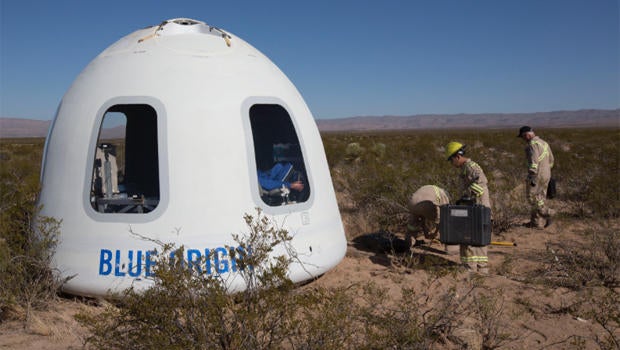
Blue Origin engineers check out a New Shepard crew capsule after a successful unpiloted test flight on December 12, 2017, the company’s sixth successful launch in a row; it was the first flight of an upgraded capsule featuring the large windows designed to give future space tourists panoramic views

 BLUE ORIGIN

Blue Origin, owned by Amazon founder Jeff Bezos, launched a reusable New Shepard sub-orbital rocket from the company’s west Texas launch site Tuesday, boosting an unpiloted crew capsule out of the dense lower atmosphere for a brief foray into space before a parachuted descent to Earth.

The booster, meanwhile, plunged back to the launch site tail first, re-starting its hydrogen-fueled BE-3 main engine to slow down, deploying four legs and settling to a picture-perfect touchdown on a circular landing pad.

The launching, the first using an upgraded booster and a crew capsule equipped with the large windows that will offer space tourists spectacular panoramic views, was carried out in secrecy, and Blue Origin did not acknowledge the flight until around 11 p.m. EST.

“Successful first flight of #NewShepard today with the largest windows in space and commercial payloads on board,” Blue Origin tweeted. “Wholly successful mission.”

Added Bezos: “#NewShepard had a successful first flight of Crew Capsule 2.0 today. Complete with windows and our instrumented test dummy. He had a great ride.”

121217-nslaunch.jpg

The New Shepard rocket returns to Earth with a rocket-powered touchdown on December 12, 2017

 BLUE ORIGIN


The crew capsule was released after the booster’s engine shut down, soaring to an altitude of 322,000 feet — about 61 miles — before arcing back toward Earth. Small drogue chutes deployed to stabilize the spacecraft followed by three large chutes that slowed the ship for a gentle 1-mph touchdown near the launch site.

The booster, flying on its own, steered itself back to a rocket-powered touchdown, kicking up a cloud of dust as it descended to an on-target landing.

It was Blue Origin’s seventh New Shepard flight overall and it’s sixth success in a row. It was the company’s first test flight since a dramatic launch Oct. 5, 2016, that simulated an in-flight abort and its first using a new, upgraded booster and a crew capsule equipped with windows.

121217-nslanding.jpg

The New Shepard crew capsule descends to Earth under parachutes after reaching the edge of space in a sub-orbital test flight on December 12, 2017

 BLUE ORIGIN

“Crew Capsule 2.0 features large windows, measuring 2.4 feet wide, 3.6 feet tall,” the company said in a caption to its YouTube video. “(It) also included 12 commercial, research and education payloads onboard.”

Blue Origin is developing the reusable New Shepard rocket and spacecraft to carry up to six space tourists, researchers and/or experiments on brief sub-orbital flights above the discernible atmosphere more than 62 miles up, or 100 kilometers. That’s the somewhat arbitrary but widely recognized “boundary” of space.

Once released from the booster, passengers in the relatively spacious crew cabin will experience four to five minutes of weightlessness as the spacecraft arcs over and begins falling back to Earth, enjoying a spectacular panoramic view through the largest windows ever designed for spaceflight.

Plunging back into the dense lower atmosphere, passengers will experience up to five times the pull of gravity at sea level before the parachutes deploy for landing.

Assuming continued testing goes well, Blue Origin hopes to being launching passengers within the next year-and-a-half or so. No word yet on how much a ticket might cost.