A sizeable spiral that appeared in the night sky over Britain and parts of Europe sparked alien speculation among some awestruck observers, though the wondrous sight wound up having a terrestrial origin. The huge blue illumination was reportedly seen by countless witnesses on Monday night as it slowly formed overhead and vanished after a few minutes. Unsurprisingly, social media was soon flooded with photos and videos of the spellbinding spiral with many wondering if the eerie whirlpool of light was otherworldly in nature.
Fortunately, fears of an impending alien invasion were soon assuaged by authorities and scientists who indicated that the spiral was no cause for alarm. Specifically, it was explained that the weird whirlpool came from a SpaceX Falcon 9 rocket that had taken to the sky earlier in the day. While such sights have become more commonplace with the increase in private space launches in recent years, much like Starlink satellites they continue to befuddle those on the ground who have yet to get the proverbial memo about the source of the odd aerial scenes.
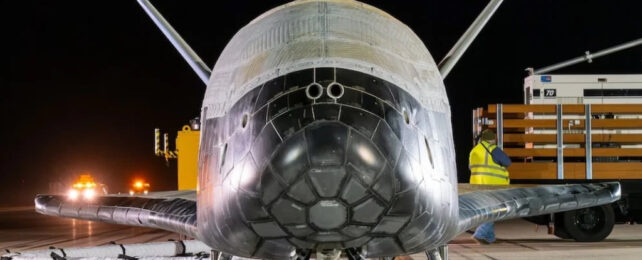
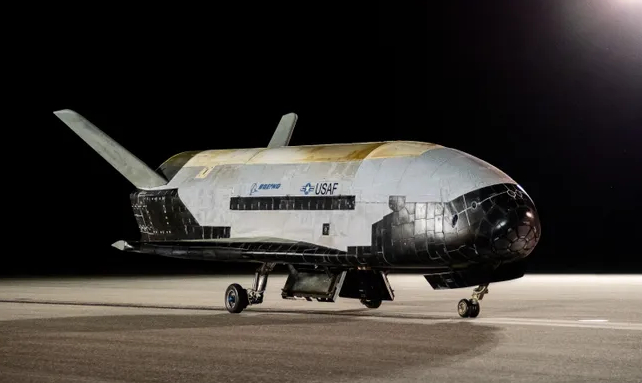
The X-37B is a reusable robotic space plane operated by the US Space Force. It resembles a miniature space shuttle at just under 9 metres long with a 4.5 metre wingspan and is an uncrewed vehicle designed for long-duration missions in low Earth orbit.
The craft launches vertically atop a rocket, lands horizontally like a conventional aircraft and serves as a testbed for new technologies and experiments that can be returned to Earth for analysis.
The US Space Force’s X-37B space plane is seen shortly after landing at NASA’s Kennedy Space Center on 12 November 2022, bringing an end to its OTV-6 mission. (Boeing/US Space Force)
It’s development was a collaborative effort between NASA, Boeing, and the US Department of Defence. It was originally conceived by NASA in the late 1990s to explore reusable spaceplane technologies but transitioned to the US Air Force in 2004 for military purposes.
The X-37B mission profiles remain classified but the Space Force acknowledges that it conducts experiments related to advanced guidance systems, thermal protection materials, autonomous orbital operations, and various payloads for the Department of Defence and NASA.
Since its first launch in 2010, the X-37B has now completed seven successful missions, extending its mission length with each flight and demonstrating amazing versatility for technology development.
Landing at the Vandenberg Space Force Base in California earlier this week , the X-37B showed how it can launch quickly and recover systems from various locations.
This 7th mission also marked the first time it was launched on a SpaceX Falcon Heavy Rocket into a Highly Elliptical Orbit. It’s an impressive fact that the Falcon has the capacity to launch ten, yes ten, of the X-37B planes at once!
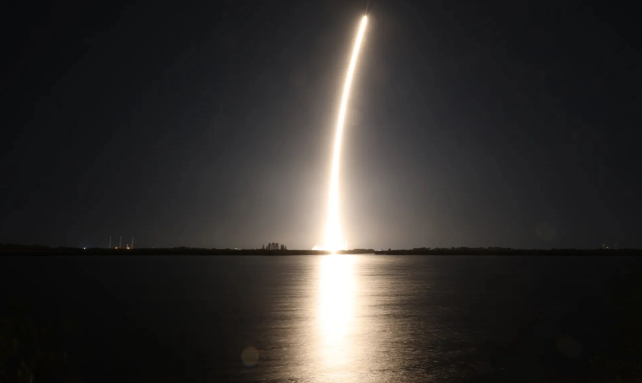
SpaceX Falcon Heavy launch. (SpaceX)
During this mission, just one was launched and it conducted numerous tests and experiments to demonstrate its advanced manoeuvring abilities (having demonstrated its aerobraking manoeuvre – using atmospheric drag over multiple passes to adjust orbit with minimal fuel burn) and enhance understanding of the space domain through space domain awareness technology.
It means that the space plane can detect and track objects in space making it useful for satellite and space debris monitoring and identification of potential threats to other objects in orbit.
The awareness of the space domain and the technology that enables this capability enhances the Space Force’s understanding of the space environment which is vital for operating in an increasingly crowded region of space.
After performing its aerobraking manoeuvre to enter Low Earth Orbit, the mission completed its objectives and safely returned to Earth. Lt. Col. Blaine Stewart praised Mission 7’s achievements, highlighting its contributions to advancing the X-37B program.
2024 YR4 turned heads when it became the most dangerously rated asteroid earlier this week.
The potentially hazardous asteroid 2024 YR4 caused consternation over the last few weeks as its odds of hitting Earth in 2032 dramatically rose. Now, those odds have plummeted to near-zero, as astronomers’ calculations of the asteroid’s path have been updated to indicate that Earth is almost certainly not in the space rock’s plans.
Almost. According to NASA’s Center for Near-Earth Object Studies (CNEOS), the asteroid’s current chance of hitting the planet in 2032 is 0.28%, or a 1-in-360 shot. That is a far cry from just earlier this week, when models had the asteroid’s impact probability at a staggering 3.1%, or 1-in-32 odds. It’s safe to say we’re out of the woods—but perhaps still in the backyard of uncertainty? A beleaguered analogy, but suffice it to say that the odds are not zero—but the sudden plummet from such a (relatively) high probability is a sigh of relief.
Though 2024 YR4 isn’t a gigantic asteroid—its size estimates range from 130 to 300 feet wide (40 to 90 meters)—it still is large enough to destroy a large city or region if hit Earth. It just wouldn’t cause a global cataclysm. Hardly reassuring stuff. The asteroid’s impact probability made it a 3 on the Torino Impact Hazard Scale, which measures the danger posed by asteroids. Torino 3s have “a 1% or greater chance of collision capable of localized destruction,” according to CNEOS.
Since the asteroid’s impact odds are now 1-in-360, the asteroid’s Torino risk is rated 1, meaning a “routine discovery in which a pass near the Earth is predicted that poses no unusual level of danger. Current calculations show the chance of collision is extremely unlikely with no cause for public attention or public concern.”
When 2024 YR4’s odds rose earlier this week, it became more hazardous than the head-turning asteroid Apophis, which was one of the most hazardous asteroids when discovered in 2004, but was found in 2021 to not be at risk of hitting Earth for at least a century.
The Asteroid Terrestrial-impact Last Alert System (ATLAS) first spotted 2024 YR4 just after Christmas, when the rock was 515,116 miles (829,000 kilometers) from Earth. Within a month, the asteroid’s odds crept up to a 1.2% chance—which sounds small, but is still a serious number when we’re talking about the chances of an asteroid with the potential to raze an entire city or region on our verdant little world. The odds kept growing, from a 1.58% chance of impact on February 2 to a 2.2% chance of striking on February 10.
But as experts told Gizmodo, this steady movement in the odds was expected. That’s because, as astronomers narrowed the range of potential paths for the asteroid, Earth remained in it. So while the total pool of paths shrank, Earth’s placement in the path meant its footprint covered more of the total possible area. Now, the asteroid’s potential path window has shrunk enough that it seems very unlikely that the rock will hit Earth.
An exceptionally skillful photograph of a SpaceX Falcon Heavy rocket passing in front of the moon took home top prize at the Sony World Photography Awards 2024.
A SpaceX Falcon Heavy rocket transits the full moon during the launch of USSF-52, Dec. 28, 2023. (Image credit: Pascal Fouquet, United States, Winner, National Awards, Sony World Photography Awards 2024)
A rocket transiting the moon is a pretty rare sight. Capturing a good photo of that kind of transit takes some serious skill.
That skill is worthy of some major praise. Pascal Fouquet, a photographer from Orlando, Florida, captured such a shot, and was chosen as the United States’ National Award first place winner for the Sony World Photography Awards 2024. The awards program comes out of a partnership between Sony and the World Photography Organization, and receives hundreds of thousands of photo submission from across the globe.
Fouquet captured his winning shot of a SpaceX Falcon Heavy rocket passing in front of the moon just before the new year, when SpaceX launched the United States Space Force X-37B spaceplane on the USSF-52 mission. The uncrewed X-37B spacecraft lifted off atop Falcon Heavy from NASA’s Kennedy Space Center (KSC) in Florida on Dec. 28, at 8:07 p.m. EST (0107 GMT on Dec. 29).
50 years ago Ed White became the first American to step into space.
June 3, 1965
Astronaut Edward H. White II, pilot for the Gemini-Titan 4 space flight, floats in space during America’s first spacewalk. The extravehicular activity (EVA) was performed during the Gemini 4 mission on June 3, 1965. White spent 23 minutes maneuvering around his spacecraft as Jim McDivitt remained inside the spacecraft. White is attached to the spacecraft by a 25-foot umbilical line and a 23-foot tether line, both wrapped in gold tape to form one cord. In his right hand, White carries a Hand-Held Self Maneuvering Unit (HHSMU), which he used to help move him around the weightless environment of space. The visor of his helmet is gold plated to protect him from the unfiltered rays of the sun.
–
It’s half a century since Ed White became the first American to step into space, in 1965. Now an almost routine part of any space mission, the EVA (Extra Vehicular Activity), or “spacewalk” was once a hazardous procedure.
During the 1950s and 1960s, the USSR scored a few early firsts in the Space Race: first satellite (Sputnik 1); first man in space (Yuri Gagarin); and first spacewalk (Alexei Leonov on March 8, 1965).
Leonov encountered many difficulties during his own spacewalk. He could only maneuver by pulling on the umbilical cord that tethered him to the spacecraft, and his suit over-inflated in the vacuum of space. Leonov had to bleed some oxygen from the suit to be able to get back in the hatch. The extent of these problems was not revealed until after the end of the Cold War.
–
June 3, 1965
Ed White over the Gulf of Mexico.
–
NASA scheduled its first spacewalk to take place during the Gemini 4 mission. On June 3, 1965, Ed White left the Gemini spacecraft and, with the aid of a Hand-Held Self Manoeuvring Unit (HHSMU), or “zip gun,” White was able to move 15 feet (5 meters) from the craft.
Communication problems meant White had to be actively ordered to re-enter the spacecraft. Opening and closing the hatch was problematic, and a planned dump into space of White’s used spacewalk equipment was abandoned.
Several more spacewalks were performed during the Gemini missions, but the astronauts tired quickly and experienced overheating. It was Buzz Aldrin who first overcame these problems, working for just over two hours outside Gemini 12. Aldrin’s experiences as a scuba diver inspired NASA’s move to training astronauts for spacewalks in large water tanks to simulate the weightlessness of space.
–
Nov. 12, 1966
Edwin E. Aldrin Jr., pilot of the Gemini 12 spacecraft, performs extravehicular activity (EVA) during the second day of the four-day mission in space. Aldrin is positioned next to the Agena work station.
–
With the advent of the space shuttle, spacewalks became routine. In 1983, NASA astronauts began using the Extravehicular Mobility Unit (EMU), a self-contained life support device. The Shuttle Remote Manipulator System (SRMS), also known as Canadarm, was developed by Canada and delivered to NASA in 1981, the first of five such arms. This machine could be used as an anchor for astronauts during spacewalks.
On Feb. 7, 1984, the Manned Manoeuvring Unit (MMU) was deployed. For the first time, this allowed an astronaut to work untethered. Using the MMU, Bruce McCandless became the first astronaut to fly free in space, moving 320 feet (98 meters) away from the shuttle.
In 2001, Susan Helms and James Voss set the record for the spacewalk with the longest duration, at eight hours and 56 minutes.
–
Mar. 6, 1969
Apollo 9 Command/Service Modules (CSM), nicknamed “Gumdrop,” and Lunar Module (LM), nicknamed “Spider,” are shown docked together as Command Module Pilot David R. Scott stands in the open hatch. Astronaut Russell L. Schweickart, Lunar Module pilot, took this photograph of Scott during his EVA as he stood on the porch outside the Lunar Module. Apollo 9 was an Earth orbital mission designed to test docking procedures between the CSM and LM, as well as test fly the Lunar Module in the relative safe confines of Earth orbit.
–
Feb. 12, 1984
Mission Specialist Bruce McCandless II, is seen further away from the confines and safety of his ship than any previous astronaut had ever been. This space first was made possible by the Manned Manuevering Unit or MMU, a nitrogen jet propelled backpack. After a series of test maneuvers inside and above Challenger’s payload bay, McCandless went “free-flying” to a distance of 320 feet away from the Orbiter.
–
Sept. 16, 1994
Astronauts Carl J. Meade and Mark C. Lee (red stripe on suit) test the Simplified Aid for EVA Rescue (SAFER) system some 130 nautical miles from Earth. The pair were actually performing an in-space rehearsal or demonstration of a contingency rescue using the never- before-flown hardware. Meade, who here wears the small backpack unit with its complementary chest-mounted control unit, and Lee, anchored to Discovery’s Remote Manipulator System (RMS) robot arm, took turns using the SAFER hardware during their shared space walk.
–
Sep. 16, 1995
The pale blue Earth serves as backdrop for astronaut Michael Gernhardt during his Extravehicular Activity (EVA). He is standing on a Manipulator Foot Restraint (MFR) attached to the Remote Manipulator System (RMS). He is positioned over the Payload Bay, and Endeavour’s forward section is reflected in his visor. A thermal cube is attached to the RMS and records temperatures during spacesuit evaluations. Unlike earlier spacewalking astronauts, Gernhardt was able to use an electronic cuff checklist, a prototype developed for the assembly of the International Space Station (ISS).
–
Nov. 14, 1984
Astronaut Dale A. Gardner, having just completed the major portion of his second extravehicular activity (EVA) period in three days, holds up a “For Sale” sign referring to the two satellites, Palapa B-2 and Westar 6, that they retrieved from orbit after their Payload Assist Modules (PAM) failed to fire. Astronaut Joseph P. Allen IV, who also participated in the two EVAs, is reflected in Gardner’s helmet visor. A portion of each of two recovered satellites is in the lower right corner, with Westar 6 nearer Discovery’s aft.
–
Russian cosmonaut conducting maintenance on the ISS








 The MarkoZen Blog