SEAL Team 6: still on the hunt

New York Times

6a

SEAL Team 6: A Secret History of Quiet Killings and Blurred Lines

The unit best known for killing Osama bin Laden has been converted into a global manhunting machine with limited outside oversight.

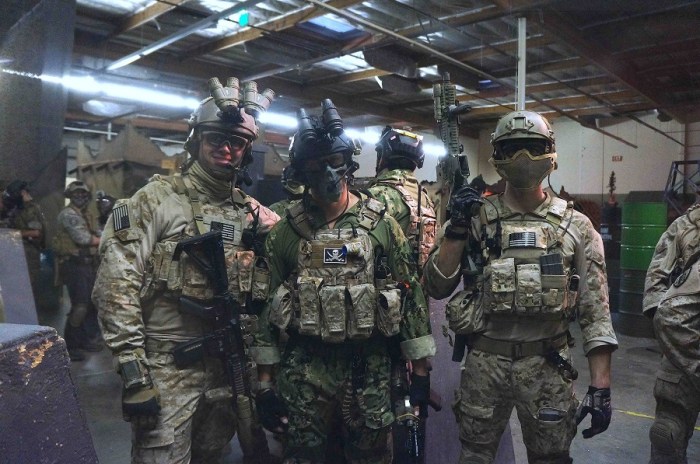
They have plotted deadly missions from secret bases in the badlands of Somalia. In Afghanistan, they have engaged in combat so intimate that they have emerged soaked in blood that was not their own. On clandestine raids in the dead of the night, their weapons of choice have ranged from customized carbines to primeval tomahawks.

Around the world, they have run spying stations disguised as commercial boats, posed as civilian employees of front companies and operated undercover at embassies as male-female pairs, tracking those the United States wants to kill or capture.

Those operations are part of the hidden history of the Navy’s SEAL Team 6, one of the nation’s most mythologized, most secretive and least scrutinized military organizations. Once a small group reserved for specialized but rare missions, the unit best known for killing Osama bin Laden has been transformed by more than a decade of combat into a global manhunting machine.

That role reflects America’s new way of war, in which conflict is distinguished not by battlefield wins and losses, but by the relentless killing of suspected militants.

Almost everything about SEAL Team 6, a classified Special Operations unit, is shrouded in secrecy — the Pentagon does not even publicly acknowledge that name — though some of its exploits have emerged in largely admiring accounts in recent years. But an examination of Team 6’s evolution, drawn from dozens of interviews with current and former team members, other military officials and reviews of government documents, reveals a far more complex, provocative tale.

While fighting grinding wars of attrition in Afghanistan and Iraq, Team 6 performed missions elsewhere that blurred the traditional lines between soldier and spy. The team’s sniper unit was remade to carry out clandestine intelligence operations, and the SEALs joined Central Intelligence Agency operatives in an initiative called the Omega Program, which offered greater latitude in hunting adversaries.

Team 6 has successfully carried out thousands of dangerous raids that military leaders credit with weakening militant networks, but its activities have also spurred recurring concerns about excessive killing and civilian deaths.

Afghan villagers and a British commander accused SEALs of indiscriminately killing men in one hamlet; in 2009, team members joined C.I.A. and Afghan paramilitary forces in a raid that left a group of youths dead and inflamed tensions between Afghan and NATO officials. Even an American hostage freed in a dramatic rescue has questioned why the SEALs killed all his captors.
6b

When suspicions have been raised about misconduct, outside oversight has been limited. Joint Special Operations Command, which oversees SEAL Team 6 missions, conducted its own inquiries into more than a half-dozen episodes, but seldom referred them to Navy investigators. “JSOC investigates JSOC, and that’s part of the problem,” said one former senior military officer experienced in special operations, who like many others interviewed for this article spoke on the condition of anonymity because Team 6’s activities are classified.

Waves of money have sluiced through SEAL Team 6 since 2001, allowing it to significantly expand its ranks — reaching roughly 300 assault troops, called operators, and 1,500 support personnel — to meet new demands. But some team members question whether the relentless pace of operations has eroded the unit’s elite culture and worn down Team 6 on combat missions of little importance. The group was sent to Afghanistan to hunt Qaeda leaders, but instead spent years conducting close-in battle against mid- to low-level Taliban and other enemy fighters. Team 6 members, one former operator said, served as “utility infielders with guns.”

The cost was high: More members of the unit have died over the past 14 years than in all its previous history. Repeated assaults, parachute jumps, rugged climbs and blasts from explosives have left many battered, physically and mentally.

“War is not this pretty thing that the United States has come to believe it to be,” said Britt Slabinski, a retired senior enlisted member of Team 6 and veteran of combat in Afghanistan and Iraq. “It’s emotional, one human being killing another human being for extended periods of time. It’s going to bring out the worst in you. It’s also going to bring out the best in you.”

Team 6 and its Army counterpart, Delta Force, have delivered intrepid performances that have drawn the nation’s two most recent presidents to deploy them to an expanding list of far-off trouble spots. They include Syria and Iraq, now under threat from the Islamic State, and Afghanistan, Somalia and Yemen, mired in continuing chaos.

Like the C.I.A.’s campaign of drone strikes, Special Operations missions offer policy makers an alternative to costly wars of occupation. But the bulwark of secrecy around Team 6 makes it impossible to fully assess its record and the consequences of its actions, including civilian casualties or the deep resentment inside the countries where its members operate. The missions have become embedded in American combat with little public discussion or debate.
6c

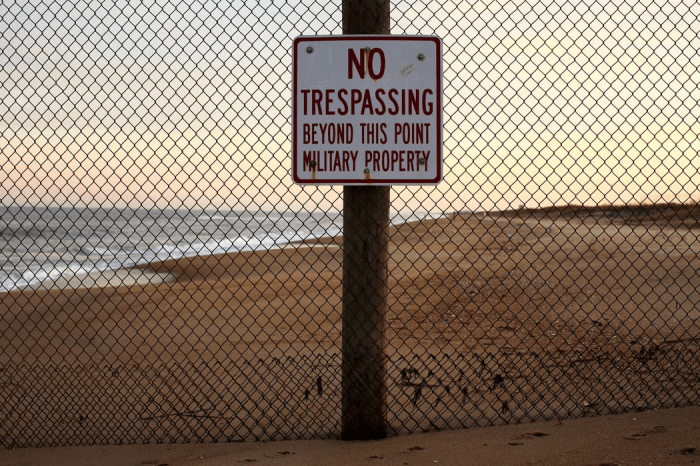
SEAL Team 6’s headquarters are just south of Virginia Beach, in an area closed off to the public. Credit Travis Dove for The New York Times

While declining to comment specifically on SEAL Team 6, the United States Special Operations Command said that since the Sept. 11, 2001, attacks, its forces “have been involved in tens of thousands of missions and operations in multiple geographic theaters, and consistently uphold the highest standards required of the U.S. Armed Forces.”

But others warn of the seduction of an endless campaign of secret missions, far from public view. “If you’re unacknowledged on the battlefield,” said William C. Banks, an expert on national security law at Syracuse University, “you’re not accountable.”

6d

A Heckler & Koch MP7 firearm, top, fitted with a suppressor to reduce muzzle flashes and sounds, and an MP5, a submachine gun widely used by law enforcement officers. In the American military, the MP7 is used only by Delta Force and SEAL Team 6. Some police SWAT teams have also bought it. Credit Doug Mills/The New York Times     

The Culture

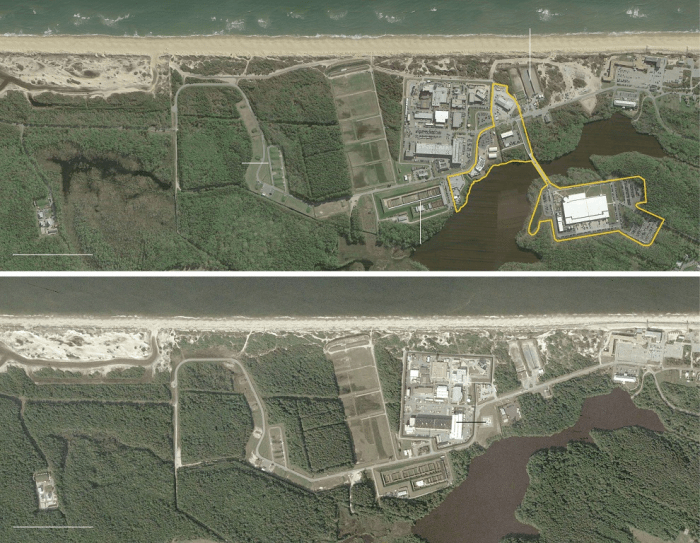
SEAL Team 6’s fenced-off headquarters at the Dam Neck Annex of the Oceana Naval Air Station, just south of Virginia Beach, houses a secretive military within the military. Far removed from the public eye, the base is home not just to the team’s 300 enlisted operators (they disdain the term “commandos”), their officers and commanders, but also to its pilots, Seabee builders, bomb disposal technicians, engineers, medical crews and an intelligence unit equipped with sophisticated surveillance and global tracking technology.
6e

SEAL Team 6 headquarters in Virgin. Top photo shows expansion of the facility in the last few years.

The Navy SEALs — the acronym stands for Sea, Air, Land forces — evolved from the frogmen of World War II. Team 6 arose decades later, born out of the failed 1980 mission to rescue 53 American hostages seized in the takeover of the United States Embassy in Tehran. Poor planning and bad weather forced commanders to abort the mission, and eight servicemen died when two aircraft collided over the Iranian desert.

He flouted rules and fostered a maverick image for the unit. (Years after leaving the command, he was convicted of military contract fraud.) In his autobiography, “Rogue Warrior,” Commander Marcinko describes drinking together as important to SEAL Team 6’s solidarity; his recruiting interviews often amounted to boozy chats in a bar.

Inside Team 6, there were initially two assault groups, called Blue and Gold, after the Navy colors. Blue used the Jolly Roger pirate flag as its insignia and early on earned the nickname “the Bad Boys in Blue,” for racking up drunken driving arrests, abusing narcotics and crashing rental cars on training exercises with near impunity.

Young officers sometimes were run out of Team 6 for trying to clean up what they perceived as a culture of recklessness. Adm. William H. McRaven, who rose to head the Special Operations Command and oversaw the Bin Laden raid, was pushed out of Team 6 and assigned to another SEAL team during the Marcinko era after complaining of difficulties in keeping his troops in line.

Ryan Zinke, a former Team 6 officer and now a Republican congressman from Montana, recalled an episode after a team training mission aboard a cruise liner in preparation for potential hostage rescues at the 1992 Summer Olympics in Barcelona, Spain. Mr. Zinke escorted an admiral to a bar in the ship’s lower level. “When we opened the door, it reminded me of ‘Pirates of the Caribbean,’” Mr. Zinke said, recalling that the admiral was appalled by the operators’ long hair, beards and earrings. “My Navy?” the admiral asked him. “These guys are in my Navy?”

That was the beginning of what Mr. Zinke referred to as “the great bloodletting,” when the Navy purged Team 6’s leadership to professionalize the force. Current and former Team 6 operators said the culture was different today. Members now tend to be better educated, more athletic, older and more mature — though some are still known for pushing limits.

“I got kicked out of the Boy Scouts,” said one former officer. Most Team 6 SEALs, he added, “were like me.”

Delta Force members, who have a reputation for going by the book, often start out as regular infantry, then move up through the Army’s Ranger units and Special Forces teams before joining Delta. But SEAL Team 6 is more isolated from the rest of the Navy, with many of its men entering the brutal SEAL training pipeline from outside the military.

After several years on regular SEAL teams — the even-numbered ones based in Virginia Beach, the odd-numbered ones in San Diego, and a unit in Hawaii dedicated to mini-submarines — SEALs can try out for Team 6. Many are eager to get to the most elite unit, but about half of them wash out.

Officers rotate through Team 6, sometimes returning for several tours, but the enlisted SEALs typically stay far longer, giving them outsize influence. “A lot of the enlisted guys think that they really run the show,” said one former senior member. “That’s part of the Marcinko style.”

And they tend to swagger, critics and defenders say. While the other SEAL teams (called “white” or “vanilla” SEALs within the military) perform similar tasks, Team 6 pursues the highest value targets and takes on hostage rescues in combat zones. It also works more with the C.I.A. and does more clandestine missions outside war zones. Only Team 6 trains to chase after nuclear weapons that fall into the wrong hands.

Latitude to Kill

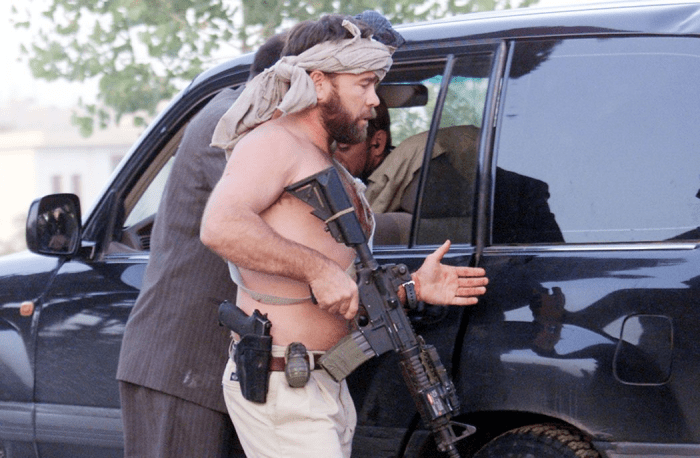
Early on in the Afghan war, SEAL Team 6 was assigned to protect the Afghan leader Hamid Karzai; one of the Americans was grazed in the head during an assassination attempt on the future president. But in the years that followed, Mr. Karzai became a bitter critic of the United States Special Operations troops, complaining that they routinely killed civilians in raids. He viewed the activities of Team 6 and other units as a boon for Taliban recruiting and eventually tried to block night raids entirely.
6f

SEAL Team 6 was assigned to protect the Afghan leader Hamid Karzai. After an assassination attempt in 2002 in Kandahar, a team member whose head was wounded used his shirt to stanch the bleeding.

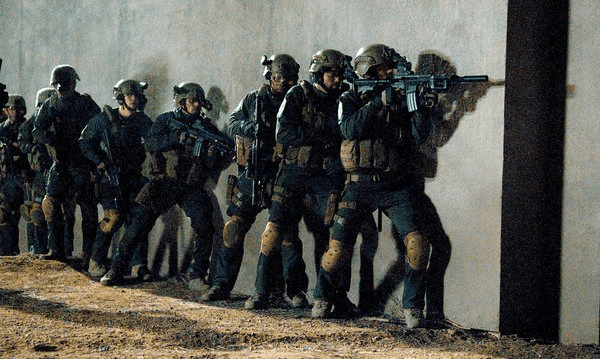
Most missions were not lethal. Several Team 6 members said they herded women and children together and knocked men out of the way, with a push or a gun muzzle, to search homes. They frequently took prisoners; a number of detainees had broken noses after SEALs punched them in struggles to subdue them, one officer said.

The Team 6 members often operate under the watchful eyes of their commanders — officers at overseas operations centers and at Dam Neck can routinely view live surveillance feeds of raids provided by drones high above — but are also given wide latitude. While Special Operations troops functioned under the same rules of engagement as other military personnel in Afghanistan, Team 6 members routinely performed their missions at night, making life-or-death decisions in dark rooms with few witnesses and beyond the view of a camera.

Operators would use weapons with suppressors to quietly kill enemies as they slept, an act that they defend as no different from dropping a bomb on an enemy barracks. “I snuck into people’s houses while they were sleeping,” Mr. Bissonnette says in his book “No Hero,” written under the pseudonym Mark Owen. “If I caught them with a gun, I killed them, just like all the guys in the command.”

And their decisions tend to be certain. Noting that they shoot to kill, a former noncommissioned officer added that the operators fire “security rounds” into those who are down to ensure that they are dead. (In a 2011 mission on a hijacked yacht off the coast of Africa, one Team 6 member slashed a pirate with a knife and left 91 wounds, according to a medical examiner, after the man and other attackers killed four American hostages. Operators are trained “to slice and dice every major artery,” said one former SEAL.)

After years of refining techniques to sneak up on enemy compounds, Team 6 members were often required to “call out” before attacking a site, akin to a sheriff announcing through a bullhorn, “Come out with your hands up.”

One Operator said that civilian casualties occurred most often during the “call out” operations, which were meant to mitigate exactly such losses. Enemy combatants, he said, would sometimes send out family members and then shoot from behind them, or give civilians flashlights and tell them to point out American positions.

Mr. O’Neill, the former Team 6 member, agreed that the rules could be frustrating. “What we found was, the more latitude for collateral damage that they gave us, the more effective we were because we’re not going to take advantage of it but we know we’re not going to be second-guessed,” he said in an interview. “When there were more rules, it did get more difficult.”
6g

 Rescues

The first high-profile rescue came in 2003, when SEAL Team 6 operators helped retrieve Pfc. Jessica Lynch, who had been injured, captured and held in a hospital, during the early days of the Iraq war.

Six years later, Team 6 members jumped out of cargo planes into the Indian Ocean with their specially designed assault boats in advance of the mission to rescue Richard Phillips, the captain of the Maersk Alabama, a container ship hijacked by Somali pirates. The operators, captured in a video shown by Mr. O’Neill, parachuted with swim fins strapped over their boots after releasing four boats — small, fast and equipped with stealth features to evade radar — that were each suspended by a canopy of multiple parachutes. SEAL snipers eventually killed three of the pirates.

In 2012, operators sky-dived into Somalia to free an American aid worker, Jessica Buchanan, and her Danish colleague, Poul Hagen Thisted. JSOC considers its performance as the standard for such missions. The SEALs used a free-fall parachuting technique called “HAHO,” for high altitude-high opening, in which they jump from a high altitude and steer their way on the wind for many miles to cross a border secretly, an exercise so risky that over the years several men died while in training.

6h

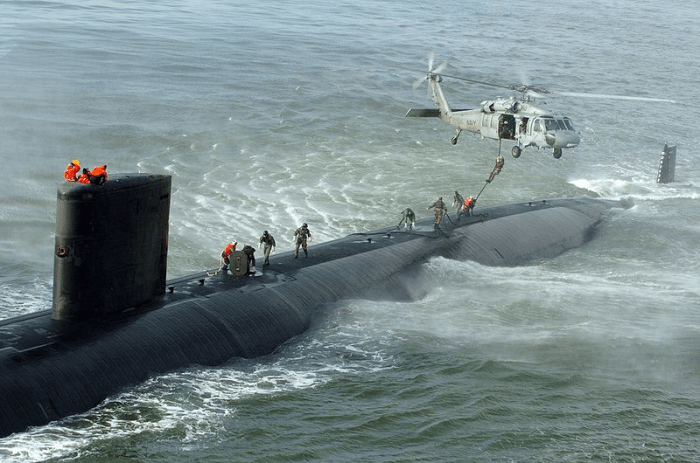
SEALS transferring to a sub

A Global Spying Force

From a string of firebases along the Afghan border, Team 6 regularly sent Afghan locals into the tribal areas of Pakistan to collect intelligence. The team transformed the large, brightly painted “jingle” trucks popular in the region into mobile spying stations, hiding sophisticated eavesdropping equipment in the back of the trucks and using Pashtuns to drive them over the border.

Outside the mountains of Pakistan, the team also ventured into the country’s southwest desert, including the volatile Baluchistan region. One mission nearly ended in disaster when militants fired a rocket-propelled grenade from a doorway, causing the roof of their compound to collapse and a Team 6 sniper atop it to fall through onto a small group of fighters. A fellow American sniper nearby quickly killed them, one former operator recounted.

Beyond Afghanistan and Pakistan, members of Team 6’s Black Squadron were scattered around the world on spying missions. Originally Team 6’s sniper unit, Black Squadron was reconfigured after the Sept. 11 attacks to conduct “advance force operations,” military jargon for intelligence gathering and other clandestine activities in preparation for a Special Operations mission.

It was a particularly popular concept at the Pentagon under former Defense Secretary Donald H. Rumsfeld. By the middle of last decade, General McChrystal had designated Team 6 to take on an expanded role in global intelligence-gathering missions, and Black Squadron operatives deployed to American embassies from sub-Saharan Africa to Latin America to the Middle East.

SEAL Team 6 used diplomatic pouches, the regular shipments of classified documents and other material to American diplomatic posts, to get weapons to Black Squadron operators stationed overseas, said a former member. In Afghanistan, Black Squadron operators wore tribal dress and sneaked into villages to plant cameras and listening devices and interview residents in the days or weeks before night raids, according to several former Team 6 members.

The unit sets up front companies to provide cover for Black Squadron operators in the Middle East, and runs floating spying stations disguised as commercial boats off the coasts of Somalia and Yemen. Black Squadron members, working from the American Embassy in Sana, the Yemeni capital, were central to the hunt for Anwar al-Awlaki, the radical cleric and American citizen who had become affiliated with Al Qaeda in the Arabian Peninsula. He was killed in 2011 by a C.I.A. drone.

One former member of Black Squadron said that in Somalia and Yemen, operators were not allowed to pull the trigger unless the highest-value targets were in their sights. “Outside Iraq and Afghanistan we were not throwing any nets,” the former member said. “It was totally different.”

Black Squadron has something the rest of SEAL Team 6 does not: female operatives. Women in the Navy are admitted to Black Squadron and sent overseas to gather intelligence, usually working in embassies with male counterparts. One former SEAL Team 6 officer said that male and female members of Black Squadron would often work together in pairs. It is called “profile softening,” making the couple appear less suspicious to hostile intelligence services or militant groups.

Black Squadron now has more than 100 members, its growth coinciding with the expansion of perceived threats around the world. It also reflects the shift among American policy makers. Anxious about using shadow warriors in the years after the 1993 “Black Hawk Down” debacle in Mogadishu, Somalia, government officials today are willing to send units like SEAL Team 6 to conflicts, whether the United States chooses to acknowledge its role or not.

“When I was in, we were always chasing wars,” said Mr. Zinke, the congressman and former Team 6 member. “These guys found them.”

What in the name of Jiminy Cricket ever happened to Howie Meeker?

howie1

Howard William Meeker, C.M. (born November 4, 1923) is a former right winger in the National Hockey League, youth coach and educator in ice hockey and television sports announcer as well as a former Progressive Conservative Member of Parliament. He was born in Kitchener, Ontario. Meeker is the last surviving member of the Maple Leafs 1947 Stanley Cup team and the inaugural NHL All-Star Game.

In the 1970s and 1980s, Meeker became known to a new generation of hockey fans as the squeaky-voiced analyst on Hockey Night in Canada. He began analyzing plays in greater depth than previous colour commentators, using the telestrator to demonstrate his points. He also worked on Vancouver Canucks telecasts on BCTV. When TSN gained NHL cable rights in 1987, Meeker joined their broadcast team, where he stayed until retiring in 1998. Meeker popularized the phrase, “Keep your stick on the ice”, made during his educational segments on Hockey Night in Canada.

Meeker spent two years as a Progressive Conservative MP while playing for the Leafs. In June 1951, Meeker won the federal by-election in the Ontario riding of Waterloo South. He did not seek re-election in the 1953 election.That’s different, having your first line NHL center-man being a member of parliament. Where did he find the time?

This photo is from 7 years ago. Howie at the time was a sprite 88 years old.

howie

Markosun’s Blog is now The MarkoZen Blog

Due to technical issues combined with some support personnel pushing the wrong buttons, my blog Markosun’s Blog is frozen in time. So I had to start a new blog, this one. If any followers from the previous blog search Google to find out why Markosun is inactive, this is the new blog. Same kind of stuff, basically anything, although it will still be family friendly. Thanks Google.

marko

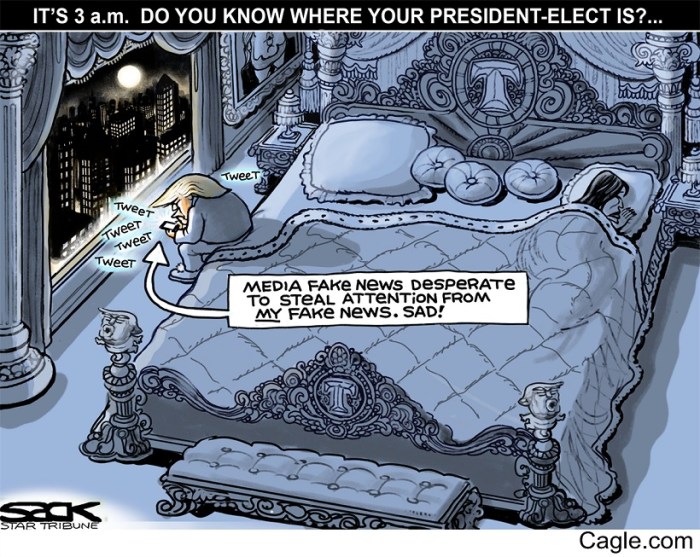
Trumpetweet

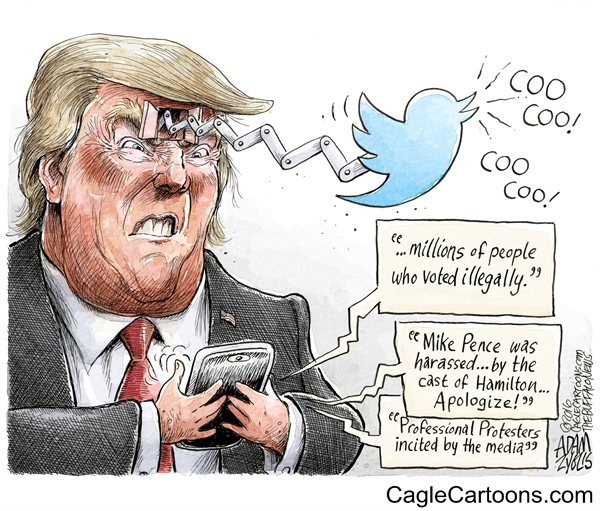
This is one of the strangest things ever in American politics. A president that comments on issues, and basically anything that comes into his head, on social media. The vast majority of Donald Trump’s tweets are about him. He is so thinned skinned that any kind of criticism will be countered with forceful insults and vindictiveness. A man with this kind of volatile temperament better have handlers nearby that can quickly and effectively reign him in.

new6

BBC

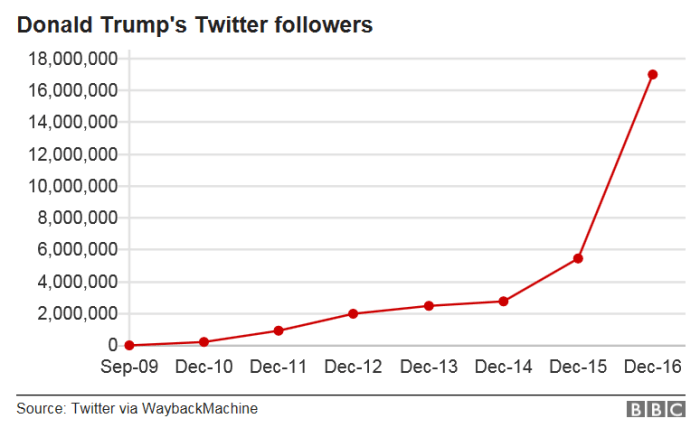
Donald Trump’s Twitter account wasn’t always the powerful spectacle it has become. Journalist Adam Harris goes through the archives to see how it evolved.

In the month since the election, Mr Trump has taken to Twitter to lambast what he views as unfavourable media coverage, rail against corporations who might take jobs overseas and defend his phone calls with international leaders.

Journalists and pundits are still trying to discover if there is a method to Mr Trump’s Twitter madness. We looked at his seven-year Twitter history to see what could be learned.

His interaction with Twitter began much like any other high profile account managed by a group of marketing professionals.

In May 2009, Mr Trump, then a private businessman, sent his first tweet promoting a forthcoming appearance on the Late Show with David Letterman.

 At the time, Peter Costanzo, a marketing staffer at his publishing company, suggested a social media push for Mr Trump’s book, Think Like a Champion. Someone had been sending out parody tweets under the @DonaldTrump hashtag, and so the businessman took @RealDonaldTrump, Costanzo told journalist Jacob Weisberg on the Slate Trumpcast.

There were tweets about The Apprentice, his appearances, family milestones and quotes from Mr Trump himself. The tweets directly from him were usually tagged “from Donald Trump,” but rarely veered into politics.

By June 2011, tweets no longer acknowledged whether they were directly from Mr Trump or originated with his team and the lines between his businesses and political pursuits began to blur.

Methods to his medium

But Mr Trump still prefers tweets to more traditional media – he hasn’t held a press conference since 27 July. Although he has only given a handful of interviews since being elected, he has tweeted more than 130 times about topics ranging from the media to foreign policy to domestic affairs.

Indeed, Mr Trump does favour tweets over contact with the press – a policy he tweeted out, of course.

new8

“If the press would cover me accurately & honourably,” he tweeted on Monday, “I would have far less reason to ‘Tweet’.”

On the other hand, his tweets appear to be influenced by the media – his tweet that said flag burners should be jailed came roughly 30 minutes after Fox News ran a story on flag burners.

And on 29 November, Mr Trump tweeted that Green Party nominee Jill Stein’s recount effort was a “scam”, joined by “badly defeated” Democrats. The tweet, however, followed a Fox News segment reporting that the Clinton campaign would join the recount efforts in Michigan, Pennsylvania and Wisconsin.

Real-life impact

As the President-elect, Mr Trump’s tweets have added import.

On Tuesday, Mr Trump criticised Boeing for the price tag associated with the manufacture of Air Force One, which he said would cost taxpayers $4bn. The company saw a near immediate dent in its share prices, but recovered after revealing that it does not yet have the contract to build it. Instead it has a development deal with the government.
“We are currently under contract for $170 million to help determine the capabilities of these complex military aircraft that serve the unique requirements of the President of the United States,” said Boeing spokesman Todd Belcher in a statement.

“We look forward to working with the US Air Force on subsequent phases of the programme allowing us to deliver the best planes for the president at the best value for the American taxpayer.”
It took six years after being inaugurated for Mr Obama to give up his Blackberry.

According to senior advisor Kellyanne Conway, who spoke during in an interview with Jake Tapper, it is still undecided whether Trump will continue to have personal access to his Twitter account when he assumes office.

Today’s Tweets

tweet1

tweet

tweet2

new7


How Antarctic bases went from wooden huts to sci-fi chic

BBC Magazine

ant

How do you build in the most isolated place on Earth? For decades Antarctica – the only continent with no indigenous population – hosted only the simplest huts as human shelters. But, as Matthew Teller finds out, architecture in the coldest, driest, windiest reaches of our planet is getting snazzier.
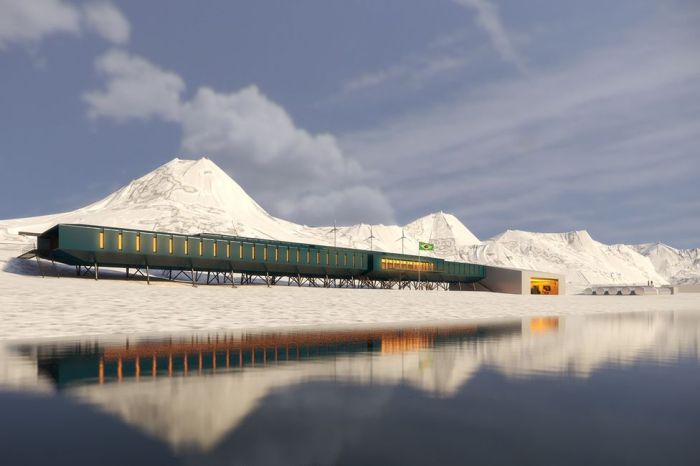
It’s an eye-popping, futuristic design – a dark, sleek building, low and long, that is destined to be a temporary waterfront home for up to 65 people at a time.

The price tag is a hefty $100m (£80m). And while a Chinese company is building it, it’s not in China, and almost no-one will ever see it.

ant1

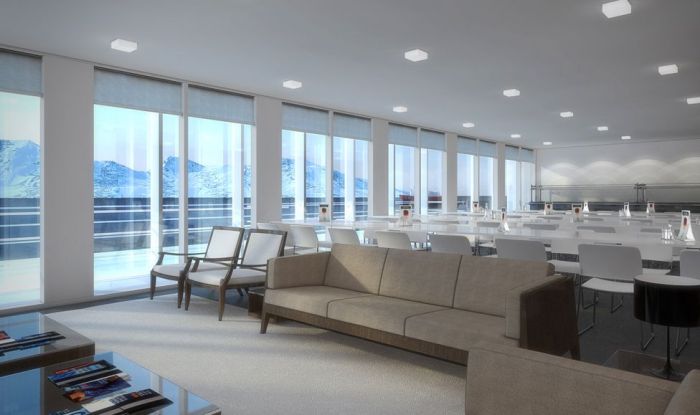
Welcome to Brazil’s Comandante Ferraz Antarctic research station.

After the original burned down in 2012, the Brazilian navy launched an architectural competition for a replacement design – won by a local firm – and then awarded the building tender to a Chinese defence and engineering contractor, CEIEC. It’s due to be completed in 2018.

A design of the Brazilian Comandante Ferraz station

Image caption The upper block will contain cabins, dining and living space; the lower block will house laboratories and operational areas

Located on a small island just off the coast of Antarctica, it lies almost 1,000km (600 miles) south of the tip of South America. No scheduled air routes come close and it’s way off any shipping lanes.

And even if you could reach it yourself, like all Antarctic research stations Comandante Ferraz will be closed to the public. Virtually nobody other than the crews posted there will ever see it in the flesh. So why, you may ask, spend so much on architectural style? Wouldn’t a dull but functional building do just as well?

Brazil is not alone in paying for eye-catching design, though.

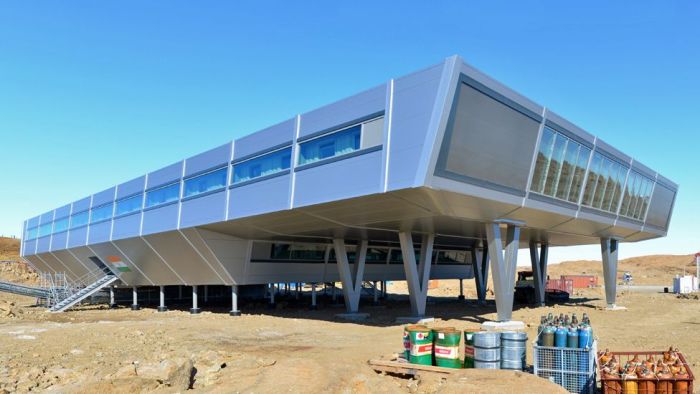
In 2013, India unveiled its Bharati station, with a similar modernist design.

ant2

Designed by bof arkitekten, Bharati overlooks the sea and is used to study polar marine life

It was made from 134 prefabricated shipping containers, for ease of transport and construction, but you would never guess it from the outside.

ant3

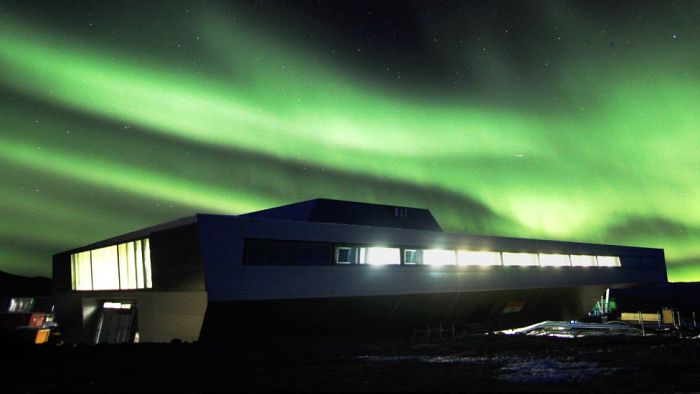
And the following year, South Korea opened its Jang Bogo station – a grand, triple-winged module lifted on steel-reinforced blocks, capable of supporting a crew of 60.

ant4

What is the explanation for this architectural flamboyance?

“Antarctic stations have become the equivalent of embassies on the ice,” says Prof Anne-Marie Brady, editor-in-chief of the Polar Journal and author of China as a Polar Great Power.

“They are showcases for a nation’s interests in Antarctica – status symbols.”

Those interests could be purely scientific. But a moratorium on mineral prospecting runs out in just over 40 years’ time, and every Antarctic player also wants to be ready to take advantage, should it not be extended.

Planting a dramatic building on the ice has become the modern equivalent of explorers of old planting a flag.

It wasn’t always like this.

In March 1903, the 33 men of the Scottish National Antarctic Expedition landed on the outlying South Orkney Islands and built a dry-stone shack.

ant5

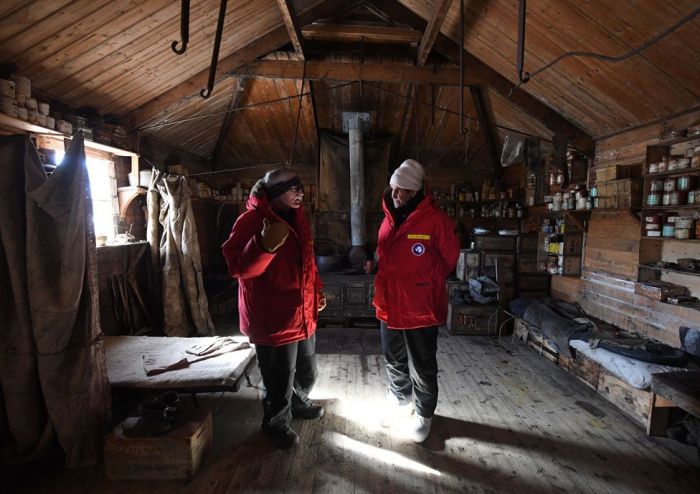
John Kerry visited the hut in November.

Then came a – relative – building boom, spurred by the International Geophysical Year (IGY) of 1957-58, a global project for co-operation in science. The 1959 Antarctic Treaty, which resulted from the IGY, suspended all territorial claims, but that led many countries to set about consolidating their presence in other ways, such as construction.

The treaty’s clause giving countries conducting “substantial research activity” in Antarctica a vote in meetings to determine the continent’s future was another incentive to maintain a physical presence.

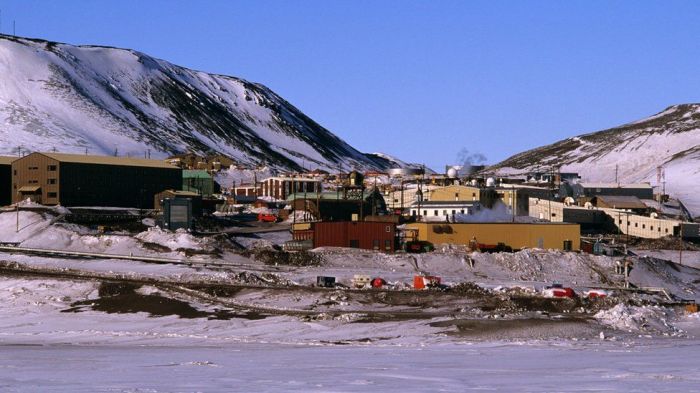
The US’s sprawling McMurdo research station dates from this period. Powered from 1962 to 1972 by a nuclear reactor, it is the biggest settlement on the continent, housing a summer population of about 1,200.

ant6

The McMurdo station has a harbour, landing strips on sea ice and shelf ice, and a helicopter pad

ant7

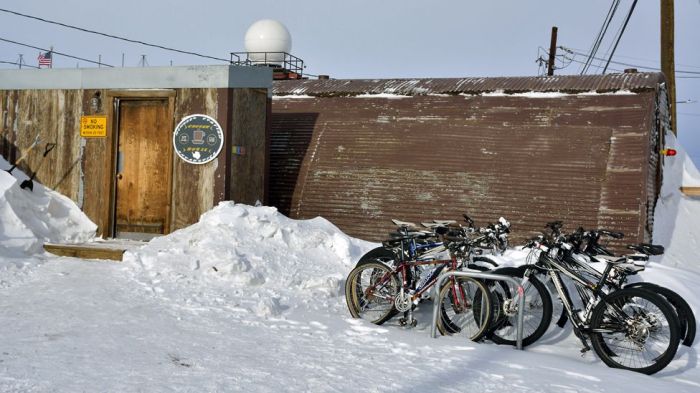
The McMurdo coffee house serves hot drinks to workers and is attached to a small cinema – the chapel of the snows, a non-denominational Christian church, is nearby

ant8

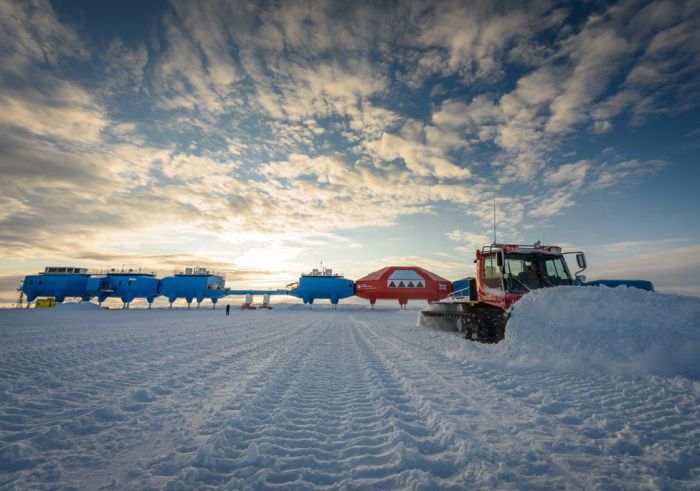
 Designed by Hugh Broughton Architects and Aecom, Britain’s Halley VI’s red module contains the communal areas

Halley VI, however, is Antarctica’s first relocatable research station. Its eight connected pods – like giant, colourful train carriages, which can be isolated to limit the spread of fire – sit on hydraulic legs mounted on huge, 8m-long skis. This means that the pods can be detached from each other, dragged by bulldozers to a new location, and the whole station reassembled.

That design is being put to good use, as Halley is currently being moved to avoid a chasm that is opening up in the ice nearby.

And Halley VI is both glamorous and comfortable.

Halley VI bedroom

Unlike earlier Halley stations, each bedroom now has a window to the outside

ant9


“All the newest bases look good as well as do the science – it’s a reflection of the priorities of our era,” says Anne-Marie Brady.

South Africa was one of the first countries to solve the problem of snow accumulation with its SANAE IV base, which opened in 1997. It was designed with stilt-like legs, which let snow blow under the building.

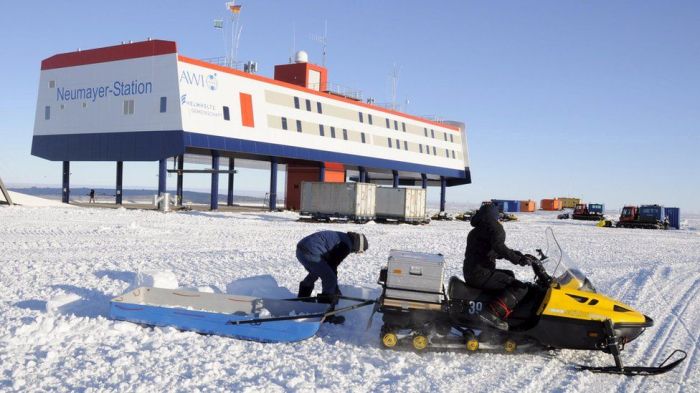
Germany applied the same concept to its Neumayer III base, which opened in 2009, with an extra refinement. Sixteen hydraulic pillars allow the entire two-storey structure to be raised every year by around a metre. The foot of each pillar is then lifted and replaced on a new firm base of packed snow.

ant10

Neumayer III always stands 6m above the ice – up to 50 people live there during the summer and nine in the winter

ant11

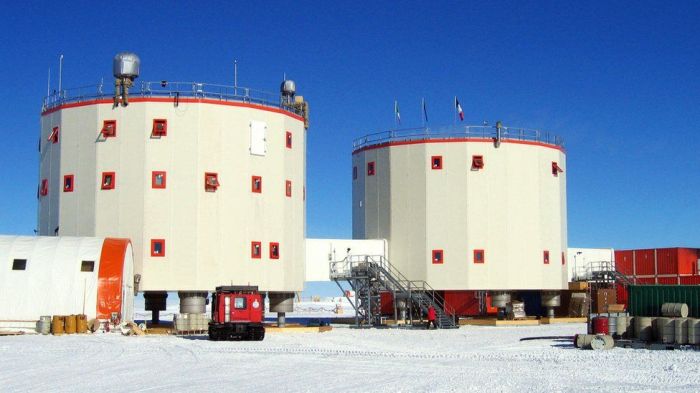
Like the UK’s Halley base, Concordia, an Italian and French research facility is used by the European Space Agency to study the physical and psychological effects of isolation – the nearest people are stationed 600 km (370 miles) away

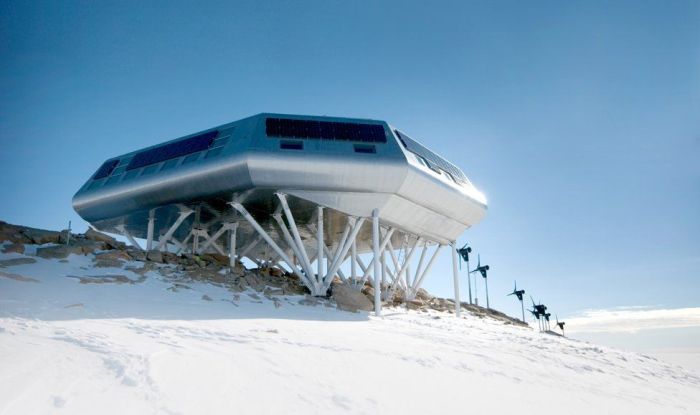
Another element of Antarctic architecture that has become critical is energy efficiency. Most stations run on polar diesel, which is expensive, polluting and difficult to transport. Belgium’s Princess Elisabeth station, an aerodynamic pod raised on steel legs, is the first with zero emissions.

Since its inauguration in 2009 it has run entirely on solar and wind energy, and – even here – has no heating. The station’s layered design means interior temperatures are maintained from waste heat generated by electrical systems and human activity, and dense wall insulation reduces heat loss to almost zero.

ant12

ant13

Photovoltaic solar panels also provide electricity, while thermal solar panels melt snow and heat water for bathrooms and kitchens

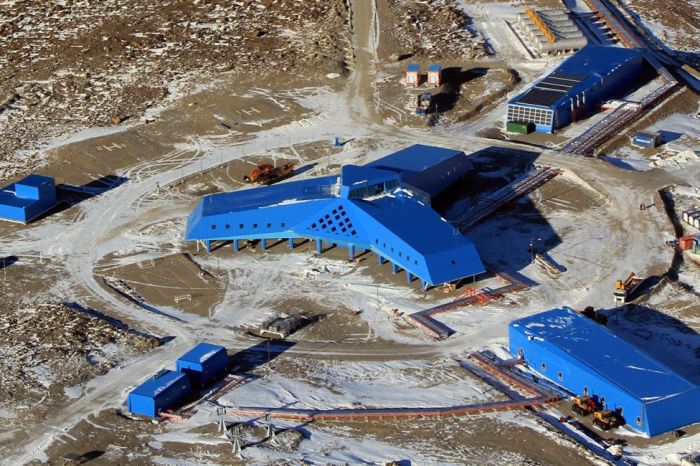
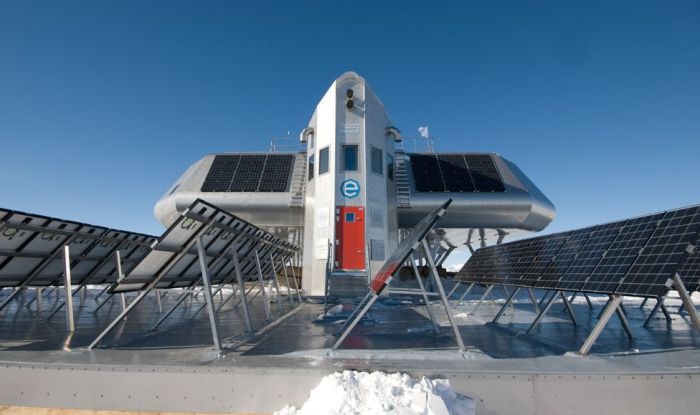
If the Princess Elisabeth station looks like something out of a Bond movie, China’s latest Antarctic station Taishan – its fourth – has been likened to a flying saucer. It was rush-built in 45 days in 2013-14, and is intended to last only a few years.

ant14

Provocative Photo surfaces of Donald Trump in Russia in 2013

A rogue Russian intelligence super-agent purportedly has released a compromising photo of Donald Trump when he was in Moscow in 2013 promoting the Miss Universe Pageant. The Russian espionage agent defected to Mongolia, then contacted CNN regarding the photo, it is rumoured the news network paid 20 million dollars to the spy for the picture.

The image was captured at the Moscow Marriott Royal Aurora Hotel. Trump was staying in the Deluxe Imperial Cossack Penthouse suite by himself. Russian military intelligence agency (GRU) had the room rigged with micro cameras and hyper sensitive listening devices. One unsubstantiated report is that the Russians recorded Donald having a six minute urination. So much for the small hands.

Trump’s security detail made up of former U.S. Marines and Navy Seal operators scanned the room and did find six cameras. However, leaked reports to Buzzfeed.com says that at least two cameras escaped detection. The camera that captured Trump in the compromising circumstance was located in the middle of a 95 inch flat-screen television. The camera was so small that it appeared to be comprised of nano technology.

The photo itself shows a naked Donald Trump siting on the edge of a bed, he appears to be in very deep contemplation. To Donald’s right is well-known Moscow socialite and sex fiend Zlata Ludmila Bolshakov-Voskoboynikov, also naked. Zlata is also known for her penchant for rough and deranged sex, very deranged rough sex. In the photo she has a very big double edged battle ax in her hands. Now that must have been one hell of a night! Hey Donald! You Beast!

The controversial and potentially explosive photo:

rosie-sister

In compliance with the World Telecommunications disinformation and propaganda charter 27b-6. This news item must be categorized as

Fake News!

Sorry.