
When Father Ray Kelly stepped to the lecturn at St. Brigid’s Catholic Church in Oldcastle, Ireland, he sang a version of Leonard Cohen’s well-known song “Hallelujah” for newly married Chris and Leah O’Kane.
As a gift to the couple, he changed the lyrics to suit their wedding. Little did Kelly know the excitement his gift to the couple would unleash.
“After it went up on You Tube there were requests to fly me out to South Africa, all over the States, Poland, Croatia, all over the place,” he says. “People just wanted me to come out and perform a wedding. And sometimes it wasn’t even to perform a wedding, but to sing ‘Hallelujah.’”
Kelly admits that reworking “Hallelujah,” which has become a kind of ubiquitous anthem over the past three decades, was first brought to his attention at another wedding he officiated seven or eight years ago.
“This little girl — she was a bridesmaid — was about 10 and she started singing Leonard Cohen’s song ‘Hallelujah’ with the words changed to suit the bride and groom,” he says. “At the end of the service I went over to her and asked for a copy of the words and she gave me a copy. And, as I found out afterwards, she actually wrote the words herself for that particular wedding with the help of her mom and dad.”
So it was that 10-year-old girl and Leonard Cohen who helped launch Kelly’s singing career. The 61-year-old priest has signed a deal with a major American label, Universal Music Group, which just released his debut CD. And yes, it includes that new version of Hallelujah.
The Cowsills are an American singing group from Newport, Rhode Island, six siblings noted for performing professionally and singing harmonies at an early age, later with their mother.
The band was formed in early 1965 by brothers Bill, Bob, and Barry Cowsill; their brother John joined shortly thereafter. Originally Bill and Bob played guitar and Barry played the drums. When John learned to play drums and joined the band, Barry began playing bass. After their initial success, the brothers were joined by their siblings Susan and Paul along with their mother, Barbara. A seventh sibling, Bob’s fraternal twin brother Richard, was never part of the band during its heyday, although he occasionally appeared with them in later years.
The band’s road manager for most of their career was Richard “Biggie” Korn. When the group expanded to its full family membership by 1967, the six siblings ranged in age from 8 to 19. Joined by their mother, Barbara Cowsill (née Russell), the group inspired the 1970s television show The Partridge Family.
“Dead Skunk” is a 1972 novelty song by Loudon Wainwright III. Released as a single in November 1972, it eventually peaked at number 16 on the Billboard charts on March 31, 1973. The song appears on Wainright’s 1972 album Album III.

The song is musically a simple folk song based on banjo, but accompanied by guitar, drums and fiddle. The lyrics describe a dead skunk in the middle of a busy road and the smell it produces for people as they drive by. Wainwright has said that the song came out of an actual accident involving a skunk, and that he wrote it afterward in 15 minutes. (“Someone had already killed it, but I ran over it.”)
Crossing the highway late last night
He shoulda looked left and he shoulda looked right
He didn’t see the station wagon car
The skunk got squashed and there you are
You got your dead skunk in the middle of the road
Dead skunk in the middle of the road
Dead skunk in the middle of the road
Stinking to high heaven
Take a whiff on me, that ain’t no rose
Roll up your window and hold your nose
You don’t have to look and you don’t have to see
‘Cause you can feel it in your olfactory
You got your dead skunk in the middle of the road
Dead skunk in the middle of the road
Dead skunk in the middle of the road
And it’s stinking to high heaven
Yeah, you got your dead cat and you got your dead dog
On a moonlight night, you got your dead toad frog
Got your dead rabbit and your dead raccoon
The blood and the guts, they’re gonna make you swoon
You got your dead skunk in the middle
Dead skunk in the middle of the road
Dead skunk in the middle of the road
Stinking to high heaven
C’mon, stink
You got it, it’s dead, it’s in the middle
Dead skunk in the middle
Dead skunk in the middle of the road
Stinking to high heaven
All over the road
Technicolor
Oh, you got pollution
It’s dead, it’s in the middle
And it’s stinking to high, high heaven
Canadian rock legend receives beloved instrument from Japanese musician decades after it was swiped in Toronto
Legendary Canadian musician Randy Bachman’s cherished Gretsch guitar was stolen from a Toronto hotel in 1977. After decades of searching and a stroke of luck, Bachman got the stolen guitar back during a Canada Day concert in Tokyo.
Randy Bachman has performed many times on Canada Day, but the event he played this year is like no other.
The former member of the Guess Who and Bachman-Turner Overdrive flew to Japan to reclaim a guitar that he’s been hunting for decades.
“I’m really happy. I’m getting my lost Gretsch guitar back,” the 78-year-old rocker told CBC News in a meeting room inside the Canadian Embassy in Tokyo.
The guitar is a 1957 Gretsch 6120 Chet Atkins, in orange, which he bought from a Winnipeg music store when he was 19 years old.
Forty-five years after it was stolen in Toronto, it’s back in his arms, and he can hardly believe it.
“If you never want to forget your anniversary, you get married on your birthday. You never forget your wedding anniversary. I’ll never forget this day,” said Bachman.

The Gretsch was his first big purchase as a young adult, and he played it on the recordings of iconic tracks like Takin’ Care of Business, American Woman, These Eyes and Undun. But when his band BTO came to Toronto in 1977, it was left in a locked hotel room, where it was somehow snatched.
Bachman launched his own search, which lasted decades and turned up nothing.
Japanese media reports suggest the Gretsch was eventually taken across the U.S. border, where it was sold to a guitar trader from Japan. The reports say Takeshi, a musician who writes for Japanese pop bands, purchased it in 2014 from a Tokyo guitar shop, without knowing its history.
Six years later, the Canadian rocker finally got a break in the case. A longtime fan and internet sleuth from White Rock, B.C., named William Long heard Bachman’s story and decided to try to hunt down the instrument using facial recognition technology. He found it in a YouTube video featuring Takeshi playing the guitar.
He contacted Bachman, who got in touch with Takeshi. Then, plans were hatched to trade it back. The Canadian bought a nearly identical Gretsch to trade for his original.
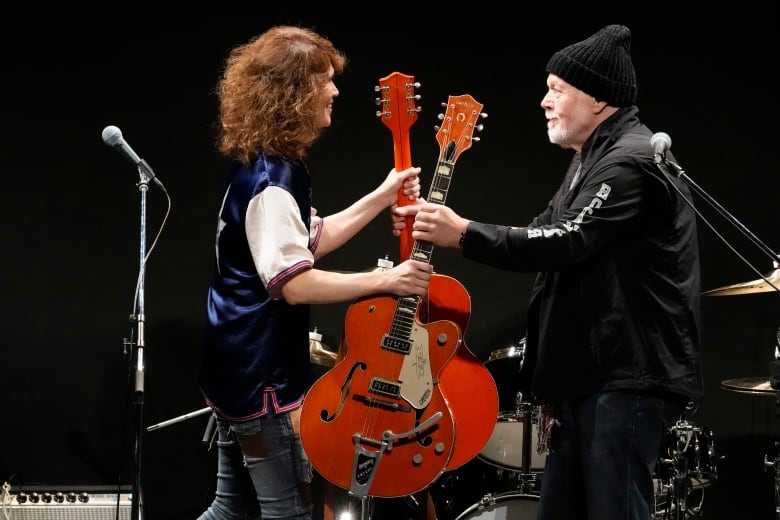
On Canada Day in Tokyo, the saga finally came to a close in front of a packed crowd at the embassy’s Oscar Peterson Theatre.
Bachman and Takeshi met for the first time ever on the stage, and in an emotional moment for both of them, traded their vintage instruments, with the Japanese musician handing back a piece of Canadian rock history.
“I was going through a lot of emotions today,” Takeshi said through an interpreter while sitting next to Bachman on stage.
“But seeing your smile after you saw that guitar, I just thought it was all worth it.”

Bachman said he has mixed emotions, too. He said he became attached to the guitar he’s trading to Takeshi, but he’s more than happy to go home with his first love.
“To come here to do the trade has been very emotional, and I appreciate this honourable man giving me the opportunity to get the guitar back,” said Bachman.
The story of Bachman’s long-lost guitar made headlines around the world over the past year, largely because of how unlikely it was to ever be found.
Winnipeg-based rock journalist John Einarson has written extensively about the Guess Who and other bands of the era, and said the odds of getting this stolen Gretsch back were “astronomical.”
 The MarkoZen Blog