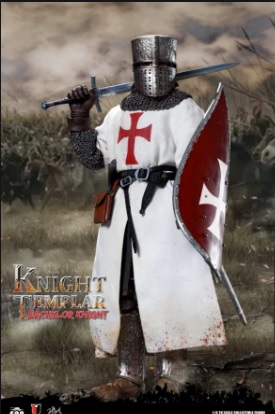
March of the Templars


The Poor Fellow-Soldiers of Christ and of the Temple of Solomon (Latin: Pauperes commilitones Christi Templique Solomonici), commonly known as the Knights Templar, the Order of the Temple (French: Ordre du Temple or Templiers) or simply as Templars, were among the most famous of the Western Christian military orders.  The organization existed for nearly two centuries during the Middle Ages.

Officially endorsed by the Catholic Church around 1129, the Order became a favored charity throughout Christendom, and grew rapidly in membership and power. Templar knights, in their distinctive white mantles with a red cross, were among the most skilled fighting units of the Crusades.  Non-combatant members of the Order managed a large economic infrastructure throughout Christendom, innovating financial techniques that were an early form of banking,  and building fortifications across Europe and the Holy Land.
Herb Alpert

Herb Alpert (born March 31, 1935) is an American jazz musician most associated with the group variously known as Herb Alpert & the Tijuana Brass, Herb Alpert’s Tijuana Brass, or TJB. Alpert is also a recording industry executive, the “A” of A&M Records, a recording label he and business partner Jerry Moss founded and eventually sold to PolyGram. Alpert also has created abstract expressionist paintings and sculpture over two decades, which are publicly displayed on occasion. Alpert and his wife, Lani Hall, are substantial philanthropists through the operation of the Herb Alpert Foundation.

Alpert’s musical accomplishments include five No. 1 albums and 28 albums total on the Billboard Album chart, nine Grammy Awards, fourteen platinum albums, and fifteen gold albums. Alpert has sold 72 million records worldwide. Alpert is the only recording artist to hit No. 1 on the U.S. Billboard Hot 100 pop chart as both a vocalist (“This Guy’s in Love with You”, 1968) and an instrumentalist (“Rise”, 1979).

Herb still performs and is scheduled for a gig in Winnipeg for April 2020.

Fool Organizers at Pro-Trump Rally play ‘Rockin the Free World’

This song is not exactly espousing the American dream.

“Rockin’ In The Free World”

There’s colors on the street
Red, white and blue
People shufflin’ their feet
People sleepin’ in their shoes
But there’s a warnin’ sign
on the road ahead
There’s a lot of people sayin’
we’d be better off dead
Don’t feel like Satan,
but I am to them
So I try to forget it,
any way I can.Keep on rockin’ in the free world,
Keep on rockin’ in the free world
Keep on rockin’ in the free world,
Keep on rockin’ in the free world.

I see a woman in the night
With a baby in her hand
Under an old street light
Near a garbage can
Now she puts the kid away,
and she’s gone to get a hit
She hates her life,
and what she’s done to it
There’s one more kid
that will never go to school
Never get to fall in love,
never get to be cool.

Keep on rockin’ in the free world,
Keep on rockin’ in the free world
Keep on rockin’ in the free world,
Keep on rockin’ in the free world.

We got a thousand points of light
For the homeless man
We got a kinder, gentler,
Machine gun hand
We got department stores
and toilet paper
Got styrofoam boxes
for the ozone layer
Got a man of the people,
says keep hope alive
Got fuel to burn,
got roads to drive.

Keep on rockin’ in the free world,
Keep on rockin’ in the free world
Keep on rockin’ in the free world,
Keep on rockin’ in the free world.

A Rock band ahead of its time named Death!

Death was a garage rock and protopunk demo band formed in Detroit, Michigan, in 1971 by the brothers Bobby (bass, vocals), David (guitar), and Dannis (drums) Hackney. The African American trio started out as an R&B band but switched to rock after seeing an Alice Cooper show. Music critic Peter Margasak (incorrectly denoting the youngest brother) retrospectively wrote of their musical direction: “The youngest of the brothers, guitarist David, pushed the group in a hard-rock direction that presaged punk, and while this certainly didn’t help them find a following in the mid-70s, today it makes them look like visionaries.” The band broke up by 1977 but reformed in 2009 when the Drag City label released their 70s demos for the first time.

The World

I see trees of green, red roses, too
I see them bloom for me and you
And I say to myself
What a wonderful world

I see skies of blue and clouds of white
Bright sunny days, dark sacred nights
And I think to myself
What a wonderful world

Colors of the rainbow are so pretty in the skies
Are also on the faces of people walkin’ by
I see friends shakin’ hands, sayin’, “How do you do?”
They’re really sayin’, “I love you”

I see babies cry, what watch them grow
They’ll learn much more than I’ll ever know
And I think to myself
What a wonderful world

Yes, I think to myself
What a wonderful world

And I say to myself
What a wonderful world

Fred Flintstone could get into the Groove

Fred Flintstone is the main character of the animated sitcom The Flintstones, which aired during prime-time on ABC during the original series’ run from 1960 to 1966.

Fred lives in the fictional prehistoric town of Bedrock, a world where dinosaurs coexist with modernized cavepeople and the cavepeople enjoy “primitive” versions of modern conveniences such as telephones, automobiles, and washing machines. Fred’s trademark catchphrase yell is “yabba dabba doo!”, a phrase that was originally his club’s cheer, and later adopted as part of the theme song from the third season on and used in the 1994 live-action Flintstones movie.

Nitro Explosion!

Richard Anthony Monsour (May 4, 1937 – March 16, 2019), known professionally as Dick Dale, was an American rock guitarist. He was a pioneer of surf music, drawing on Middle Eastern music scales and experimenting with reverberation. Dale was known as “The King of the Surf Guitar”, which was also the title of his second studio album.

Dale worked closely with the manufacturer Fender to produce custom-made amplifiers including the first-ever 100-watt guitar amplifier. He pushed the limits of electric amplification technology, helping to develop equipment that was capable of producing a louder guitar sound without sacrificing reliability.


“Who Was In My Room Last Night?”

I’m flying…
I’m flying, I’m flying, I’m flying, I’m flying, I’m flying, I’m flying, flying away, I’m flying away
I’m flying, I’m flying, I’m flying, I’m flying, I’m flying, I’m flying, I’m flying
I’m flying, I’m flying, I’m flying, I’m flying, I’m flying, I’m flying

All night long, my body burned
The sheets were wet and cold
The lights were on, my eyes were gone
And any second lose control

The pounding on my window’s
Just the pounding in my head
I wonder who was in my room last night
Who the hell was in my bed?

There must have been a body there
I swear I felt some flesh
It took a little time, but I figured they were mine
There were fingers going down my chest

My mouth went through the ceiling
And my body fell to the floor
I couldn’t find a key ’cause there was no hole I could see
And someone had moved the door

The cops, the priest, the crisis line
And no one really had a clue
No one to tell us who was touchin’ me
Or exactly what I could do

My throat was dry, my hopes were high
But nothing really ever got said
But who was in my room last night?
Who the hell was in my bed?