Dome concepts for Winnipeg 

As a hopefully beautiful summer approaches Winnipeg , the citizens realize the dark, cold, windy, snow covered hell frozen over reality  of an impending winter will be here in five months .

domemark2

Winters in Winnipeg are usually long and dry with occasional blasts of bitterly cold weather from the northwest.  Out of Canada’s 100 largest cities, Winnipeg’s winter is the tenth coldest with an average low of −20.2 °C (−4.4 °F). The snow cover season lasts 132 days; usually from November till March, sometimes earlier or later. From December through February the maximum daily temperature exceeds 0 °C (32 °F), on average, for only 10 days and the minimum daily temperature falls below −20 °C (−4 °F) on 49 days. The coldest temperature ever recorded in Winnipeg was −47.8 °C (−54 °F), on 24 December 1879 and the coldest since then was −45 °C (−49 °F) on 18 February 1966. Within the past twenty years, the temperature has dipped below −40.0 °C (−40 °F) once on 5 February 2007 as well as both 29 and 30 January 2004. On 1 February 1996 the temperature was −41.8 °C (−43.2 °F) however, the wind chill was -57.1, making this the coldest windchill in the city’s history.

But let us think ahead. If the funding and technology could coalesce, what about a dome, or domes for the city?  That way the citizens could sit outside on their decks, mow the lawn and never have to plug in the car year round. The city’s snow removal budget would be non-existent, that extra revenue could be applied to the dome payments. Outdoor swimming pools could stay open all the time, drive-in restaurants could sell ice cream for 12 months and cyclists could inflame the tempers of drivers all bloody year!  It would be sensational!

If the city, provincial and federal governments could each provide 10 billion dollars, and the elite prosperous entrepreneurs combined with the business oligarchs of Winnipeg provide another 10 billion, voila, the project rockets skyward. Lets do it!

Downtown Winnipeg in January

domexx

Notice a second dome in the background protecting St. Boniface

The Osborne Village area during a polar vortex in February

domez

Sensational! Go canoeing on the Assiniboine River while a Siberian Polar Front invades western Canada, and Edmontonians are freezing their backsides, ha!

The Golden Boy atop the Legislative building would not have to endure blistering ice pellets that rain down from the frozen ionosphere.

domemark

What seems like unattainable dreams can come true, we just have to believe and stay with the dream.  Persist, never say die! The dream also needs a gold mine to be discovered underneath downtown Winnipeg.

astrox

The Vertical Forest of Milan

avertical

Bosco Verticale (Vertical Forest) is a pair of residential towers in the Porta Nuova district of Milan, Italy, between Via Gaetano de Castillia and Via Federico Confalonieri near Milano Porta Garibaldi railway station. They have a height of 110 metres (360 ft) and 76 metres (249 ft) and will host more than 900 trees (approximately 550 and 350 trees in the first and second towers respectively) on 8,900 square metres (96,000 sq ft) of terraces. Within the complex is also an 11-story office building; its facade does not host plants.

The towers were designed by Boeri Studio (Stefano Boeri, Gianandrea Barreca and Giovanni La Varra). It also involved input from horticulturalists and botanists.

The building was inaugurated in October 2014.

avertical1

The project was designed as part of the rehabilitation of the historic district of Milan between Via De Castillia and Confalonieri. It consists of two residential towers of which the largest is 26 floors and 110 meters high (called Torre E) and the smaller tower is 18 floors and 76 meters high (called Torre D). It contains 400 condominium units priced from 3,000 – 12,000 Euro per square metre.

It is called Bosco Verticale because each tower houses trees between three and six meters which help mitigate smog and produce oxygen. It is also used to moderate temperatures in the building in the winter and summer. The plants also attenuate noise. The design was tested in a wind tunnel to ensure the trees would not topple from gusts of wind. Botanists and horticulturalists were consulted by the engineering team to ensure that the structure could bear the load imposed by the plants. The steel-reinforced concrete balconies are designed to be 28 cm thick, with 1.30 metre parapets.

avertical2

The construction of the towers began in late 2009 and early 2010, involving 6,000 onsite construction workers. Between mid-2010 and early 2011 construction progressed very slowly and the towers rose by only five floors while the core rose to the seventh floor. Construction progressed throughout 2011, and by the beginning of 2012 the structures were completed, and construction of the facades and installation of the plants began on 13 June 2012. The building was inaugurated in October 2014.

On April 11, 2012, one of the buildings was used as a temporary art gallery and opened to the public for an art exhibition hosted during Milan Fashion Week.

The two buildings have 730 trees (480 large, 250 small), 5,000 shrubs, and 11,000 perennials and ground cover on its facades. The original design had specified 1,280 tall plants and 920 short plants encompassing 50 species. Overall, the vegetation is the equivalent of that found in a one hectare woodlot. The innovative use of heat-pump technology is helping to slash heating and cooling costs.

avertical3

On November 19, 2014, Bosco Verticale won the International Highrise Award, prestigious international competition bestowed every two years, honouring excellence in recently constructed buildings that stand a minimum of 100 meters (328 feet) tall. The five finalists were selected from 26 nominees in 17 countries.

On the 12th of November 2015, the Council on Tall Buildings and Urban Habitat (CTBUH) Awards Jury selected Bosco Verticale, Milan, as the overall “2015 Best Tall Building Worldwide” at the 14th Annual CTBUH International Best Tall Building Awards Symposium, Ceremony & Dinner, celebrated at the Illinois Institute of Technology, Chicago.

Gardeners rappel down ropes

avertical4

avertical5

avertical6

avertical7

avertical8

avertical9

avertical10

Welcome to the jungle: plants overrun Chinese apartment blocks

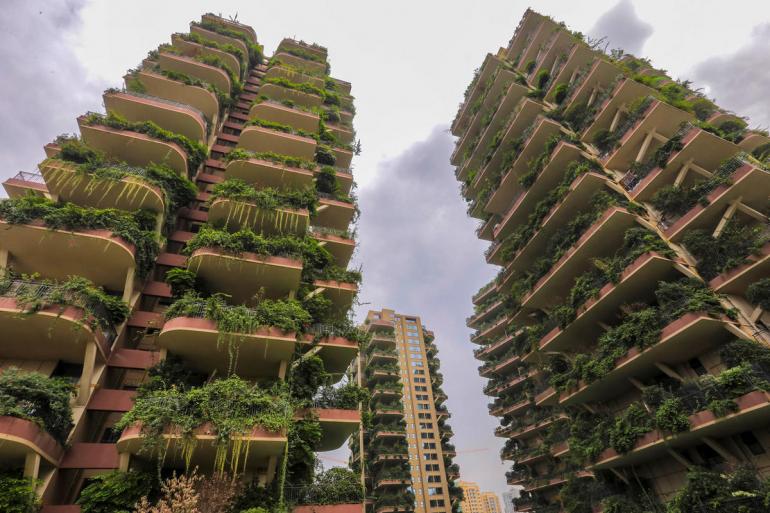
Living in a home surrounded by greenery is on every person’s wish list, but someone very clearly said, ‘be careful what you wish for’. An experimental green housing project in a Chinese megacity had residents overjoyed with the fact that they have their own thriving green patch to live around. This complex is Chengdu’s Qiyi City Forest Garden that takes pride in standing tall as a vertical forest. All of the 826 apartments were sold out by April of 2020. The apartment highlight is the balcony area that’s fitted with as many as 20 types of plants that provide lush greenery and filters air and noise pollution too.

In only a matter of a few months, this Chinese complex went from eco-paradise to veritable hell. The apartments that are left unoccupied by tenants have been occupied by hoards of pesky insects that have completely ruined the facade of the building making it look like a desolate, run-down facility. The infestation of mosquitoes has kept tenants away and only about 10 families have moved in. The remaining eight towers of 30 floors each have been overrun by their own plants causing the mosquito invasion. What could be a vision in green if pruned and cared for properly is seen rotting in neglected balconies, with branches hanging over railings all over the towers making them look nightmarish so much that some plants have completely swallowed some balconies?

Chengdu is one of the major cities in China with a severe smog problem. This vertical forest idea was a way of combating everyday battles that comes with air and noise pollution but guess mosquitoes didn’t feature in the scheme of things. The project developer said in response that they will provide maintenance four times a year and will also step up pest control efforts.

Heatwaves, drought and wildfires in Europe

Temperatures across Europe have caused governments to issue health warnings.

Portugal, Spain and France have seen temperatures rise well above 40C (104F), and in the UK, the government has issued an extreme weather notice.

Experts say heatwaves and droughts are becoming more frequent and extreme because of climate change.

A handout photo made available by the communication department of the Gironde Fire brigade SDIS33 shows firemen fighting a forest fire in Belin-Beliet, in the Gironde region of southwestern France, 9 August 2022 - issued 10 August 2022.
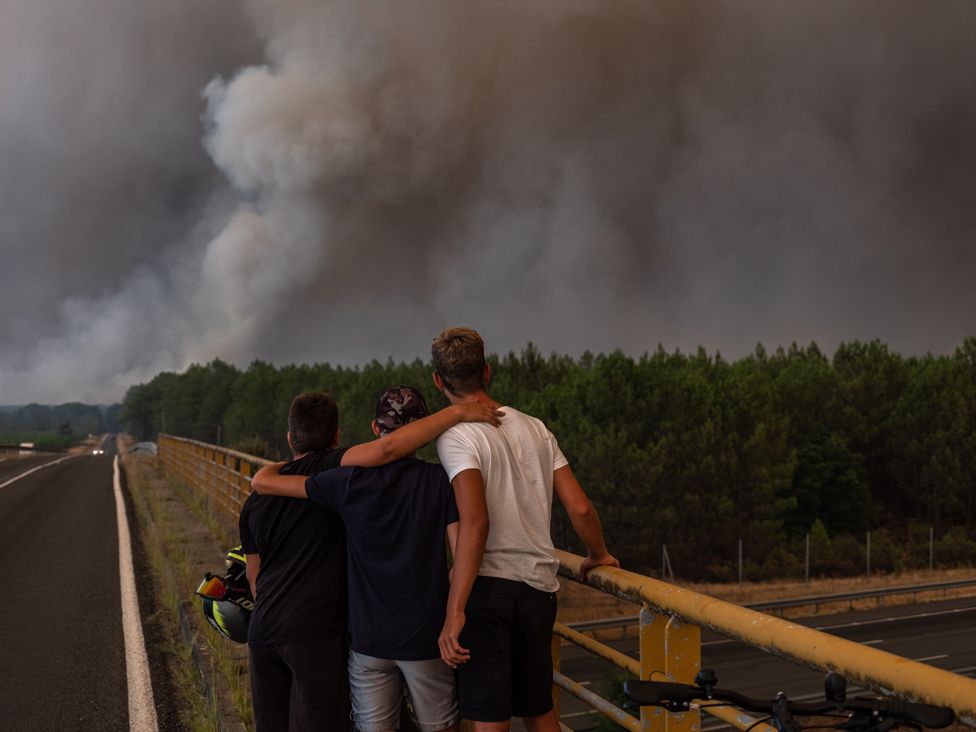
In south west France, more than 1,000 firefighters have been battling a massive wildfire near Bordeaux, for a third day, as blistering temperatures continue to rise.
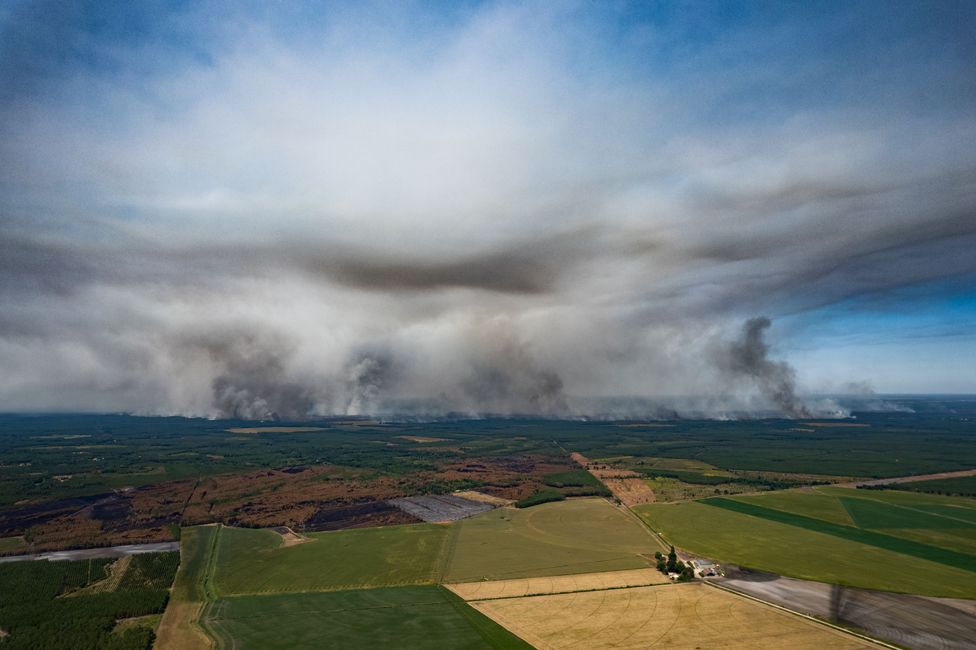
Forest fire around the town of Hostens, France, on August 10, 2022. Many villages were evacuated, such as Saint-Magne, Mano, Belin-Beliet, Moustey and Saugnac-et-Muret, and the A63 highway were also closed.
Thousands of people have been evacuated from their homes as dozens of properties and large areas of forest are destroyed.
Forest fire around the town of Hostens, France, on August 10, 2022.
The fire in the Gironde region, is one of several major blazes burning in France.
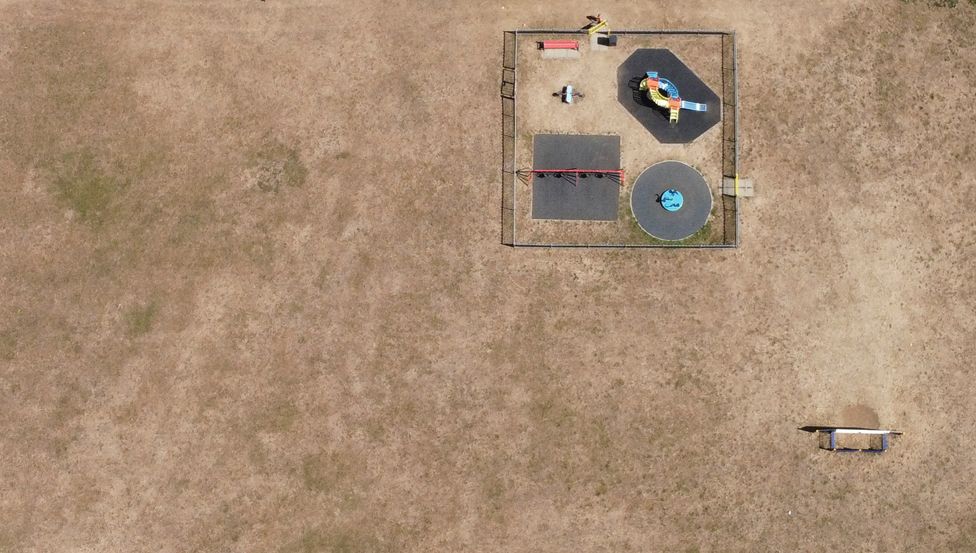
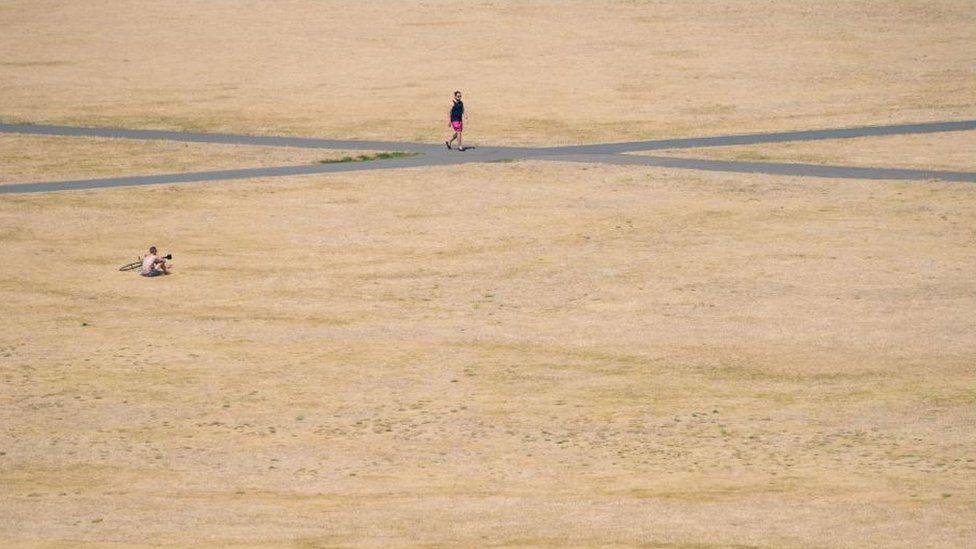
Dried out ground in a park, following a long period of little rainfall and hot weather, in St Albans, England.
An amber extreme heat warning has come into force in the UK, with temperatures forecast to hit 37C (99F) in some parts over the next four days. Many parks and fields have dried out following a long period of little rainfall.
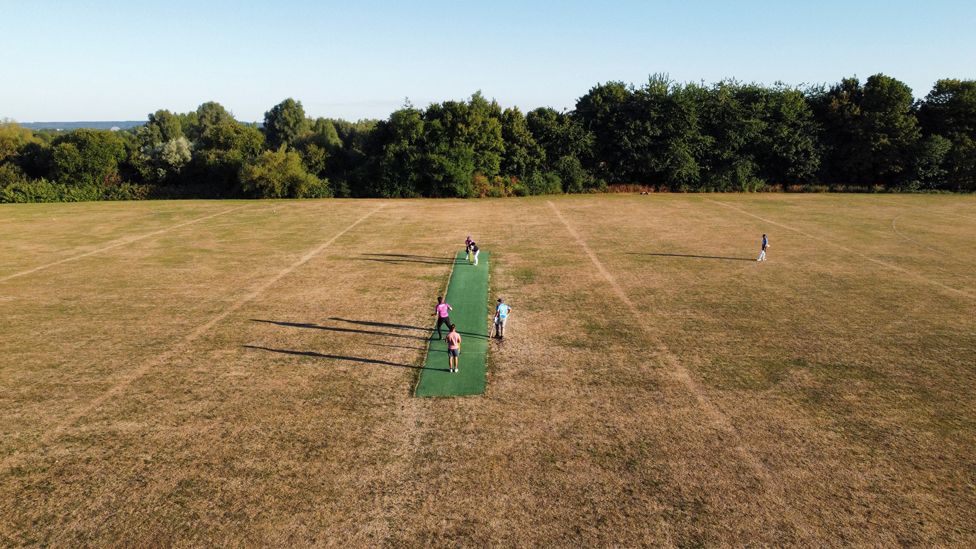
A general view of a dried out grass outfield during a T20 Last Man Stands cricket match between MK Stallions (batting) and MK Super Kings cricket clubs, in Milton Keynes, Britain, 10 August 2022.
A cricket match between MK Stallions and MK Super Kings went ahead in the middle of a dried outfield in Milton Keynes, England.
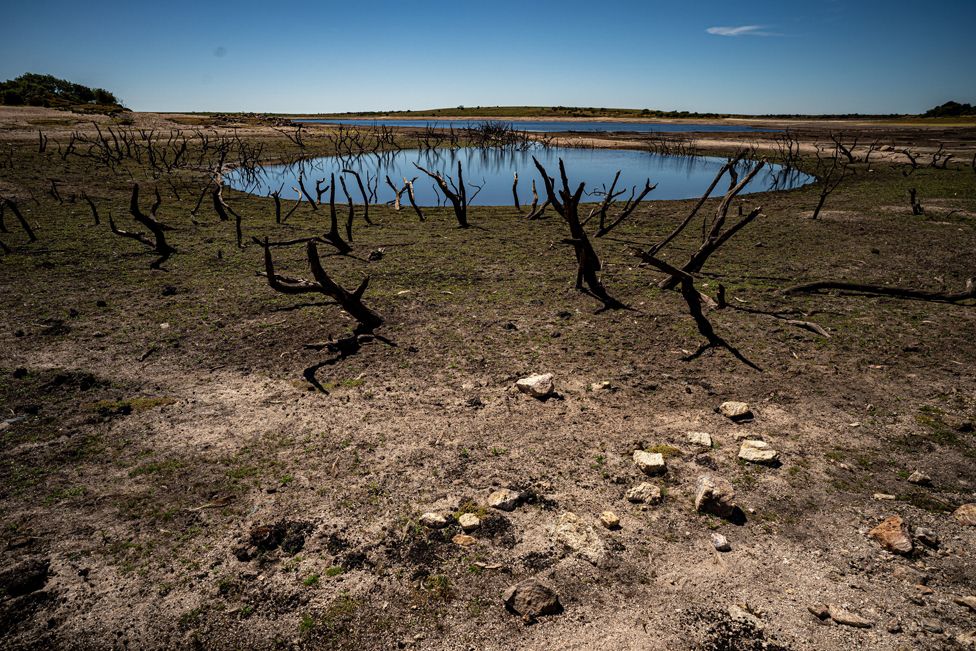
Dried mud and old trees at Colliford Lake, where water levels have severely dropped exposing the unseen trees and rocks on 10 August 2022.
Water levels have severely dropped, exposing the unseen trees and rocks at Colliford Lake, a reservoir on Bodmin Moor in Cornwall, England.
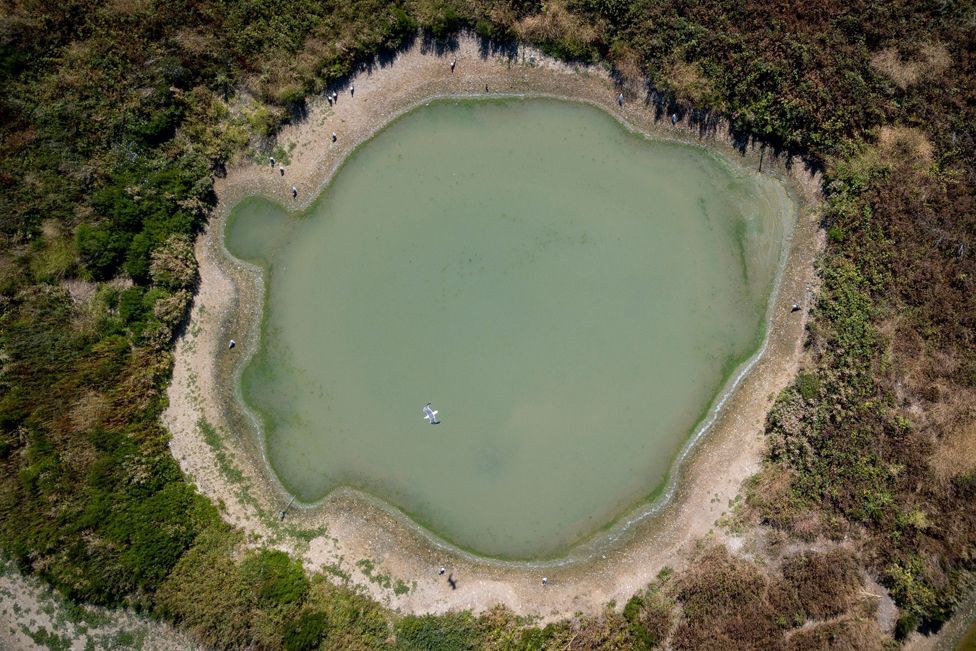
A water reservoir is seen with low water levels at Walthamstow Wetlands in London, Britain, 10 August 2022.
Low water levels are seen at the reservoir at Walthamstow Wetlands in London. Thames Water, which operates London’s water supply, plans to introduce hosepipe ban in order to save water.
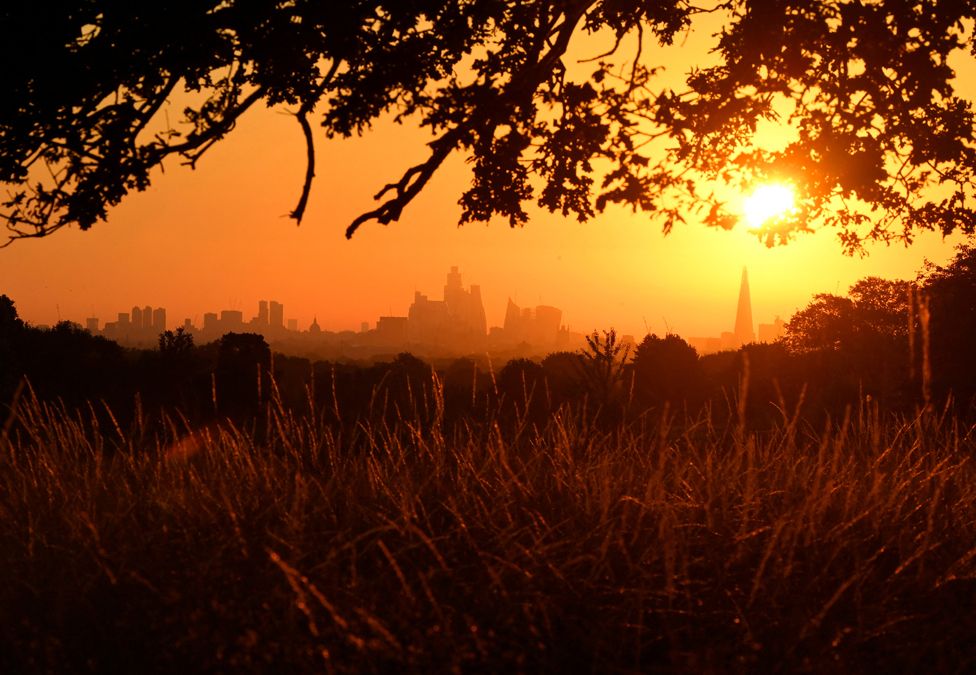
The sun rises above the London skyline, as a second heatwave is predicted for parts of the country, in London, Britain, 11 August 2022.
The sun rises above the London skyline. The heatwave will likely affect health, transport and working conditions.
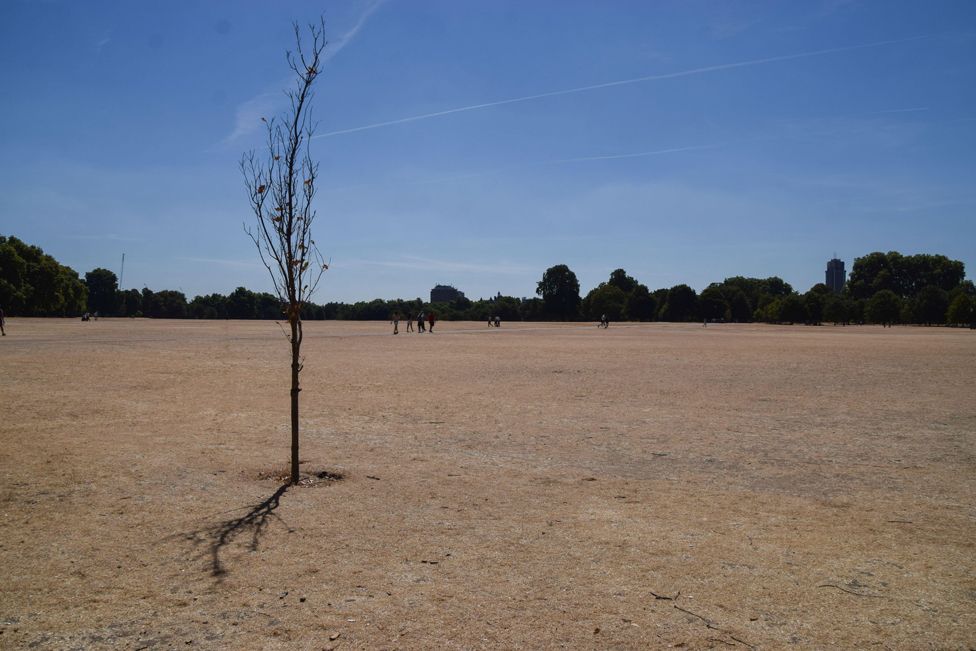
A bare tree in a parched Hyde Park on a scorching day in London, 10 August 2022
The current warning follows the driest July for England since 1935. A bare tree stands in a parched Hyde Park in London, England.
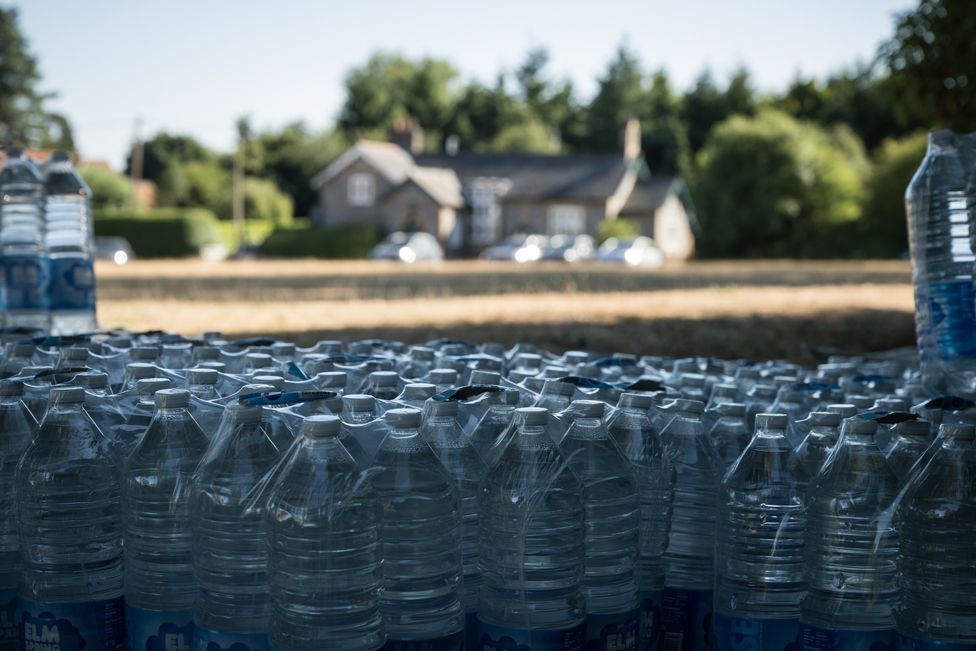
Bottles of water are stacked on the village green following a loss of domestic water supply on 10 August 2022 in the village of Northend near Henley-on-Thames, England.
Bottles of water are stacked on the village green following a loss of domestic water supply in the village of Northend, near Henley-on-Thames, England.
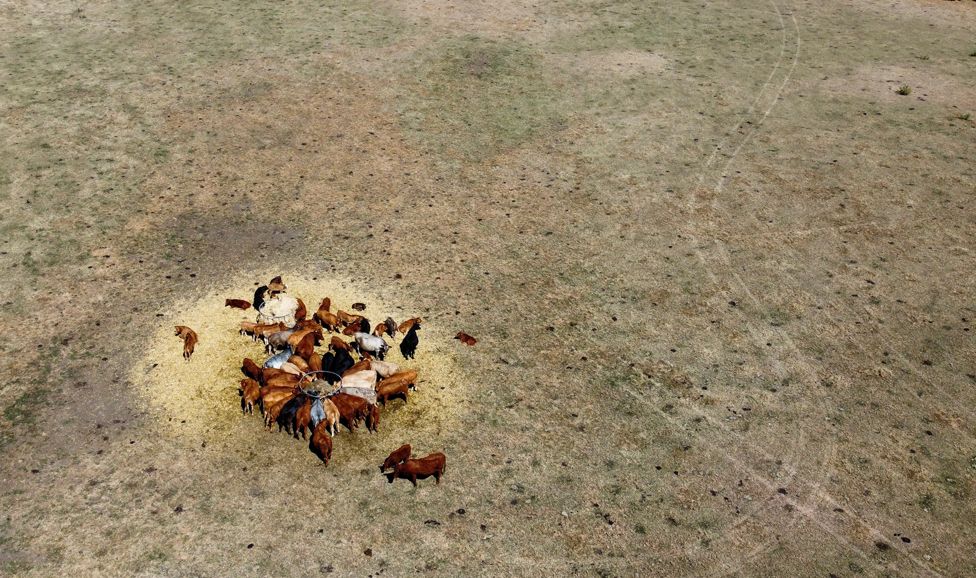
Cows eat straw and grass silage which is normally a winter feed at a farm in Harpole, near Northampton, Britain, 10 August 2022.
Cows eat straw and grass silage which is normally a winter feed at a farm in Harpole, near Northampton, England. The cows have been on the supplementary food since the start of August due to hot, dry weather and lack of grass.
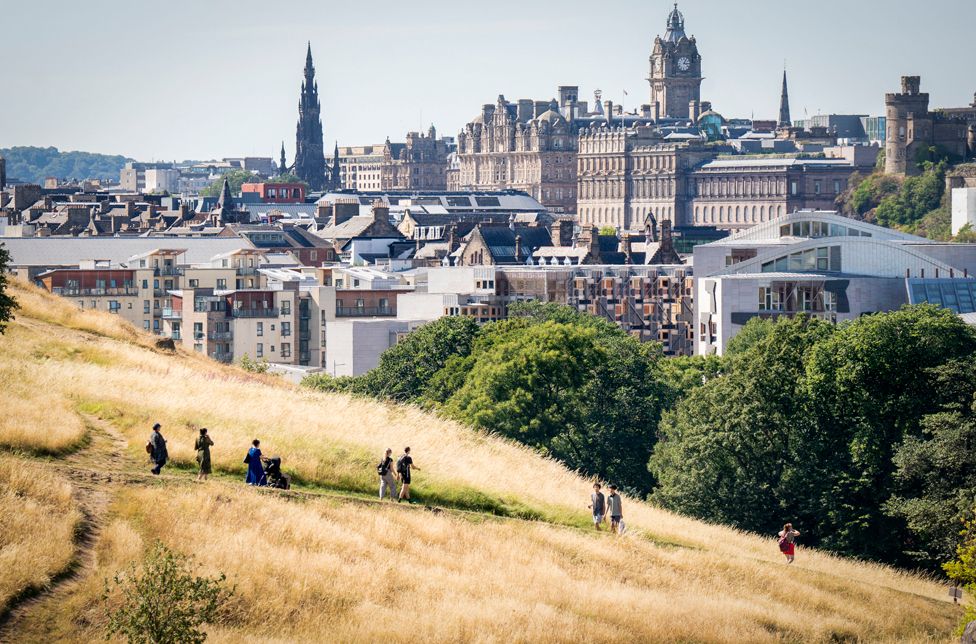
Grass turned yellow due to dry conditions in Holyrood Park, Edinburgh, Scotland, 10 August 2022.
Large areas of grass have turned yellow due to the dry conditions in Holyrood Park, Edinburgh. The Scottish Fire and Rescue Service (SFRS) issued a ‘very high’ risk of wildfires alert across southern and eastern Scotland with long, dry sunny spells expected over the coming days.
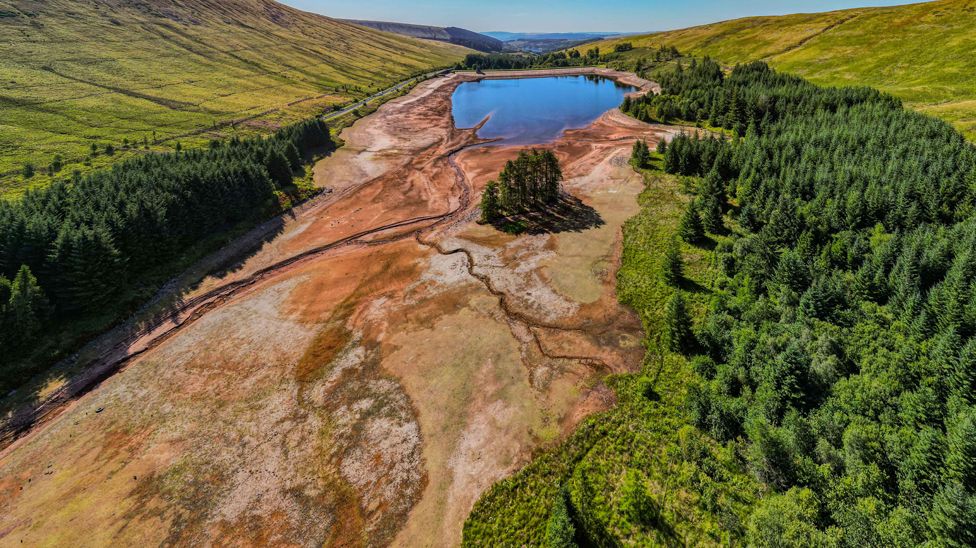
Cantref Reservoir in in Nant-Ddu, Cwm Taf, Brecon Beacons Powys, Wales, which is owned by Welsh Water, photographed from a drone which shows how low the water level has dropped.
Cantref Reservoir in Nant-Ddu, in the Brecon Beacons. The area is normally one of the wettest in the UK and supplies Cardiff and large parts of South Wales with water.
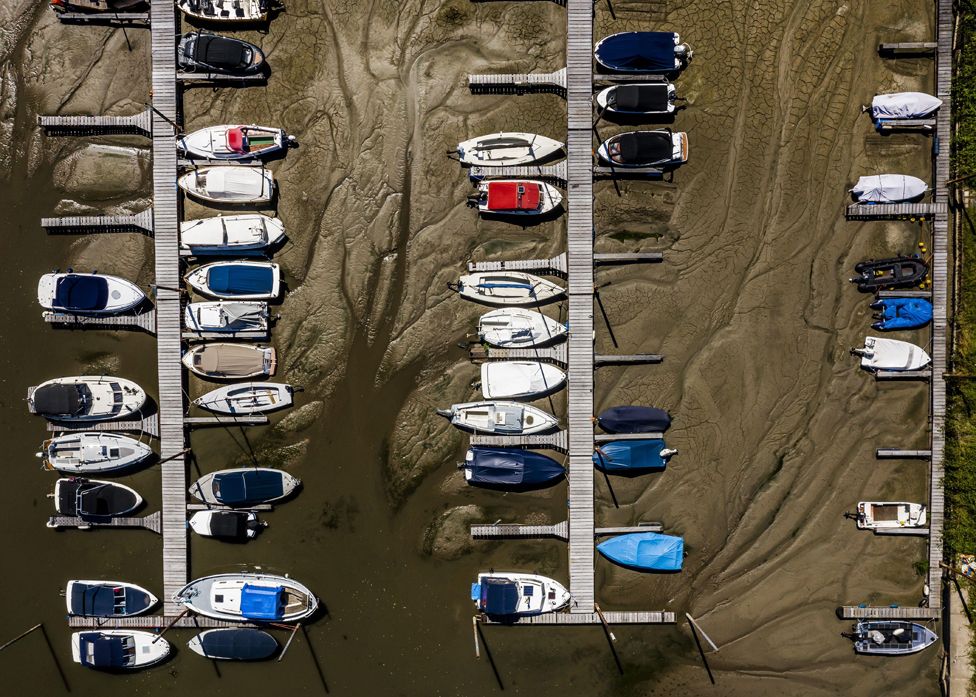
Boats are lying in the mud in the marina Beusichem, Netherlands, 10 August 2022
Boats lie in the mud in the marina at Beusichem, Netherlands. The drought and low water level has caused problems in the Lek and many other rivers.
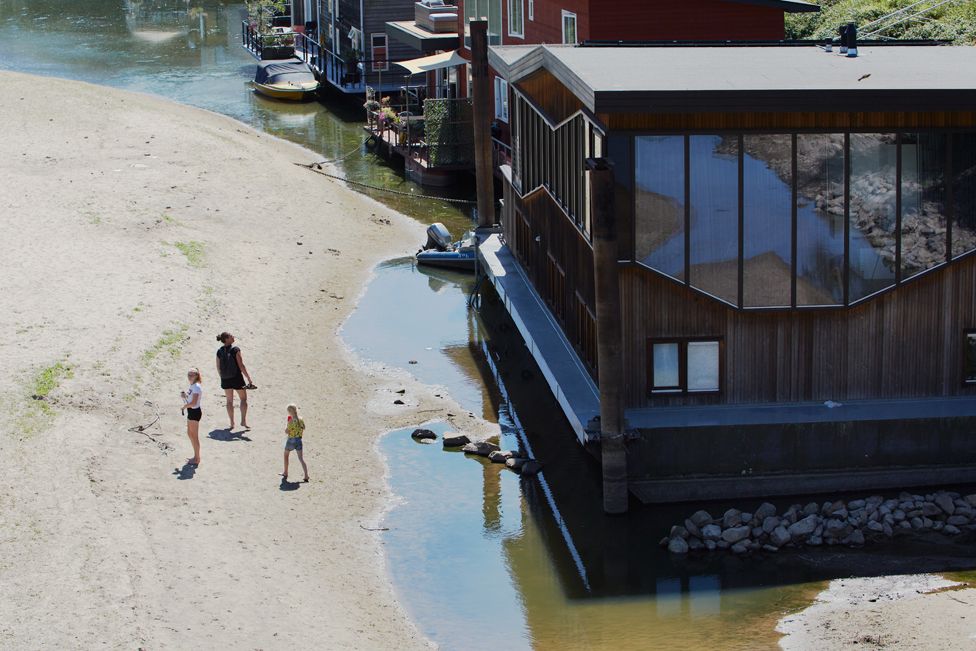
People walk near boat houses on the banks of the Waal River on August 10, 2022 in Nijmegen, Netherlands.
People walk near boat houses on the banks of the Waal River in Nijmegen, Netherlands. The ongoing drought has cut operation capacities by half along the lower Rhine from Rotterdam to Germany.
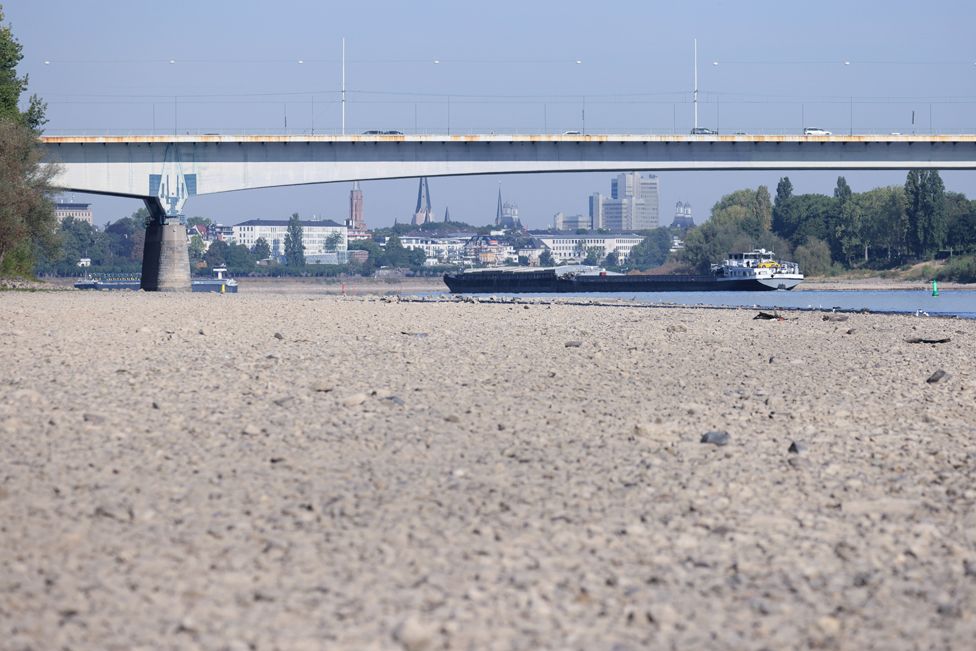
A cargo ship travels on the Rhine on August 10, 2022 in Bonn, Germany.
A ship travels on the Rhine in Bonn, Germany despite low water levels. Cargo ships are currently unable to travel with full loads, driving up shipping prices.
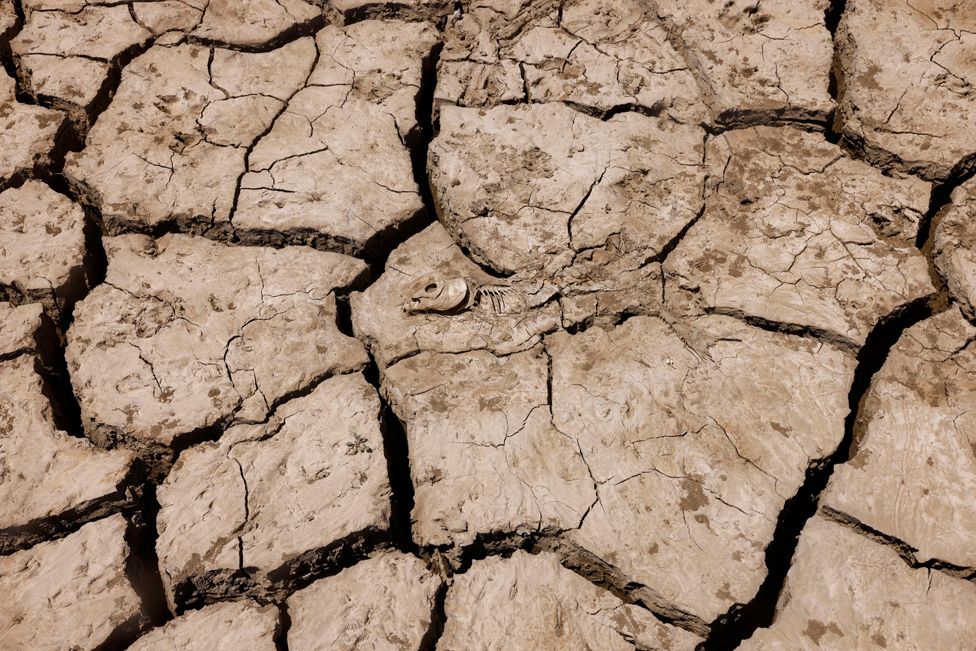
A dead fish lies on the cracked ground of La Vinuela reservoir during a severe drought in La Vinuela, near Malaga, southern Spain.
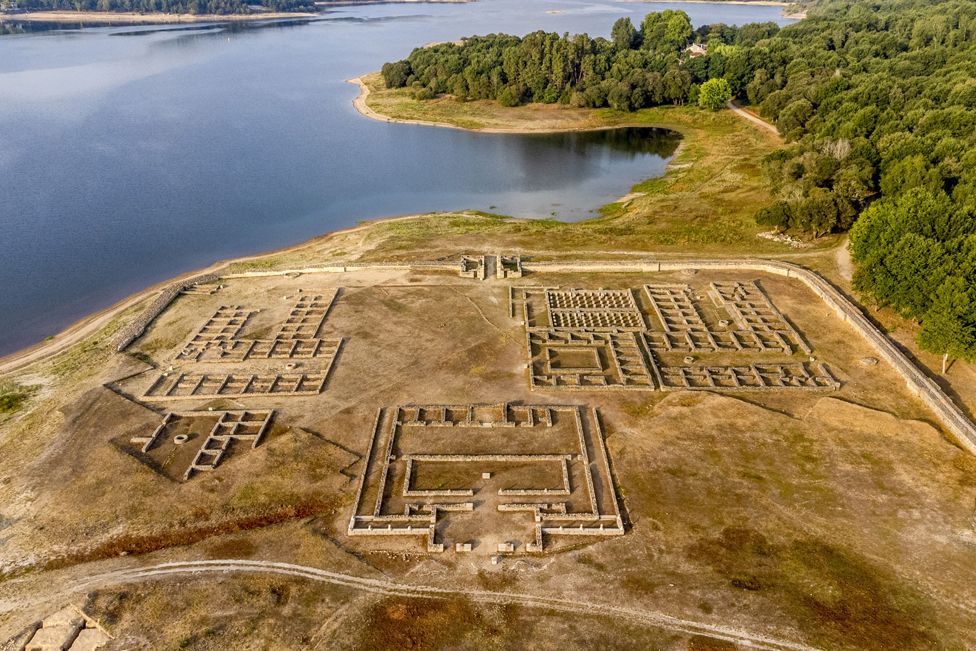
A view of the Roman camp Aquis Querquennis, located on the banks of the Limia river in the As Conchas reservoir, in Ourense, Spain, 10 August 2022.
A view of the Roman camp Aquis Querquennis, located on the banks of the Limia river in the As Conchas reservoir, in Ourense, Spain. The camp is usually submerged but is exposed due to the low water level.
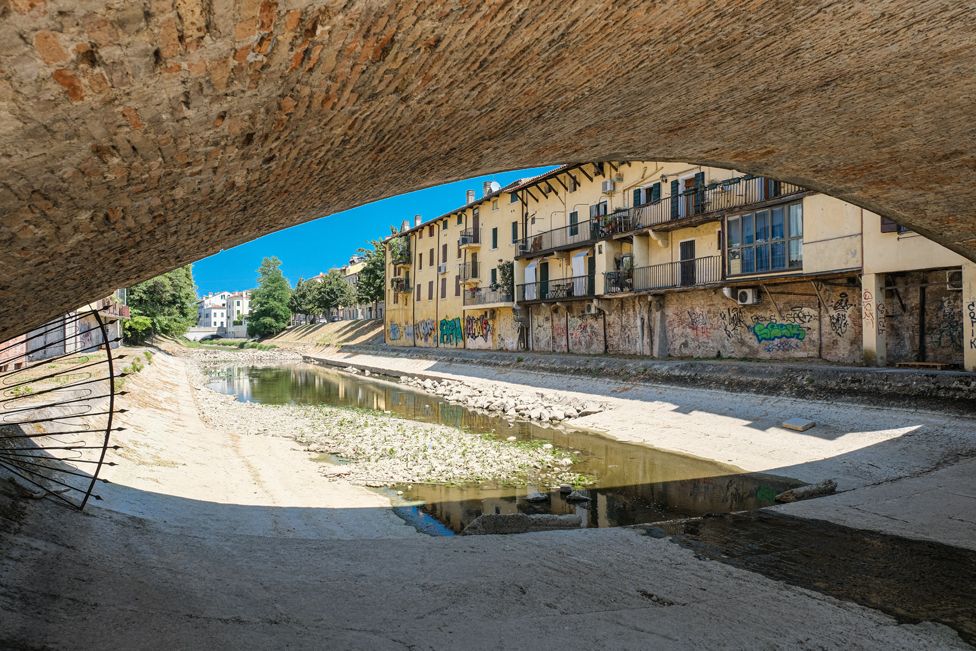
The river under the Ponte di Sant'Agostino di Padova, Padua
Northern Italy is battling its worst drought in 70 years, with the government recently declaring a state of emergency in five regions due to a lack of rain and sweltering temperatures. The river under the Ponte di Sant’Agostino di Padova, Padua, has almost run dry.
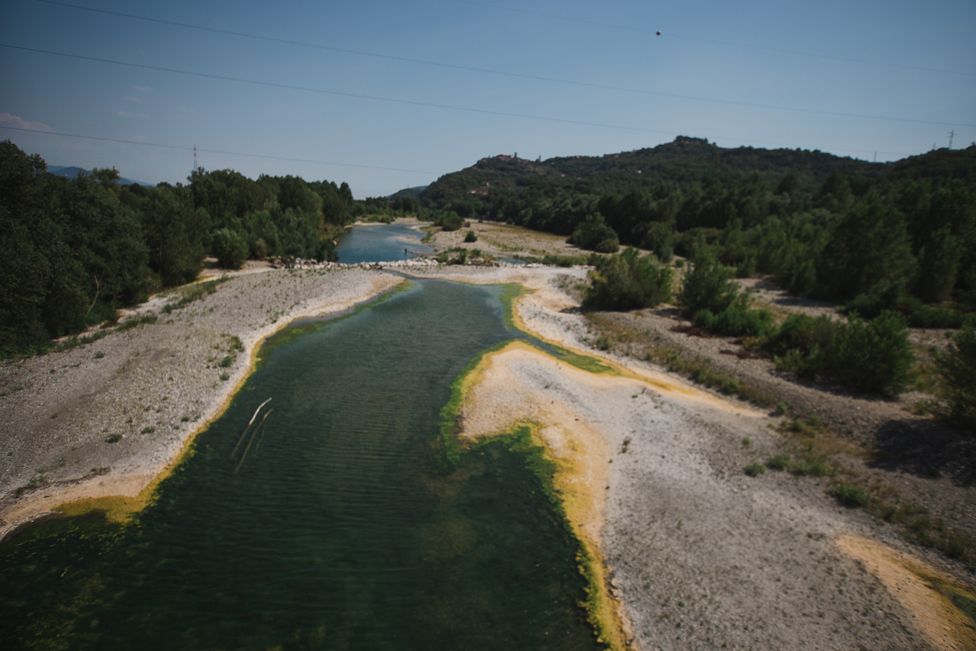
A view of the Magra river, which is at an all-time low, in Liguria.
The Magra river, which is at an all-time low, originates in Tuscany from Mount Borgognone and flows into the Tyrrhenian Sea at Bocca di Magra, in Liguria.
A tributary of the Bacchiglione di Padova, with the Specola in the background, Padua, Italy.
A tributary of the Bacchiglione di Padova, with the Specola in the background.
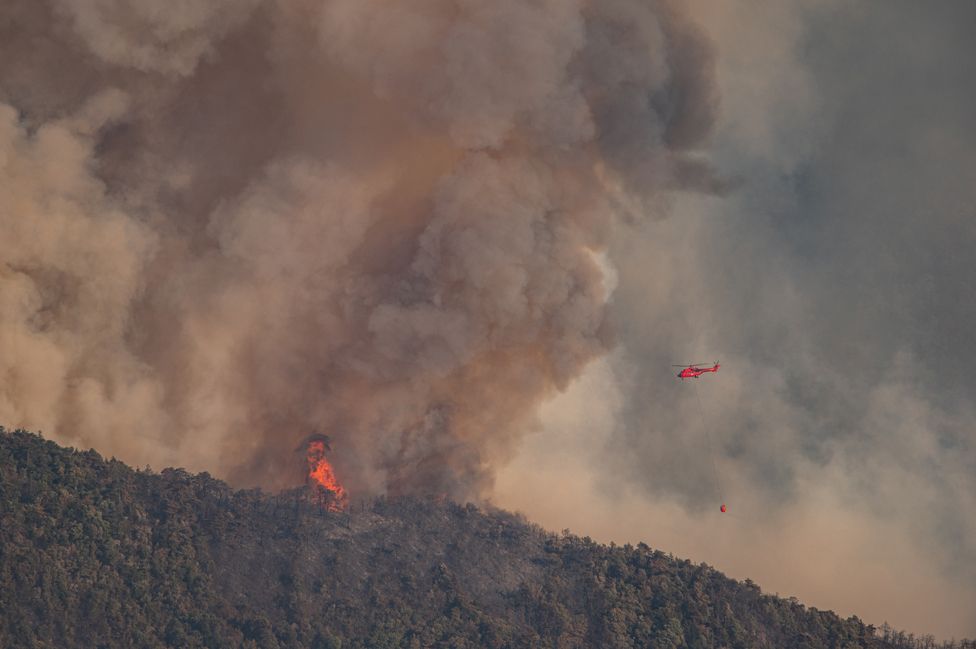
A water bomber helicopter is mobilized on a major forest fire near the town of Romeyer in south-east France.
A water bomber helicopter is mobilised on a major forest fire that broke out near the town of Romeyer in south-east France. The fire has destroyed more than 225 hectares of forest.
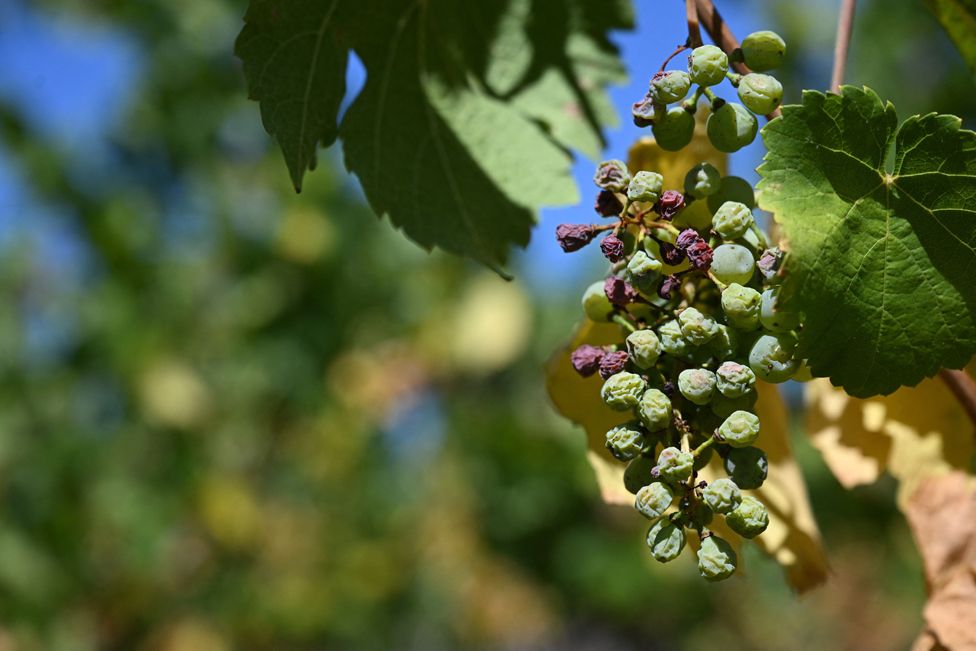
Some dried grapes are pictured in Wettolsheim, north-eastern France, on 10 August 2022.
Grapes wither on the vine in Wettolsheim, north-eastern France.
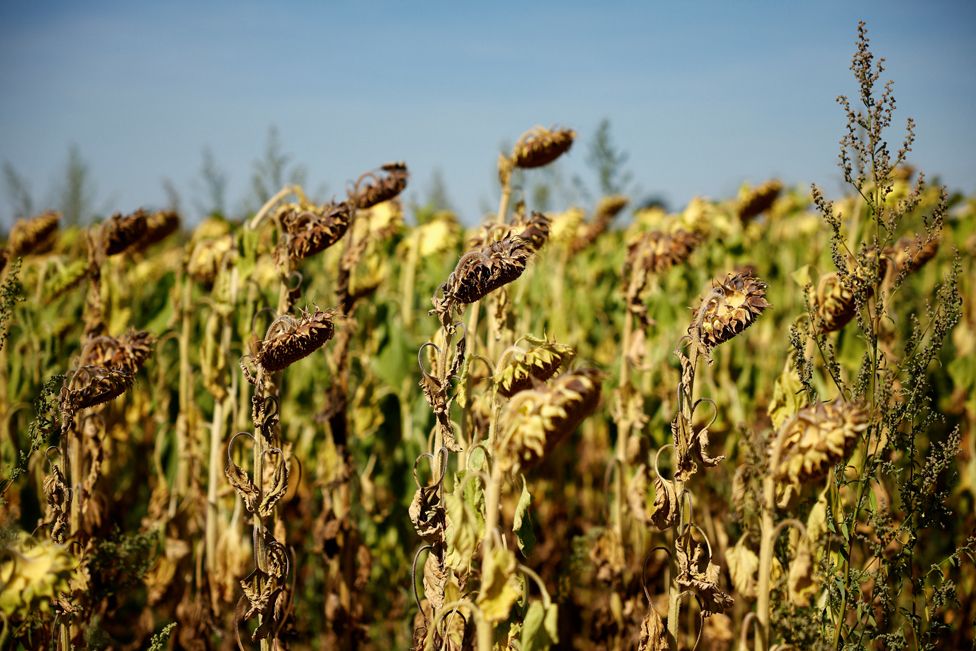
A sunflower field is seen near D'Huison-Longueville as a historical drought hits France, 8 August 2022.
France’s worst drought since records began has caused crops to shrivel.

BBC

In pictures: Hot weather sweeps across UK

Photographs from the day when high temperatures are forecast across the UK, with London set to be one of the hottest places in the world.

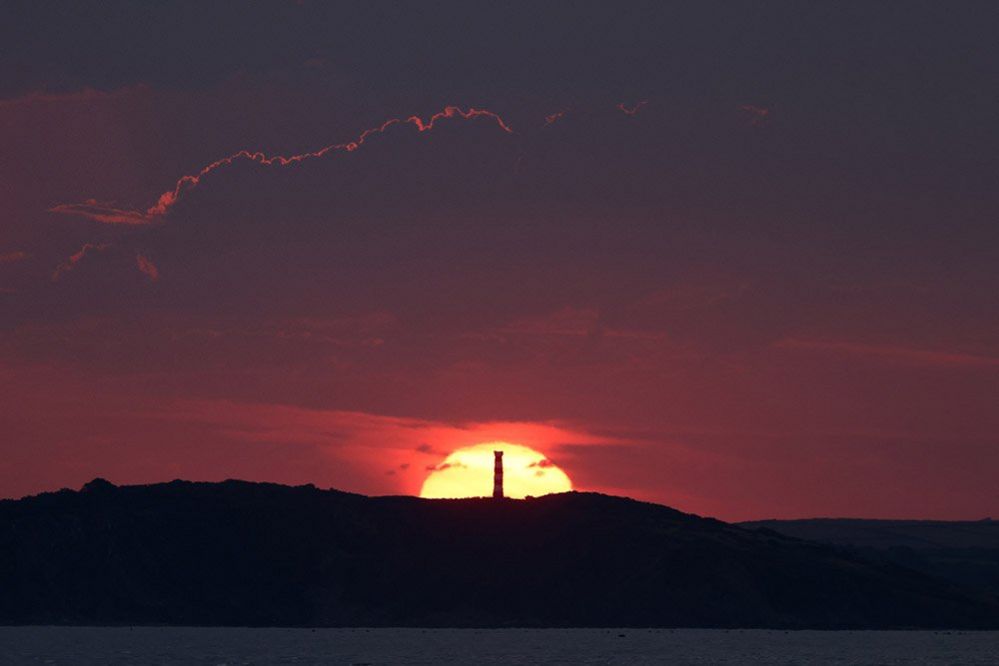
The sun rises in Mevagissey Harbour in Cornwall
The Sun rises in Mevagissey Harbour, in Cornwall, on the day UK temperatures could hit 41C.
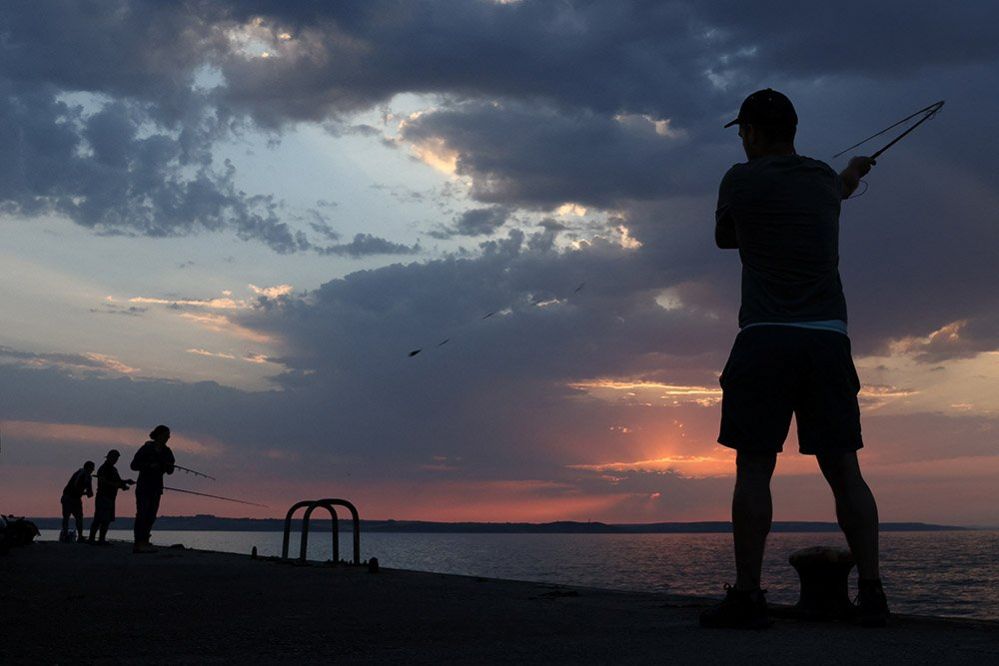
Fishermen in the early morning light
Nearby, fishermen are out to land an early catch.
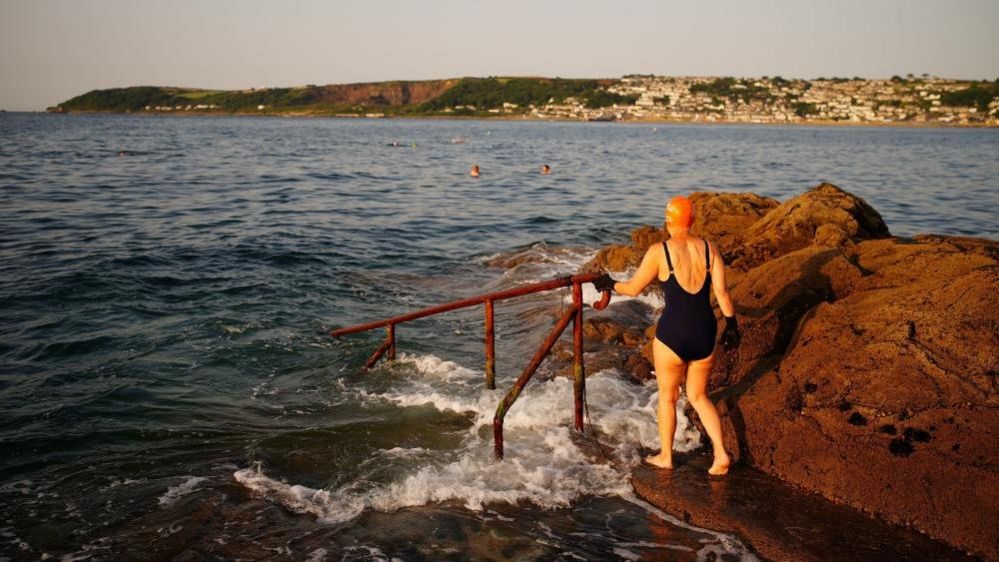
People preparing to enter the water in Penzance, Cornwall
In Penzance, Cornwall, swimmers took to the water just after sunrise.
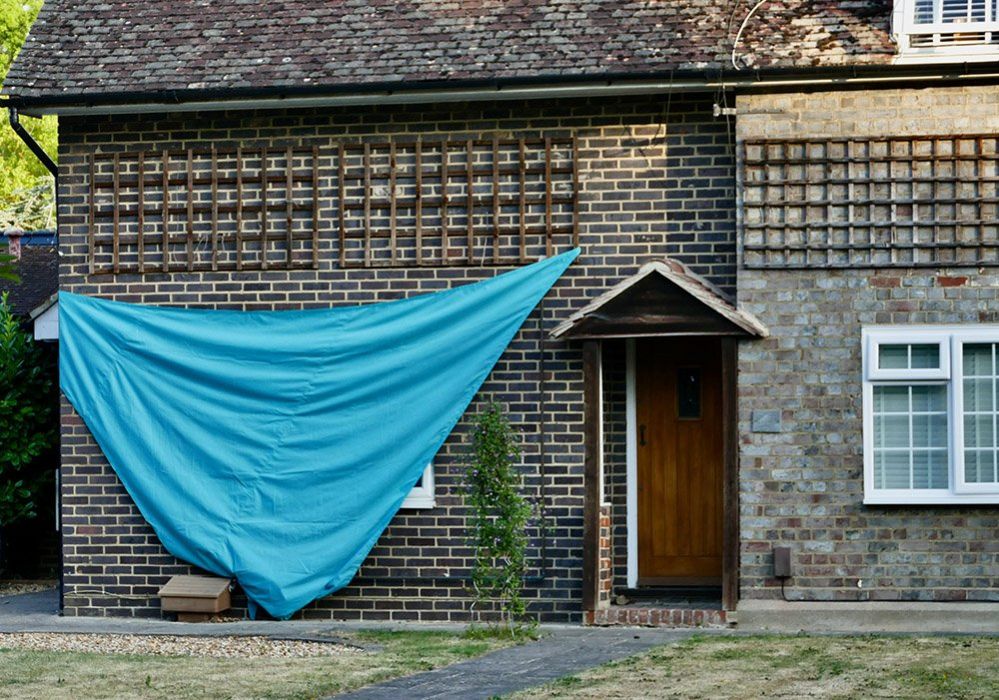
A home in Berkshire with it's front window covered
A homeowner covers the front windows to try to keep out the sunshine.
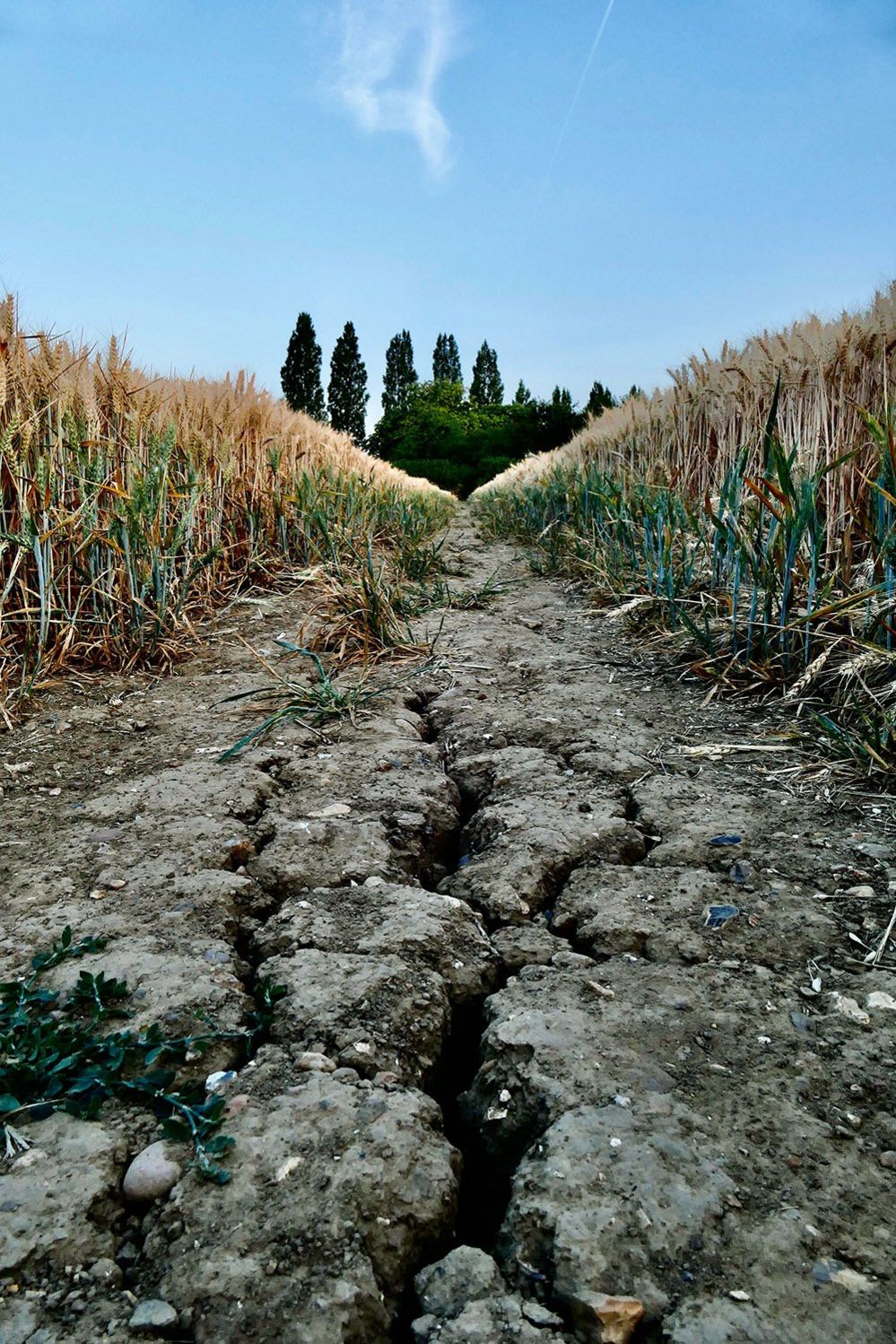
Cracked footpath
A country path in Dunsden, Oxfordshire, is dry and cracked because of the lack of rain in the recent hot spell.
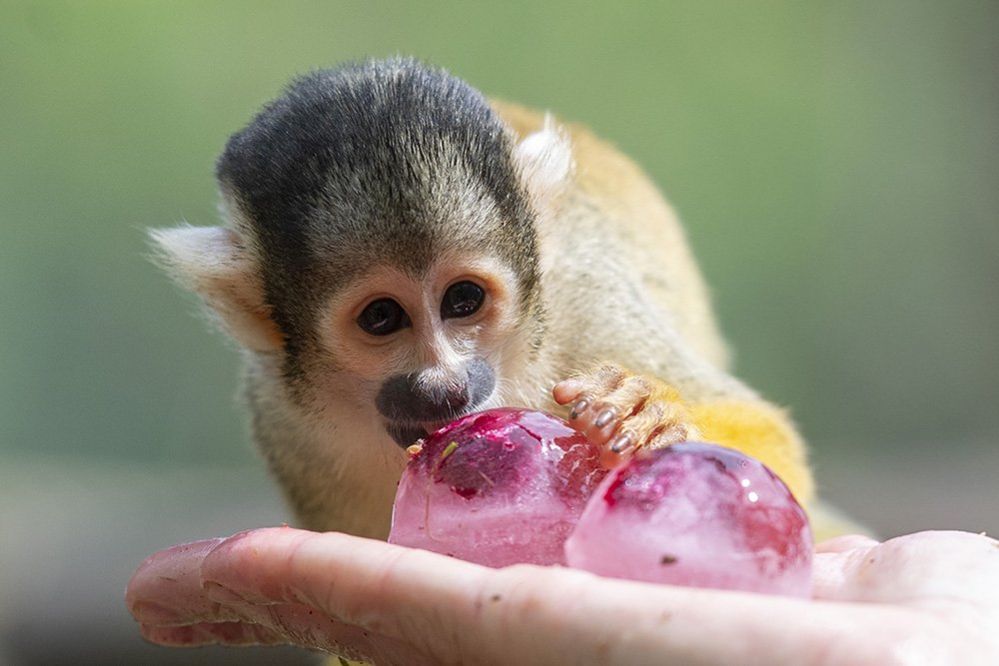
Bolivian squirrel monkey
A newborn Bolivian squirrel monkey keeps cool at Chessington Zoo, in Surrey.
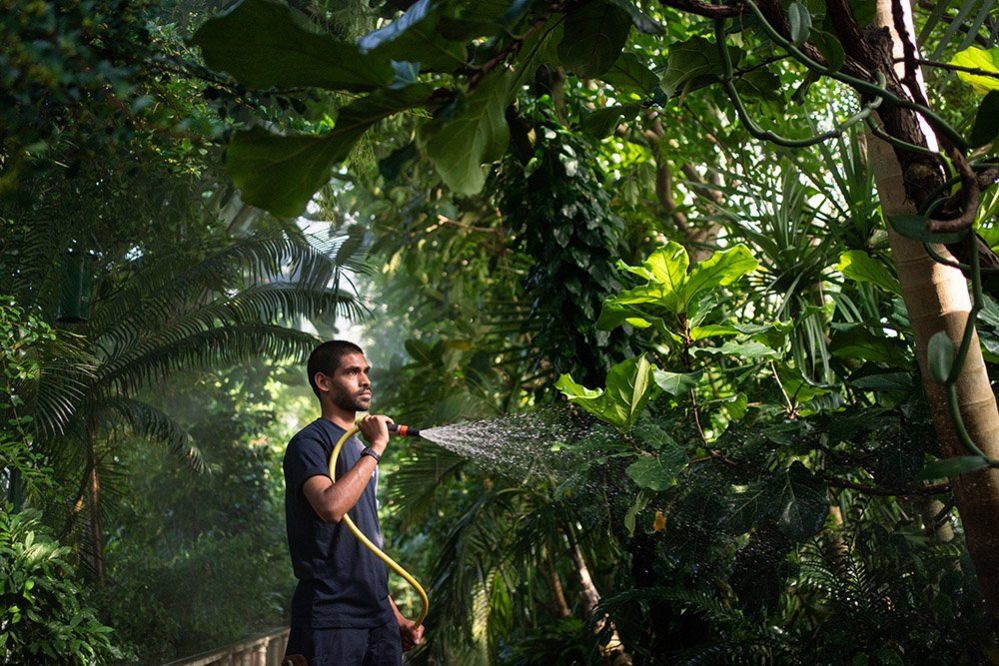
Horticulture student Muhammed Ismail Moosa waters the plants in the Palm House at the Royal Botanical Gardens Kew
At the Royal Botanic Gardens, Kew, in south-west London, horticulture student Muhammed Ismail Moosa waters the plants in the Palm House.
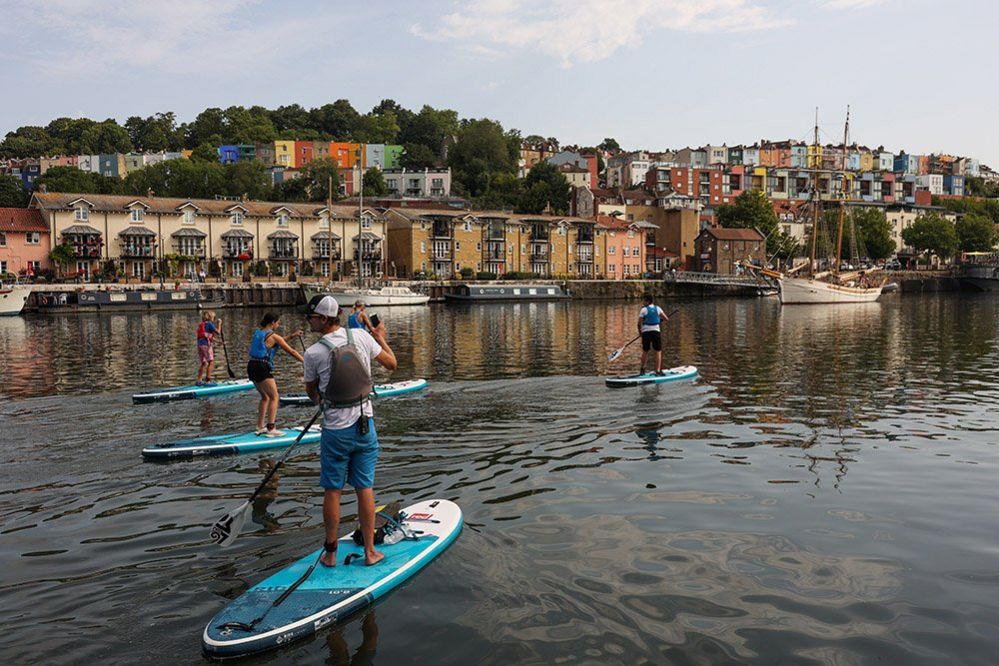
Paddle boarders in Bristol
Paddleboarders make the most of the cooler morning, in Bristol.
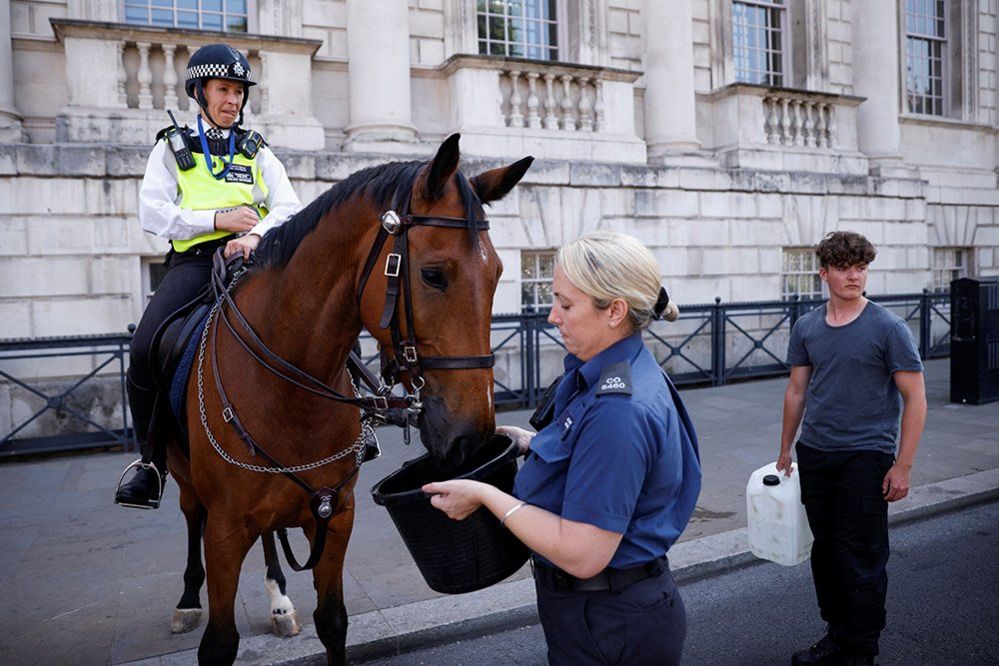
A police horse is given water from a bucket
Police horse Zorro drinks water from a bucket on Whitehall, in central London.
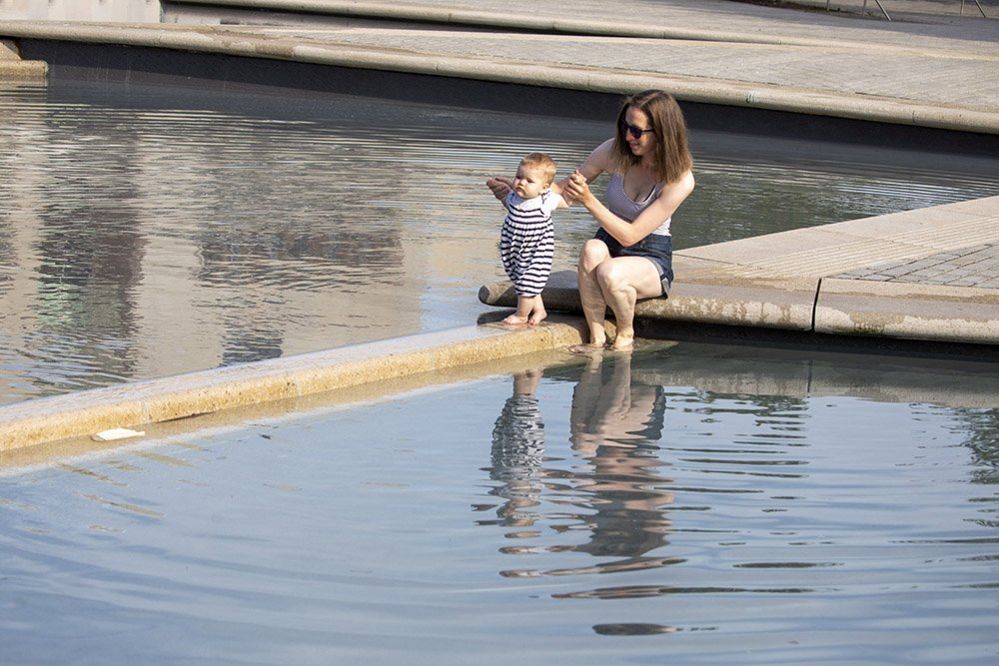
Mother and daughter beside a pond
Joanne Dunwell and her eight-month-old daughter stay cool in the ponds in Holyrood Park, Edinburgh.
A member of the Queen's Guard receives water to drink
A soldier of the Queen’s Guard is given drinking water outside Buckingham Palace, in central London.
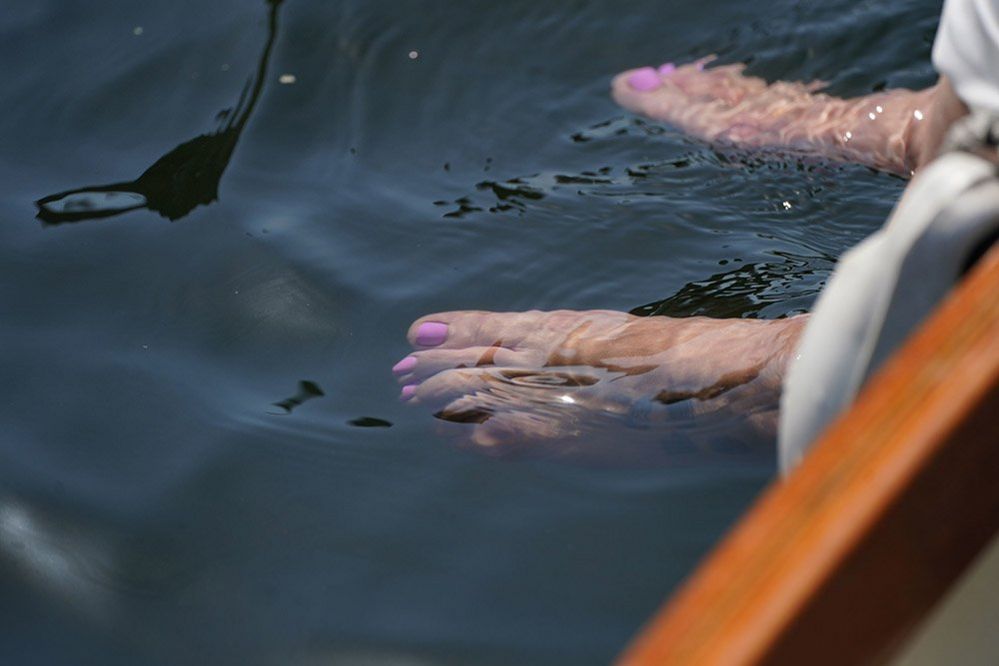
Woman's feet in a river
A woman keeps cool by dipping her feet in the River Thames near Chertsey, in Surrey.
Women on a punt on the River Cam
Visitors to Cambridge take to the River Cam.
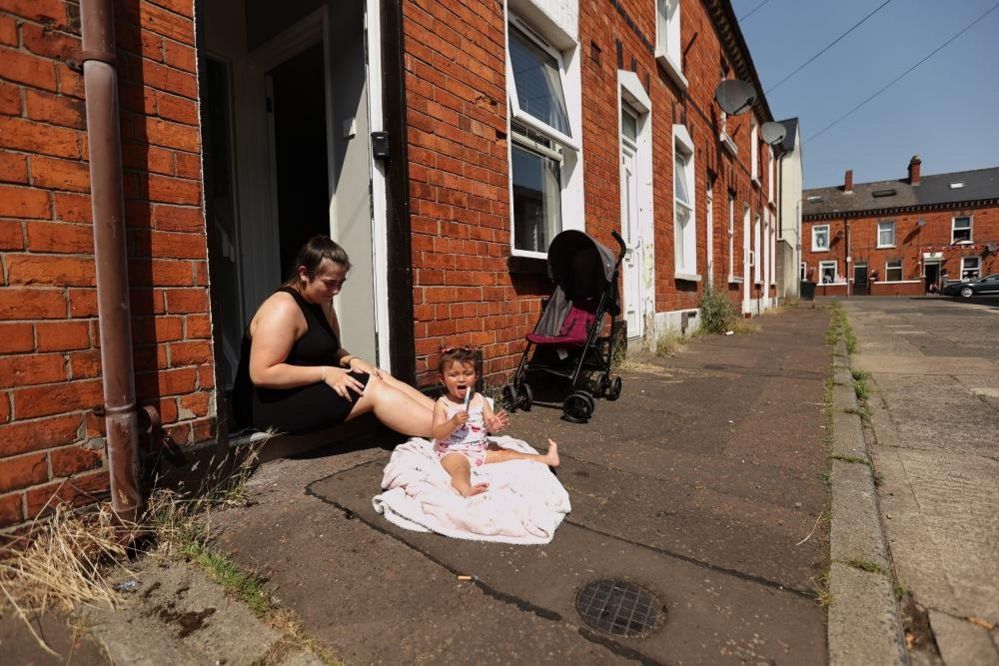
Mother and daughter outside their front door
Jasmine Bowers with her daughter, who is eating a lollipop outside their home in north Belfast.
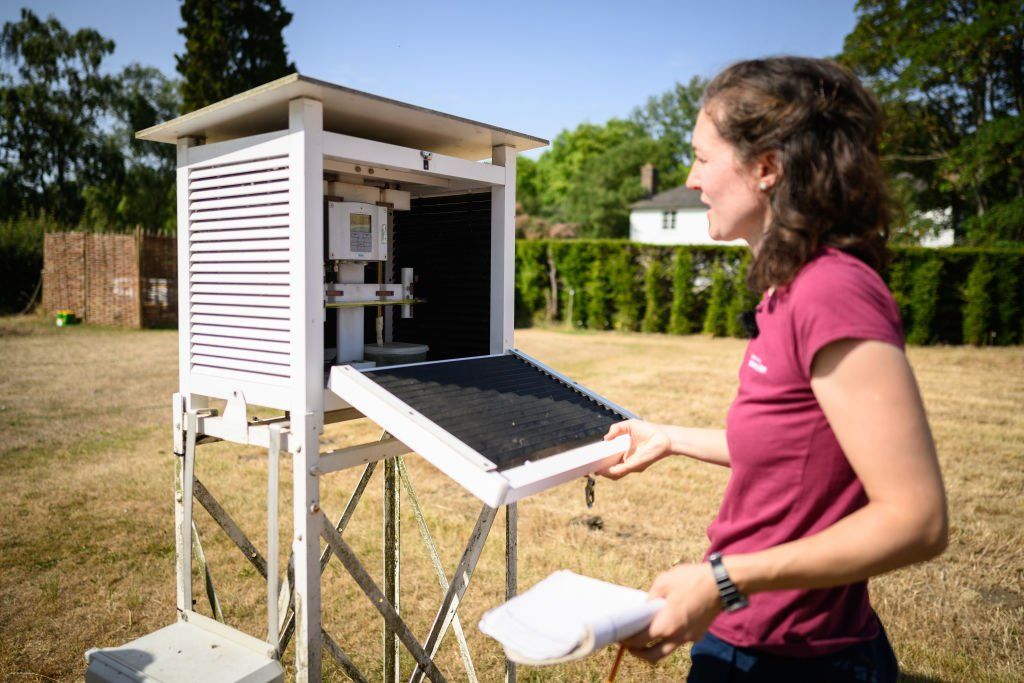
Assistant horticulturist Katie Martyr at a weather station
Assistant horticulturist Katie Martyr checks the readings for the previous 24 hours on Monday morning at the Cambridge University Botanic Garden, which previously recorded the UK’s highest temperature of 38.7C (101F ) in July 2019.
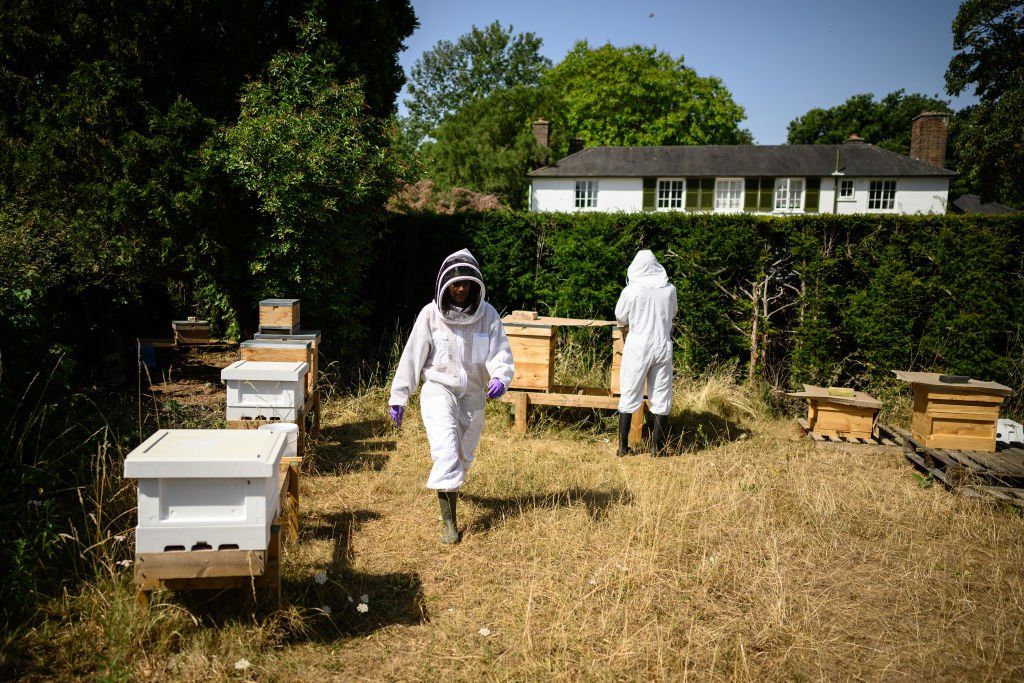
Beekeepers at work
Elsewhere at the Cambridge University Botanic Garden, beekeepers check on the beehives. They add extra water pots and place cardboard on top of the hives to help mitigate the impact of extreme heat.
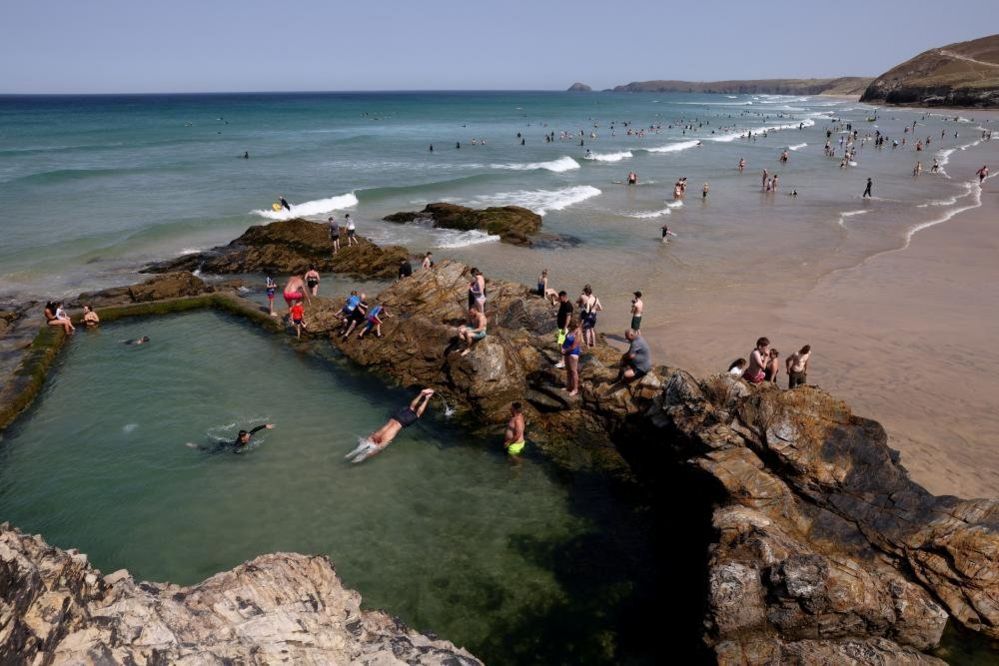
People swim in the tidal pool during hot weather at Perranporth Beach in Cornwall
People swim in the tidal pool at Perranporth Beach in Cornwall.
A person standing under a water sprinkler outside Queen Elizabeth II Centre in central London
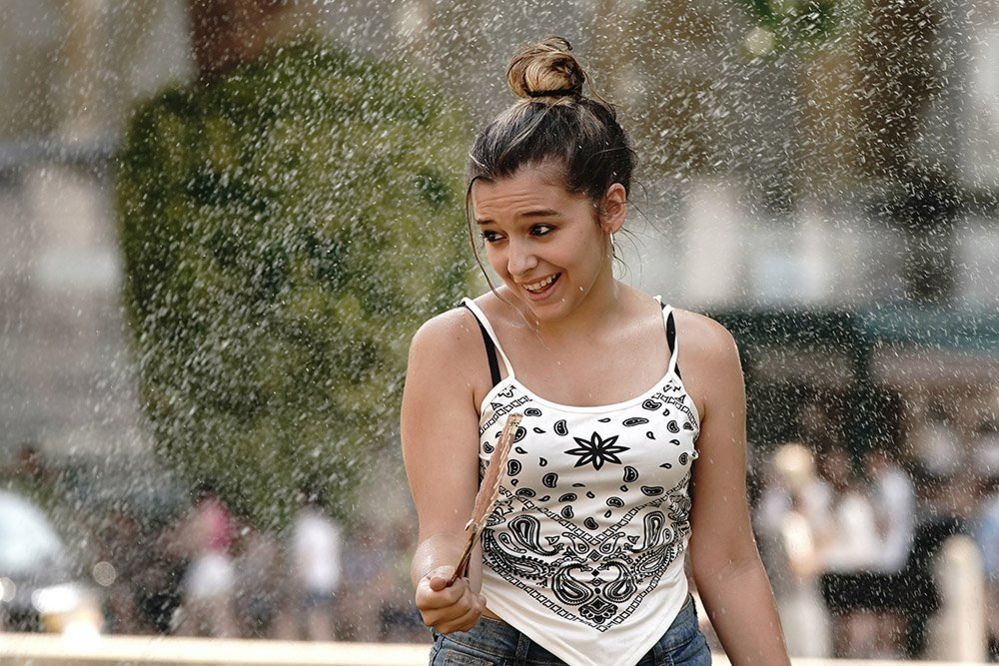
A woman keeps cool beside a water sprinkler outside Queen Elizabeth II Centre in central London.
People in a paddling pool in a park
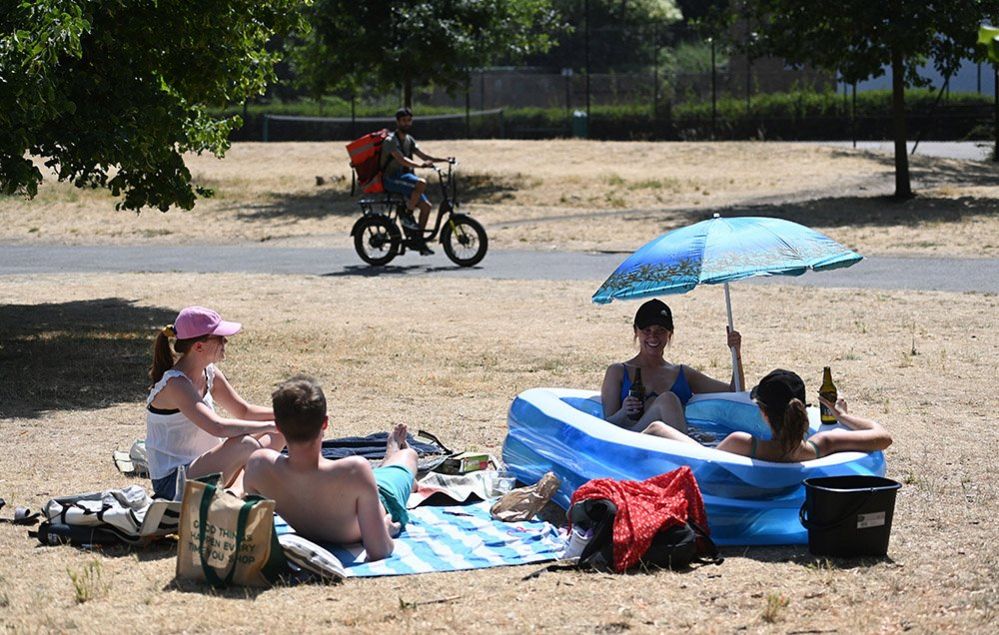
People sit in a children’s paddling pool which was filled by a council parks vehicle in central London.
People walk in the sun in Greenwich Park
A man walks in the sun in Greenwich Park on what is already the hottest day of the year across the UK.

BBC

Sodbusters and Muddy Water

Workers laying down sod. I did this decades ago and it is extremely hard work. Avoid it at all costs.

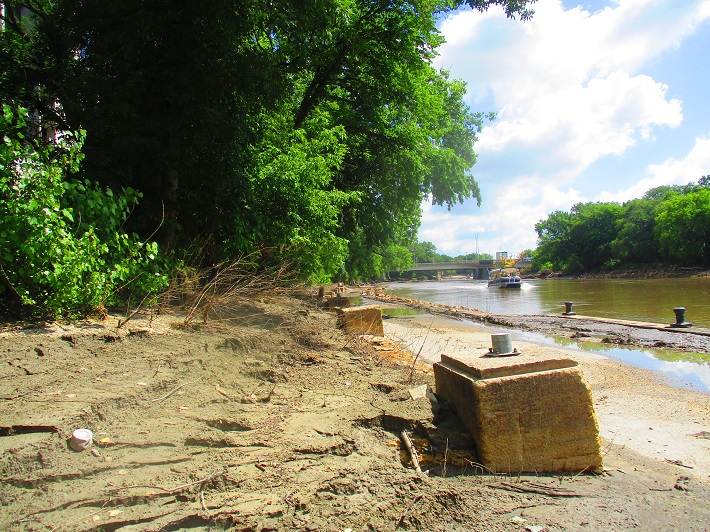
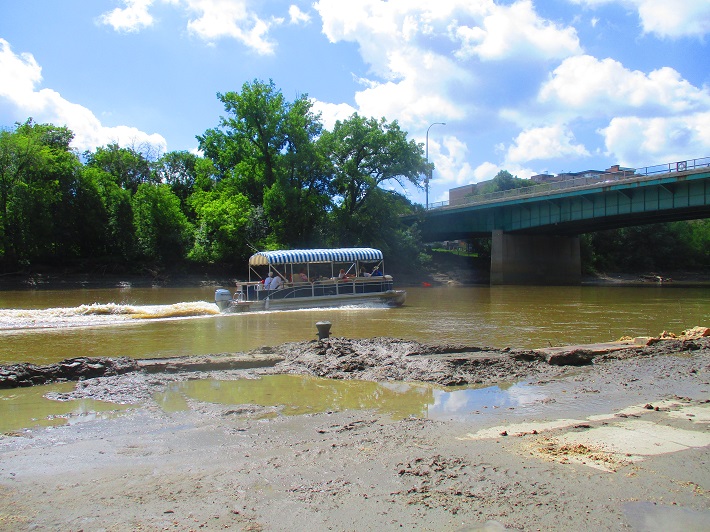
River walk in Winnipeg finally above water. Covered in mud. Now wait for the cleanup.

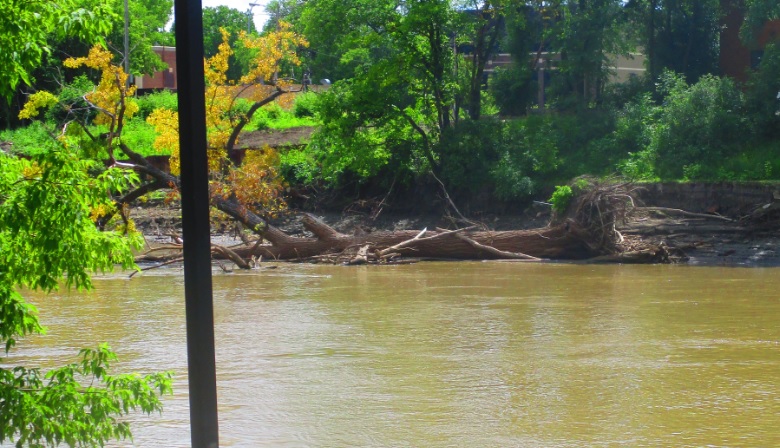
Two trees that were leaning for the last few years were completely tipped over by this years flood waters.

Trees before. Two on the left.

Present day.

River banks look almost tropical. All the rain and hot weather is making plants thrive this year.

Homeless tent camp. The explosion of homeless people in North America has to be addressed.

Assiniboine River Ice Flow

This post was blogged in 2018. This year there has been substantially more snow in Manitoba. So something more intense could be on the horizon. Updates on the way.

The Assiniboine and Red river watersheds.

Assiniboinerivermap

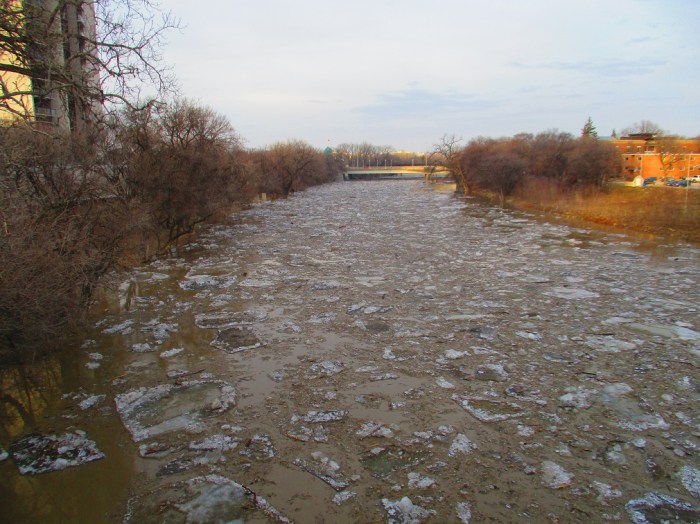
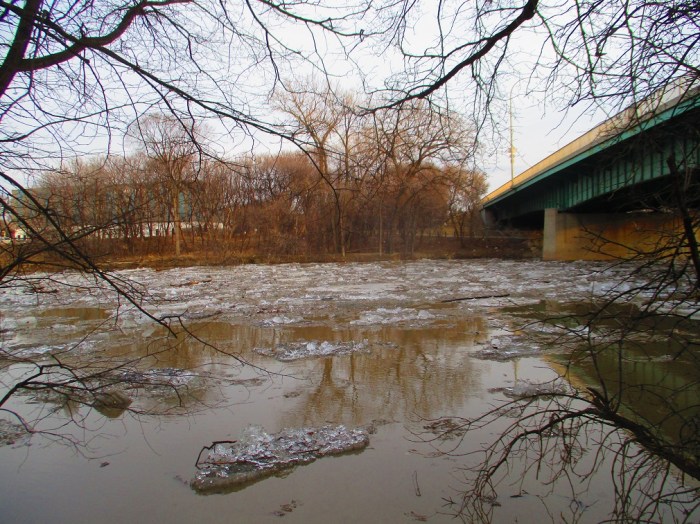
The big melt is underway in Manitoba. The Assiniboine River has substantially risen in the last few days. The current is hauling the broken ice on the Assiniboine into the Red River in downtown Winnipeg.
hice
hice1
hice3
hice4

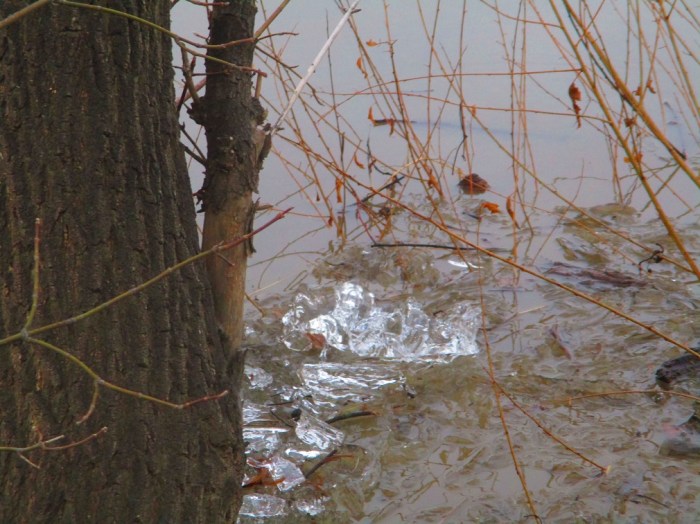
Crystal like ice that looks pretty cool

hice5

THE LIFE AND DEATH STRUGGLE ON THE GANGES

Above, the western Himalaya spot where the Ganges begins, at the confluence of the Bhagirathi and Alaknanda rivers.
From May to December, a female-led Nat Geo expedition team traveled the length of India’s holiest river, from sea to source, to get an unprecedented view of plastic pollution in a watershed–and ultimately, how to solve it.
As visual storytellers, immersive producer Veda Shastri and photographer and Nat Geo Explorer Sara Hylton depicted a complex and nuanced portrait of the Ganges—the dependence on both the river and plastic for people who live alongside it; their utmost respect and love for it; and their relative powerlessness at changing the structures that lead to plastic pollution.

“It was eye-opening seeing how dependent and integrated with the river the communities were—the spiritual component has a sanctity regardless of the levels of pollution,” Veda tells me. “It is truly a life source—for everyday sustenance.”

For Veda, the end of the 2019 journey, published in the April issue of National Geographic, is what stays with her. As they traveled upstream, the team witnessed a marked reduction in the level of pollution, and by the time they reached the city of Rishikesh, they were able to get a more unadulterated view of the Ganges.

“Incredible to witness that magic,” she says.

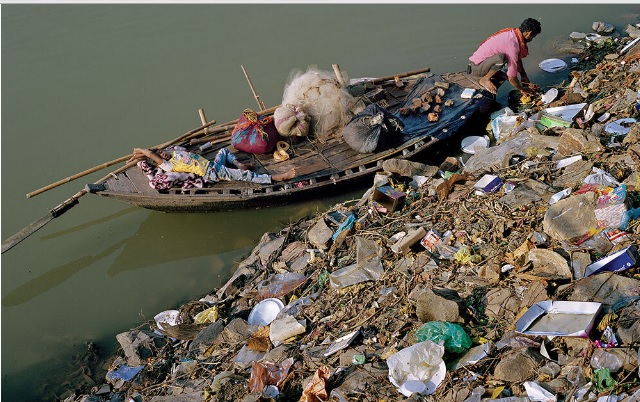
Fishing amid the trash: Fisherman Babu Sahni, 30, and his eight-year-old son, Himanshu Kumar Sahni, approach a bank on a Ganges tributary. Trash collection is rare in rural India, and ad hoc dump sites like this one are common. Most plastic waste in the ocean gets there by washing off the land.

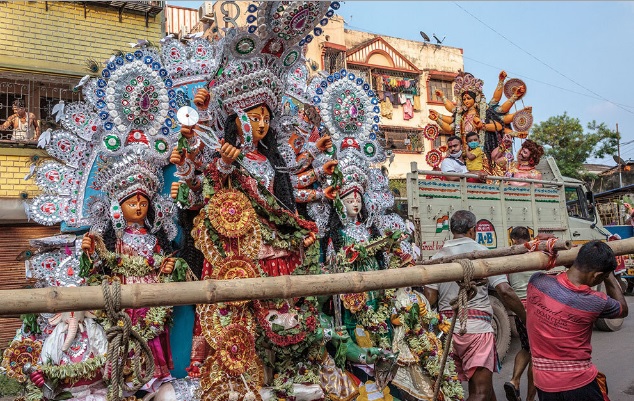
Before the goddess is submerged: Celebrants transport a likeness of the goddess Durga through the streets of Howrah, near Kolkata, during the Durga Puja festival. It ends with the immersion of the idols in a tributary of the Ganges.

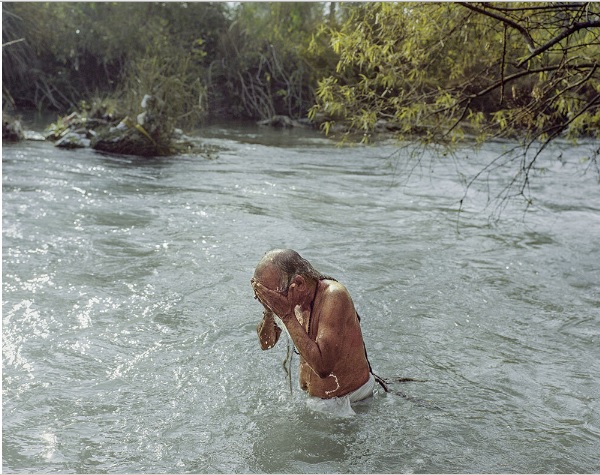
A personal interest in a cleaner river: Swami Shivanand Saraswati, 75, bathes in the Ganges at his Matri Sadan ashram in Haridwar. He leads a long-running and ambitious campaign to protect the river from mining, new dams, and pollution.

National Geographic

Environmental Photographer of the Year 2021 winners revealed

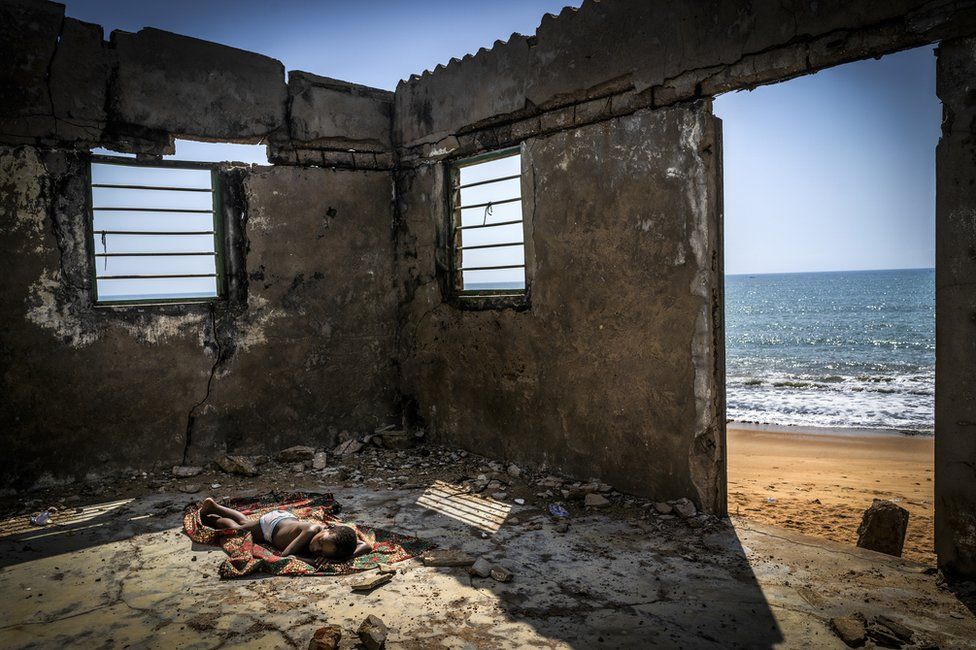
Spanish photographer Antonio Aragón Renuncio has won Environmental Photographer of the Year 2021 for his photo of a child sleeping inside a house destroyed by coastal erosion on Afiadenyigba beach in Ghana.

A child sleeps inside a derelict building on a beach in Ghana in 2019

The image, entitled The Rising Tide Sons, highlights the rising sea levels in West African countries, which are forcing thousands of people to leave their homes.

Mr Renuncio receives £10,000 prize money.

The Environmental Photographer Of The Year competition, now in its 14th year, showcases some of the world’s most inspirational environmental photography.

The award celebrates humanity’s ability to survive and innovate and supports the calls to action in the United Nations Sustainable Development Goals.

The winners of this year’s competition were revealed at the UN Climate Change Conference (COP26) in Glasgow.

Here are other winning photos from the competition, with descriptions by the photographers.

Young Environmental Photographer of the Year: Inferno, by Amaan Ali, taken in Yamuna Ghat, New Delhi

A boy tries to stop an approaching forest fire in Yamuna Ghat, New Delhi, India

“A boy fighting fires in a forest near his home in Yamuna Ghat, New Delhi, India.”

line

The Resilient Award: Survive for Alive, by Ashraful Islam, taken in Noakhali, Bangladesh

An aerial view of sheep on a dry and cracked landscape

“Flocks of sheep search for grass amongst the cracked soil.

“Extreme droughts in Bangladesh have created hardships for all living beings.”

line

Sustainable Cities winner: Net-zero Transition – Photobioreactor, by Simone Tramonte, taken in Reykjanesbær, Iceland

A photobioreactor seen in Reykjanesbaer, Iceland

“A photobioreactor at Algalif’s facilities in Reykjanesbaer, Iceland, produces sustainable astaxanthin using clean geothermal energy.

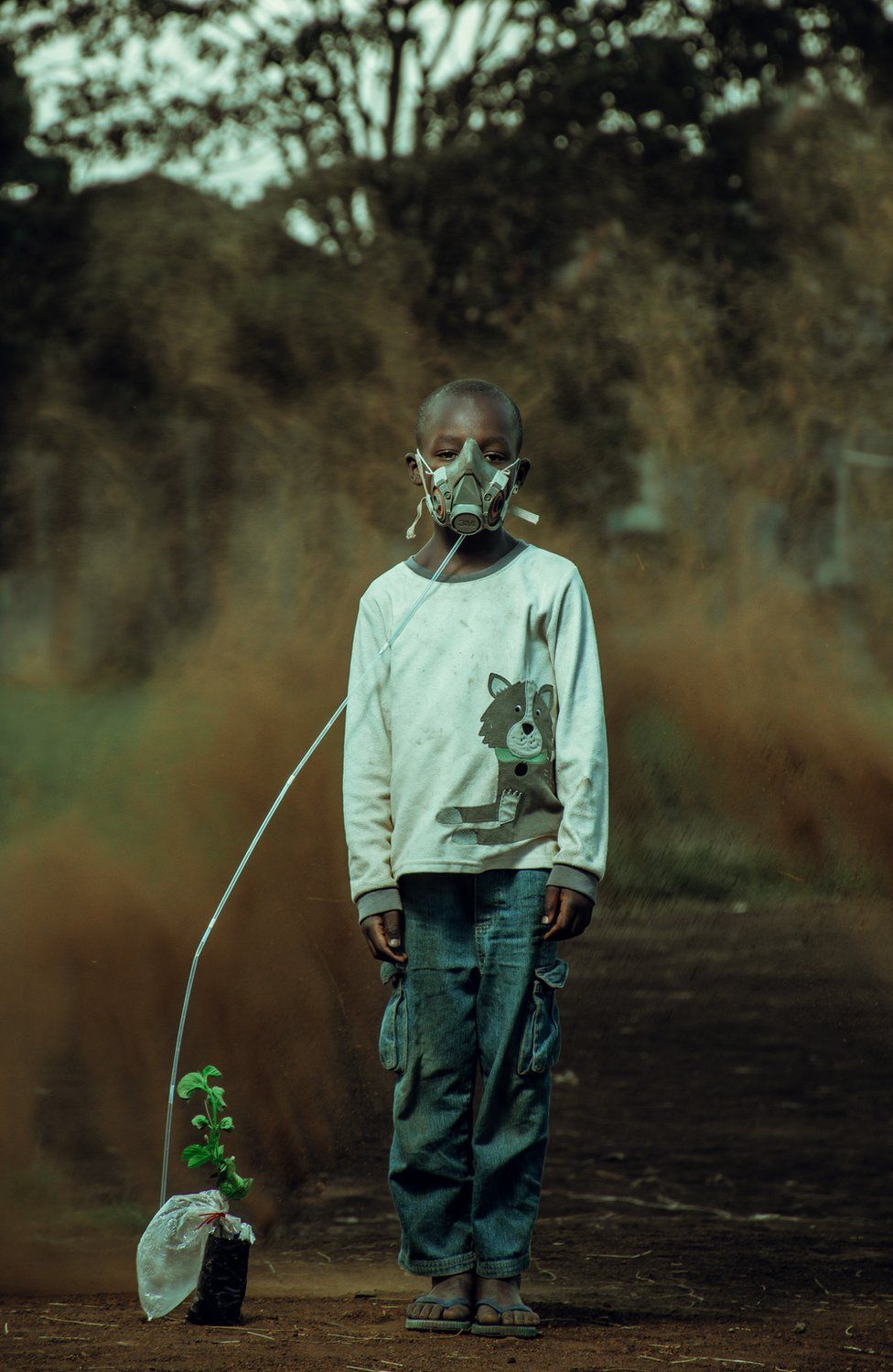
Climate Action winner: The Last Breath, by Kevin Ochieng Onyango, taken in Nairobi, Kenya

A boy is seen wearing an oxygen mask attached to a plant, with a sand storm behind him

“A boy takes in air from the plant, with a sand storm brewing in the background, in an artistic impression of the changes to come.”

line

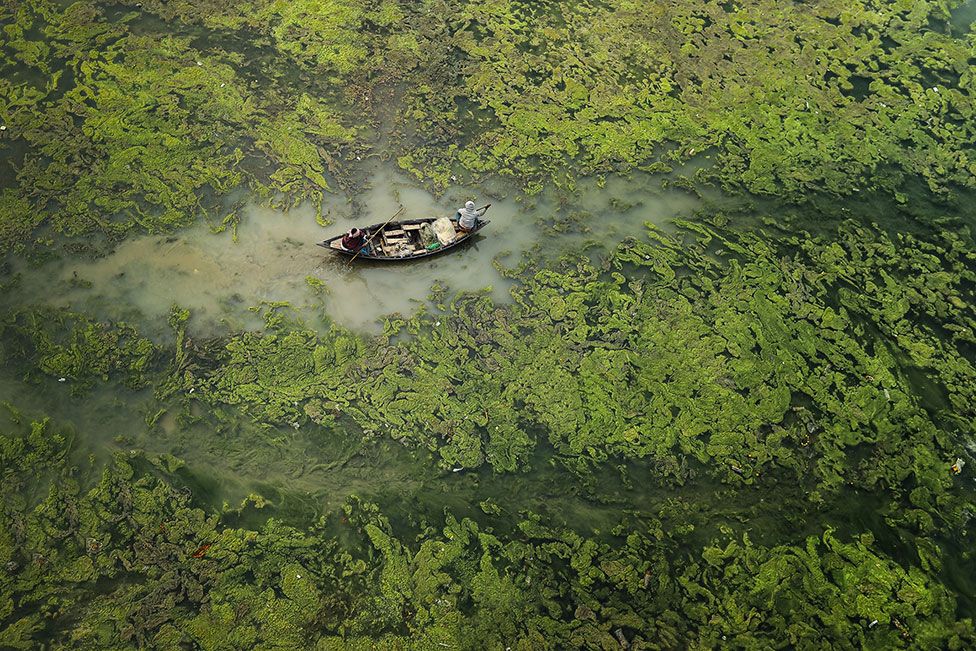
Water and Security winner: Green Barrier, by Sandipani Chattopadhyay, taken at Damodar river, West Bengal, India

An aerial view of a boat surrounded by algal blooms on the Damodar river in India

“Irregular monsoon seasons and droughts cause algal bloom on the Damodar river, India.

“Algal blooms prevent light from penetrating the surface and prevent oxygen absorption by the organisms beneath, impacting human health and habitats in the area.”

line

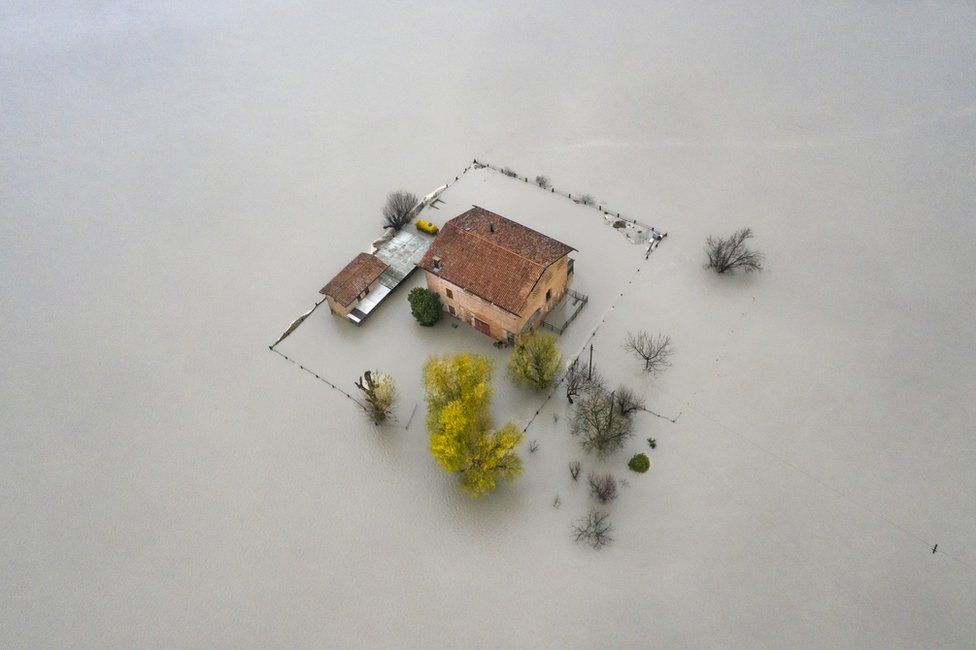
Environments of the Future winner: Flood, by Michele Lapini, taken at River Panaro, Nonantola, Modena, Italy

An aerial view of a house surrounded by flood water in the Po Valley

“A house is submerged by the flooding of the River Panaro in the Po Valley due to heavy rainfall and melting snow.”

line

Here are some of the shortlisted images in the competition.

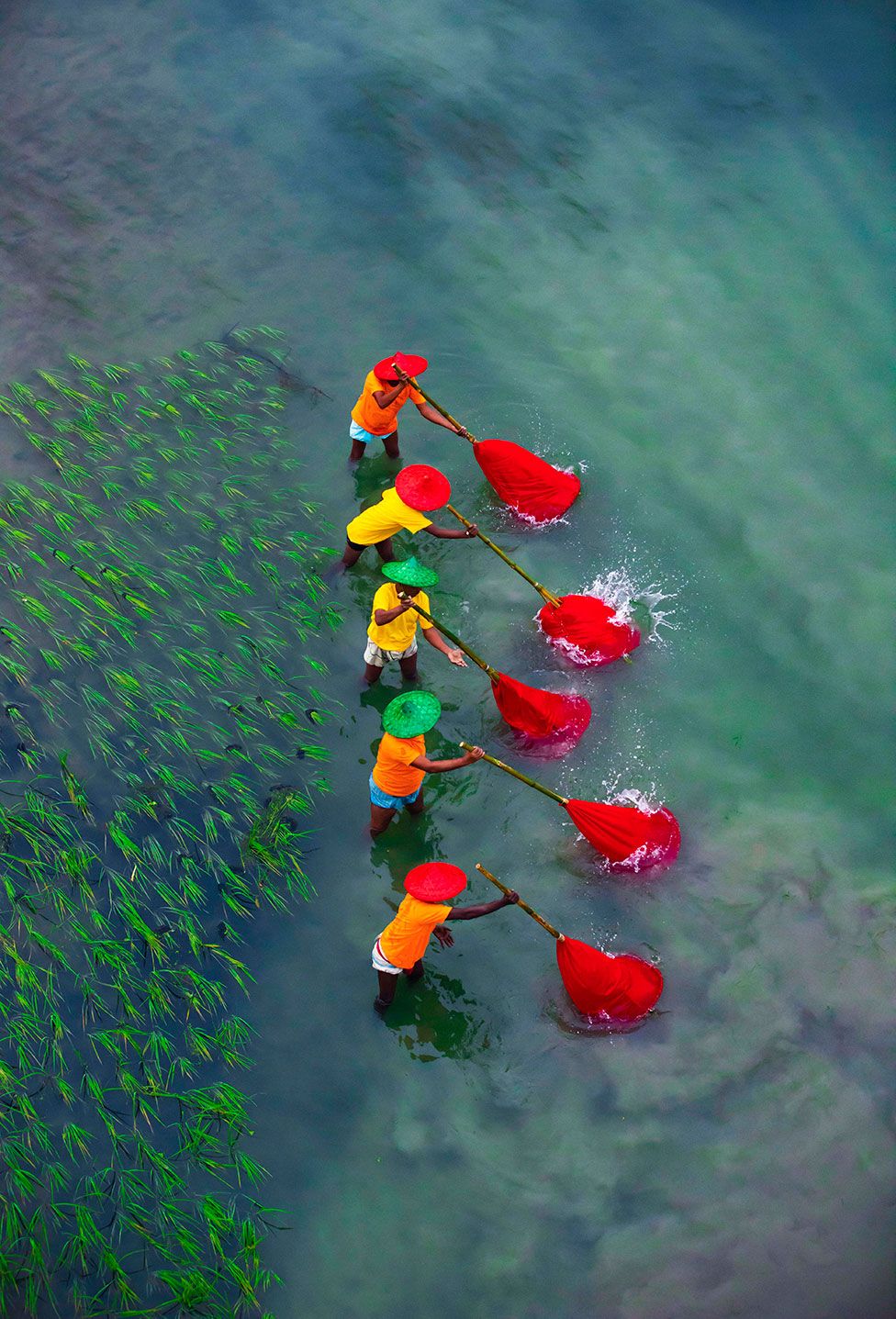
Fishing in River, by Ashraful Islam, taken in Sirajgong, Bangladesh

People fish with nets in a river in Sirajgong, Bangladesh

“Algae accumulates and fills the whole river, then many boatmen come here to fish in the water.

“The river is filled with green moss.”

line

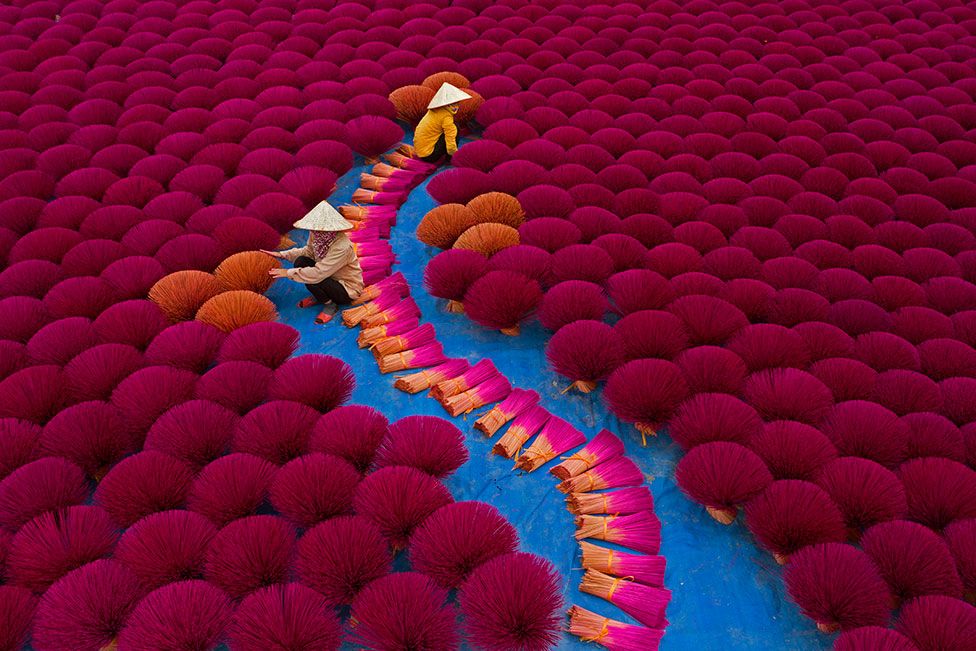
Drying Incense, by Azim Khan Ronnie, taken in Hanoi, Vietnam

Workers sit surrounded by thousands of incense sticks

“Vietnamese workers sit, surrounded by thousands of incense sticks in Quang Phu Cau, a village in Hanoi, Vietnam, where the sticks have been traditionally made for hundreds of years.

“Incense plays an important role in the spiritual lives of Vietnamese people.”

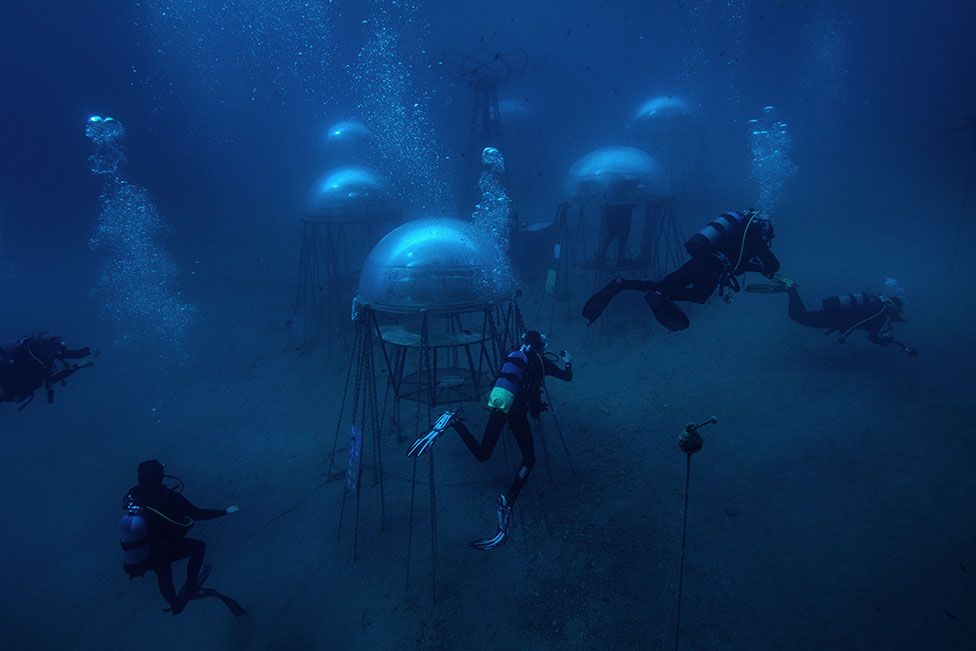
The Nemo’s Garden, by Giacomo d’Orlando, taken in Noli, Italy

Divers swim around underwater pods, which are an alternative system of agriculture

“The Nemo’s Garden represents an alternative system of agriculture especially dedicated to areas where environmental conditions make plant growth extremely difficult.

“This self-sustainable project aims at making underwater farming a viable eco-friendly solution to counteract the increasing climate-change pressures on our future.”

line

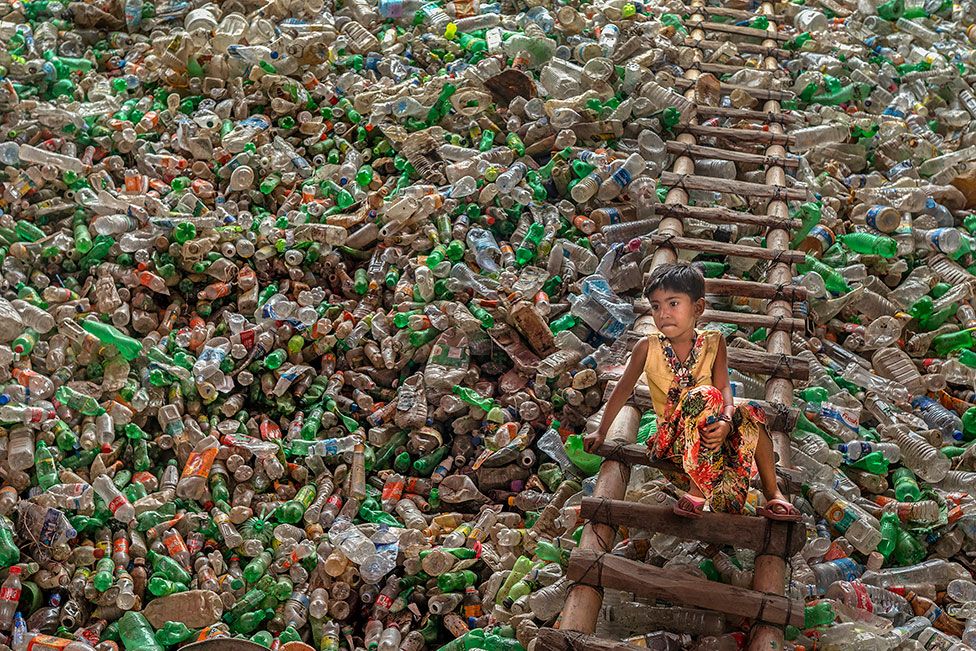
Environment Confined in Plastic, by Subrata Dey, taken in Chittagong, Bangladesh

A child sits on a ladder surrounded by plastic bottles at a plastic-recycling factory in Chittagong, Bangladesh

“I captured this picture from a plastic-recycling factory in Chittagong, Bangladesh.

“Plastic recycling helps protect the environment from plastic pollution and greenhouse gas emissions.”

line

Clean Energy, by Pedro de Oliveira Simões Esteves, taken in Serra de São Macário, Portugal

Wind turbines next to a misty mountainous area in Portugal

“Wind-energy turbines, moments before the sun sets over the mountains on a cloudy day.”

line

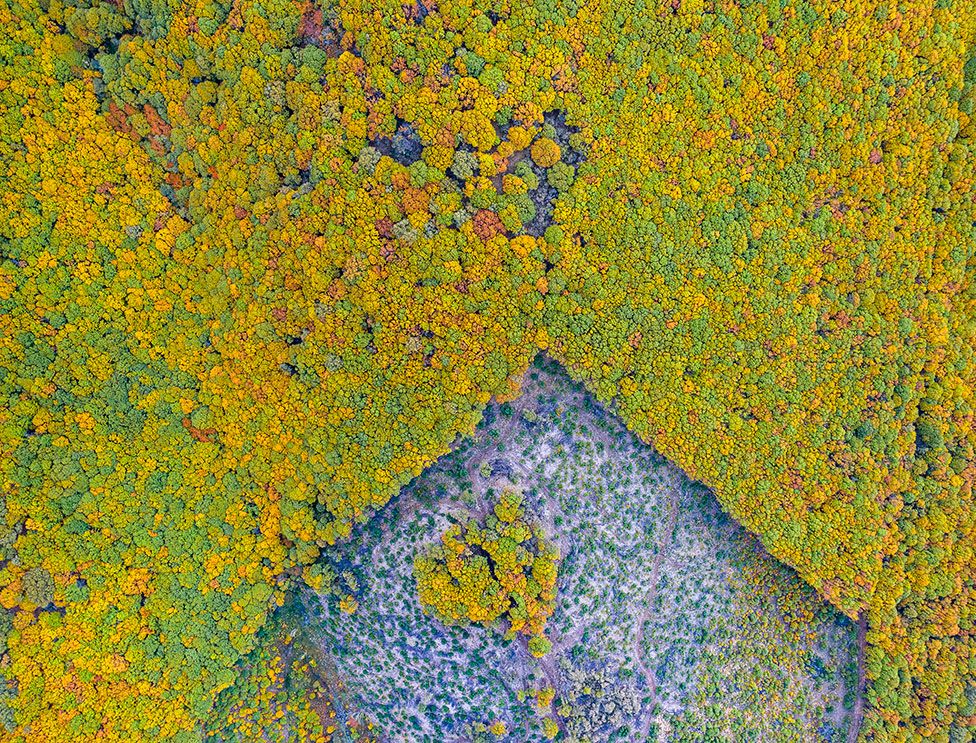
The Polygonal Forest, by Roberto Bueno, taken in Sierra de Béjar, Salamanca, Spain

An aerial view of a forest management technique in Sierra de Béjar, Salamanca, Spain

“A good management of forests is fundamental to contain climate change.

“This is a chestnut forest managed by wood owners in a sustainable way.

“They cut trees in polygonal areas and in the middle of them they leave smaller areas with trees that help the natural reforestation of the wood.”

BBC