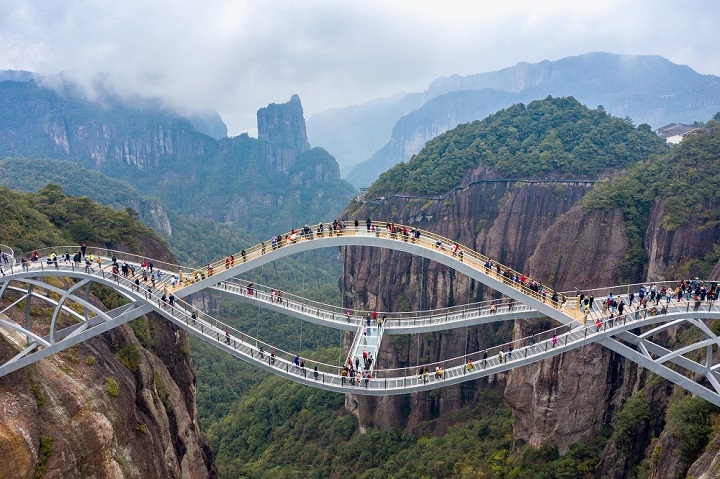
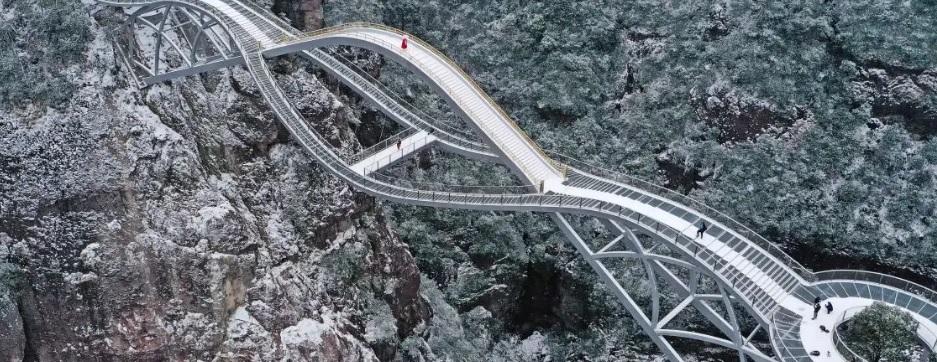
According to the official Weibo account for the Shenxianju Scenic Area, construction on the Ruyi bridge began in 2017 and was finally opened in September of 2020. In a second post, the park explained that the bridge spans 100 meters across the east and west gorges of Shenxianju. A rough translation of the post read: With a total length of 100 meters and a vertical height of more than 140 meters, it spans the east and west gorges of Shenxianju. Intertwined into an undulating bridge body, visitors have a sense of experience when they pass. The rigid and soft shape is perfectly integrated with the natural scenery of the Fairy House, just like a jade ruyi in the sky, and like a fairy draped silk. The painting is like a screen, and when seen from a distance, the mountains are full of movement, and they also carry beauty and auspiciousness.
Tornado safety measures. If you own a house and you are in the house. The ideas below could really help.
A storm shelter or storm cellar is a type of underground bunker designed to protect the occupants from violent severe weather, particularly tornadoes. They are most frequently seen in the Midwest (“Tornado Alley”) and Southeastern United States (“Dixie Alley”) where tornadoes are generally frequent and the low water table permits underground structures.
The most common tornado shelters have steep stairs, making them inaccessible to people with ambulatory disabilities. The base model, found in some backyards in Oklahoma, is an underground concrete box, like this one.
I would need at least 4 beers in my system before I would walk on this bridge.
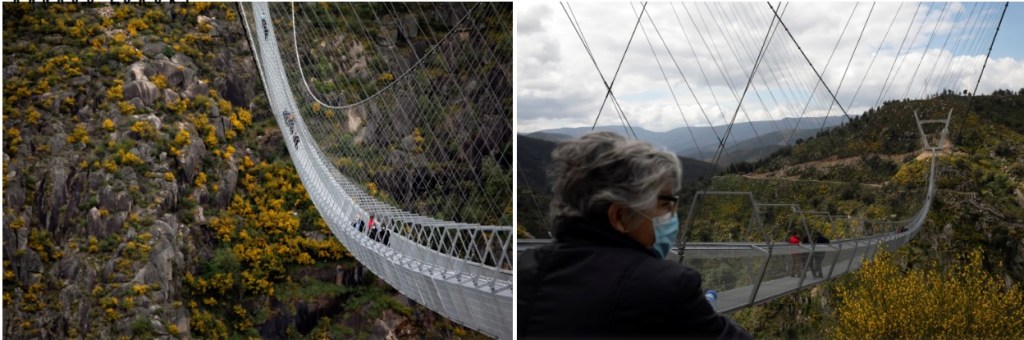
Arouca 516 is a suspension bridge located in the municipality of Arouca, in the North Region and the Aveiro District in Portugal. The bridge has a length of 516 m (1,693 ft). The bridge is suspended 175 m (574 ft) above the Paiva River, which it spans. Its name is a reference to its extension in meters (516) and the municipality where it is located (Arouca).
Its length exceeds by 16 m (52 ft) the Charles Kuonen Suspension Bridge, opened on 29 July 2017, with a length of about 500 m (1,600 ft) and connecting Grächen and Zermatt in Switzerland.
Construction of the bridge started in May 2018. It is a hanging bridge which is supported by two V-shaped concrete towers. The bridge opened on 29 April 2021 to residents of the municipality and on 2 May 2021 to the general public, with prior purchase of the ticket on the internet. Access to the bridge is possible either from Canelas or Alvarenga and a guide will always join the visitor group. The first person to cross the bridge was Hugo Xavier.
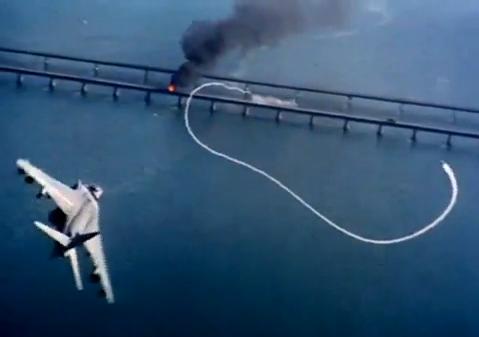
True lies was one of the Terminator’s better movies. Especially if you are a fighter jet buff. The Marine Corps Harrier jet scenes were really cool. But in the movie what was that awesome bridge? Well it is described below.
Scenes from the movie:
The Harriers moving in to attack the terrorists
The Harriers evade anti-aircraft missiles fired by the terrorists
The terrorists are on their way to fornicate with the virgins and drink free wine in Muslim Martyr heaven. Not to mention play some cards with Osama Bin Laden and watch porn movies.
More on the bridge
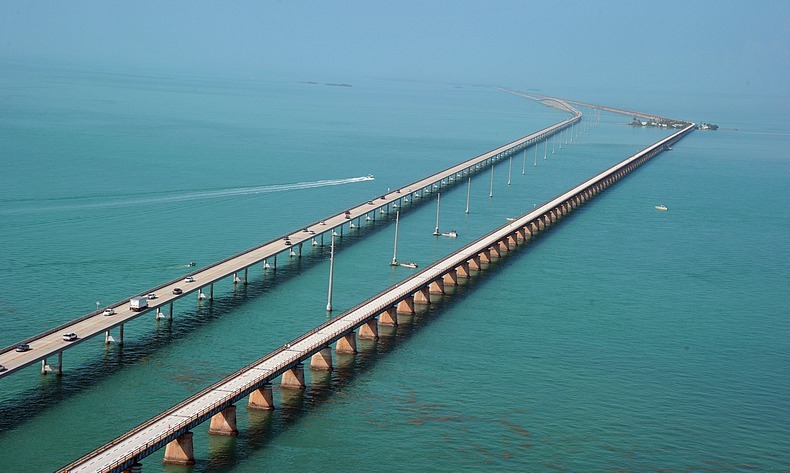
The Seven Mile Bridge is an iconic bridge in the Florida Keys of United States, stretching out into the open sea, connecting Knight’s Key in the Middle Keys to Little Duck Key in the Lower Keys. At the time of its completion in 1982, it was the longest continuous concrete segmental bridge in the world, and is currently one of the longest bridges in America.
Seven Mile Bridge actually consist of two bridges in the same location. The older bridge, originally known as the Knights Key-Pigeon Key-Moser Channel-Pacet Channel Bridge, was constructed from 1909-1912 as part of the Overseas Railroad. After the railroad sustained considerable damage during the Labor Day Hurricane of 1935, the bridge was refurbished for automobile use only. Dismantled tracks was recycled, painted white, and used as guardrails. It had a swing span that opened to allow passage of boat traffic, near where the bridge crosses Pigeon Key – a small island that once served as the work camp for the Florida East Coast Railway. When Hurricane Donna in 1960 inflicted further damage, decision to construct a new bridge was made.
A new, wider and sturdier Seven Mile Bridge was built right next to it from 1978 to 1982. When that happened, the original Seven Mile Bridge was nudged out of Florida’s transportation system. The vast majority of the original bridge still exists, used as fishing piers and access to Pigeon Key, but the swing span over the Moser Channel of the Intracoastal Waterway has been removed.
The total length of the new bridge is just under seven miles at 6.79 miles (10.93 km), and is shorter than the original. Each April the bridge is closed for approximately 2.5 hours on a Saturday and a “fun run,” known as the Seven Mile Bridge Run, of 1,500 runners is held commemorating the Florida Keys bridge rebuilding project. The event began in 1982 to commemorate the completion of a federally funded bridge building program that replaced spans that oil tycoon Henry Flagler constructed in the early 1900s to serve as a foundation for his Overseas Railroad.
The old bridge is still a popular spot with both locals and tourists, but it’s slowly falling apart. Salt water and storms are eroding the bridge faster than the state can afford to repair it. Much of the bridge is now closed – only a 2.2 mile section of the Old Seven Bridge is still open to pedestrians and cyclists.
Two years ago, a nonprofit community group called “Friends of Old Seven” was formed to try to preserve, and if possible, repair the bridge. The Florida Department of Transportation, which owns the bridge, cannot afford to sink a lot of money into the bridge’s upkeep, but is still willing to donate half of the $18 to $20 million required to repair the bridge. The community is now working hard to put up the other half.
Some people can go up as high as the sky and they don’t think twice about it. On high ladders, cranes, beams on high buildings or climbing up a soaring communications tower these guys never flinch.
Some of the best photos of this behaviour were taken during the construction of the Empire State Building in New York City. Construction of the 102 story building was completed in 14 months. An amazingly fast time for such a giant building.
Excavation of the site began on January 22, 1930, and construction on the building itself started symbolically on March 17—St.Patrick’s Day—per Al Smith’s influence as Empire State, Inc. president. The project involved 3,400 workers, mostly immigrants from Europe, along with hundreds of Mohawk iron workers, many from the Kahnawake reserve near Montreal. According to official accounts, five workers died during the construction. Governor Smith’s grandchildren cut the ribbon on May 1, 1931.
Some photos of the construction workers way way up:
Must be waiting for more girders.
Looks like they ordered out. No pizza back then so this must be cookies.
And today workers still go very high to construct very high structures and for maintenance.
The photo below shows workers doing maintenance on the highest communications tower in the United States. It is a TV tower in Sioux Falls, South Dakota. These guys went up 2,200 feet. That is a 1,000 feet higher than the Empire State Building.
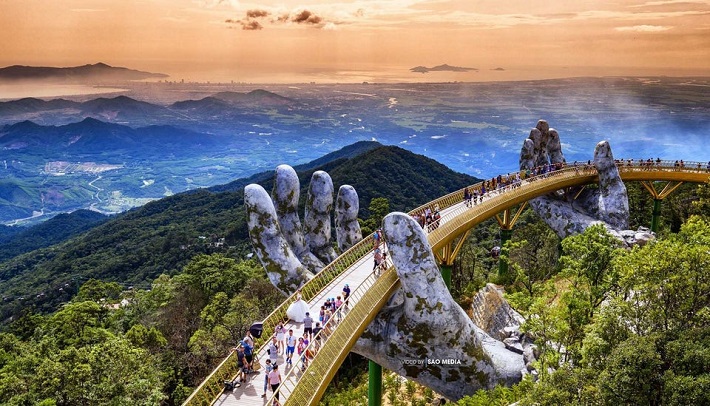
The Golden Bridge (Vietnamese: Cầu Vàng) is a 150-metre-long (490 ft) pedestrian bridge in the Bà Nà Hills resort, near Da Nang, Vietnam. It is designed to connect the cable car station with the gardens (avoiding a steep incline) and to provide a scenic overlook and tourist attraction. The bridge loops nearly back around to itself, and has two giant hands, constructed of fibreglass and wire mesh, designed to appear like stone hands that support the structure.
The client for the project was the Sun Group. The bridge was designed by TA Landscape Architecture (under Ho Chi Minh City University of Architecture) based in Ho Chi Minh City. The company’s founder, Vu Viet Anh, was the project’s principal designer, with Tran Quang Hung as the bridge designer and Nguyen Quang Huu Tuan as the bridge’s design manager. Construction began in July 2017 and was completed in April 2018. The bridge opened in June 2018.
Iron Mountain Inc. is an enterprise information management services company founded in 1951 and headquartered in Boston, Massachusetts. Its records management, information destruction, and data backup and recovery services are supplied to more than 156,000 customers throughout North America, Europe, Latin America, and Asia.
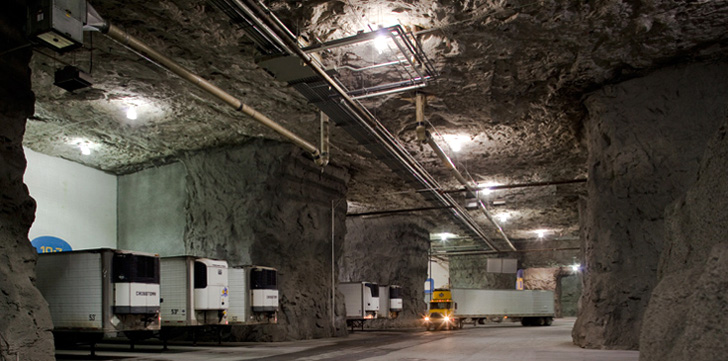
The Iron Mountain storage facility is a high-security storage facility in a former limestone mine at Boyers, Pennsylvania, near the city of Butler in the United States.
It began storing records in 1954 and was purchased by Iron Mountain in 1998. It is here that Bill Gates stores his Corbis photographic collection in a refrigerated cave 220 feet (67 m) underground. Nearby, the U.S. Office of Personnel Management leases another underground cavern to store, and process government employee retirement papers.
Located inside a cavernous former limestone mine in rural Boyers, the underground, climate-controlled, 1.9 million square-foot facility houses some of the world’s most valuable information, including data centers, government archives — and notably, the Bill Gates-owned Corbis Image Collection. Hollywood’s major motion-picture studios also send original film reels to the facility — away from the threat of California’s earthquakes and wildfires — for safekeeping.
Iron Mountain also boasts an underground lake fed by a natural spring that is used for cooling the data centers, as well as drinking water for its 2,200 employees. The facility also supplies its own fire trucks, should flames ever break out. There’s also a high-tech studio for digitizing and editing media. While we’re not allowed to spill the beans on what all is stored there (Iron Mountain keeps its customers’ information confidential), we can reveal that the facility’s locked, numbered vaults contain original films from a bevy of blockbuster and classic movies, as well as sound recordings from some of the biggest names in the music industry.
The conspiracy theorists have a field day with these high-security underground facilities. They claim UFO space ships and space alien communities are housed in these facilities. If you are prone to outrageous conspiracies these underground secret facilities must make your mouth water.
Halley VI Research Station is the first fully relocatable research station in the world. It was commissioned in 2006 and its unique and innovative structure was the result of an international design competition in collaboration with the Royal Institute of British Architects (RIBA). The state-of-the-art research facility is segmented into eight modules, each sitting atop ski-fitted, hydraulic legs. These can be individually raised to overcome snow accumulation and each module towed independently to a new location.
The station took four years to build and delivered its first scientific data in 2012. Its iconic design houses a cutting-edge science platform and modern, comfortable accommodation.
The central red module contains the communal areas for dining, relaxation etc., while the blue modules provide accommodation, laboratories, offices, generators, an observation platform and many other facilities. Remote scientific equipment, set up for long-term monitoring, is housed in a number of cabooses around the perimeter of the site, which also contains numerous aerials and arrays for studying atmospheric conditions and space weather.
Science at Halley VI provides vital information for a global understanding of ozone depletion, polar atmospheric chemistry, sea-level rise and climate change. Since it was first established in 1956, meteorological and atmospheric data has been continually collected at Halley, providing an unbroken record.
The station operates throughout the year with a maximum population of 70 in the summer and an average of 16 over winter. The Emperor penguin colony near Halley, which is present from May to February, is a special attraction, while other recreational trips take members further inland towards the “hinge zone” where the floating ice shelf is joined to the continent.
There have been six Halley bases built so far. The first four were all buried by snow accumulation and crushed until they were uninhabitable. Various construction methods were tried, from unprotected wooden huts to steel tunnels. Halley V had the main buildings built on steel platforms that were raised annually to keep them above the snow surface. However, as the station’s legs were fixed in the ice it could not be moved and its occupation became precarious, having flowed too far from the mainland to a position at risk of calving as in iceberg.













 The MarkoZen Blog