Cocaine Hippos

Could Pablo Escobar’s escaped hippos help the environment?

Colombia’s “cocaine hippos” are making waves in their new home, but whether that’s a good thing or not depends on who you ask.

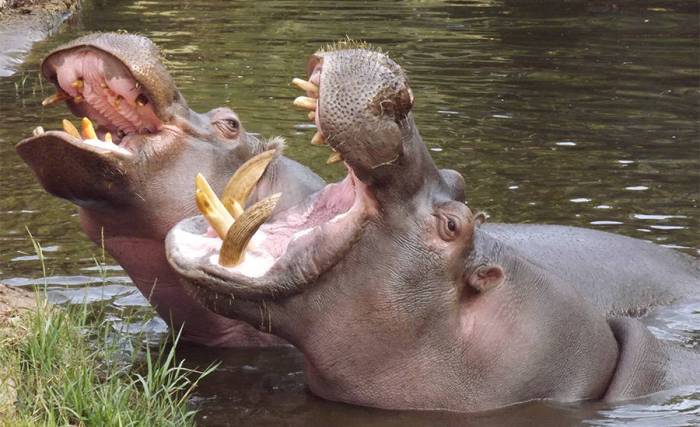
WHEN THE NOTORIOUS drug lord Pablo Escobar was shot dead in 1993, the Colombian government took control of his luxurious estate in northwestern Colombia, including his personal zoo. Most of the animals were shipped away, but the four hippopotamuses—of which Escobar was especially fond—were left to fend for themselves in a pond. Now, there are dozens and dozens of them.

For over a decade the Colombian government has been pondering how to best curb the growing population, a strategy largely supported by conservation experts. But not everyone is on board. Without direct evidence that the animals are doing harm, some ecologists argue that there’s no reason to cull or relocate them. Indeed, the hippos could fill in for species that humans pushed to extinction thousands of years ago—an idea known as rewilding.

When the hippos were left behind, it accidentally kicked off a rewilding experiment that’s now been running for more than 25 years. The first results of this experiment are trickling in and much like the large animals, they’re muddying the waters.

Known unknowns

The hippos have escaped Escobar’s former ranch and moved into Colombia’s main river, the Magdelena. Spread over a growing area, nobody knows exactly how many there are—but estimates indicate there may be a total population between 80 and 100, says Jonathan Shurin, an ecologist with University of California San Diego who studies the animals.

That’s at least a couple dozen higher than estimates just two years ago. Given that there were four in 1993, the population appears to be growing exponentially. “Within a couple of decades, there could be thousands of them.”

The hippos present quite a problem for the government. David Echeverri, a researcher with the Colombian government’s environmental agency Cornare, which is overseeing management of the animals, says he has no doubt they act like an invasive species. If allowed to remain unchecked, they will displace endemic animals like otters and manatees, he says. They also pose a danger to local residents since they can be territorial and aggressive, though no serious injuries or deaths have occurred as yet.

After one hippo was killed in 2009, there was a quick public outcry, quashing any plans to cull them. Instead, the government has been investigating ways to sterilize the creatures, or to move them out of the wild into captive facilities, Echeverri says. But the animals weigh thousands of pounds and aren’t exactly fond of human handling, so relocating or castrating them is both dangerous, difficult, and expensive. One juvenile hippo was successfully moved to a Colombian zoo in September 2018, but it cost 15 million pesos (about $4,500 USD).
South America lost dozens of giant herbivore species in the last 20,000 years or so, including the somewhat hippo-esque toxodons, which may have been semi-aquatic, as well as water-loving tapirs. Although several tapir species remain today, all are declining. “Hippos could likely contribute a partial restoration of these effects, likely benefitting native biodiversity overall,” Svenning says. He’d let the hippos be for now, while monitoring the creatures to ensure they don’t become a problem.

Jonathan Shurin, an ecologist with University of California San Diego who studies the animals notes that the animals may be providing a valuable service for native plants that once relied on large, now-extinct mammals to disperse their seeds. “We’re planning to look at their poop and see what’s in there,” he says.

But while he says it’s possible they’re stepping into roles that have been vacant for millennia, that may not be something the humans in the area ultimately want. No one really knows how native wildlife like manatees, river turtles, and otters will be affected by that kind of rewilding, and more hippos may mean increased conflict with people.

“Right now, the people are just coexisting with them,” he says. But that could change if this population of notoriously disagreeable animals grows exponentially. “There’s concern about public safety.”

They also attract tourists and tourism dollars, which my help offset some concerns about the animals. Upwards of 50,000 tourists visit Hacienda Napoles every year, according to some estimates.

For now, without immediate plans to relocate or sterilize all the animals, the creatures will continue to fend for themselves and expand. Shurin looks forward to studying the long-term impacts of their residency, assuming they indeed remain. “It’s a big experiment,” says Shurin—and “we’re going to find out.”

National Geographic
5-year-old caught driving to California to buy himself a Lamborghini

Hot Wheels weren’t good enough for him.

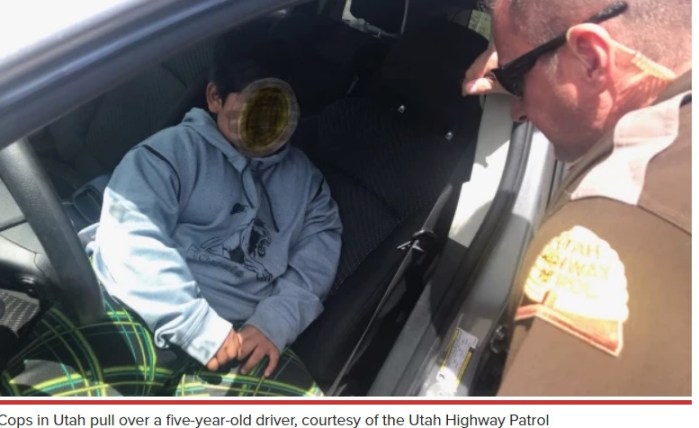
A 5-year-old boy was caught driving his parents’ car on a freeway in Utah on Monday — apparently on his way to California to buy a Lamborghini.

The kid driver made it a handful of miles, from his home in Ogden to I-15’s 25th Street offramp, Utah State Police said.

Troopers initially thought they’d stumbled upon an impaired driver, but soon found their perp was actually a child with a penchant for luxury cars.

The boy told them he left home after an argument with his mom, in which she refused to buy him a Lamborghini.

So he decided to go get one himself.

“He might have been short on the purchase amount, as he only had $3 dollars in his wallet,” state police posted on Twitter.

Their post included a photo of the boy in a grey sweatshirt and patterned shorts, wringing his hands inside his parents’ car.

UHP Sgt. Nick Street confirmed to local outlet KSL that the boy is indeed 5 years old, though the angle at which the photo was taken may have made him look older.

Cops didn’t mention a punishment for the boy — but going to bed without dinner could be in his future.

Speeding Car Goes Airborne After Slamming into Roundabout in Poland

A jaw-dropping video from Poland shows a motorist speeding towards a roundabout and failing to turn in time, sending his car flying through the air. The incredible scene, which was captured on film by a traffic camera, reportedly occurred in the village of Rabien this past Sunday. The community’s volunteer fire department subsequently shared the footage on social media as a warning to drivers.

According to their post, the car was so badly damaged that rescue workers had to cut the vehicle open in order to remove the driver, who suffered several serious injuries from the accident. He’s currently recuperating at a local hospital and may wind up facing charges for the mishap as officers on the scene took blood samples from the motorist after detecting the smell of alcohol at the scene.

Massive Monkey Brawl Erupts Over Food in Tourist-Deprived Thailand

A jaw-dropping video from Thailand provides a chilling example of how the coronavirus has spawned chaos in unexpected ways as it shows an enormous group of monkeys accustomed to eating handouts from tourists now forced to fight over a meager scrap of food. The unsettling scene was reportedly filmed this week in the city of Lopburi. Usually a prime destination for visitors from around the world, the location has become a veritable ghost town due to the concerns over the pandemic.

Due to the downturn in tourism, the area’s resident monkey population, which numbers in the thousands, has grown increasingly hungry as was evident in the unnerving incident filmed by stunned onlooker Sasaluk Rattanachai. In her video, the deprived primates can be seen roaming the streets by the hundreds in an apparent search for sustenance. Although it’s hard to discern exactly what one of the monkeys wound up finding to eat, its meal does not last very long as the creature is soon swarmed by the other starving animals in a truly terrifying turn of events.

“They looked more like wild dogs than monkeys,” Rattanachai marveled, “they went crazy for the single piece of food. I’ve never seen them this aggressive.” One can only hope that similar showdowns do not erupt at local grocery stores across America once the initial stockpiles of toilet paper and other hoarded sundries that people have acquired over the last few days begin to dwindle in the weeks to come.

Somebody feed the damn monkeys please!

100,000 Duck Army Sent from China to Pakistan to Fight Locust Infestation?

A Chinese local state media report said earlier on Thursday that 100,000 ducks would be sent from the country’s Zheijiang province to Pakistan to eat-up the billions of locusts that are causing mass crop devastation.

Pakistan declared a national emergency earlier this month, saying locust figures were the worst in more than two decades. The media report initially stated ducks would be deployed to the worst affected affected areas  — Sindh, Balochistan and Punjab provinces. China had used ducks in the past to chomp through crop-damaging locusts.

The initial media report generated 520 million views on China’s popular social media platform Weibo with netizens rooting for the birds by posting comments including “Heroic ducks in harm’s way!” and “Go ducks! I hope you come back alive!

Update:

Experts assigned to help Pakistan combat its locust infestation have stepped-back from an earlier proposal of deploying some 100,000 ducks to devour the plague of crop-ravaging insects. They suggested pesticide instead.

Pakistani climate not duck-friendly 

Professor Zhang Long, a member of the China Locust Disaster Control Task Force and a professor at China Agriculture University, told reporters the Chinese ducks would not be suited to the environmental conditions in Pakistan.

“Ducks rely on water, but in Pakistan’s desert areas, the temperature is very high,” Zhang said. He and the other members of the Chinese specialist group have been designated to help Pakistan fight the locusts.

Instead, Zhang advised the use of chemical or biological pesticides, and suggested using an aircraft to deploy the pesticides, according to China’s CCTV.

Favorable weather conditions and a delayed government response have helped the locusts breed and attack crop areas.

The desert locusts — large herbivores that resemble grasshoppers — arrived in Pakistan from Iran in June and have already ravaged cotton, wheat, maize and other crops.

East Africa and India have also seen mass crop destruction due to locust invasions. In January, the UN called for international help to fight swarms of desert locusts sweeping through East Africa.

Locust swarms can fly up to 150 km (90 miles) a day with the wind, and consume as much in one day as about 35,000 people.

Ice makes strange sounds in bizarre new video

Dropping a chunk of ice down a 450ft borehole can produce weird sounds resembling cartoon ricochets.

In a recent Twitter post, isotope geochemist John Andrew Higgins, who is currently working in Antarctica, shared footage of an interesting experiment involving a borehole and a chunk of ice.

“What does a 9 inch ice core sound like when dropped down a 450 ft hole ?” he wrote. “Like this!”

The sounds produced by the falling ice are undeniably bizarre – resembling something like cartoon lasers or gunshot ricochets repeating over and over followed by a heartbeat-like thudding.

This phenomenon was recorded previously by glaciologist Peter Neff who received over 10 million views for his footage of a piece of ice being dropped down a 295ft borehole.

“The first thing you hear as the ice is falling is the pitch of the sound changing,” he said. “That’s the Doppler effect. Then when the ice hits the bottom of the bore hole, the sound doesn’t only come straight up – the sound waves start to bounce off the sides of the hole.”

“That’s why you hear this ‘pew!’ with sort-of a heartbeat sound afterwards.”

You can check out the sounds for yourself in the video below.

Owl Swims in Michigan Lake

A Michigan sheriff’s department captured some amazing and rather rare footage of an owl swimming in a lake. The odd scene reportedly took place early Monday morning at Lake St. Clair and was spotted by officers from the marine division of the Macomb County Sheriff’s Office. Fortunately, they managed to film the wondrous sight and subsequently shared it on their Facebook account.

Marveling that they had “a special guest this morning,” the sheriff’s office theorized that the creature was a “snowy owl that has been seen on several occasions in the area.” In the video, the bird swims along through the lake until it reaches the shore, where it climbs up onto a rock and shakes the water off from its feathers. The owl then takes off and flies away from the area, proving to be adept at air, sea, and land travel.

Since owls do not possess waterproof feathers, for them to swim is something of an unusual occurrence and, wildlife experts say, generally only happens when the creatures are forced into such a predicament. Although the sheriff’s office did not speculate as to what led this event unfold, they asked residents to “please remember to respect these beautiful animals by being a good observer” and keep their distance from the birds should they encounter them.

19 of the Weirdest Stories from 2019

19 of the Weirdest Stories from 2019

By Tim Binnall

This past year saw a smorgasbord of strange stories and an uncanny array of unusual accounts that at times bordered on the unfathomable. Whether it was an eerie alien spotted in someone’s driveway, a tourist nearly swept out to sea on an ‘ice throne,’ or a bizarre conspiracy theory about recycled pizza at a popular chain restaurant, there was no shortage of odd items in the news over the last twelve months. With that in mind, as we await the start of both a new year and a fresh decade, here are 19 of the weirdest stories from 2019:

A Florida dog put a car into reverse and drove it in circles for nearly an hour

(CNN)Anne Sabol’s cul-de-sac in Port St. Lucie, Florida, is fairly quiet.

Well, it was, until a dog hopped in its owner’s running car, kicked it in reverse, drove in circles for an hour and smashed a neighbor’s mailbox before safely exiting the vehicle without so much as a scratch.
But Sabol didn’t know who was behind the wheel when she first spotted the car, whirling around the block like an inept student driver might.
“At first I thought I saw somebody backing up, but then they kept going, and I’m like, ‘OK, what’re they doing?'” she told CNN affiliate WPBF.
Then the cops came. And then the fire department. Authorities watched from a distance as the driving dog did donuts.
Finally, the vehicle hit a mailbox and some garbage cans, then slowed down.
Port St. Lucie police opened the door, and Sabol watched as a large black Labrador retriever hop out of the driver’s seat.
“‘OK, this is turning weird,'” she remembered thinking.

It turns out, the dog’s owner, who asked to remain anonymous, had left his car running in the street when the dog changed gears and didn’t stop driving for almost an hour, Port St. Lucie police said.
The community escaped injury save for the mailbox, which the dog’s owner promised to fix.
As for the pup, it’s impossible to know its thoughts behind the wheel. Did it jump at the chance for a joyride and a fleeting taste of freedom? Or was this all a harrowing accident as the dog felt all control slip through its paws?
Sabol, for one, was impressed.
“They should give that thing a license.”