Mysterious Monolith Appears in Utah

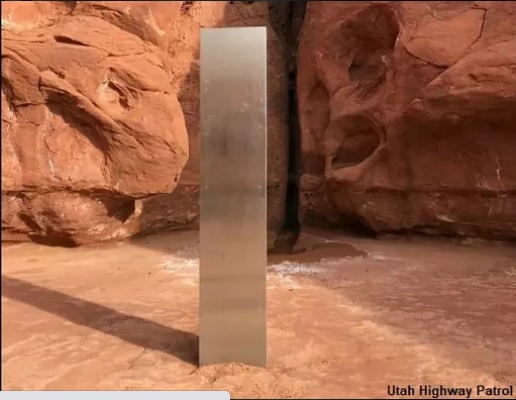
A helicopter survey of bighorn sheep living in the wilderness of Utah led to the unexpected discovery of a mysterious monolith which had suddenly appeared planted in the ground. According to a local media report, the weird find was made this past Wednesday by officers with the Utah Department of Public Safety as they helped the state’s Division of Wildlife Resource with their annual creature count. As they flew over the southern part of the state, one of the biologists aboard the chopper noticed something highly unusual which brought their work to a sudden stop.

“We just happened to fly directly over the top of it,” pilot Bret Hutchings recalled, “he was like, ‘Whoa, whoa, whoa, turn around, turn around!’ And I was like, ‘what.’ And he’s like, ‘There’s this thing back there – we’ve got to go look at it!'” The source of all the excitement was a puzzling metal monolith standing strikingly out of place in a cove of the state’s iconic red rocks. Understandably curious about the object, the team proceeded to land the helicopter and investigate it up close. “We were kind of joking around that if one of us suddenly disappears,” Hutchings laughed, “then the rest of us make a run for it.”

Fortunately, the ten-to-12-foot tall rectangular metal object was not dangerous, though it was undoubtedly mysterious. The team observed that it did not appear to have fallen from the sky and, instead, was likely planted in the ground. As for its purpose, they initially suspected that perhaps it was somehow connected with NASA, maybe as a means of contacting satellites, but ultimately concluded that it appeared more likely to be some kind of artwork rather than a scientific instrument.

For now, the monolith remains in place, although the group has opted not to reveal its precise location lest ill-equipped thrillseekers journey to find it and wind up needing to be rescued from the remote location. It remains to be seen whether or not the nature of the odd object will ever come to be known or if it will simply vanish as quickly as it appeared with the meaning behind the monolith forever a mystery.


Blast from the Past

This story is 10 years old.  But it is still jaw dropping.

Smoking baby reportedly has quit

The tubby Indonesian toddler who caused a sensation last spring by enthusiastically puffing on cigarettes in a widely viewed video has quit smoking, according to media reports.

Two-year-old Ardi Rizal of South Sumatra, who reportedly smoked 40 cigarettes a day, has broken his nicotine addiction through a 30-day rehabilitation program, the Jakarta Globe reported Thursday.

“He has stopped smoking and doesn’t ask for cigarettes anymore,” Arist Merdeka Sirait, chairman of Indonesia’s National Commission on Child Protection, said, according to another publication, Earth Times.  According to earlier reports, the child was placed in state custody after the video emerged and the boy’s parents said he would cry and throw tantrums if he went too long without smoking a cigarette.

Heavy smoking appeared to have caused the boy’s brain to shrink and could cause other health problems later, Sirait said, according to Earth Times.

“He needs to be in a smoking-free environment so that he doesn’t start smoking again,” Sirait said.

Anti-smoking advocates say Indonesia’s tobacco industry markets its products to children, according to the Globe.

Very Bizarre Plants on the slopes of Mt. Kilimanjaro

These plants look like they belong on a different planet. They are a type of groundsels.

Dendrosenecio kilimanjari is a giant groundsel found atop Mount Kilimanjaro in Africa. It was originally known as Senecio kilimanjari, but a recent botanical reclassification split off some species formerly in Senecio, putting it and various other species in the new genus Dendrosenecio. Both genera are in the family Asteraceae. The giant groundsels of the genus Dendrosenecio evolved, about a million years ago, from a Senecio that established itself on Mount Kilimanjaro, with those that survived adapting into Dendrosenecio kilimanjari. This later colonised other mountains by some means – the standard distance for wind dispersal of seeds is a few metres – and these isolated populations adapted in ways different from the parent population, creating new species.

The Story of the Stuntman who attempted to Zoom over Niagara Falls

Robert Overacker, a 39-year-old man from Camarillo, California, went over the Canadian Horseshoe Falls at approximately 12:35 p.m. October 1st, 1995 on a single jet ski.

Entering the Niagara River near the Canadian Niagara Power Plant, he started skiing toward the Falls. At the brink, he attempted to discharge a rocket propelled parachute that was on his back. It failed to discharge. His brother and a friend witnessed the stunt.

His body was recovered by Maid of the Mist staff. Overacker, married with no children, became the fifteenth person since 1901 to intentionally go over the Falls in or on a device.

NIAGARA FALLS, Ontario (AP) _ An autopsy shows that a California car salesman who tried to ride a Jet Ski over Niagara Falls was not killed in the 180-foot fall but drowned.

Robert Overacker had no broken bones or any other injuries from the fall, Dr. Azim Velji, the pathologist who performed the autopsy, said Monday.

Overacker, 39, of Camarillo, Calif., had been training for the stunt for seven years. During the jump Sunday, he wore a rocket that was to propel him into the air, and he carried a parachute that never opened.

Several tourists said they saw Overacker at the base of the falls moving his arms as if he were trying to swim.

Overacker, who graduated from a California stunt school, apparently was aware of the risks: Just before leaving home last week, he made arrangements for his own funeral.

Remote Control Car Spotted Speeding Down Highway Flummoxes Finnish Cops

Authorities in Finland were left scratching their heads after a traffic camera photographed a remote control car speeding down a highway at over forty miles-per-hour. The strange incident reportedly occurred earlier this month along a major highway near the community of Toytari. Measuring approximately 20 inches long, the car was clocked at going a whopping 43 miles-per-hour, which is actually ten miles-per-hour over the speed limit.

Stressing that the miniature vehicle was not a toy, traffic safety official Dennis Pasterstein explained that “this is a model car for a more serious enthusiast with a much more powerful engine. Ordinary toys do not travel at such a speed.” Be that as it may, he indicated that “I haven’t seen anything like this before” and expressed the hope that “this is also the last time” since “pranks and games are fun, but the highway is a completely wrong place to play.”

To that end, he noted that motorists who encounter the tiny car speeding around on the highway would likely be confused by what they are seeing and take evasive action to avoid it, thus potentially causing an accident. As for who may have been at the controls of the vehicle, Pasterstein surmised that it was likely a person standing off to the side of the highway since, fortunately for them, they weren’t spotted by the camera.

Reminds me of a scene from the movie ‘The Dead Pool’ with Clint Eastwood.

Strange Airports

Courchevel International Airport (Courchevel, France)

Background:
Getting to the iconic ski resort of Courchevel requires navigating the formidable French Alps before making a hair-raising landing at Courchevel International Airport. The runway is about 1700 feet long, but the real surprise is the large hill toward the middle of the strip.
Why It’s Unique:
“You take off downhill and you land going uphill,” Schreckengast says. He adds that the hill, which has an 18.5 percent grade, is so steep that small planes could probably gain enough momentum rolling down it with no engines to safely glide off the edge. Landing at Courchevel is obviously no easy task, so pilots are required to obtain certification before attempting to conquer the dangerous runway.


Congonhas Airport (Sao Paulo, Brazil)

Background:
Most major cities have an airport, but rarely are they built just 5 miles from the city center, especially in metropolises like Sao Paulo. Congonhas’ close proximity to downtown can be attributed in part to the fact that it was completed in 1936, with the city experiencing rapid development in the following decades.
Why It’s Unique:
While having an airport only 5 miles from the city center may be a convenience for commuters, it places a strain on both pilots and air traffic control crews. “It becomes a challenge in terms of safety to just get the plane in there,” Schreckengast says. “Then you throw on noise restrictions and these terribly awkward arrival and departure routes that are needed to minimize your noise-print and it becomes quite challenging for pilots.” Fortunately, Sao Paulo’s many high-rise buildings are far enough away from the airport that they aren’t an immediate obstacle for pilots landing or taking off.


Don Mueang International Airport (Bangkok, Thailand)

Background:
From a distance Don Mueang International looks like any other midsize airport. However, smack-dab in the middle of the two runways is an 18-hole golf course.
Why It’s Unique:
Schreckengast, who has worked on consulting projects at this airport, says one of the major problems is that the only taxiways were located at the end of the runways. “We recommended that they build an additional taxiway in the middle, from side to side, and they said ‘absolutely not, that will take out a green and one fairway.’” The airport and the course were originally an all-military operation, but have since opened up to commercial traffic. Security threats, however, have limited the public’s access to the greens.


Madeira International Airport (Madeira, Portugal)

Background:
Madeira is a small island far off the coast of Portugal, which makes an airport that is capable of landing commercial-size aircraft vital to its development. This airport’s original runway was only about 5000 feet long, posing a huge risk to even the most experienced pilots and limiting imports and tourism.
Why It’s Unique:
Engineers extended the runway to more than 9000 feet by building a massive girder bridge atop about 200 pillars. The bridge, which itself is over 3000 feet long and 590 feet wide, is strong enough to handle the weight of 747s and similar jets. In 2004, the International Association for Bridge and Structural Engineering selected the expansion project for its Outstanding Structure Award, noting that the design and construction was both “sensitive to environmental and aesthetic considerations.”


Gibraltar Airport (Gibraltar)

Background:
Between Morocco and Spain sits the tiny British territory of Gibraltar. Construction of the airport dates back to World War II, and it continues to serve as a base for the United Kingdom’s Royal Air Force, though commercial flights land on a daily basis.
Why It’s Unique:
Winston Churchill Avenue, Gibraltar’s busiest road, cuts directly across the runway. Railroad-style crossing gates hold cars back every time a plane lands or departs. “There’s essentially a mountain on one side of the island and a town on the other,” Schreckengast says. “The runway goes from side to side on the island because it’s the only flat space there, so it’s the best they can do. It’s a fairly safe operation as far as keeping people away,” he says, “It just happens to be the best place to land, so sometimes it’s a road and sometimes it’s a runway.”


Kansai International Airport (Osaka, Japan)

Background:
Land is a scarce resource in Japan, so engineers headed roughly 3 miles offshore into Osaka Bay to build this colossal structure. Work on the manmade island started in 1987, and by 1994 jumbo jets were touching down. Travelers can get from the airport to the main island of Honshu via car, railroad or even a high-speed ferry.
Why It’s Unique:
Kansai’s artificial island is 2.5 miles long and 1.6 miles wide—so large that it’s visible from space. Earthquakes, dangerous cyclones, an unstable seabed, and sabotage attempts from protestors are just some of the variables engineers were forced to account for. As impressive as the airport is, Stewart Schreckengast, a professor of aviation technology at Purdue University and a former aviation consultant with MITRE, cautions that climate change and rising sea levels pose a very real threat to the airport’s existence. “When this was built, [engineers] probably didn’t account for global warming,” he says. “In 50 years or so, this might be underwater.”

Self-Described ‘Trans Satanist Anarchist’ Wins Republican Nomination for County Sheriff

Aria DiMezzo, a self-described “transsexual Satanist anarchist” who ran for the sheriff’s job in Cheshire County, New Hampshire, with the campaign slogan “F*** the Police”, decisively won the Republican nomination this weekend.

DiMezzo said that she had expected to lose to a write-in candidate, adding that her surprising victory proves “the system is utterly and hopelessly broken”. She went on to explain that any system that a system that allows thousands of people to walk into a voting booth and vote despite not knowing anything about the person they are nominating for the most powerful law-enforcement position in the county is undoubtedly broken. The young GOP nominee claims that she has always been upfront about who and what she is, but that the very fact that she won shows just how “clueless the average voter is”.

“So you’re mad. I get it,” Aria DiMezzo wrote in a blog post on her campaign website, addressing the hate mail she’s been receiving since she received the GOP nomination. “Your anger is with the system that has lied to you. Your anger is with the system that convinced you to believe in it, trust it, and have faith in it, when it is completely and utterly broken.”

“I’m running for sheriff because I oppose that very system, and the sheriff has the most hands-on ability in Cheshire County to oppose that system,” she said. “The system that let you down by allowing me — the freaking transsexual Satanist anarchist — be your sheriff candidate is the same system I’m attacking. I’m sorry, and I know it hurts to hear, but that system is a lie. The entire thing is a lie. It’s broken from beginning to end, and my existence as your sheriff candidate is merely how this reality was thrown into your face.”

Marilyn Huston, the chair of the Cheshire County GOP, told Inside Sources that DiMezzo “did very well with the primary and that was wonderful,” but added that the unlikely Republican nominee never showed up to GOP meetings and events, despite being invited. To be fair, doing so would have done her campaign more harm than good…

Aria DiMezzo got 4,211 votes, easily beating her traditional GOP opponent, who only managed to garner a few hundred votes. She will now be running against popular incumbent Democrat Eli Rivera, who is seeking a fifth term as Cheshire County sheriff.

Even if she doesn’t win, I think it’s safe to say that DiMezzo got her point across very clearly. If this doesn’t make people understand that the electoral system in the US is broken, nothing will.

“Sweet Satan, how can you not be an anarchist?!” the GOP nominee wrote in her blog post. “Between 75 and 80 percent of the primary voters — the ones alleged to be more politically aware than the average voter — were completely and totally ignorant of who they were voting for! What is the percentage with the average voter? 90 percent? 95 percent? These people are deciding who gets to rule you!”


Skyquakes

This a very very strange phenomena.

Skyquakes are unexplained reports of a phenomenon that sounds like a cannon, trumpet or a sonic boom coming from the sky. The sound produces shock wave that can vibrate a building or a particular area. They have been heard in several locations around the world. Such locations include the banks of the river Ganges, Marwari village in Himachal Pradesh, the East Coast and inland Finger Lakes of the United States, the Magic Valley in South Central Idaho of the United States, Colombia, Southern Canada, as well as areas of the North Sea, Japan, Australia, Italy, Drogheda, Bettystown, Slane, Dundalk, Ireland, Pune, Ambala, The Netherlands, Norway, Bengaluru, Tierra del Fuego Argentina, United Kingdom and recently (11 April 2020) in Jakarta, West Java, Brazil, Uruguay, (23 April 2020) in Tampico, Mexico, on May 11 2020 in Central Java and on May 21 2020 in Bandung, West Java.

They have been reported from an Adriatic island in 1824; Western Australia, South Australia and Victoria in Australia; Belgium; frequently on calm summer days in the Bay of Fundy, Canada; Lough Neagh in Northern Ireland; Scotland; Passamaquoddy Bay, New Brunswick; Cedar Keys, Florida; Franklinville, New York in 1896; and northern Georgia in the United States.

Their sound has been described as being like distant but inordinately loud thunder while no clouds are in the sky large enough to generate lightning. Those familiar with the sound of cannon fire say the sound is nearly identical. The booms occasionally cause shock waves that rattle plates. Early white settlers in North America were told by the native Haudenosaunee Iroquois that the booms were the sound of the Great Spirit continuing his work of shaping the earth.

The terms “mistpouffers” and “Seneca guns” both originate in Seneca Lake, NY, and refer to the rumble of artillery fire. James Fenimore Cooper, author of The Last of the Mohicans, wrote “The Lake Gun” in 1850, a short story describing the phenomenon heard at Seneca Lake, which seems to have popularized the terms.

Hypotheses
Their origin has not been positively identified. They have been explained as:

Coronal mass ejection CMEs often generate shock waves similar to what happens when an aircraft flies at a speed higher than the speed of sound in Earth’s atmosphere (sonic boom). The solar wind’s equivalent of a sonic boom can accelerate protons up to millions of miles per minute—as much as 40 percent of the speed of light.
Meteors entering the atmosphere causing sonic booms.
Gas:
Gas escaping from vents in the Earth’s surface.
With lakes, bio gas from decaying vegetation trapped beneath the lake bottoms suddenly bursting forth. This is plausible, since Cayuga Lake and Seneca Lake are two large and deep lakes.
Explosive release of less volatile gases generated as limestone decays in underwater caves.
Military aircraft (though it cannot explain occurrences before supersonic flight started).
In some cases, they have been associated with earthquakes. Earthquakes may not hold as a general cause because these sounds are often unaccompanied by seismic activity, other than the vibrations induced by sound.
In North Carolina, one speculation is that they are the sound of pieces of the continental shelf falling off into the Atlantic abyss. However, the Atlantic abyss is too far away from the east coast, and the Atlantic ridge is the result of very slow-moving tectonics and could not produce such sounds, given how often they occur.
Underwater caves collapsing, and the air rapidly rising to the surface.
Possible resonance from solar and/or earth magnetic activity inducing sounds.
Volcanic eruptions
Avalanches, either natural or human-made for avalanche control.
A recent explanation is that the noise is very distant thunder which has been focused anomalously as it travelled through the upper atmosphere.

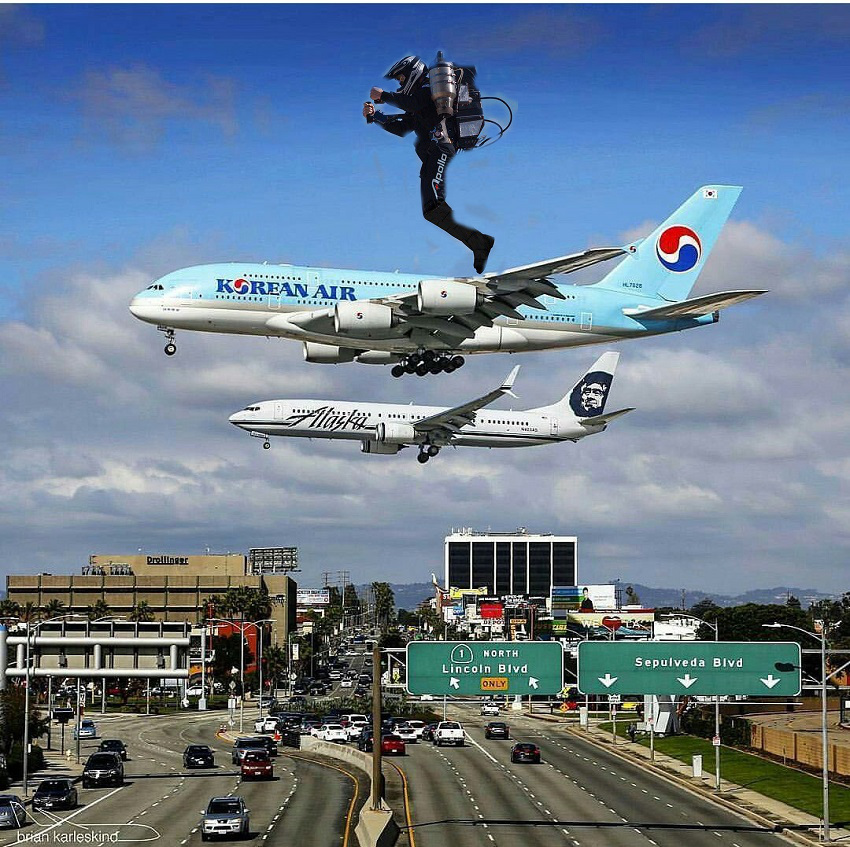
Pilots Report Seeing ‘Guy in Jetpack’ Flying Near LAX

Only in Los Angeles.

In a bizarre story out of Los Angeles, the pilot of a jet coming in for a landing at LAX reported seeing a person in a jetpack flying alongside their aircraft. The very strange incident reportedly occurred on Sunday evening as an American Airlines flight was headed towards Los Angeles International Airport. The normally routine task of landing the plane took a weird turn when the pilot looked out his window and spotted a proverbial ‘rocketeer’ in the sky next to the airliner.

Understandably concerned about the ‘unidentified flying person,’ the pilot promptly contacted the control tower at LAX to report the curious sighting. “We just passed a guy in a jetpack,” he told them with a tone suggesting that he was more annoyed than bewildered by the odd aerial interloper. To their credit, officials at the airport also seemed to take the sighting in stride and simply asked “were they off to your left side or right side?”

In response to the inquiry, the pilot said “off to the left side, maybe 300 yards or so, at about our altitude,” which was around 3,000 feet at the time. The sighting was subsequently confirmed by two other pilots who told the tower that they had also seen the mysterious individual flying near the airport. Although the series of sightings sound somewhat hard to believe, aviation experts say that it is possible that someone with an advanced jetpack could actually pull off the foolish feat.

As one might imagine, authorities are taking the matter seriously since someone flying a jetpack in the congested airspace around LAX could have disastrous consequences. Attempts to locate and identify the individual at the center of the case have so far proven futile. One suspects that now that their misadventure has spawned international headlines and likely would result in some kind of legal trouble, ‘jetpack man’ will likely stay silent and, hopefully, stick to the ground.

Girl in Taiwan Is Swept High by a Kite

Powerful winds swept a 3-year-old girl into the sky after she became entangled in the kite’s tail during a festival in Taiwan. The girl landed safely.

HONG KONG — A 3-year-old girl was swept high into the sky after a streamer became tangled around her neck during a kite-flying festival in northern Taiwan this weekend.

The child hovered above throngs of spectators and was zipped around by strong winds for a heart-stopping 30 seconds amid inflatable pandas and astronauts as screams erupted from spectators.

The girl, who was identified by news outlets only by her last name, Lin, landed mostly unscathed at the Hsinchu International Kite Festival. She suffered abrasions around her neck and face, the mayor of Hsinchu, Lin Chih-chien, wrote in a Facebook post on Sunday. She was admitted to a hospital for a medical examination, he said.

The startling episode drew an apology from the mayor, led to the suspension of festivities and added a frisson of horror to an event that usually draws tens of thousands of visitors for what’s supposed to be a fun time at the two-day festival.

“The city government expresses its deepest apologies to the public and to the individuals involved, and we will review the reasons to avoid this type of accident from ever happening again, conducting a thorough review and holding people to account,” he wrote.

The girl is not the only toddler to have found herself in a harrowing situation in recent days.

Last Monday in Greece, a 3-year-old girl was swept out to sea in a winged unicorn inflatable toy before she was rescued by a ferryboat captain.

The kite festival in Taiwan, featuring larger-than-life designs from around the world, took place on a grassy expanse at a fishing port on the last weekend before kindergartens and other schools reopened for a new year. On Saturday, the Asia Kite Foundation, a Taiwan-based group that helped promote the kite-flying event, had urged families to take care on Sunday, when gales were forecast for the afternoon.

Sure enough, the winds were strong.

At 4 p.m., children gathered around for the unfurling of a “candy kite,” officially named “Joy Falls From Heaven.” A compartment attached to the long, voluminous orange fabric was filled with candy, and once it was sent into the air like a flying piñata, confection was supposed to rain down. Footage showed several men struggling to control the long streamer as gusts of wind whipped it around.

Somehow, as a powerful draft lifted the ballooning kite from the grass, its tail lassoed the 3-year-old by the neck and hoisted her upward. The pumpkin-orange kite suddenly became a parachute.

Dangling from the kite, the girl was whizzed across a sky full of floating cartoon figures and jerked around like a spool. Screams and shouts could be heard.

When the winds shifted less than a minute later, the girl was spun rapidly in circles before people managed to pull the kite to the ground. Spectators jumped onto the kite’s tail to prevent it from taking off again.

Speaking to reporters on Monday, Shie Jiun-hung, an official with the Fisheries Department, said the girl’s parents had blamed themselves for the accident.

He said that the local government would no longer allow candy kites to take flight again in public events and would impose stricter rules in the future.

As for the girl, the official said that she returned home Sunday and promptly had a nap.