Supersonic Business Passenger Jet Zooming in Over the Horizon

The Aerion AS2 is a supersonic business jet under development by Aerion Corporation. In May 2014, it was announced that the Aerion AS2 would be part of a larger Aerion SBJ redesign, which aimed for release after a seven-year developmental period. Aerion partnered with Airbus in September the same year. In December 2017, Airbus was replaced by Lockheed Martin. Its General Electric Affinity engine was unveiled in October 2018. In February 2019, Boeing replaced Lockheed Martin.

The Aerion AS2 12-passenger aircraft aims for Mach 1.6 with a supersonic natural laminar flow wing for a minimum projected range of 4,750 nm (8,800 km). A $4 billion development cost is anticipated, for a market of 300 over 10 years and 500 overall for $120 million each.

supersonic

In December 2017, Aerion and Lockheed Martin announced that they would explore its joint development without Airbus, aiming to fly in 2023 and be certificated in 2025. On December 15, after discussions with Lockheed’s Skunk Works, they announced a MoU to explore over a year the joint development of the supersonic business jet: engineering, certification and production. Lockheed previously developed supersonic aircraft like the F-16, the F-35, F-22, and the Mach 3+ SR-71, and they concluded that the AS2 concept warranted time and resource investment after reviewing Aerion’s aerodynamic technology. Throughout the two-and-a-half-year engineering collaboration with Airbus, Aerion advanced the AS2 aerodynamics and designed preliminary wing and airframe structures, a systems layout, and a fly-by-wire control system concept. Between May and December 2017, the GE collaboration resulted in moving the engines from the trailing edge to the wing leading edge, featuring a T-tail, and a higher wing aspect ratio.

Aerion said it is spending $1 billion for the AS2. Aerion and Lockheed wanted to freeze its engines, wings, and fuselage configuration in summer 2018, with the goal of selling 30 jets per year for $3.6 billion over 20 years.

supersonic1

While military jets have had supersonic capabilities for decades, the economics are daunting for civilian operations. High ticket prices helped do in the Concorde after 27 years of service, which slurped twice as much fuel as a Boeing Co. jumbo jet while carrying only one-fourth as many passengers.

In the years since Air France and British Airways parked their Concordes, would-be supersonic jet developers have turned to business aircraft in hopes of putting newer technology in a smaller airframe to attract wealthy buyers and globe-trotting chief executive officers.

aerion
aerion1
aerion2
aerion3
aerion4

Great Big Airship

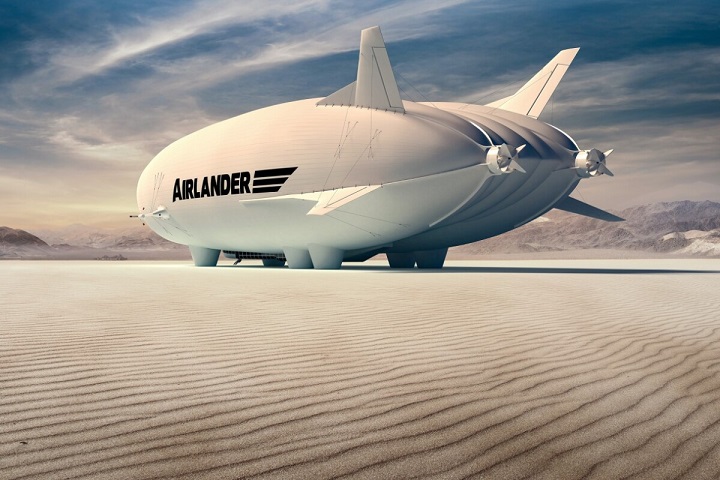
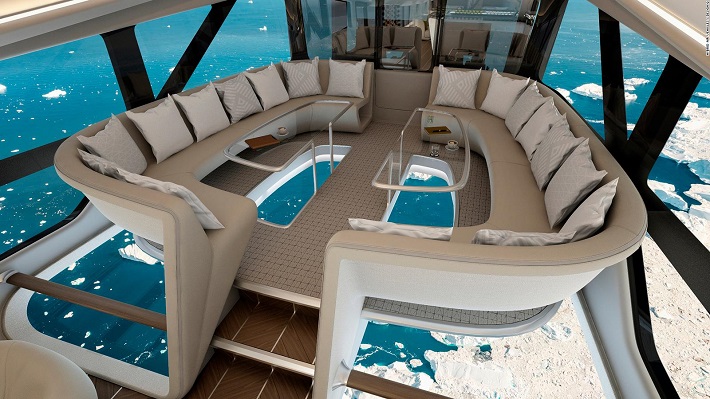
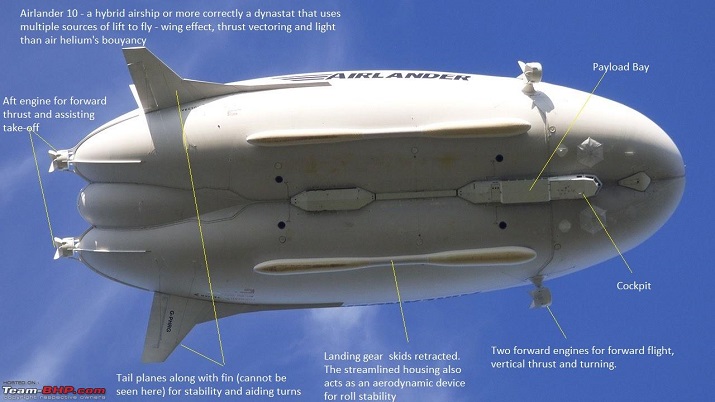
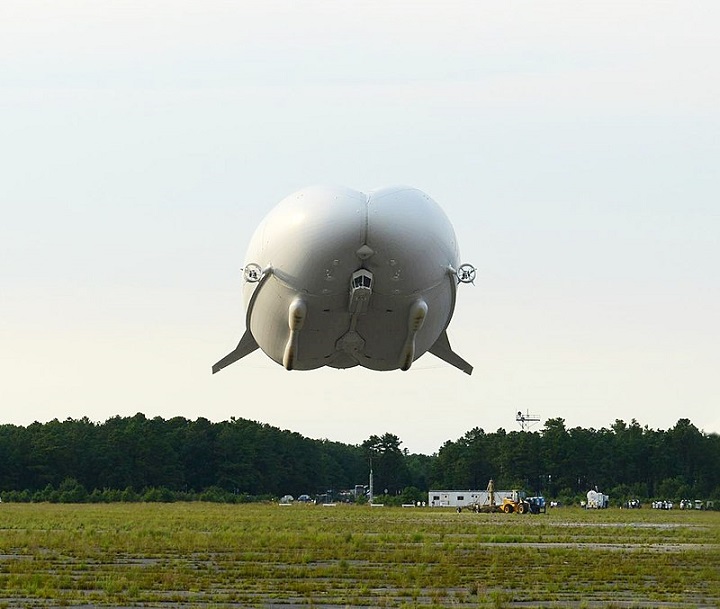
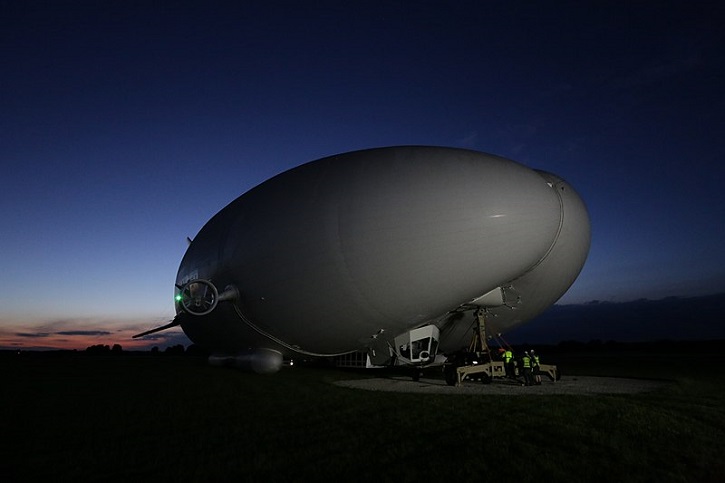
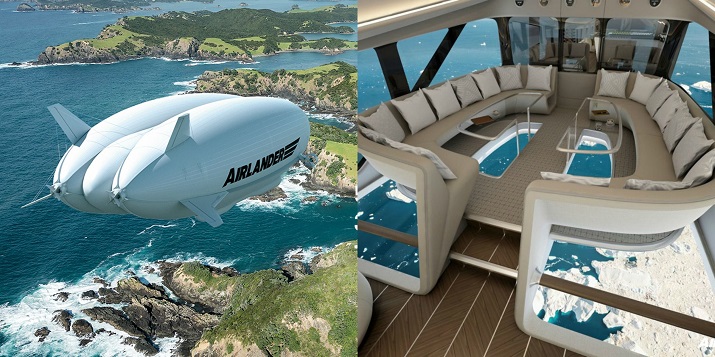
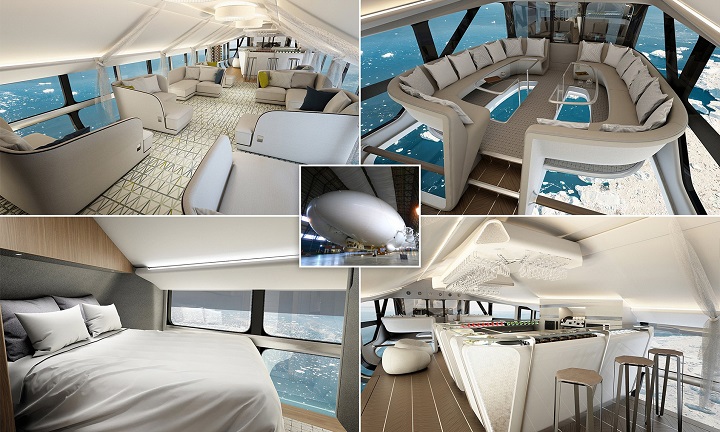
The Hybrid Air Vehicles Airlander 10, originally developed as the HAV 304, is a hybrid airship designed and built by British manufacturer Hybrid Air Vehicles (HAV). Comprising a helium airship with auxiliary wing and tail surfaces, it flies using both aerostatic and aerodynamic lift and is powered by four diesel engine-driven ducted propellers.

The HAV 304 was originally built for the United States Army’s Long Endurance Multi-intelligence Vehicle (LEMV) programme. Its maiden flight took place in 2012 at Lakehurst, New Jersey, in the US. In 2013, the LEMV project was cancelled by the US Army.

HAV reacquired the airship and brought it back to Cardington Airfield in England. It was reassembled and modified for civilian use, and in this form was redesignated the Airlander 10. The modified aircraft completed design certification testing before being written off when it came loose from its moorings in a high wind on 18 November 2017 at Cardington Airfield.

A production run of the Airlander 10 is now planned for 2025.

General characteristics

  • Capacity: 10,000 kg (22,050 lb)
  • Length: 92 m (302 ft 0 in)
  • Wingspan: 43.5 m (143 ft 0 in)
  • Height: 26 m (85 ft 0 in)
  • Volume: 38,000 m3 (1,340,000 cu ft)
  • Gross weight: 20,000 kg (44,100 lb)
  • Max takeoff weight: 33,285 kg (73,381 lb)
  • Powerplant: 4 × 4 litre V8 turbocharged diesel engines, 242 kW (325 hp) each

Last 2 photos remind me of an ass.

Performance

  • Cruise speed: 148 km/h (92 mph, 80 kn)
  • Endurance: 5 days manned
  • Service ceiling: 6,100 m (20,000 ft)
    Loiter speed 20 knots (37 km/h)

Operation Christmas Drop

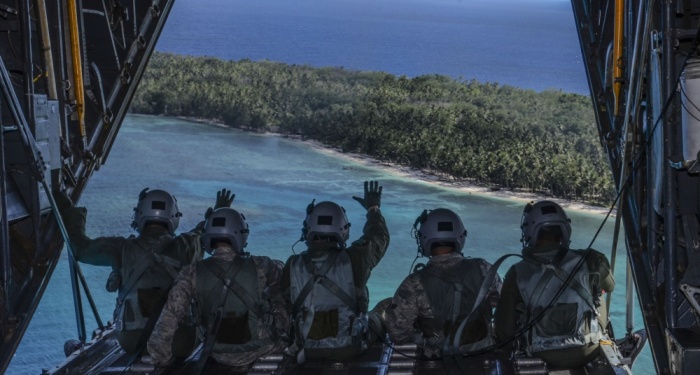
For the last sixty eight years the US Air Force has been playing Santa Claus to some 20,000 people inhabiting dozens of tiny Micronesian islands spread across a vast area in the western Pacific Ocean. Each year in December, these islanders receive all sorts of gifts and useful supplies packed in approximately a hundred crates and dropped gently to earth on green military parachutes. Known as Operation Christmas Drop, this effort on the part of the United States Air Force has been called the “longest running humanitarian mission in the world.”

Operation Christmas Drop has its roots to the Christmas of 1952, when the crew of an Air Force B-29 aircraft, flying a mission to the south of Guam, saw some of the islanders waving at them. In the spirit of the season, the crew gathered some items they had on the plane, placed them in a container, attached a parachute and dropped the bundle to the islanders below.

drop

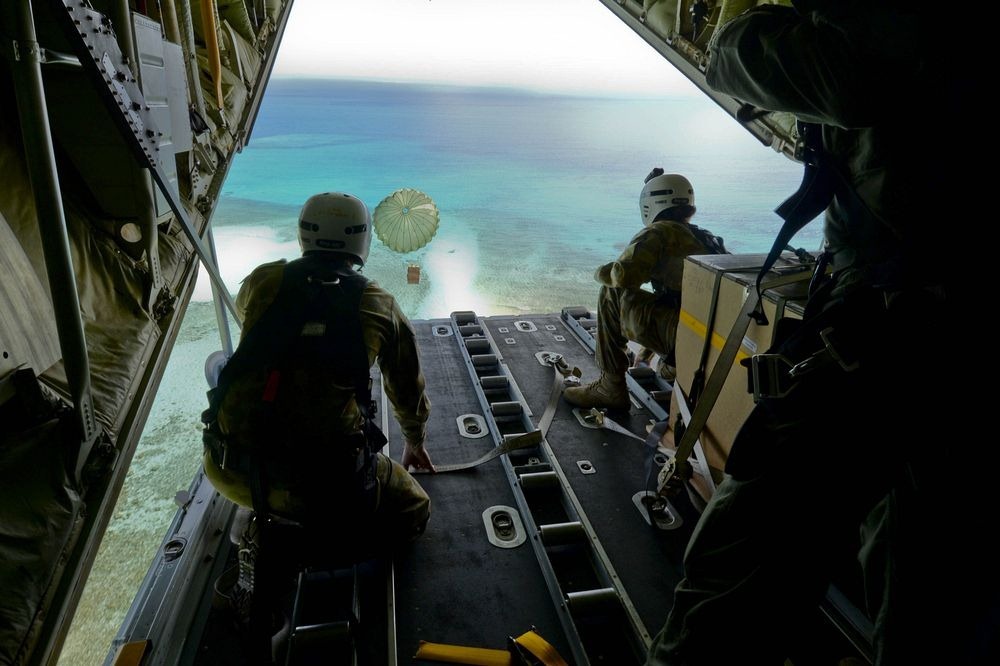
An airman of the US Air Force pushes a bundle from a C-130 Hercules during Operation Christmas Drop over Guam on Dec. 5, 2016. Photo credit: U.S. Air Force/Senior Airman Delano Scott

drop1

A witness to the first drop on the island recalls, “We saw these things come out of the back of the airplane and I was yelling: ‘There are toys coming down’”. The effort grew from there into a major annual training exercise.

All the gifts are donated by residents, civic organizations, military personnel and businesses of Guam, which are collected by private organization and the US Air Force, and then sorted and packed into boxes. The items sent to the Micronesian include fishing nets, construction materials, powdered milk, canned goods, rice, coolers, clothing, shoes, toys, school supplies and so on.

The Air Force uses old parachutes that have outlived their military usefulness, but are still strong enough to support bundles weighing up to 500 pounds. The parachute is said to be the most important item on the bundle. Islanders use it for a variety of applications, from roofing their houses to covering their canoes.

Some of these islands are so remote that they receive supplies from passing ships only once or twice per year.

“Christmas Drop is the most important day of the year for these people,” said Bruce Best, a communications specialist at the University of Guam who has been volunteering his time to help Operation Christmas Drop for the last 34 year.

“The yearly success of this drop is a testament to the generosity of the civilian and military population of Guam,” said U.S. Air Force sergeant and Operation Christmas Drop committee president. “We continue to do this to help improve the quality of life of the islanders. We may take it for granted that we can go to a mall to purchase our daily needs, but these folks do not have the same privilege from where they live.”

In recent years, the US Air Force has received assistance from members of the Royal Australian Air Force and Japan Air Self-Defense Force in the collection and distribution of the Christmas Drop crates. According to organizational data, by 2006, the Christmas drop operations have delivered more than 800,000 pounds of supplies.

drop5

A bundle exits the ramp of a C-130H aircraft during an airdrop mission over the Federated States of Micronesia during Operation Christmas Drop.

A pallet containing toys, holiday decorations and other donated items floats toward an island of the Western Pacific and Micronesia area, bringing holiday cheer Dec. 14 during Operation Christmas Drop. While Santa Claus must find a rooftop to land his reindeer on, America's Airmen and their four-propeller C-130 Hercules deliver the holiday items from the air and move on to their next target. (U.S. Air Force photo/Senior Airman Brian Kimball)
drop4
drop6

A resident of Mokil Atoll waves to the C-130 crew after receiving an air dropped aid package.

operation-christmas-drop-3

Loadmasters from the 36th Airlift Squadron, Yokota Air Base, Japan, prepare humanitarian aid bundles destined for remote islands within the Micronesian Islands.

operation-christmas-drop-15

Senior Airman Angel Torres, 36th Airlift Squadron C-130 Hercules loadmaster, pushes a low-cost, low-altitude bundle drop over the Federated States of Micronesia during Operation Christmas Drop.

operation-christmas-drop-1

Airmen from the Royal Australian Air Force deliver a low-cost, low-altitude bundle during Operation Christmas Drop to the island of Mogmog. Photo credit: U.S. Air Force/Staff Sgt. Katrina Brisbin

operation-christmas-drop-9

A bundle exits the ramp of a C-130H aircraft during an airdrop mission over the Federated States of Micronesia during Operation Christmas Drop.

operation-christmas-drop-11

Tech. Sgt. Magen Harger, 36th Medical Support Squadron medical lab technician, pushes a box of supplies to islanders.

operation-christmas-drop-7

Packages make their way to the shore of Kayangel Island during Operation Christmas Drop.

operation-christmas-drop-14

Islanders watch a C-130 Hercules fly overhead during Operation Christmas Drop 2015 at Fais Island, Federated States of Micronesia.

operation-christmas-drop-8

Micronesian islanders receive supplies airdropped from a C-130 Hercules near Andersen Air Force Base.

Operation Christmas Drop is primarily conducted from Andersen Air Force Base on Guam and Yokota Air Base in Japan.

micro

Cool Airliners

plane

Kulula.com (stylized as kulula.com) and commonly referred to as Kulula is a South African low-cost airline, operating on major domestic routes from O. R. Tambo International Airport and Lanseria International Airport, both serving the city of Johannesburg. The airline’s headquarters are located at Bonaero Park, Kempton Park, Ekurhuleni, Gauteng. The name ‘Kulula’ comes from the Nguni languages of Zulu and Xhosa, meaning It’s easy.

NASA wind tunnels 1927-1991

tunnel
tunnel1

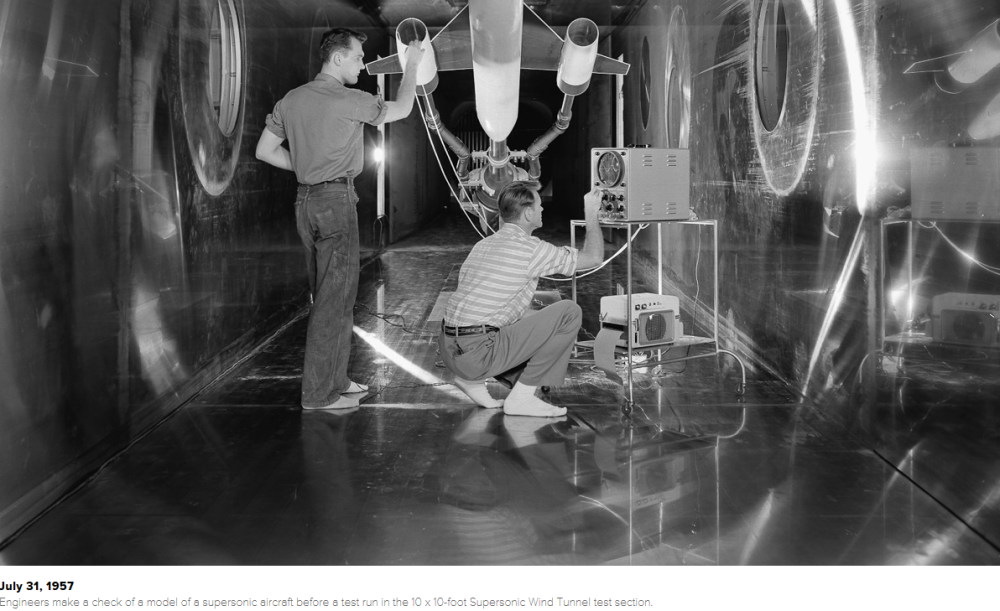
Before any NASA craft is cleared for liftoff, it must undergo exhaustive testing in one of the administration’s 42 major wind tunnels, which range from just a few inches wide to cavernous enough to contain a full-sized airplane.

With an aircraft model held on a stationary post, air is accelerated through the tunnel by fans, allowing engineers to study the effects of different designs on flight characteristics such as lift, drag and stability.

NASA’s earliest wind tunnel predates NASA itself, and was built in 1920 at the Langley Research Center, then under the auspices of the National Advisory Committee for Aeronautics (NACA).

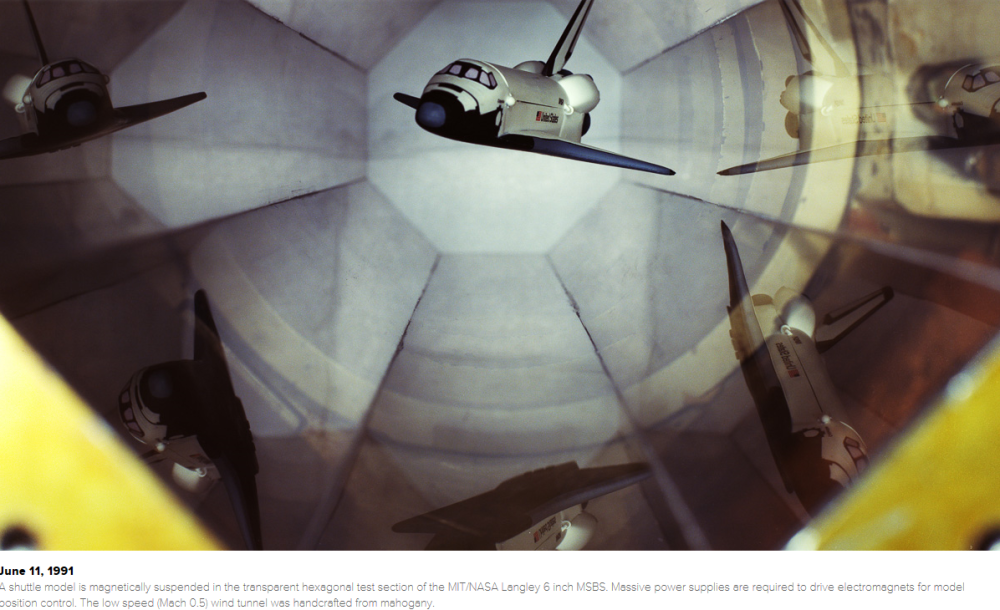
As flight technology became more advanced and complex, so did the testing facilities. Specialized tunnels were developed to simulate subsonic, transsonic, supersonic and even hypersonic speeds — five times the speed of sound. Some tunnels can approximate the fiery heat of atmospheric re-entry, while others can test the effects of ice buildup at high altitudes. Some newer facilities can magnetically suspend aircraft models in midair, eliminating aerodynamic interference from support structures.

Today, NASA-operated wind tunnels are routinely used to test and tweak military and civilian aircraft.

tunnel2
tunnel3
tunnel4
tunnel5
tunnel6
tunnel7

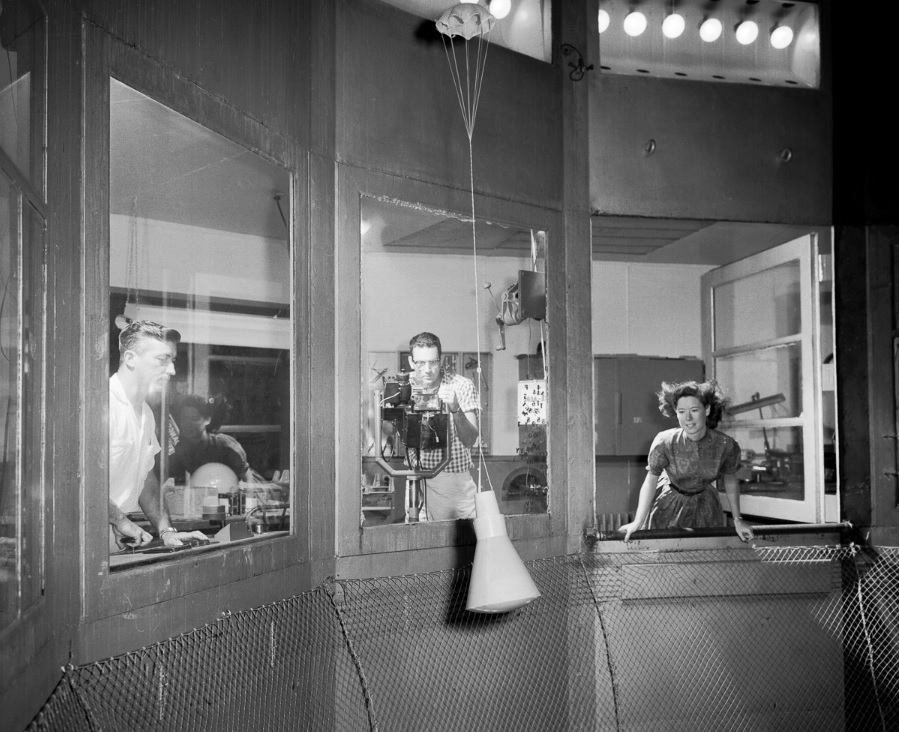
Sept 11, 1959 A Mercury capsule model in the Spin Tunnel.

c. 1960

A 10-story bank of vanes which turn the air around one of the four corners of the 40 x 80-foot Wind Tunnel at Ames Research Center.

c. 1962

Technicians install a model of an Apollo command module in the 9 x 6-foot Thermal Structures Tunnel for tests of possible heat shield materials.

tunnel9

April 14, 1975

A space shuttle model undergoes a wind tunnel test simulating the ionized gasses that surround a shuttle as it reenters the atmosphere.

April 1, 1980

A Marshall Space Flight Center engineer holds a replica of the proposed Liquid Booster Module while observing the testing of a small Space Shuttle orbiter model at Wind Tunnel 14.

Nov. 17, 1986

NASA technician W.L. Jones inspects a transport model Pathfinder I between test runs at Langley’s National Transonic Facility.

April 10, 1990

The Pioneer Aerospace Parafoil undergoes testing in the world’s largest wind tunnel, the 80 x 120-Foot Tunnel at NASA’s Ames Research Center in Mountain View, California.

tunnel10

LAPD Helicopter Footage May Solve LAX ‘Jetpack Man’ Mystery

Newly released footage from a Los Angeles Police Department helicopter suggests that the mysterious ‘jetpack man’ spotted near LAX on multiple occasions over the last year may have actually just been an errant balloon. The curious case began back in the summer of 2020 when a pilot approaching the airport reported to air traffic controllers that there was a “guy in a jetpack” flying around the area. This was followed by a subsequent sighting in October of last year as well as a third such encounter with the unidentified flying individual that took place this past July. An investigation by the FBI indicated that they suspected that the aerial anomaly was, in fact, a balloon, and now newly released materials reportedly released by the LAPD lend considerable credence to that theory.

Captured in November of last year, but only coming to light this week, the footage as well as some photos show what is clearly a sizeable human-shaped balloon floating at a high altitude above the city of Los Angeles. Specifically, it is believed that the object is a seven-foot-tall inflatable depiction of the character Jack Skellington from the hit film Nightmare Before Christmas. Given the time frame of the video, it is suspected that the balloon may have ‘escaped’ or was released from a residence where it had been used as a Halloween decoration. While this particular piece of footage was not captured during one of the three aforementioned ‘jetpack man’ sightings, authorities believe that it serves as a proverbial proof of concept that explains the seemingly inexplicable incidents.

To that end, the FBI says that their investigation into the series of events has failed to yield any additional ‘jetpack man’ witnesses nor any video footage from the three encounters that spawned headlines and led to authorities looking into the matter. For their part, the FAA issued a statement saying that the department “has worked closely with the FBI to investigate every reported jetpack sighting” and stressed that “so far, none of these sightings have been verified.” So while the case may not technically be closed, the LAPD footage is the best evidence yet that the ‘jetpack man’ was not an ill-advised prankster making trouble, but a balloon that was only briefly spotted by the bewildered pilots.

See also: https://markozen.com/2020/09/01/pilots-report-seeing-guy-in-jetpack-flying-near-lax/