HALIFAX, N.S. — Halifax is welcomed a big American visitor on Friday, when the aircraft carrier USS Gerald R Ford and its strike group arrived in the Nova Scotia capital.
The carrier is the flagship of the Gerald R. Ford Carrier Strike Group, which includes air, maritime, and ground assets from NATO allies and partner nations, according to a news release.
The group set sail from Norfolk, Va., on Oct. 4, and has been exercising in the Atlantic Ocean.
This port visit is the first outside the U.S., alongside ships from NATO nations to include Demark, the Netherlands, Spain, and Germany.
The nuclear-powered flagship is named in honour of the 38th president of the United States, who served in the navy during the Second World War.
Aircraft carriers have always evoked awe and amazement with their size and capabilities of launching airplanes from their giant decks. Today the giant carriers that patrol the oceans belong to the United States Navy. These ships displace 100,000 tons and are over a thousand feet long. The U.S. currently has 11 of these super carriers with another under construction. Other countries have aircraft carriers but nothing approaching the size of the American ships.
France has carriers less than half the size of the U.S. carriers. The U.K. has carriers with a displacement of 65,000 tons. Other than the U.K and France there a few other countries with smaller carriers. But there are two countries with very big carriers. Not as big as the U.S. but bigger than the U.K and French ships. Russia has one and China has another one.
Admiral Kuznetsov is the Russian carrier. It displaces 65,000 tons and does limited patrolling in the Mediterranean.
There was a second carrier of the same design that apparently has landed up in the hands of the People’s Liberation Army Navy of China, the Varyag.
Varyag being towed in Istanbul.
Varyag was to be an Admiral Kuznetsov class multirole aircraft carrier of the Soviet Union. She was known as Riga when her keel was laid down at Shipyard 444 (now Nikolayev South) in Nikolayev December 6, 1985. Design of the carrier was undertaken by the Nevskoye Planning and Design Bureau. She was launched December 4, 1988, but she was renamed Varyag (Varangian) in late 1990, after the famous Russian cruiser.
Construction stopped by 1992, with the ship structurally complete but without electronics. With the dissolution of the Soviet Union, ownership was transferred to Ukraine; the ship was laid up, unmaintained, then stripped. In early 1998, she lacked engines, a rudder, and much of her operating systems, and was put up for auction.
It was purchased at auction for US$20 million by Chong Lot Travel Agency, a company widely believed to be a front for Chinese People’s Liberation Army Navy (PLAN) Chong Lot stated that the ship would become a floating entertainment center and casino in the Chinese SAR of Macau. However, this has been proven incorrect as the ship is docked in Dalian and painted PLAN grey. The Chinese Navy has reportedly named the carrier Shi Lang and received delivery of the ship in October 2010. Defense News and Intelligence sources claim that the ship has been refitted and will be put through Sea Trials in the summer of 2011.
Now that China is about to have an aircraft carrier in its inventory, there are some futuristic concept carrier designs showing up on-line with Chinese colours and aircraft.
This catamaran design would be very fast in the water and allows for basically 2 carrier megastructures to be fused together.
These giant ships would be giant targets also. The enemy would throw everything they had at the beast. These ships would be very susceptible to U.S. cruise missiles and torpedoes.
Taking the futuristic carrier concept to a whole new level is the idea of an aircraft carrier that could fly itself. A big nuclear powered platform that could fly at high altitude and launch fighter jets and helicopters while airborne.
These renderings show the power plants as giant fans along the sides of these leviathans. It would be a lot of tonnage to keep in the sky for extended periods.
These giant flying ships would also be very detectable to radar and other sensors. But maybe they would have a cloaking capability, which would allow them to pass into enemy airspace undetected and unleash the wrath of the fighter bombers zooming off the decks.
The one below has the power fans running down the centre of the ship. It looks like a Chinese design.
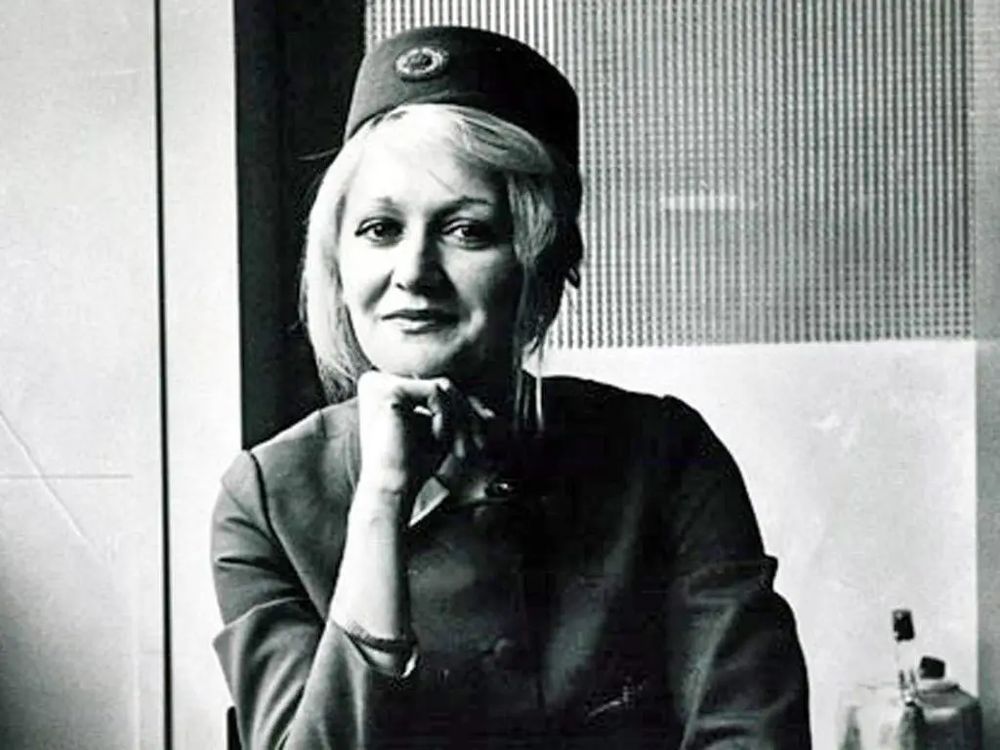
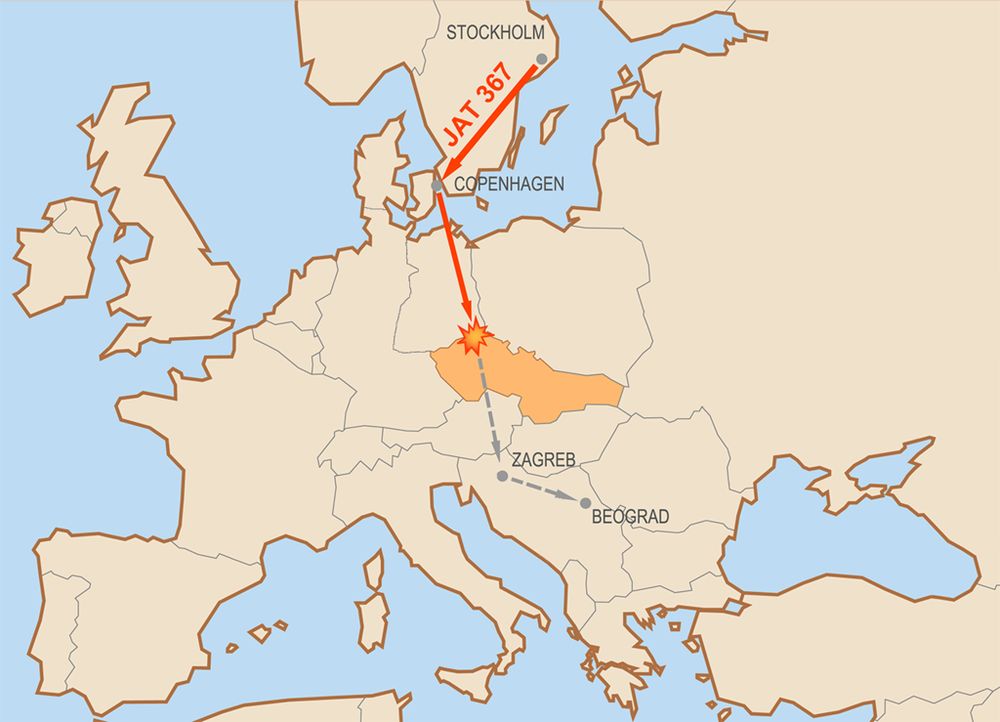
On January 26, 1972, the JAT Yugoslav Airlines Flight 367 flying from Stockholm to Belgrade became the target of a terrorist attack. A suitcase bomb tucked inside the baggage compartment of the McDonnell Douglas DC-9-32 aircraft exploded when the airplane was cruising at an altitude of 33,000 feet over East Germany. The explosion tore through the fuselage of the narrow-body jetliner, breaking it apart into three pieces. The wreckage then crashed near the village of Srbská Kamenice in Czechoslovakia. Typically, there should have been no survivors, but this time around there was one—a flight attendant named Vesna Vulovic.
Vesna Vulovic.
The 22-year old Serbian flight attendant Vesna Vulovic was part of the secondary cabin crew who boarded the airplane in Copenhagen, where the flight made a brief stopover en route to Belgrade. But Vulovic was not supposed to be on the doomed flight. Vulovic’s schedule got mixed up with that of another stewardess named Vesna, and she was subsequently placed on the wrong flight. Nevertheless, Vulović was happy for the mistake because it allowed her to travel to Denmark, a country she had never been to before.
At 4:01 pm, forty-six minutes after take off from Copenhagen Airport, the bomb placed in the baggage compartment went off, and the airplane broke apart. As the cabin depressurized, the passengers and other flight crew were sucked out of the plane into freezing temperatures and fell to their deaths. Vulovic miraculously got trapped inside one of the broken sections of the fuselage by a food cart, protecting her from frigid temperatures, as it plummeted towards the ground. The fuselage section with Vulovic trapped inside crash landed in thick snow in a heavily wooded area, which cushioned the impact.
A villager named Bruno Honke discovered Vulovic when he heard her screaming amid the wreckage. Honke had been a medic during World War II and was able to keep Vulović alive until rescuers arrived. She suffered a fractured skull, two broken legs, and three broken vertebrae, one of which was crushed completely. Her pelvis was fractured and several ribs were also broken. Her injuries resulted in her being temporarily paralyzed below the waist, and she spent several days in coma. Doctors later told her that her history of low blood pressure caused her to pass out quickly after the cabin depressurized and kept her heart from bursting on impact.
Vulovic couldn’t remember anything about her flight and the ordeal. The last thing she remembered was greeting passengers as they boarded. The next thing she remembered was seeing her parents in her hospital room about one month later. She had to be told that she survived a plane crash, and when shown a newspaper headline by her doctor, she reportedly fainted.
Photo: CTK / Alamy Stock Photo
After several surgeries, and ten months later, Vulovic was able to walk again although the accident left her with a permanent limp. By September 1972, and less than nine months after the incident, Vulovic was eager to go back to work, but JAT gave her a desk job instead, because they didn’t want Vulovic drawing too much publicity.
Back home, Vulovic became a national celebrity and received a decoration from Yugoslav President Josip Tito. The Serbian folk singer Miroslav Ilić even wrote a song in her honor. In 1985, Vulovic ended up in the Guinness Book of World Records for surviving the highest fall without a parachute, at 10,160 meters (33,330 feet).
For decades after the crash, Vulovic struggled with survivor’s guilt. “Whenever I think of the accident, I have a prevailing, grave feeling of guilt for surviving it and I cry … Then I think maybe I should not have survived at all,” she told The Independent in 2012. Vulovic declined therapy to help cope with her experiences and instead turned to religion, becoming a devout Orthodox Christian. She stated that her ordeal had turned her into an optimist. “If you can survive what I survived, you can survive anything,” she said.
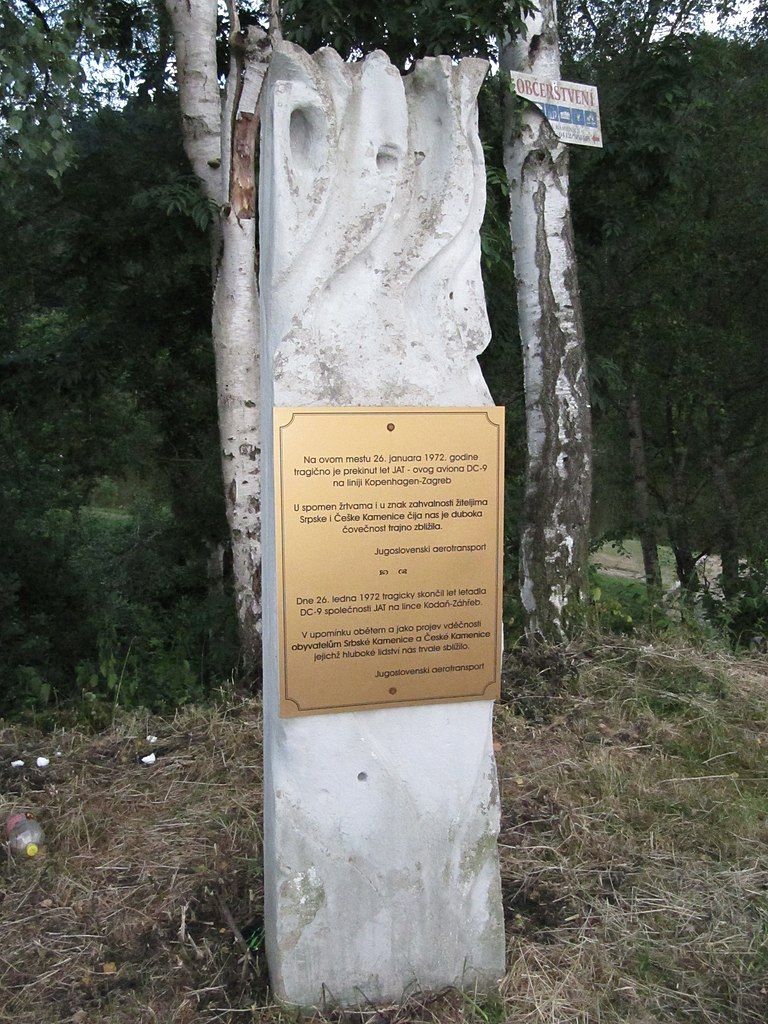
Monument to victims of the Yugoslav aircraft tragedy of 1972, in Srbská Kamenice. Photo: palickap/Wikimedia
When she was asked whether she considered herself lucky, she replied: “No, I’m not. I’m not lucky. Everybody thinks I am lucky, but they a mistaken. If I were lucky I would never had this accident and my mother and father would be alive. The accident ruined their lives too.”
Vulovic became a political activist in later life, that cost her her job—she was fired from JAT for speaking out against Serbian statesman Slobodan Milošević and taking part in anti-government protests. She avoided arrest because the government was concerned about the negative publicity that her imprisonment would bring. She later campaigned on behalf of the Democratic Party and advocated for Serbia’s entry into the European Union, which she believed would bring economic prosperity.
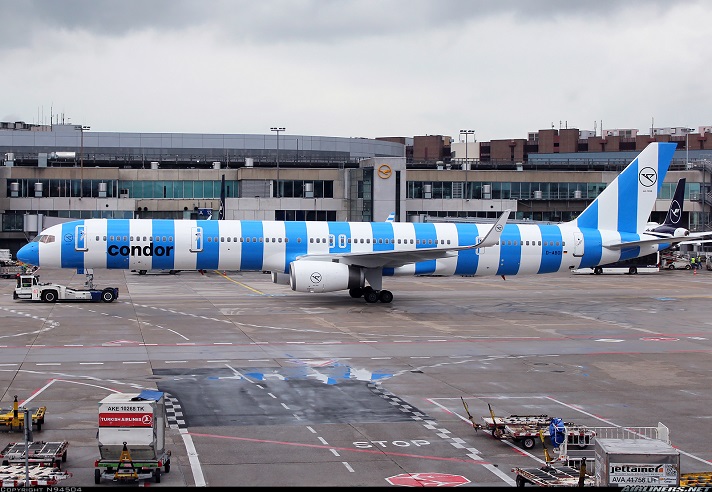
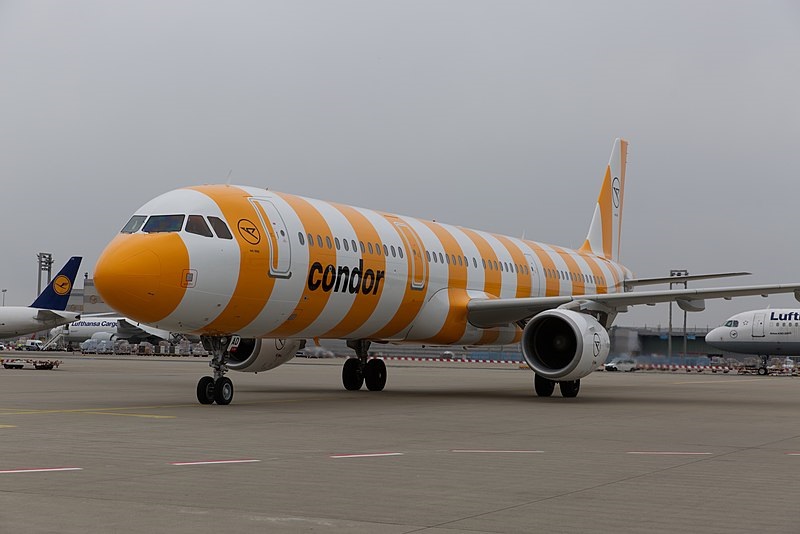
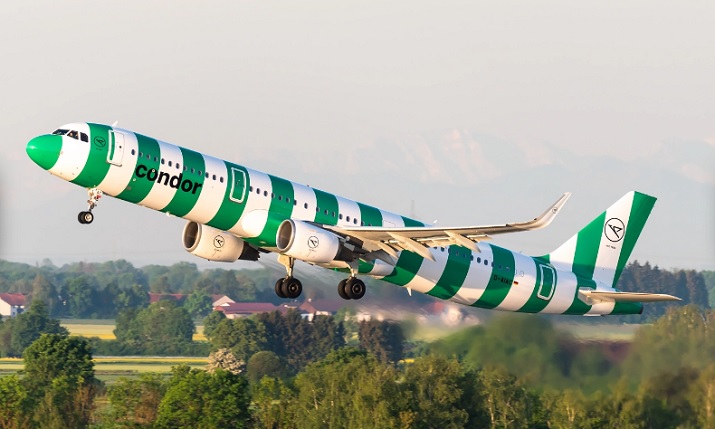
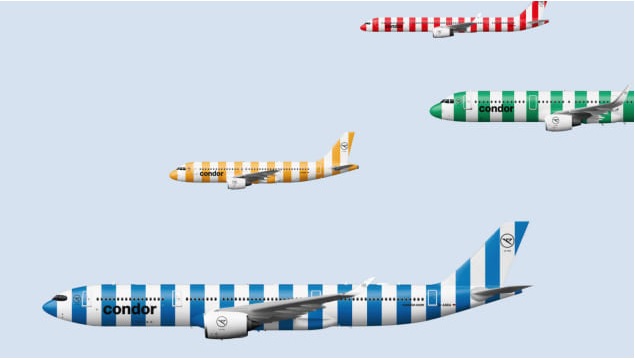
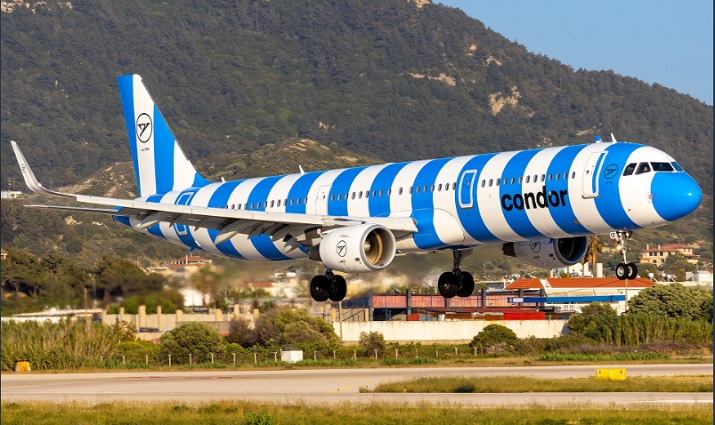
(CNN) — Most airplane exteriors look more or less the same — white backdrop, bold lettering, company logo — but every now and again, an airline unveils a livery that stands out from the pack. Take All Nippon Airways’ “Flying Honu” A380s, designed to resemble bright colored turtles, or the stunning indigenous art that adorns one of Qantas’ Boeing 787-9 Dreamliners. German airline Condor is the latest carrier to step up its livery game with a simple yet stylish paint job. Condor’s fleet is tricked out in candy-colored bold stripes, inspired by “parasols, bath towels and beach chairs,” according to the airline. Condor was owned by British holiday company Thomas Cook, which collapsed in 2019. Now the leisure airline is striking out on its own, with a new look to celebrate. The colorful stripes, designed by Berlin creative agency Vision Alphabet, aim to evoke nostalgia for vacations past and excitement for vacations of the future. There are five color options: Condor says the blue stripes represent the sea, the yellow stripes recall sunshine, red represents “passion”, green represents “island” and a beige-gold stripe should make travelers think of a sandy beach.
The airline suggests the stripes also represent “the diversity of Condor’s guests, employees and the multitude of opportunities to discover the world with Condor.”
Ralf Teckentrup, Condor’s CEO, said in a statement that the colorful stripes are the airline’s “new trademark.” Accordingly, it’s not just Condor’s exterior that’s been reimagined. Condor’s logo on its social media account is now emblazoned with stripes, while boarding passes and inflight items like blankets are being reimagined. Condor promises crew uniforms will also “shine in the new design,” with more details and photos to come.
Condor has over 50 aircraft in its fleet, and promises the majority will be painted by 2024. Expect to see six of the striped aircraft in operation by this summer, with these aircraft flying to destinations including the Canary Islands, Greece and Egypt.
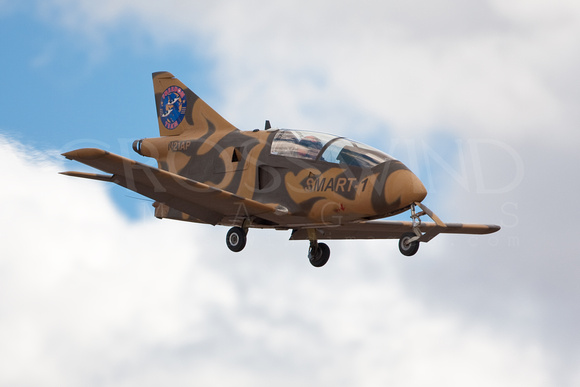
The BD-5 Micro is a series of small, single-seat homebuilt aircraft created in the late 1960s by US aircraft designer Jim Bede and introduced to the market primarily in “kit” form by the now-defunct Bede Aircraft Corporation in the early 1970s.
In total, only a few hundred BD-5 kits were completed, although many of these are still being flown today. The BD-5J version holds the record for the world’s lightest jet aircraft, weighing only 358.8 lb (162.7 kg).
With the demise of the Bede Aircraft Company, the BD-5 entered a sort of limbo while builders completed their kits. The early safety problems and the challenge of adapting a suitable engine exacerbated delays. Over the next few years, however, solutions to most of these problems arrived in one form or another. Many other changes have also been incorporated to improve the original design. Today the BD-5 is a rewarding, if demanding aircraft.
General Characteristics
Crew: one, pilot
Length: 12 ft to 13.5 ft w/stretch kits (3.88 m to 4.11 m)
Wingspan: 14 ft to 21 ft 6 in (4.26 m to 6.55 m)
Height: 5 ft 2 in (1.6 m)
Wing area: Depends on wing used (-5A, -5B or -5J)
Empty weight: 167 kg and up
Loaded weight: 407 lb to 809 lb
Max. takeoff weight: 1,100 lb (530 kg)
Powerplant: 1 × Various reciprocating engines, from Rotax to Turbo Honda; turboprop with modified Solar T62; jet with Microturbo Couguar or TRS-18,
The table below presents the top 50 countries by the number of business jets in operation. It will come as no surprise that the number of aircraft registered in the US is far greater than anywhere else in the world. Out of all of the 50 countries below, the US alone accounts for 67 per cent of business jets and 63 per cent of the global fleet.
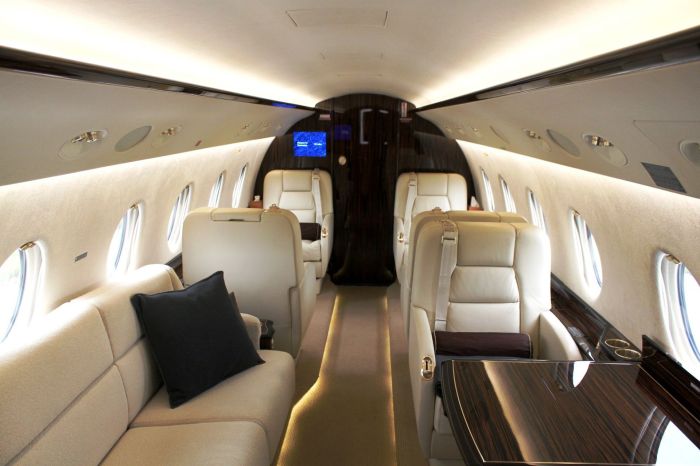
Gulfstream G650. Highest rated business jet
In sixth position with 264 aircraft, the Isle of Man, located off the coast of the UK, opened for business in May 2007 and is continuing to be seen as a popular and quick place to register aircraft.
Latin American occupies three places in the top 10, with Brazil and Mexico in second and third Venezuela at number 10. Brazil, in particular, is a vast country that takes time to travel across, so the number of smaller aircraft provide businesses with vital links between towns and cities. Although no age analysis is available, the number of older aircraft in both Mexico and Venezuela is noticeable and with little official information available, it is proved difficult to obtain true numbers of aircraft that are still currently active.
Austria’s position at number seven is partly due to a number of aircraft with Russian owners. Russia’s own import duty and tax payable on aircraft placed on the Russian register makes Austria a very attractive alternative country to register aircraft – something that also benefits the Isle of Man.
The number of business jets registered in China excludes aircraft registered in Hong Kong, Macao and Taiwan, each of which appear under their own entries. If we were to consolidate the three countries, China would jump two places in the list to number seven. Hong Kong, in particular, has a large number of aircraft registered and appear at 35th place with 32 business jet on the register.
Most popular private jet registries
Position
Registered Country
No. of Aircraft
1
United States
12,051
2
Brazil
764
3
Mexico
704
4
Canada
483
5
Germany
387
6
Isle of Man
264
7
Austria
244
8
United Kingdom
241
9
China
203
10
Venezuela
168
11
South Africa
160
12
Australia
154
13
Argentina
142
14
India
140
15
Portugal
138
16
France
132
17
Switzerland
123
18
Bermuda
117
19
Cayman Islands
114
20
Turkey
110
21
Spain
100
22
Italy
99
23
Denmark
62
24
United Arab Emirates
61
25
Saudi Arabia
56
26
Russian Federation
53
27
Luxembourg
48
28
Belgium
45
29
Aruba
45
30
Nigeria
41
31
Japan
36
32
Sweden
36
33
Malta
35
34
Czech Republic
34
35
Hong Kong
32
36
Philippines
32
37
Indonesia
27
38
Netherlands
27
39
Finland
26
40
Morocco
26
41
Thailand
25
42
Ukraine
24
43
Egypt
23
44
Chile
20
45
Serbia
17
46
Bulgaria
16
47
Kazakhstan
16
48
Colombia
16
49
Greece
15
50
Pakistan
15
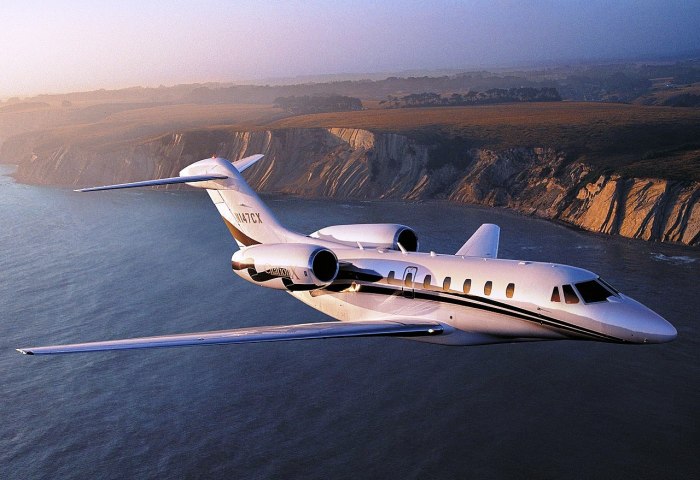
Most popular business jet: Cessna Citation series with over 7000 built
Housing the largest aircraft and missile facility around the globe, the Davis-Monthan Air Force Base in Tucson is a trove of aviation history. The Arizona boneyard is responsible for nearly 4,000 vehicles that are maintained, recycled for parts, and stored across miles of the dry, desert landscape. Photographer Bernhard Lang (previously) visited the site recently to document the aircraft, which are organized in neat rows and grouped by model. Containing both rusted and disassembled machines and those in pristine condition, the boneyard is designed for preservation “in order to make (the planes) airworthy again if necessary, a current topic in times of the Ukraine war and the global discussion about deliveries of arms,” Lang says.











 The MarkoZen Blog

