Very strange looking aircraft  

Men and their flying machines.  Giant ones, tiny ones, some with forward-swept wings, all kinds of strange aircraft have been invented.  Here are some of the strangest looking ones I have found.

The Spruce Goose above flew only once in 1947 and was designed to carry over  700 people. It was actually a wooden heavy transport aircraft designed and built  by the Hughes Aircraft company. It was built by the U.S. War Department because  of wartime raw material restrictions on the use of aluminum. Its official name  is Hughes H-4 Hercules but Spruce Goose somehow stuck. This heavy transport  flying boat is the largest flying boat ever built, and has the largest wingspan  of any aircraft in history with span exceeding the length of a football field.  It is currently housed in Evergreen Aviation Museum in McMinnville, Oregon, USA.

This over-eating plane, officially, the Boeing 747 Large Cargo Freighter, is a  wide-body cargo aircraft and the world’s longest cargo loader constructed by  drastic modifications to an existing Boeing 747-400. Boeing uses this plane to  bring in aircraft parts from suppliers around the world. Only 4 of the type have  been built.

Pregnant Guppy

As weird as its name, this plane was a large, wide-bodied cargo aircraft built  in the United States by Aero Spacelines and used for ferrying outsized cargo  items, most notably NASA’s components of the Apollo moon program. Infact, the  Dreamlifter was inspired from this beauty. Only 1 unit if this aircraft was ever  built and it served a good 15 years, starting in 1962.

Northrop Tacit Blue

Before you start laughing, do understand that this aircraft was a pioneer in  stealth technology. There was only one produced, by the U.S. Air Force, in 1982,  which was meant to demonstrate that a stealth low observable surveillance  aircraft with a low probability of intercept radar and other sensors could  operate close to the forward line of battle with a high degree of survivability.  The pioneer plane is currently housed at the National Museum of the US Air  Force.

Horten HO 229

Designed by Horten brothers of Germany this plane was a late-World War II  prototypefighter/bomber. Its odd shape can be attributed to the fact that it was  designed to be more difficult to detect with radar. Horten Ho 229 never made it  to actual war and was only flown as a prototype.

Officially, the Vought V-173 was designed by Charles H. Zimmerman. It was an  American experimental test aircraft built as part of the Vought XF5U “Flying  Flapjack” World War II United States Navy fighter aircraft program and without doubt it is one of the most strangest planes ever built.
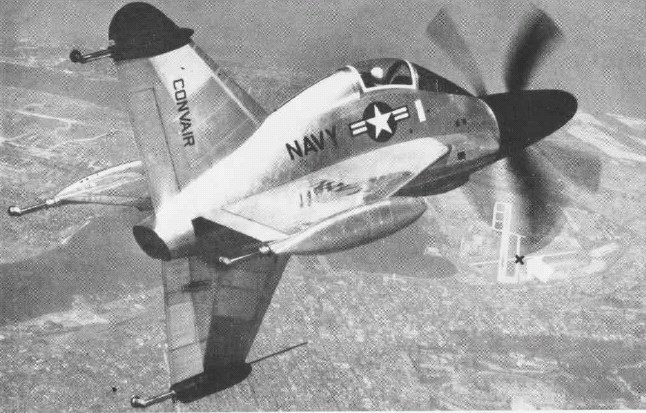

The Convair XFY Pogo tailsitter was an experiment in vertical takeoff and landing. The Pogo had delta wings and three-bladed contra-rotating propellers powered by a 5,500 hp (4,100 kW) Allison YT40-A-16 turboprop engine. It was intended to be a high-performance fighter aircraft capable of operating from small warships. Landing the XFY-1 was difficult as the pilot had to look over his shoulder while carefully working the throttle to land.

The Grumman X-29 was an experimental aircraft that tested a forward-swept wing, canard control surfaces, and other novel aircraft technologies. The aerodynamic instability of this arrangement increased agility but required the use of computerized fly-by-wire control. Composite materials were used to control the aeroelastic divergent twisting experienced by forward-swept wings, also reducing the weight. Developed by Grumman, the X-29 first flew in 1984 and two X-29s were flight tested over the next decade.

The Russians had their version as they always do.

The Sukhoi Su-47 Berkut (Russian: Су-47 Беркут – Golden Eagle) (NATO reporting name Firkin), also designated S-32 and S-37 (not to be confused with the single-engined delta canard design offered by Sukhoi in the early 1990s under the designation Su-37) during initial development, was an experimental supersonic jet fighter developed by Sukhoi Aviation Corporation. A distinguishing feature of the aircraft was its forward-swept wing, similar to that of the Tsybin’s LL-3., that gave the aircraft excellent agility and maneuverability. While serial production of the type never materialized, the sole aircraft produced served as a technology demonstrator prototype for a number of advanced techhnologies later used in the 4.5 generation fighter SU-35BM and current Indo-Russian 5th generation fighter prototype Sukhoi PAK FA.

The Hawker Siddeley Nimrod was a military aircraft developed and built in the United Kingdom. It is an extensive modification of the de Havilland Comet, the world’s first jet airliner. It was originally designed by de Havilland’s successor, Hawker Siddeley, now part of BAE Systems.

It was designed with an extended nose for radar, a new tail with electronic warfare (ESM) sensors mounted in a bulky fairing, and a MAD (Magnetic anomaly detector) boom. After the first flight in May 1967, the RAF ordered 46 Nimrod MR1s. The first example (XV230) entered service in October 1969.  Five squadrons were eventually equipped with the MR1.

Aircraft with huge rotating radar domes.

The Grumman E-2 Hawkeye is an American all-weather, aircraft carrier-capable tactical airborne early warning (AEW) aircraft. This twin-turboprop aircraft was designed and developed during the late 1950s and early 1960s by the Grumman Aircraft Company for the United States Navy as a replacement for the earlier E-1 Tracer, which was rapidly becoming obsolete. E-2 performance has been upgraded with the E-2B, and E-2C versions, where most of the changes were made to the radar and radio communications due to advances in electronic integrated circuits and other electronics. The fourth version of the Hawkeye is the E-2D, which first flew in 2007.

XF-107A Experimental Fighter Bomber

The air intake was in the unusual dorsal location as the USAF had required the carriage of an underbelly semi-conformal nuclear weapon. The original chin intake caused a shock wave that interfered in launching this weapon. The implications this had for the survivability of the pilot during ejection were troubling. The intake also severely limited rear visibility. Nonetheless this was not considered terribly important for a tactical fighter-bomber aircraft, and furthermore it was assumed at the time that air combat would be via guided missile exchanges outside visual range.

Modern Fighter Pilot Flight Helmets 

flight helmet, sometimes nicknamed a “bone dome”, is a special type of helmet primarily worn by military aircrew.

A flight helmet can provide:

  • Impact protection to reduce the risk of head injury (e.g. in the event of a parachute landing) and protection from wind blast (e.g. in the event of ejection).
  • A visor to shield the eyes from sunlight, flash and laser beams.
  • Noise attenuation, headphones and a microphone (except when included in a mask).
  • A helmet mounted display, mounting for night vision goggles and/or a helmet tracking system (so the aircraft knows where the pilot is looking).

helmet nasa

SR-71 Blackbird pilot helmet. The plane flew so fast and high that the helmet resembles a space helmet.

helmet blackbird

helmet blackbird1

The Soviet (Russian) MIG-25 Foxbat also flew very high and fast.

helmet soviet mig 25

Chinese helmet variations

helmet chinese

U.S. Navy helmet

helmet us navy

F/A-18 Super Hornet carrier pilots

070525-N-0890S-021 PERSIAN GULF (May 25, 2007) - Lt. Cmdr. John Depree and Lt. j.g. David Dufault, both assigned to the "Black Aces" of Strike Fighter Squadron (VFA) 41, go over pre-flight checks prior to launch aboard nuclear-powered aircraft carrier USS Nimitz (CVN 68). Nimitz Carrier Strike Group and embarked Carrier Air Wing 11 are deployed to 5th Fleet conducting maritime operations and supporting the global war on terrorism. U.S. Navy photo by Mass Communication Specialist Seaman Apprentice David L. Smart (RELEASED)

helmet

F-22 Raptor pilot helmet

helmet usaf

U.S. Marine Corp Harrier pilots always wear camo helmets

helmet us marines

helmets marines

U.S. Air Force Thunderbirds demo team

Mixed martial artist champion, Ronda Rousey, adjusts her flight mask in preparation for her Thunderbird F-16 Fighting Falcon flight at Nellis Air Force Base, Nev., Nov. 9, 2012. (U.S. Air Force photo/Staff Sgt. Larry E. Reid Jr., Released)

Royal Canadian Air Force

helmets canada

F-35 Lightning II

helmet f-35

Each helmet costs $400,000!

Vision Systems International (VSI; the Elbit Systems/Rockwell Collins joint venture) along with Helmet Integrated Systems, Ltd. developed the Helmet-Mounted Display System (HMDS) for the F-35 Joint Strike Fighter aircraft. In addition to standard Helmet Mounted Display (HMD) capabilities offered by other systems, HMDS fully utilizes the advanced avionics architecture of the F-35 and provides the pilot video with imagery in day or night conditions. Consequently, the F-35 is the first tactical fighter jet in 50 years to fly without a HUD. A BAE Systems helmet was considered when HMDS development was experiencing significant problems, but these issues were eventually worked out. The Helmet-Mounted Display System was fully operational and ready for delivery in July 2014.

The F-35 does not need to be physically pointing at its target for weapons to be successful. Sensors can track and target a nearby aircraft from any orientation, provide the information to the pilot through their helmet (and therefore visible no matter which way the pilot is looking), and provide the seeker-head of a missile with sufficient information. Recent missile types provide a much greater ability to pursue a target regardless of the launch orientation, called “High Off-Boresight” capability. Sensors use combined radio frequency and infra red (SAIRST) to continually track nearby aircraft while the pilot’s helmet-mounted display system (HMDS) displays and selects targets; the helmet system replaces the display-suite-mounted head-up display used in earlier fighters. Each helmet costs $400,000.

The F-35’s systems provide the edge in the “observe, orient, decide, and act” OODA loop; stealth and advanced sensors aid in observation (while being difficult to observe), automated target tracking helps in orientation, sensor fusion simplifies decision making, and the aircraft’s controls allow the pilot to keep their focus on the targets, rather than the controls of their aircraft.

And Lastly

ajets (2)

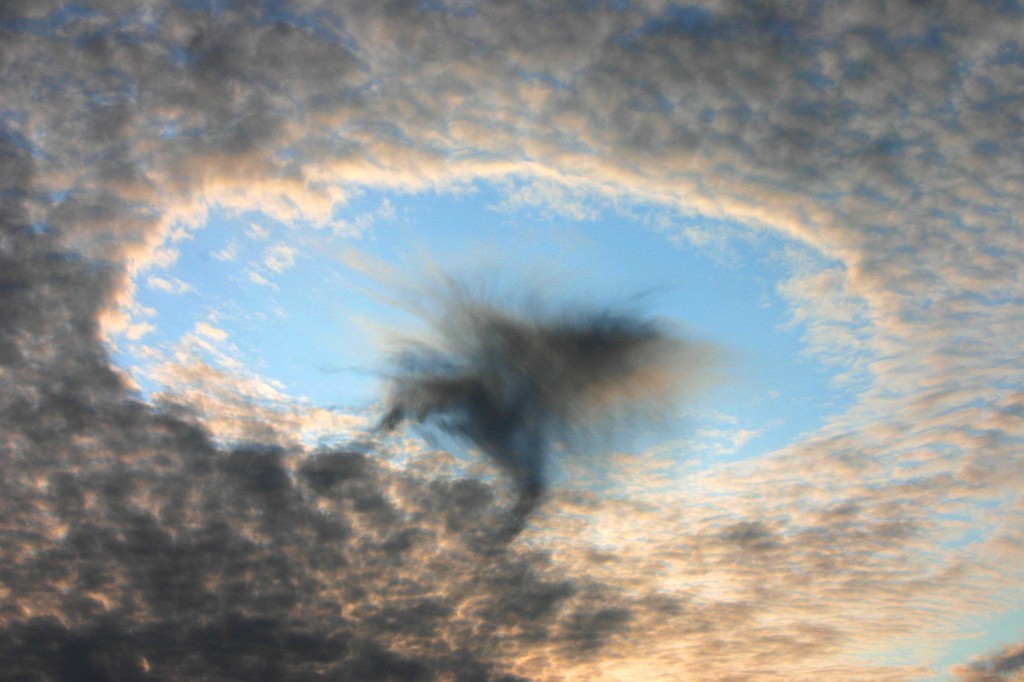
‘UFO’ Clouds Mystify Florida Fishermen

A group of fishermen in Florida were left scratching their heads at the sight of several strange-looking clouds that appeared to be alien in nature. The peculiar incident  reportedly occurred last week off the coast of Key West. Capturing the curious scene on film, one of the witnesses can be heard exclaiming “look at these clouds, what is going on” as he spans across the sky showing around seven of the circular formations that somewhat resemble classic flying saucers.

The group subsequently posted the footage online in the hopes that someone could identify the puzzling phenomenon that they witnessed that day. While many viewers jokingly suggested that the anomalies were cloaked extraterrestrial craft, the fishermen were not actually in danger of being abducted by aliens as there is a meteorological explanation for what manifested in the sky. What the group witnessed was, in fact, a weather phenomenon known as a ‘punch hole cloud’ which occurs when planes passing overhead distribute ice crystals that interact with the atmosphere and create the alien-looking formations.

A fallstreak hole (also known as a cavum, hole punch cloud, punch hole cloud, skypunch, cloud canal or cloud hole) is a large gap, usually circular or elliptical, that can appear in cirrocumulus or altocumulus clouds. The holes are caused by supercooled water in the clouds suddenly evaporating or freezing, and may be triggered by passing aircraft.

Because of their rarity and unusual appearance, fallstreak holes have been mistaken for or attributed to unidentified flying objects.

Optical Illusion Causes Plane to Appear Frozen in Sky Over San Francisco

A puzzling piece of footage that seems to show a plane frozen in mid-air over San Francisco sparked speculation that the wondrous scene was a “glitch in the matrix,” but the odd sight is actually just an optical illusion. The spellbinding video (seen above) reportedly emerged over the weekend after it was posted online by a traveler who gazed out the window of their flight and was stunned by what they saw. The footage subsequently spread like wildfire on social media with people offering all manner of theories as to what was unfolding in the sky over the city.

While the most predominant suggestion was that the footage captured a proverbial “glitch in the matrix,” other imaginative observers quickly pointed the finger at, of course, aliens. However, it turns out that both fantastic theories are incorrect as the cause of the curious sight was merely an optical illusion known as the parallax effect. The phenomenon occurs when an individual observes an object that is traveling at the same relative speed as themselves, which causes it to look stationary.

U.S. F-15E Strike Eagle flying at low level over Norway 

F-15E-low-level-Norway

Cool GoPro footage shot by 492nd and 493rd Fighter Squadrons during Arctic Fighter Meet 2021.

From May 23 to 27, the 48th Fighter Wing from RAF Lakenheath, trained alongside the Norwegian, Swedish and Finnish air forces during exercise Arctic Fighter Meet 2016.

Seven jets (F-15C and F-15E) from the 492nd and 493rd Fighter Squadrons deployed to Bodø airbase, Norway, to conduct BFM (basic fighter maneuvers) and DACT (Dissimilar Air Combat Training) to improve combined air operations.

The Arctic Fighter Meet gave the U.S. pilots the opportunity to train with the “Nordics”: Finnish Air Force F-18s, Royal Norwegian Air Force F-16s and Swedish Air Force Gripens. “That allows us to get a different perspective on how other aircraft maneuver because when we go to war, we don’t expect to fight other F-15s” said Maj. Nick Norgaard, the Arctic Fighter Meet 2021 project officer in a release.

The joint training gave also the Eagle pilots a chance to shoot some interesting GoPro footage.

Alaska based F-15E

An F-15E Strike Eagle flys over glacial fields during a training mission April 20 over Alaska. The F-15E is assigned to the 90th Fighter Squadron at Elmendorf Air Force Base, Alaska, which traces its history back to August 1917. The F-15E at Elmendorf AFB will soon be replaced by the F-22 Raptor. (U.S. Air Force photo/Tech. Sgt. Keith Brown)

“Elephant Walk” of 70 F-15E Strike Eagles of the US Air Force’s 4th Fighter Wing at Seymour Johnson AFB, North Carolina, April 16th 2012.

f-15e2

Now that is one hell of a lot of punch!