German Teenager Makes Illegal Climb of The Great Pyramid of Giza

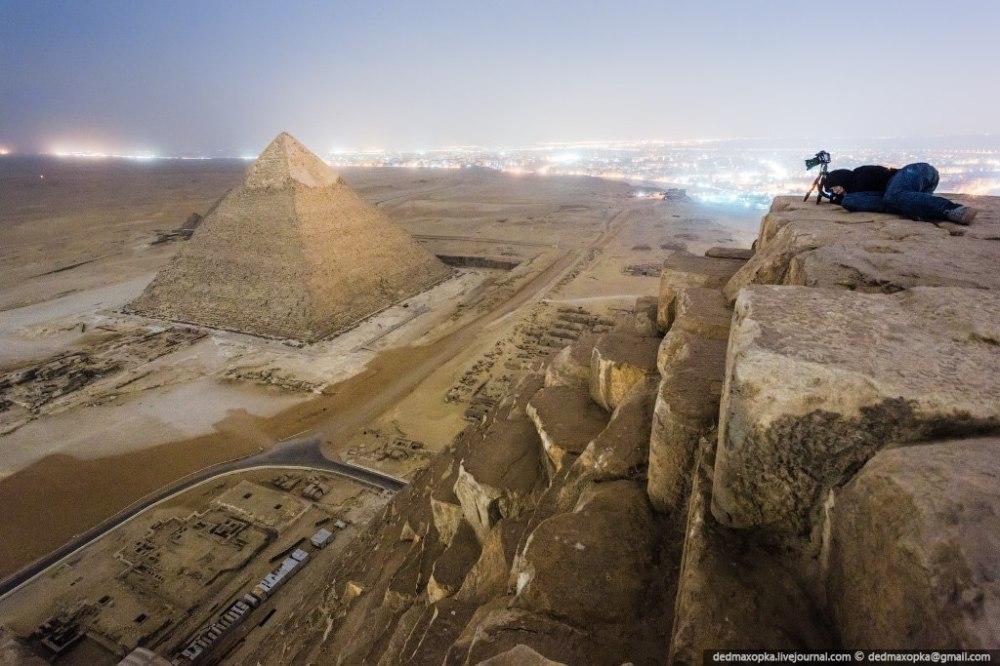
A German teenager found himself in hot water with Egyptian authorities after being arrested for climbing the Great Pyramid of Giza. Andrej Ciesielski scaled the legendary monument earlier this month in a daring daylight climb that amazingly only took him about 8 minutes to accomplish. Despite being spotted by police during his ascent, Ciesielski continued to the top of the pyramid to savor the once-in-a-lifetime view and document his incredible feat. Upon returning to ground level, the young man was arrested and could have faced up to three years in jail for the stunt. He was eventually released after agreeing to let authorities delete the footage and photos from his climb. Fortunately, Ciesielski had a way to recover the digital material and is now sharing the evidence of his awesome adventure with the world. 

One slip and it’s going to be a head-over-heels crash that could cause permanent damage.

Here are some photos of Russian adventurers who climbed the pyramid a few years ago.

pyramid
pyramid1

pyramid2

pyramid3

pyramid4

pyramid5

pyramids

After a hard day of pyramid climbing, go to the KFC and indulge in deep fried Goat Stew.  Available only at Egyptian KFC outlets.

pyramids2

Giant Flying Reptile Pterosaur

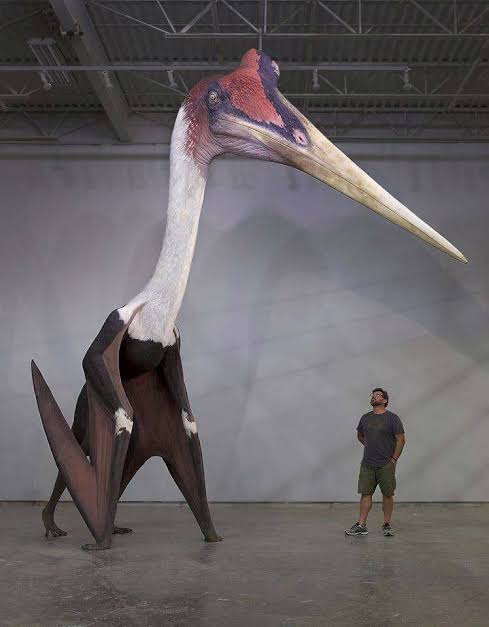
Quetzalcoatlus Northropi An Ancient Bird Next To A Human

Image running into this thing. Luckily no humans around when this beast was on the planet.

Quetzalcoatlus is a pterosaur known from the Late Cretaceous period of North America, it was one of the largest known flying animals of all time. Quetzalcoatlus is a member of the family Azhdarchidae, a family of advanced toothless pterosaurs with unusually long, stiffened necks. Its name comes from the Aztec feathered serpent god, Quetzalcoatl, in Nahuatl. The type and only species is Q. northropi.

The first Quetzalcoatlus fossils were discovered in Texas, United States, from the Maastrichtian Javelina Formation at Big Bend National Park (dated to around 68 million years ago in 1971 by Douglas A. Lawson, a geology graduate student from the Jackson School of Geosciences at the University of Texas at Austin. The specimen consisted of a partial wing (in pterosaurs composed of the forearms and elongated fourth finger), from an individual later estimated at over 10 m (33 ft) in wingspan.

When it was first named as a new species in 1975, scientists estimated that the largest Quetzalcoatlus fossils came from an individual with a wingspan as large as 15.9 m (52 ft). Choosing the middle of three extrapolations from the proportions of other pterosaurs gave an estimate of 11 m, 15.5 m, and 21 m, respectively (36 ft, 50.85 ft, 68.9 ft). In 1981, further advanced studies lowered these estimates to 11–12 m (36–39 ft).