Animals
Elephant in the room
BBC
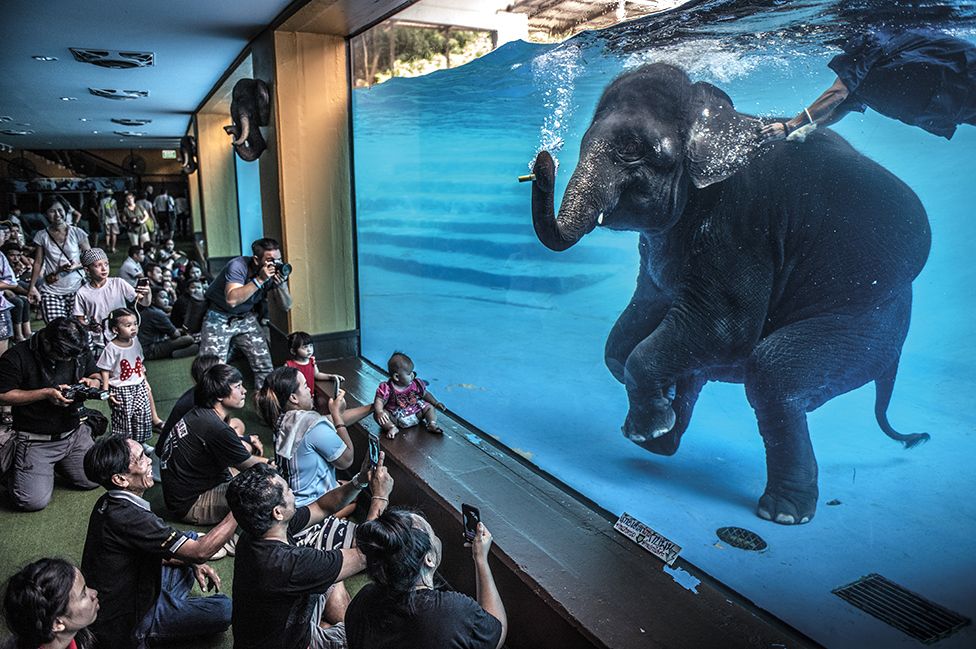
Adam Oswell wins the Photojournalism award for this picture which shows zoo visitors in Thailand watching a young elephant perform underwater. Elephant tourism has increased across Asia. In Thailand, there are now more elephants in captivity than in the wild.
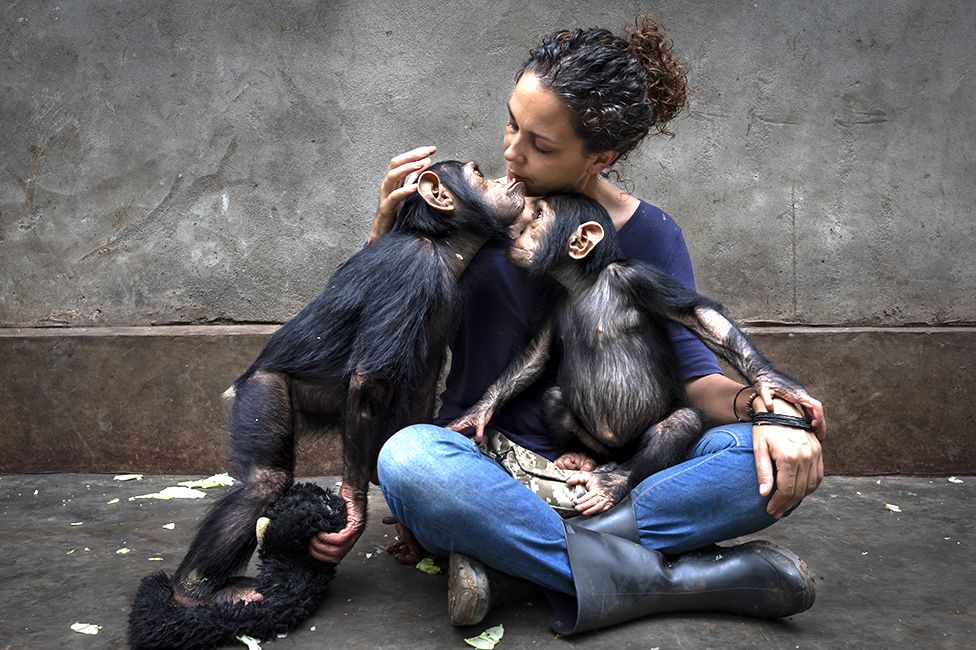
Brent Stirton was awarded the Photojournalist Story Award. His sequence of images profiles a rehabilitation centre caring for chimpanzees orphaned by the bushmeat trade in Africa. The director of the centre is seen introducing a newly rescued chimp to others in her care.
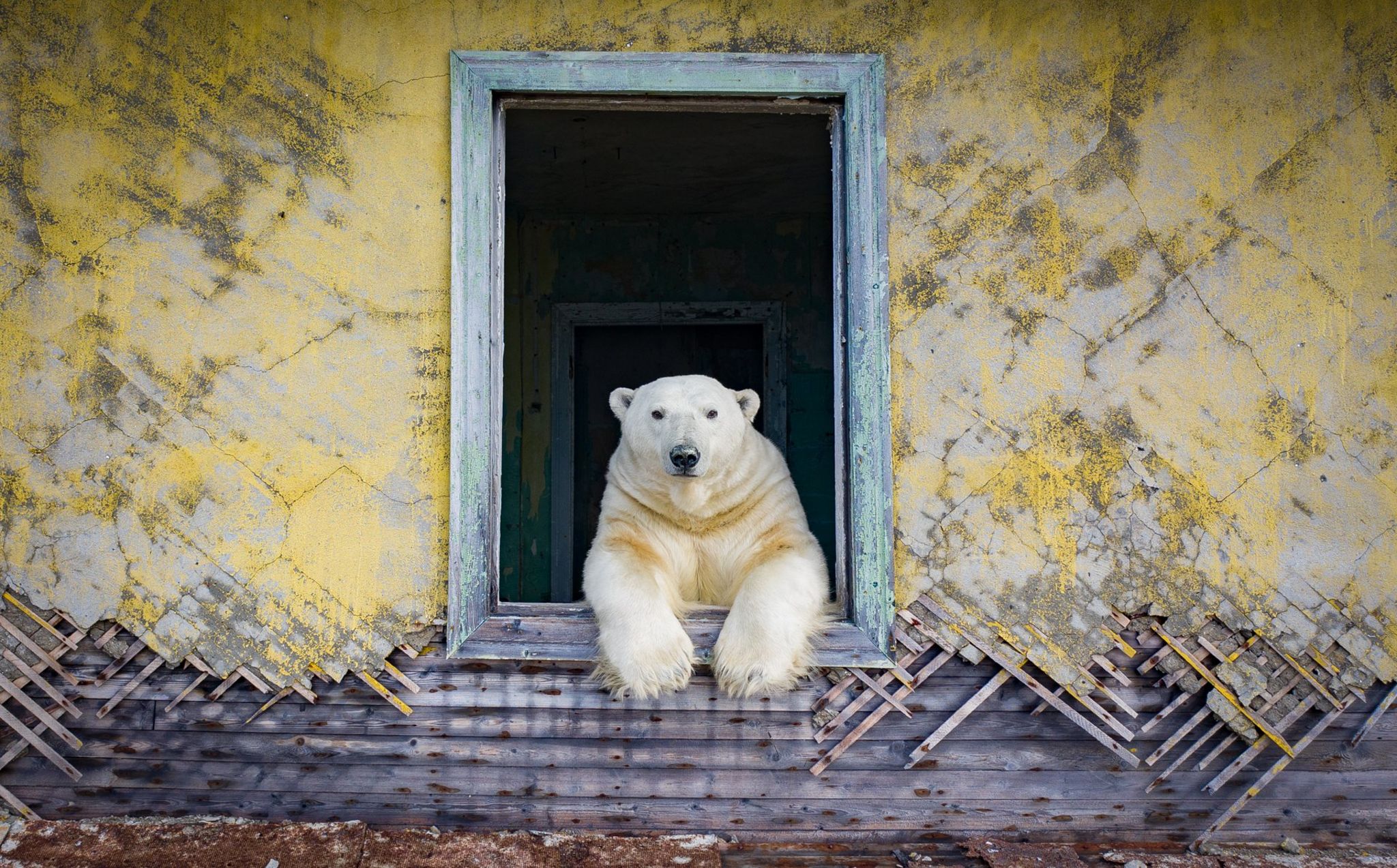
More than 20 polar bears took over Kolyuchin Island, Russia which has been abandoned since 1992, in search of food. With climate change reducing sea ice, polar bears are finding hunting more difficult, pushing them closer to human settlements to scavenge. A low-noise drone was used to capture the striking image.
Police pull over car with huge bull in passenger seat
Police in Norfolk, Nebraska pulled over a car for having a huge bull standing in its passenger seat.
The car had half of its roof cut off in order to fit the animal.
The man driving the car was given a warning by police, and was ordered to take the bull back home. No-one was injured in the process.
News Channel Nebraska overheard on a police scanner that officers would be attending the scene, so rushed out to capture the moment on camera.
The Ankole-Watusi derives from cattle of the Ankole group of Sanga cattle breeds of east and central Africa. Some of these were brought to Germany as zoo specimens in the early twentieth century, and from there spread to other European zoos. Some were imported to the United States, and in 1960 a herd was started in New York State by cross-breeding some of them with an unrelated Canadian bull. A breed society, the Ankole Watusi International Registry, was set up in 1983, and in 1989 a breed standard was drawn up. In 2016 the total number for the breed was thought to be approximately 1500 head, some 80% of them in the United States.
The Ankole-Watusi may be a number of different colors, but is usually red. The horns are unusually large, with a wide spread and the largest circumference found in any cattle breed. Guinness World Records lists a bull named CT Woodie with a horn circumference of 103.5 cm (40.7 in) and a steer named Lurch, with horns measuring 95.25 cm (37.50 in), as record-holders.

Lion wandering city streets in Pakistan
A gang of miscreants attempting to smuggle a lion through a Pakistani city saw their plan go up in smoke when the big cat escaped from their vehicle and wound up roaming the streets. The bizarre incident reportedly occurred on Tuesday evening during rush hour in Karachi. The normally bustling traffic in the city came to a screeching halt when motorists realized that they were sharing the streets with an out-of-place lion that had appeared out of nowhere. As one might imagine, the presence of the big cat sparked something of a panic among residents as one man was nearly attacked by the creature.
The lion managed to evade capture for approximately two hours until wildlife officials were able to drive the animal into a building where they finally subdued the beast. A subsequent investigation by police led them to five individuals who they determined had been responsible for the big cat being in Karachi that day. When questioned, they claimed that the creature was sick and that they were transporting it to a veterinarian when it somehow escaped from their truck. However, their alibi fell apart when cops noticed that their vehicle contained a distinctly different animal which cast considerable doubt upon their tale: an old tortoise.
The fact that the gang had been driving around Karachi with both a lion and a very large turtle in their truck led authorities to surmise that the men were in the midst of a smuggling scheme that went wildly awry when the big cat busted loose. Their assessment of the situation was seemingly confirmed when one of the suspected smugglers declared to authorities that “we do not want the lion. It can be handed over to anyone.” The big cat and its unlikely turtle companion have since been sent to the Karachi Zoo for safekeeping until wildlife officials determine how best to release them into the wild. The would-be smugglers, meanwhile, will likely be hit with significant fines if not jail time for the wild misadventure.
Sasquatch of the Corn
With the unrelenting wildfires in the forests of Canada this year, the elusive Sasquatch has had to move into safer locations. They are now prowling corn fields. Good place to hide, and lots of readily available food.

Incredibly Rare Spotless Giraffe Born at Tennessee Zoo
An incredibly rare spotless giraffe was recently born at a zoo in Tennessee and the wondrous creature is believed to be the only one of its kind in the world. The remarkable animal was reportedly born in late July at Bright’s Zoo in the city of Limestone. In announcing the peculiar creature’s arrival on Monday, they marveled that “giraffe experts believe she is the only solid-colored reticulated giraffe living anywhere on the planet.” The zoo’s founder, Tony Bright, recalled that the animal’s uniqueness was apparent from the moment of its birth as it clearly sported a coat of brown fur rather than the characteristic pattern of spots seen on nearly every other creature of its kind.
Following the arrival of the surprising-looking animal, zoo director David Bright said they began contacting other facilities “all over the country” to gauge just how unusual the creature might be and the response that they repeatedly received from seasoned professionals was that nobody had seen such a giraffe before. In fact, the only other record of a spotless version of the animal born in captivity occurred at a Japanese zoo in the 1970s. The zoo also performed blood work on the creature to ascertain if there might be some kind of illness that caused her curious condition, but the results indicated that it was perfectly healthy and no different from another giraffe that had been born at the facility a few weeks earlier.
Now standing a whopping six-feet-tall after just a few weeks, the spotless giraffe has seemingly seamlessly adjusted to life within her herd as the zoo indicated that the creature is “thriving.” The circumstances surrounding the animal’s birth are actually rather fortuitous, Tony Bright mused, as “in the wild, they use those spots for camouflage.” so the creature would have faced something of a perilous life had it been born in the wild. The zoo has yet to settle on a name for the animal and have opened up the process to the public by way of a vote on their Facebook page wherein people can choose among the four options of Kipekee, Firyali, Shakiri, and Jamella with the winner being announced on Labor Day.
Da Bears

Bear size comparison graph at bottom.


AMERICAN BROWN or GRIZZLY BEAR Ursus arctos horribilis snarling, July USA


Chinese Zoo Squashes Speculation That Its Bear is a Human in Costume
A zoo in China was forced to issue a statement squashing online speculation that one of its bears is actually a costume-clad human. The strange case reportedly began when a visitor to the Hangzhou Zoo filmed one of the creatures walking on its hind legs and interacting with people watching the animal. When the footage was posted on social media in China, several viewers observed that the bear’s fur sported strange wrinkles and that it also seemed to possess inordinately thin legs. Those physical characteristics quickly led to many theorizing that the zoo was pulling a fast one on patrons by way of featuring a human dressed up as a bear.
The rumors apparently became so rampant online that the zoo ultimately felt compelled to assure the public that the animal is genuine. Explaining that while the perception of bears is that they are “a huge figure,” the facility noted that the creature in question is actually a Malaysian sun bear, which is actually rather diminutive. A spokesperson for the zoo also noted that the area had been experiencing temperatures in excess of 100 degrees Fahrenheit and, as such, a costume-clad individual “would not last more than a few minutes before collapsing.” The online confusion is somewhat understandable as multiple facilities in China have been caught orchestrating similar ruses wherein they have tried to pass off dogs, donkeys, or even inflatable birds as ‘exotic animals.’
Now I think this one is definitely a man in a bear costume.
Stubbs the Cat who was Mayor

Stubbs (April 12, 1997 – July 21, 2017) was a cat who was the honorary mayor of Talkeetna, Alaska, from July 18, 1997, until his death.
Stubbs was described as a tourist attraction, having been flooded with cards and letters, and drawing 30 to 40 tourists each day (most of whom were en route to other Alaska destinations, such as Denali) who hoped to meet “the mayor”. His position was honorary, as the town is only a historic district.
Every afternoon, Stubbs went to a nearby restaurant and drank water laced with catnip out of a wineglass or a margarita glass.
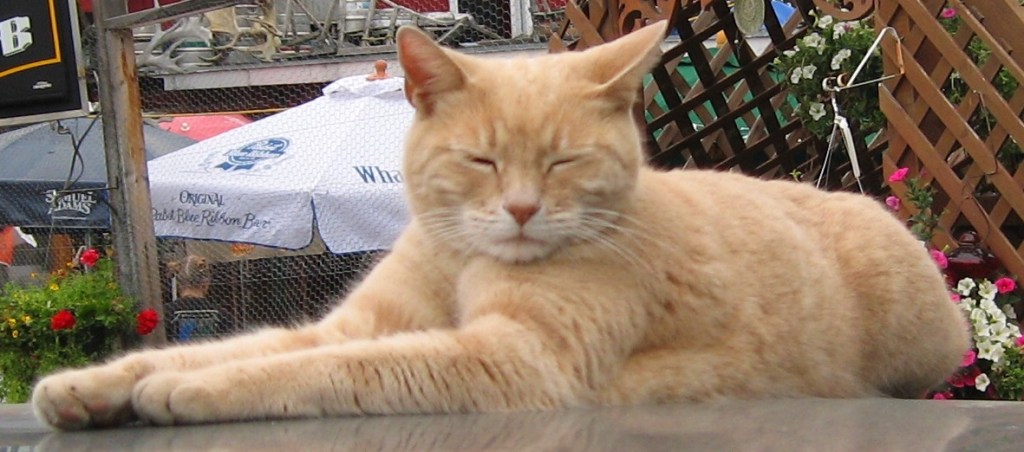
Stubbs died in 2017 at the age of 20.
In 1997, Lauri Stec, manager of Nagley’s General Store, found Stubbs in a box full of kittens in her parking lot. The owners were giving the kittens away; Stec chose “Stubbs” because he did not have a tail.
Stubbs was widely described as having been elected after a write-in campaign by voters who opposed the human candidates, but NPR pointed out that this could not have happened because “the tiny town has no real mayor, so there was no election.” Nagley’s General Store was used as Stubbs’s “mayoral office” during his tenure.
Stubbs was featured in an effort to protest the 2014 United States Senate election in Alaska when people urged voters to write Stubbs in on the ballot. Stubbs was featured in a video criticizing both the Democratic and Republican candidates for Senate.
One opinion writer for the Alaska Dispatch News insisted that the whole story was false, and that Talkeetna did not have a cat mayor.
In 2015, Stubbs was growing older and thus slowed down his public presence. He died on July 21, 2017. His owners said that “He was a trouper until the end of his life.” Stubbs lived to the age of 20 years and three months.
Stubbs’s owners have suggested that another family cat, Denali, may assume Talkeetna’s “mayoralty”.
Injuries
On August 31, 2013, Stubbs was attacked by a dog. He was placed under heavy sedation at a veterinary hospital 70 miles (110 km) away in Wasilla, having suffered a punctured lung, a fractured sternum, and a deep cut in his side. A crowd-funding page was set up to help pay his veterinary bills. Stubbs remained in the veterinary hospital for nine days before returning to the upstairs room of the general store. As a result, he was discouraged from roaming. Donations toward his care were received from around the world; the surplus was given to an animal shelter and to the local veterinary clinic.
Other incidents included Stubbs being shot by teenagers with BB guns, falling into a restaurant’s deep fryer (which was switched off and cool at the time), and hitching a ride to the outskirts of Talkeetna on a garbage truck.
‘I knew it was circling me’: Man attacked by shark was waiting to die, then dolphins saved his life
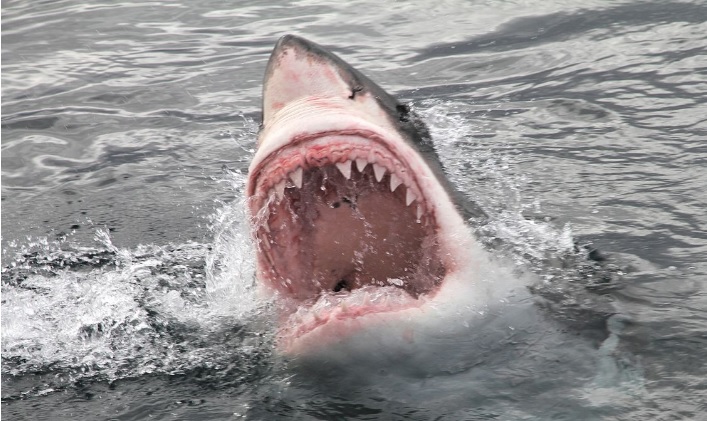
NatGeo Sharkfest episode focuses on stories of whales and dolphins saving people from sharks. But are they really trying to protect us?
Martin Richardson was swimming in the Red Sea in Egypt when he was attacked by a mako shark (Isurus oxyrinchus). He was bitten approximately five times and was waiting to die when something unusual happened.
“There was no reason for the shark to stop,” he said in “Saved from a Shark,” a new show from National Geographic. “I had lost approximately 5 pints [2.8 liters] of blood. You only have 8 to 9 [pints, or 4.5 to 5 L] in your body. I was waiting for a feeding frenzy… I knew it was circling me… I turned away and looked at the mountains. I gave up.”
At this moment, a group of dolphins appeared just behind Richardson, and the attack stopped. He was then pulled onto a boat that had been racing to get to him before the shark did and rushed to hospital, where needed more than 300 stitches. “I firmly believe the dolphins saved my life,” he said.
Do whales and dolphins really protect humans from sharks? “Saved from a Shark” — part of NatGeo’s SharkFest — looks closely at four cases where people were seemingly protected from the predators in the water.”Being saved by another animal is certainly a very romantic notion,” Tom Hird, marine biologist and shark conservationist, said in the program.

But it’s not so clear that’s what’s actually going on in most cases.
Mike Heithaus, professor in the department of biological sciences at Florida International University, said it’s unlikely dolphins were intentionally saving Richardson’s life.
“The dolphins see a big cloud of blood, they know a shark is in the area.” If they had young, they’d want to scare the shark away from the young. “They may not have been trying to save Martin,” he said in the show.
In another case explored in the film, Nan Hauser, director of the Cook Islands Whale Research, revisited the moment in 2017 when a humpback whale (Megaptera novaeangliae) she was diving with saved her from a huge tiger shark (Galeocerdo cuvier) that was stalking her. In footage shot during the encounter, Hauser is approached by the whale, pushed and then lifted onto its snout.
“[The whale is] looking at me and I know he’s got something to tell me,” she said in the program. “I do not understand. He wants me to understand. I look down into the deep blue. And I then I see [the tiger shark] right below me.
“I know — and the whale knows — this is a serious situation and I want to get out of the water. Then all of a sudden I was swooped up by the whale… now he’s got me right on the front of his face.”
The footage captured shows the whale engaging in a behavior similar to what it would do to protect a calf, Heithaus said.
Howether, Heithaus said the most unusual case was when a group of lifeguards swimming off the coast of New Zealand were encircled by a group of dolphins. Unbeknownst to the group, a great white shark (Carcharodon carcharias) was stalking them. “I’m used to having dolphins swimming alongside me, but this was totally different,” Rob Howes, one of the lifeguards in the water, said in the program.
One of the larger male dolphins charged towards him, and he then realized it was targeting the approaching shark. “Everything built to a big crescendo. Then everything went calm. The shark disappeared very quickly. It was bizarre.”
Heithaus said in most cases, whales and dolphins are probably not protecting humans for altruistic reasons — more likely they are trying to protect themselves or their young. But with the lifeguards in New Zealand, “this is one case where it really seemed like the dolphins were protecting people,” he told Live Science in an email.
 The MarkoZen Blog