Animals
Massive Dolphin Megapod Caught on Camera
Rare footage captured one of the largest groups of spinner dolphins ever filmed, known as a megapod, hunting flying fish in the Pacific Ocean off Costa Rica as part of PBS’s “Spy in the Ocean” nature miniseries. The team used a “spy dolphin” equipped with a camera and an animatronic bird drone to infiltrate and observe the dolphins. Known as the acrobats of the dolphin world, spinner dolphins can leap over 10 feet high out of the water and spin seven times in a single jump. The megapod communicated through clicks and whistles, and the gathering covered an extensive area both on the surface and underwater, consisting of thousands of dolphins at its peak. The use of spy cameras on animatronic animals provided a unique perspective on the dolphins’ behavior without disrupting them with large, obtrusive cameras.
Nightmarish deep-sea footballfish washes up on California beach in rare stranding
A deep-sea Pacific footballfish found on Moro Beach in Crystal Cove State Park is the second of this species to wash up in recent years, but the reason behind the strandings remains a mystery.

A ghoulish, pitch-black fish with a long stalk on its head recently washed up on a beach in Southern California — the second of its kind to end up onshore there in recent years, Crystal Cove State Park officials announced Oct. 17.
A ghoulish, pitch-black fish with a long stalk on its head recently washed up on a beach in Southern California — the second of its kind to end up onshore there in recent years, Crystal Cove State Park officials announced Oct. 17.
Experts identified the bizarre-looking animal as a female Pacific footballfish (Himantolophus sagamius), a species of anglerfish that lives in the Pacific Ocean at depths of 2,000 to 3,300 feet (600 to 1,000 meters). It follows an earlier stranding in May 2021, when a visitor at the state park discovered another fish of the same species on the shore.
“To see an actual anglerfish intact is very rare and it is unknown how or why these fish ended up onshore,” Crystal Cove State Park officials wrote in a Facebook post. “Their teeth, like pointed shards of glass, are transparent and their large mouth is capable of sucking up and swallowing prey the size of their own body.”
Pacific footballfish are one of more than 300 species of anglerfish living in the deep sea worldwide, according to the California Academy of Sciences. Female anglerfish can grow up to 24 inches (61 centimeters) long — about 10 times as large as some of their male counterparts, which have evolved to latch onto females and act as lifelong parasitic providers of sperm on-tap.
“Only females possess a long stalk on the head with bioluminescent tips used as a lure to entice prey,” park officials wrote in the post. The males of some species merge their bloodstreams with their host’s, “eventually coalescing with the female until nothing is left of their form but their testes for reproduction,” they added.
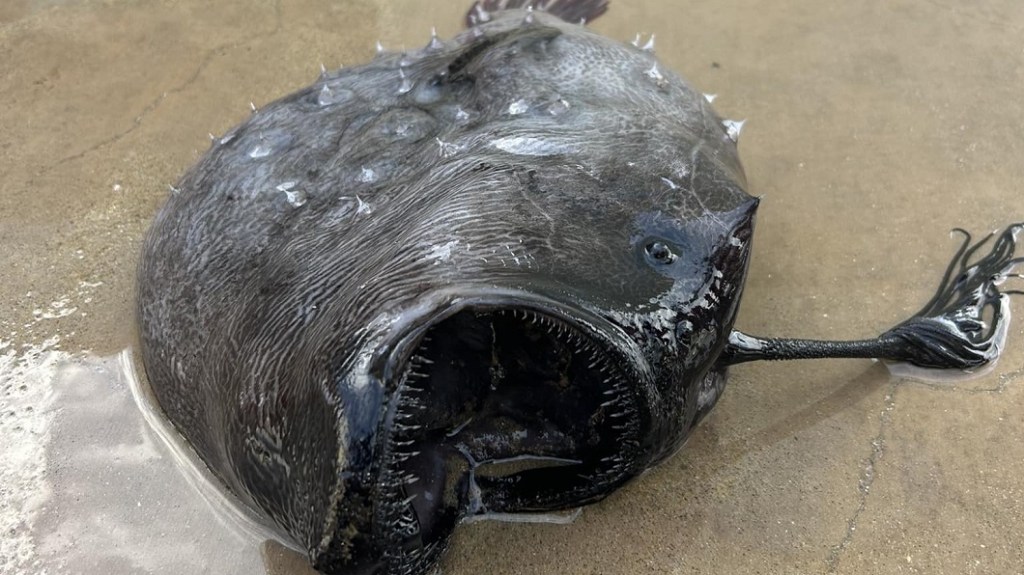
That is definitely one very Ugly fish.
A seasonal lifeguard discovered the dead anglerfish on Moro Beach close to the lifeguard headquarters, “just in time for Friday the 13th,” the officials wrote. It was later picked up by the California Department of Fish and Wildlife for analysis.
The specimen measured about 14 inches (36 cm) from mouth to tail fin, Michelle Horeczko, a senior environmental scientist supervisor with the Department of Fish and Wildlife, told the Los Angeles Times. Only 30 or so specimens of this species have been collected globally, she said, so the discovery will provide valuable information about the life of Pacific footballfish.
After examining the fish, scientists handed it over to the Natural History Museum in Los Angeles, where the Pacific footballfish discovered in 2021 is also housed, “so that the specimen can be preserved and available for scientific research,” Horeczko said.
While the reason for the stranding remains a mystery, “seeing this strange and fascinating fish is a testament to the curious diversity of marine life lurking below the water’s surface in California’s marine protected areas,” the Facebook post said.
Fat Cat in Edmonton goes swimming
A fat cat from Edmonton has made a splash on TikTok for his workout routine. Peaches the Purrmaid, weighing nearly 25 pounds, has been swimming in an effort to lose weight. During the pandemic, owner Chastity Emes attempted to get Peaches to accompany her on walks to drop the weight, but didn’t have much luck. “I had a harness for him and tried to get him out of the condo, and we didn’t make it out of our hallway because he just kind of flopped over and decided it wasn’t going to happen,” Chastity Emes, Peaches’s owner. With walks not being an option, Peaches took up swimming as part of her weight loss journey. Mason DePatie has that story.
Bigfoot Filmed From Train in Colorado?
An intriguing video filmed from a passenger train in Colorado shows a curious bipedal creature that some believe to be Bigfoot lurking on a mountain. The remarkable footage came to light this week by way of Shannon Parker, who explained to a local media outlet that the sighting took place on Sunday as she and her husband, Stetson, were riding on the Narrow Gauge Railroad which connects the communities of Durango and Silverton. As the trip was winding down, the couple looked out the window of the train and were stunned to see what appeared to be a creature walking along a mountainside on two feet before squatting down in some brush.
Fortunately, the couple were not the only passengers to see the possible Sasquatch as a man sitting next to them also observed the peculiar creature and managed to film it with his cell phone. According to Shannon, she later showed the footage and some pictures from the sighting to workers on the train and they had no explanation for what the oddity on the mountainside could have been. “When we spoke to the conductor on the train he told us he hasn’t ever seen anything like it before,” she recalled to Newsweek, “and he himself has experienced unexplainable things while snowshoeing in those mountains.”
Since being posted online, the footage has spread like wildfire with many marveling at how clear it is in comparison to the average purported Bigfoot video. That said, response to the sighting has been largely mixed with some suggesting that the creature in the scene is a genuine Sasquatch, while more skeptical observers have posited that perhaps it was some kind of prank either orchestrated by the train company or a mischievous individual hoping to pull a fast one on the passengers.
Grazer is third female winner of Fat Bear Week
By Madeline Halpert
BBC News, New York
The wait is over. After a highly anticipated week of competition, voters have crowned a new winner of Fat Bear Week.
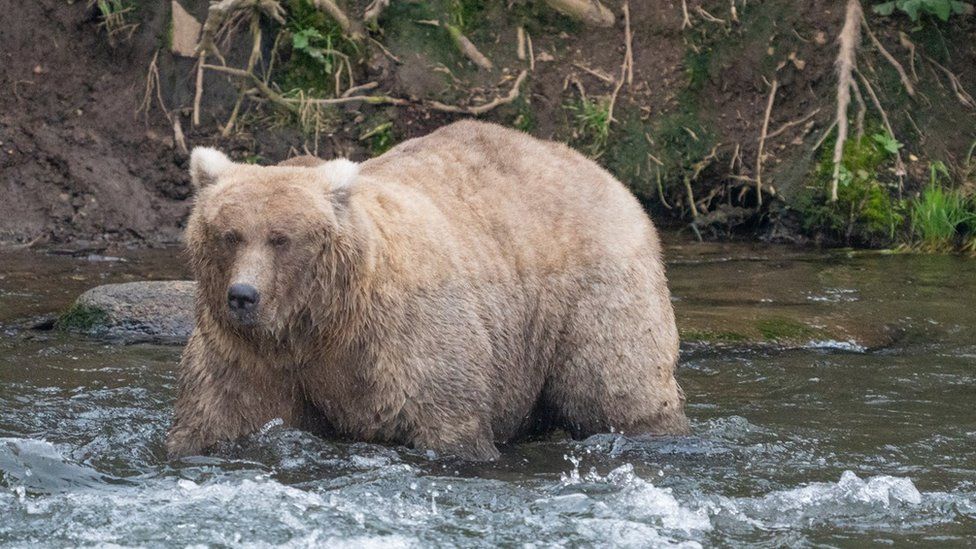
They chose 128 Grazer, a defensive mother bear and first-time winner of the sought-after title.
She beat second placed 32 Chunk, a larger bear, by more than 85,000 votes.
“The gutsy girl grounded the guy with a gut,” the Alaska Katmai National Park & Preserve, which hosts the event, said in a tweet.
“32 Chunk, proved his prominent posterior was worthy of a whopping win. But in the end, Chunk got Grazered,” the park service added.
Fat Bear week, an online event founded in 2014 by former park ranger Mike Fitz, has become an internet sensation, attracting millions of viewers each year.
Each year, fans pick their favourite of 12 plump brown bears from Alaska’s Katmai National Park that have gathered along the Brooks River to chomp on salmon and pack on as many pounds before winter.
This year, Grazer received a whopping total of 108,321 votes, according to Explore.org, which tracks the contest for the park service.
A large mother to two litters of cubs with a long muzzle and “conspicuously blonde ears”, Grazer is one of the fattest bears to hunt for salmon in the Brooks River, the National Park Service said.
She was introduced to the area as a young cub in 2005, and has since become one of the most successful fishers on the waters.
“She can chase down fleeing salmon in many parts of the river or patiently scavenge dead and dying salmon after they spawn,” the National Park Service said.
She has guts, too. The National Park Service said Grazer often preemptively confronts and attacks much larger and more dominant male bears to ensure her cubs’ safety.
This year, she beat two favourites for the title: 480 – aka Otis – a 27-year-old brown bear weighing roughly 1,200lb, and 747 – or Colbert – a two-time Fat Bear Week champion weighing about the same.
Her final rival, Chunk – a large adult male with a low-hanging belly – has come out of his shell in recent years, growing from a fairly deferential bear to one of the river’s largest and most dominant males.
Still, he proved no match for Grazer, whose “combination of skill and toughness makes her one of Brooks River’s most formidable, successful, and adaptable bears”, the National Park Service said.
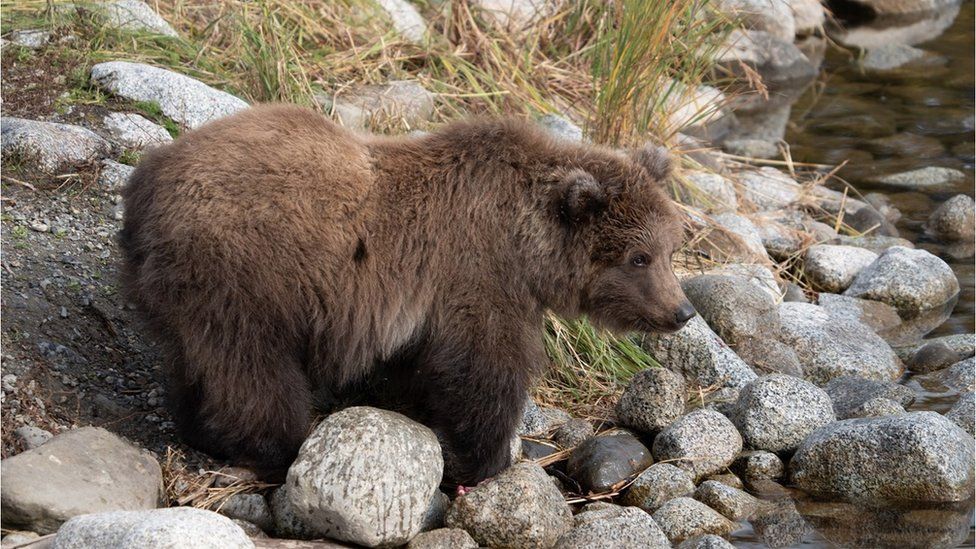 IMAGE SOURCE,NPS PHOTO / F. JIMENEZImage caption,
Can the newcomer make his mark? Bear 806 Jr is less than a year old, but shows significant promise (and fluff)

Grizzly Bears Follow Hikers
Oh the urge to run would have been intense.
 The MarkoZen Blog