PotSquatch with really bad hair conditioner stumbles upon TV report

A Massachusetts TV station’s live report from Thursday’s massive storm featured as surprise guest as ‘sasquatch’ stumbled upon the scene.
Standing in downtown Springfield, meteorologist Jennifer Pagliei attempted to report on the conditions in the city, but viewers were likely more transfixed by the costume-clad ‘creature’ that appeared behind her.


In a remarkable display of professionalism, Pagliei barely missed a beat when she noticed the abominable snowman ambling nearby.
As one might expect, the scene became somewhat of a viral sensation after it was shared on social media.
Beyond a bit of good fun, the ‘Bigfoot’ appearance apparently came from a Yeti with a message as it was revealed that the prankster was, in fact, ‘Potsquatch,’ the mascot for a marijuana supply store in Massachusetts.
This also answer may answer the question of what would possess someone to don a full body creature costume and dash around during a snowstorm.

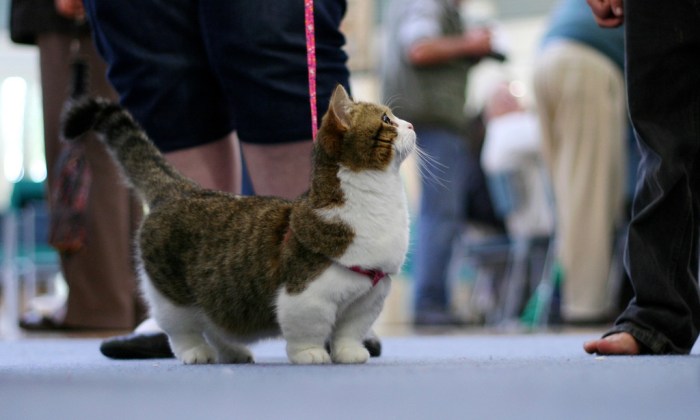
The Munchkin Cat

munchkin1

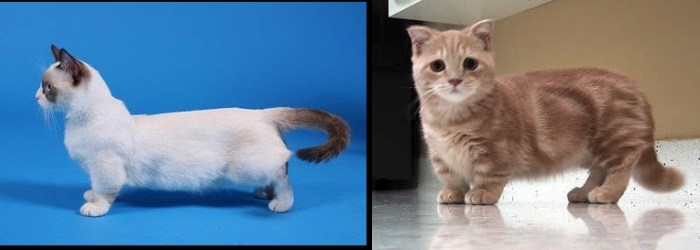
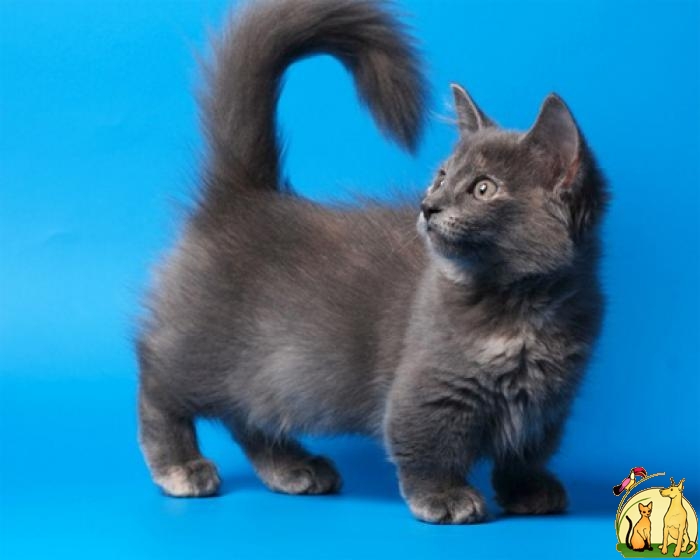
The Munchkin is a relatively new breed of cat characterized by its very short legs, which are caused by a naturally occurring genetic mutation. Much controversy erupted over the breed when it was recognized by The International Cat Association in 1995 with critics voicing concern over potential health and mobility issues.

Short-legged cats have been documented a number of times around the world since the 1940s. A British veterinary report in 1944 noted four generations of healthy short-legged cats which were similar to normal cats except for the length of the legs. This line disappeared during the Second World War but other short-legged cats were spotted in Russia during 1956 and the United States in the 1970s.

In 1983, Sandra Hochenedel, a music teacher in Louisiana, found two pregnant cats who had been chased by a bulldog under a truck. She kept one of the cats and named her Blackberry and half of her kittens were born short-legged. Hochenedel gave a short-legged male kitten from one of Blackberry’s litters to a friend, Kay LaFrance, and she named the kitten Toulouse. It is from Blackberry and Toulouse that today’s Munchkin breed is descended.

munchkinyy

The Munchkin is generally described as a sweet-natured, playful, people-oriented, outgoing and intelligent cat which responds well to being handled. The shortness of their legs does not seem to interfere with their running and leaping abilities.
The Munchkin has similar characteristics to normal domestic cats, due to their frequent use as out-breeding It is a small to medium-sized cat with a moderate body type and medium-plush coat. Male Munchkins typically weigh between 6 and 9 pounds (3–4 kg) and are usually larger than female Munchkins, which typically weigh between 4 and 8 pounds. The hind legs can be slightly longer than the front which creates a slight rise from the shoulder to the rump.

munchkin2

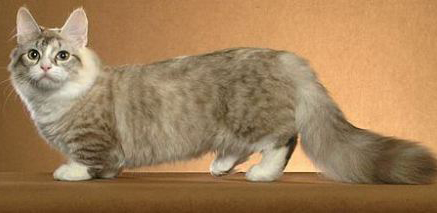
The Munchkin has been crossed with the curly-coated LaPerm to create the Skookum, the hairless Sphynx to create the Minskin and Bambino, with the extremely curly-coated Selkirk Rex to produce the Lambkin, the Persian breed group which includes Himalayans and Exotic Shorthair, to create the Napoleon and crossed with the Bengal to create the Genetta.

munchkin-cat6

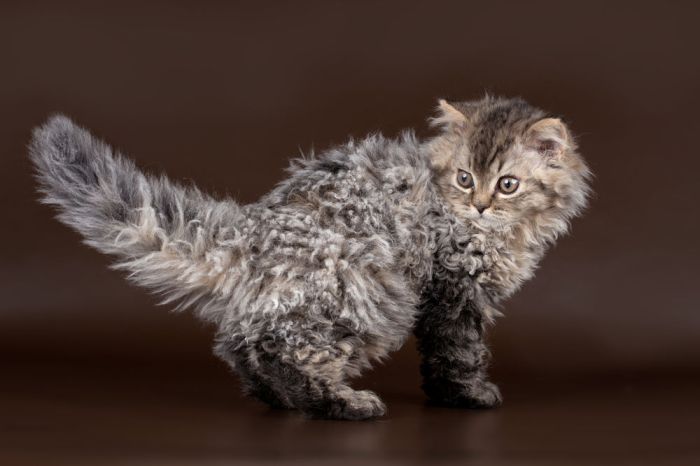
Selkirk Rex

Selkirk Rex On Brown Background

The Elegance and Symmetry of Diving Pigs

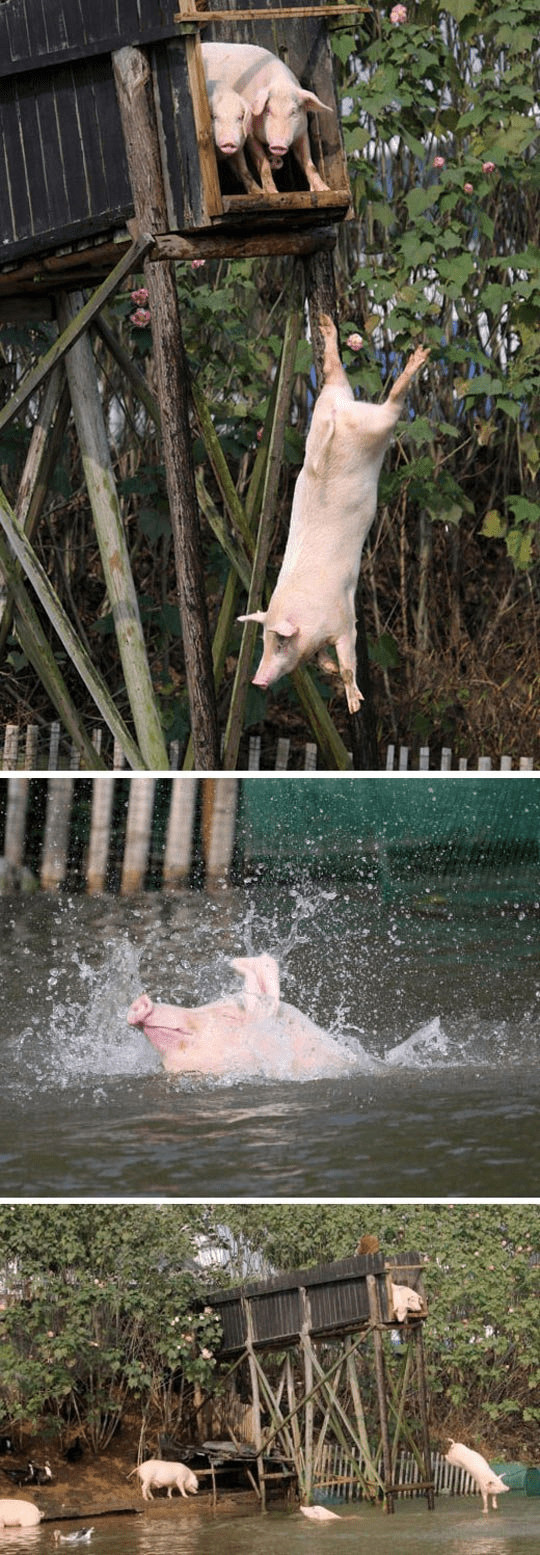
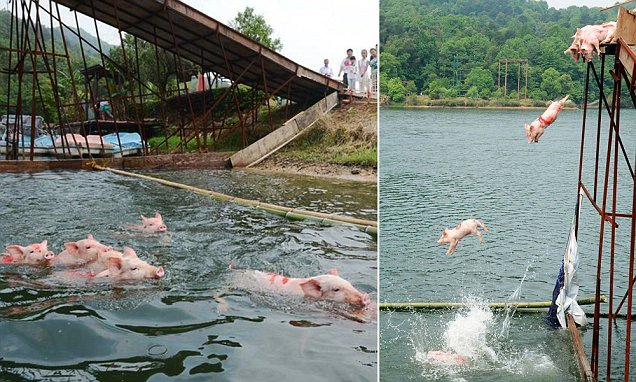
Swine across China are jumping or being shoved off platforms and splashing into pools and ponds, where they bob around before paddling to shore.
Images on the Internet and reports in newspapers suggest that creating a leaping, amphibious pig is another realm where China, which raises more than half the world’s pigs, can claim global pre-eminence. Online photos show piglets prodded to dive off a bridge into a lake. Others show a spotted-pig triathlon of diving, swimming and hurdling.
Aquatic swine are not exclusive to China. Australia has a family with diving pigs, and in the Bahamas you can frolic in the surf with them. But China’s rural entrepreneurs have turned the pursuit into a tourist draw and a selling point for pork. Proponents say that diving pigs are healthier, leaner and tastier.

hogs

“We wanted to make the pigs grow healthier, because usually they’re too lazy,” said Zou Wei, a manager in the planning department of Tuhe Black Pork, a company in Shandong Province that puts some of its hogs through a routine of diving and swimming. “To start with, the pigs don’t like it, but you force one onto the diving platform and it slides down, the others see that and follow.”

The Piggy Kingdom Family Amusement Park in Zhejiang Province has taken the amusement factor to new heights. Pictures and video from the park show pigs being heaved off a platform and thrashing in the air until smacking into water 39 feet below. That’s about six feet more than the tallest Olympic diving platform.

“The Piggy Amusement Park is a bit smelly,” one visitor said, according to a report on the local government’s website. “But the piglets were cute diving into the water and the kids loved it.”

hogs1

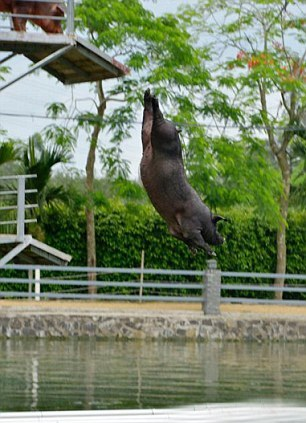
This dark-haired porker has the technique down pat.

hogs2

hogs3

Judges give this red-haired piglet tens all-around!

As with human athletes, it’s a matter of mind-set, said Yang Shiliu, a former researcher in the Hunan Animal Husbandry and Veterinary Institute, who is considered one of the foremost experts on pig diving.

“The occasional divers will be hesitant,” Mr. Yang said in a telephone interview from Changsha, the capital of Hunan Province in southern China. “Once they’re used to it, they don’t mind.”

Besides, he said, pigs are more adept at swimming than other athletic activities. The Salon pig-breeding company in Hunan considered making pigs jog for exercise, he said, but found that their trotters were too dainty for their bulky bodies. Moreover, he said, “aquatic exercise is a bit more intense.”

Some people have been appalled by the spectacle of pigs being pushed into ponds. “Making pigs dive into water is abusing them,” one person said. “Our citizens have no heart.”

Animal rights advocates, however, have been restrained in their criticism. Jeff Zhou, a China representative for Compassion in World Farming, which campaigns against animal abuse, said pigs in China’s factory farms suffer worse fates than diving, including castration without anesthesia and immobilization in sow stalls and farrowing crates.

But platform diving was not necessarily a pig’s idea of fun, he added.

“It can bring a certain kind of stress to them at the very beginning,” he said. He said farmers should base exercise regimes “on the needs of animals, not the amusement of humans.”

Pig-diving proponents insist that they are doing both.

Groundhog Manitoba Merv sees his shadow and predicts six more weeks of winter, worse yet, Merv is a Dang Puppet!

merv

Just after sunrise, Manitoba Merv, the rodent forecaster at Oak Hammock Marsh Interpretive Centre made his Groundhog Day prediction, and it’s grim.

Merv saw his shadow, so Manitobans will have another six weeks of winter.

Oak Hammock Marsh staff say Merv’s predictions have been amazingly accurate.

For the past 23 years, Manitoba Merv has correctly predicted the arrival of spring and only made one error.

The groundhog may well be correct about this year’s prediction. Six weeks from now is mid-March, which is typically when the first geese return, Oak Hammock Marsh staff say.

mervv

I don’t trust groundhogs anyway, or gophers and badgers for that matter. All they’re doing is guessing. And more and more the guessing is being made by puppeteers.

mervz

Moose Populations

aamoose

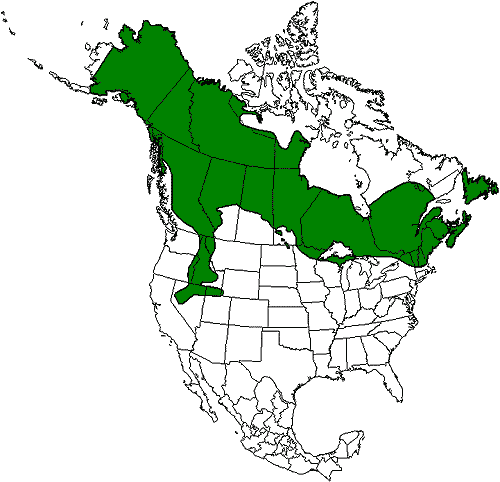
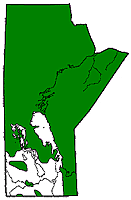
Moose are found throughout the province of Manitoba ranging south from the U.S border, north to the Nunavut Territory. Until recently, there has been only an occasional report of moose in the prairie region of southern Manitoba, but populations have now become established in the Pembina and Souris River Valleys. They are also found in Spruce Woods Provincial Forest and Turtle Mountain Provincial Park in southwestern Manitoba from where they were absent until as late as the early 1970’s.

moose_na

The moose population in Manitoba is about 27,000 animals. Populations in accessible southern areas are at lower than desired levels. The demand for consumptive use of moose continues to exceed supply in the more accessible areas. Discussions with user groups regarding moose population recovery are ongoing. First Nations, Métis and licensed hunters actively harvest the moose. Equitable distribution of sustainable harvest, providing opportunity for all stakeholders, will require constructive consultation.

As additional forestry and recreational development occurs east of Lake Winnipeg and north and east of The Pas, more intensive management will be required to ensure that the moose population can be maintained.
moose_prov

Populations
North America:
In Canada : There are an estimated 500,000 to 1,000,000 moose with 150,000 in Newfoundland in 2007 descended from just four that were introduced in the 1900s.

In United States : probably around 300,000, as follows:
Alaska: The state’s Department of Fish and Game estimated 200,000 in 2011.
Northeast: A wildlife ecologist estimated 50,000 in New York and New England in 2007, with expansion expected.
Rocky Mountain states: Wyoming is said to have the largest share in its 6-state region, and its Fish and Game Commission estimated 7,692 in 2009.
Upper Midwest: Michigan estimated 433 (in its Upper Peninsula) in 2011, Wisconsin Department of Natural Resources 20–40 (close to its UP border with Michigan) in 2003, Minnesota 5600 in its northeast in 2010, and under 100 in its northwest in 2009; North Dakota closed, due to low moose population, one of its moose-hunting (geographic) units in 2011, and issued 162 single-kill licenses to hunters, each restricted to one of the remaining nine units.

Europe and Asia:
Finland : In 2009, there was a summer population of 115,000 moose.
Norway : In 2009, there were a winter population of around 120,000 moose. In 2015 31,131 moose were shot. In 1999, a record number of 39,422 moose were shot.
Latvia : in 2015, there were 21,000 moose.
Estonia : 13,260 individuals
Poland : 2,800 individuals
Czech Republic : maximum of 50 animals
Russia : In 2008, there were approximately 730,000 moose.
Sweden : Summer population is estimated to be 300,000–400,000 moose. Around 100,000 are shot each fall.

Manitoba Moose (hockey mascot)

amoose