Zippy The Performing Chimp 1955
Here is something that would make the SPCA and Humane Society of today cringe in utter agony.


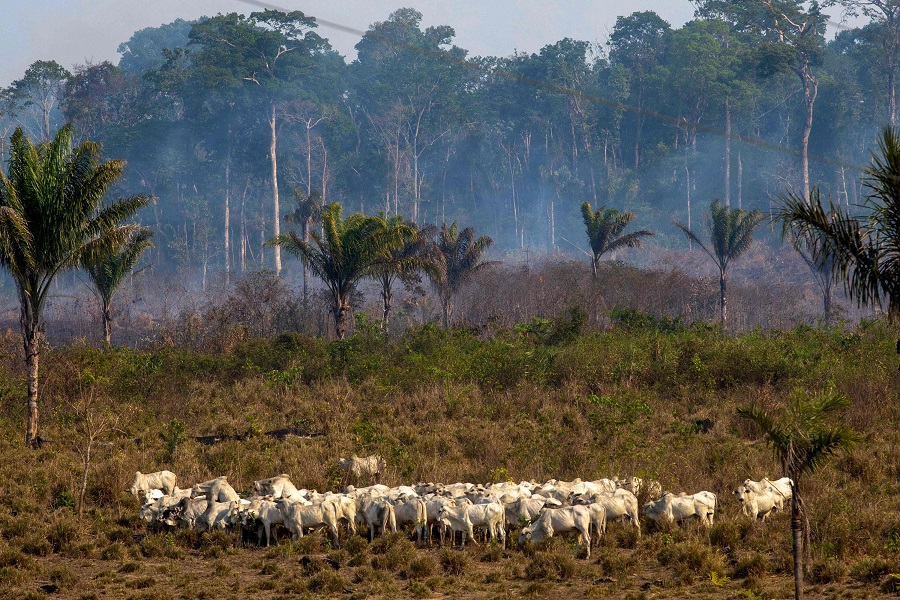
The world cattle inventory in 2020 was reported at 987.5 million head.
India has the largest cattle inventory in the world in 2020 followed by Brazil & the United States. Roughly 65% of the world’s cattle are in India, Brazil & the United States. (The cattle inventory in India includes water buffalo).




It’s the kind of beast Steven Spielberg might feature in a movie. Villagers in Bunawan township in the Philippines celebrated what they hope is the end of a reign of terror when they captured a 21 feet long, 2,370 pound crocodile. Two years ago, a child was eaten by a crocodile that was never caught. Since July, a fisherman went missing, and a croc is a prime suspect. Villagers also reported that they saw a crocodile kill a water buffalo this summer. But this week, using steel cable traps and an animal carcass as bait, they caught the beast and it’s the largest crocodile ever to be taken alive. It took nearly 100 people to haul the monster from a creek, then a crane to lift it into a truck. While this capture may set Guinness Book records, there are still an estimated 250 such giant freshwater crocodiles still in the wild and roughly 1,000 of the saltwater variety. So perhaps they shouldn’t celebrate too quickly. And don’t forget Spielberg’s classic film Jaws in which the residents of a town terrorized by a great white shark rejoice when one of the creatures is killed, only to learn a harsh lesson later — -the real culprit was still out in the water. We hope the real life story has a better ending.

The giant squid has never been captured alive. These enormous sea creatures — scientists estimate that they may grow to be as much as 45 feet long and weigh up to a ton — occasionally wash up on shore but are more often found by deep sea fishermen who accidentally catch them in their commercial trawl nets. Giant squids have eight thick arms and two longer tentacles. Their eyes can be as much as 10 inches in diameter. In 2004, Japanese scientists successfully photographed a live squid nearly 3,000 feet underwater off the coast of the Ogasawara Islands. And here’s a fun thought: these inky cephalopods might be the true objects of sailors’ terror-filled tales or misguided affections, as sightings of merpeople and sea monsters date back hundreds of years. The most famous fictional incarnation of this legendary animal can be found in Jules Verne’s novel Twenty Thousand Leagues Under the Sea in which the crew of the Nautilus does battle with a nefarious giant squid that has tentacles as long as the ship itself. Actually, now that we think about it, maybe it’s better that live squids don’t surface very often.

Arachnophobes, take this opportunity to look away, because the Goliath Birdeater Tarantula might be your biggest fear. As the largest spider in terms of mass, the Goliath Tarantula can grow up to nearly a foot across, weighing in at more than six ounces, with fangs that are over an inch long. Native to the remote rain forests of South America, this tarantula was named based on reports from explorers who claimed to see one eating a hummingbird. But while their scale can prompt them to seek out this type of large prey, for the most part, the Goliath primarily feeds on insects and other invertebrates, which it traps using its silk web and kills with its fatal venom. Despite their creepy appearance and vicious reputation, however, the tarantula’s bite is no worse than a wasp sting to humans, and to date there have been no reports of human fatalities due to this arachnid. Not like that makes us want to cuddle up to the Goliath anytime in the foreseeable future.

Don’t let its appearance fool you. That blob floating in the ocean is far from innocuous and it isn’t a jellyfish. As the name implies, the Portuguese Man-of-War isn’t a nice beast to meet in the ocean, as roughly 10,000 people swimming off the Australian coast discover each year. The creature is actually a “colonial organism” made of multiple polyps, the largest, a bladder filled with gas that is similar to the atmosphere, is often mistaken for a jellyfish — and it gives the animal it’s name since the bladder looks like the sail of an old Man-of-War battle ship). The other three polyps, gastrozooid (feeding), gonozooid (reproduction) and dactylozooid (defense), are clustered around the
bladder. The dactylzooids compose tentacles that can be more than 150 feet in length. Tiny fish can live in the tentacles, but when a human or larger fish is stung, the venom leaves red welts that can last multiple days. The recommended treatment is to apply salt water to the sting. Unlike jelly fish, vinegar is not recommended as a treatment, and contrary to old wives’ tales, urine is not a recommended treatment for a jellyfish or a Man-of-War. Let’s just say that avoiding this animal all together is the best defense.

Why pick one gigantic, ugly fish when you can pick three? First up is the rarely seen oarfish, an eel that is the Guinness Book of World Records holder as the longest bony fish in the world. Oarfish — really a family of several species — can grow to as long as 56 ft. in length. While they usually live in deep water, they can sometimes float to the surface when dying — a habit that’s caused them to be mistaken for mythical sea serpents. The Brazilian arapaima is the biggest freshwater fish on the planet — they can reach 14 ft. and tip the scales at morethan 400 lbs. Unfortunately for their survival, arapaima are also very tasty — the species is threatened by overfishing. That’s not something the very nasty giant snakehead has to worry about, though. The Southeast Asian river fish is pretty big, but it’s also extremely aggressive, attacking anything that might threaten its young — including human beings. The snakehead can walk on land with its soft pectoral fins, and even breathe air for a little while. Don’t make one mad — it will find you.

These guys definitely win for the least scary name, but the box jellyfish is proof that some of the most innocent-looking things can actually be incredibly dangerous — sort of like Justin Bieber. The fearsome box jellyfish or sea wasp can be found in the tropical Indo-Pacific, and their tentacles, each of which contain about 5,000 stinging cells, pack a serious punch. Box jellyfish poison is among the most toxic in the world, attacking the heart and nervous system. The pain from a sting is apparently so great victims beg to have the poisoned limbs amputated, and can sometimes simply go into heart failure because of the agony. Oh, and they’re also nearly translucent, meaning swimmers can collide with them unaware. Your best bet might be to make friends with a sea turtle — they’re impervious to the box jelly venom, and love to eat the spongy creatures.

There are a lot of ways to get on this list: be super poisonous, be super scary or just be nasty looking. But the Burmese python does it the old-fashioned way — it’s just really, really big. The constrictor is one of the largest snakes in the world, usually growing up to 25 ft. and some 200 lbs, but there have been pythons as long as 50 ft. and as heavy as 1,000 lbs. And the snakes put that bulk to good use — they grab their victims with sharp teeth, wrap themselves around their target and simply squeeze. After their lunch has suffocated, the pythons swallow them whole with super-stretchy jaws. Fortunately, Burmese pythons rarely attack human beings, and thanks to habitat loss in the Southeast Asian jungle, the snakes are actually now a threatened species. So they should be more afraid of you — though if you meet one in a dark corner of the rainforest, somehow I doubt that’ll be the case.


With over 5,000 eye-witness accounts, tens of thousands of documented footprints, recorded vocalizations and some video, photo and film evidence the Sasquatch creature is a either a grand legend, or a blood and bones entity. Sane people report seeing the creature close up. And they say it is not a bi-pedal bear or a guy in a gorilla suit. It is a big, smelly ape that walks on 2 legs. But damn can this thing hide. Eventually one is going to eat some rotten berries and get disoriented, then it may stagger onto a hilly highway, and some big rambling semi truck is going to nail it dead on. Then the skeptics won’t know what to say.
As far as anybody knows the Sasquatch hasn’t killed any human beings. Although Teddy Roosevelt wrote about an incident in Montana in the 1910’s where a mountain man was stalked by a Bigfoot. His badly beaten body was found by two trappers some time later. Farmers and ranchers have reported missing chickens and sheep shortly after a Sasquatch was observed in the area.
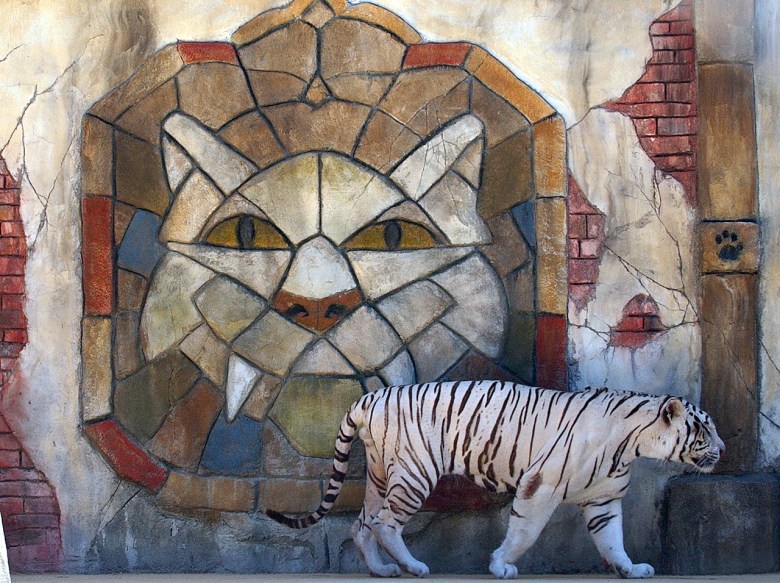
Although many big cats, like their diminutive domestic cousins, are none too fond of soggy fur and wet whiskers, tigers positively thrive in the water, and are often found enjoying a bath in rivers and ponds. Far from shunning water, the biggest of the big cats actively seek it out, with cooling temperatures a perfect tonic to the extreme heat of the day in much of Asia. Tigers are also powerful swimmers, capable of travelling up to 4 miles in the water and commonly seen carrying their kills across lakes.

So much for the swimming skills of tigers in the wild, but what about those of the creatures that find themselves in the arms of captivity? Well, the same rules apply, except that man-made bodies of water become each beast’s watering hole, and there are probably one or two more spectators than these naturally shy cats would prefer. Not so in the case of Odin, though, the famous white Bengal tiger living in Six Flags Discovery Kingdom Zoo in Vallejo, near San Francisco.

Odin seems purr-fectly suited to the watery stage and can be watched in action diving daily for his meals in a large pool with glass walls – built to allow visitors to watch him gliding through the water with, says one British newspaper, “all the grace of a polar bear”. Now 8 years old, Odin has been making a spectacle of himself for quite some time, and with his pictures pasted all over the Web, this superlative swimmer’s popularity shows no signs of waning.

Odin was hand-reared at the zoo and once weaned, his trainer Lee Munroe soon discovered his talent for jumping in after chunks of meat thrown into a pool of water. Like other tigers – apart from the vegetarian variety – Odin loves the taste of fleshy goodness probably even more than he does a cool dip in the afternoon. But by no means every big cat will dive and swim underwater – even for meat treats – and that includes other tigers and jaguars, who also like the water.

Clearly Six Flags saw an opportunity for making their already exceptional looking white Bengal tiger even more of a crowd pleaser. Ten-foot long from nose to tail, and with the super sharp claws and teeth of all tigers, Odin is in many ways like others of his kin. The only major difference of course is that he is white. Neither an albino nor a distinct subspecies, the white tiger is a tiger with an unusual genetic combination – a recessive gene – that creates its pale coloration.

White tigers are incredibly rare in the wild, the last one seen there having been shot in 1958. There are dozens in zoos, but with the inbreeding of these popular beasts to preserve their special trait, white tigers are more likely to be born with physical defects such as cleft palates and curvature of the spine. That said, the future looks bleaker still for the species as a whole, as an estimated world population of 100,000 tigers at the start of the 20th century has shrunk to about 2,000 in the wild.

As we face up to the tragic possibility that within our lifetimes, zoos might be the only places left to observe these majestic animals, one final word about Odin to lighten the mood. Lest the tiger-phobes demonise him for his frightening expressions, it seems the funny faces he pulls are actually to stop water from going up his nose. Awww. Is an oversized clothes peg out of the question?

Odin, the beloved and popular 17-year-old white Bengal tiger at Six Flags Discovery Kingdom in Vallejo, has died, park officials confirmed.
Suffering from chronic arthritis and pain, Odin was humanely euthanized on Monday about a week shy of his 18th birthday, said Lee Munro, an animal ambassador at the park.
“It’s very hard for me and very hard for the entire park,” Munro said by phone Tuesday about Odin’s death. “I was Odin’s sidekick and helped raise him from when he was two weeks old.”
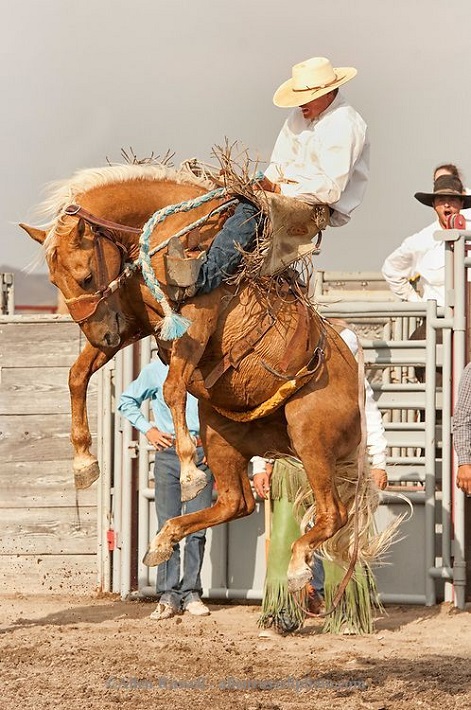
Rodeo is a competitive equestrian sport that arose out of the working practices of cattle herding in Spain and Mexico, expanding throughout the Americas and to other nations. It was based on the skills required of the working vaqueros and later, cowboys, in what today is the western United States, western Canada, and northern Mexico. Today, it is a sporting event that involves horses and other livestock, designed to test the skill and speed of the cowboys and cowgirls. American style professional rodeos generally comprise the following events: tie-down roping, team roping, steer wrestling, saddle bronc riding, bareback bronc riding, bull riding and barrel racing. The events are divided into two basic categories: the rough stock events and the timed events. Depending on sanctioning organization and region, other events such as breakaway roping, goat tying, and pole bending may also be a part of some rodeos.
American rodeo, particularly popular today within the Canadian province of Alberta and throughout the western United States, is the official state sport of Wyoming, South Dakota, and Texas. The iconic silhouette image of a “Bucking Horse and Rider” is a federal and state-registered trademark of the State of Wyoming. The Legislative Assembly of Alberta has considered making American rodeo the official sport of that province. However, enabling legislation has yet to be passed.









It’s possible that cats that seem to become engrossed in television programs may have a higher prey drive than other cats. Because of that, their attention might be more easily caught by movements and changing colors on the TV, which can make them think there might be a rodent or bird in the room.
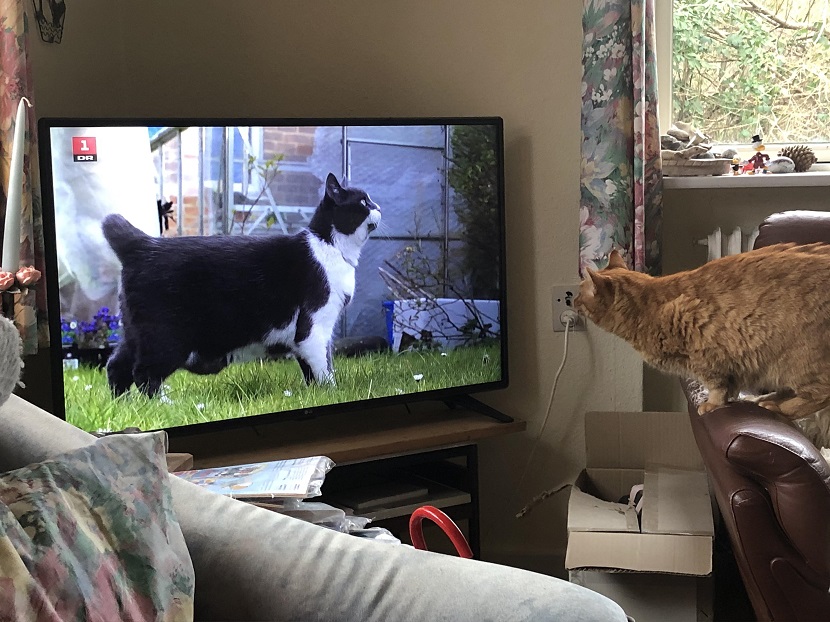
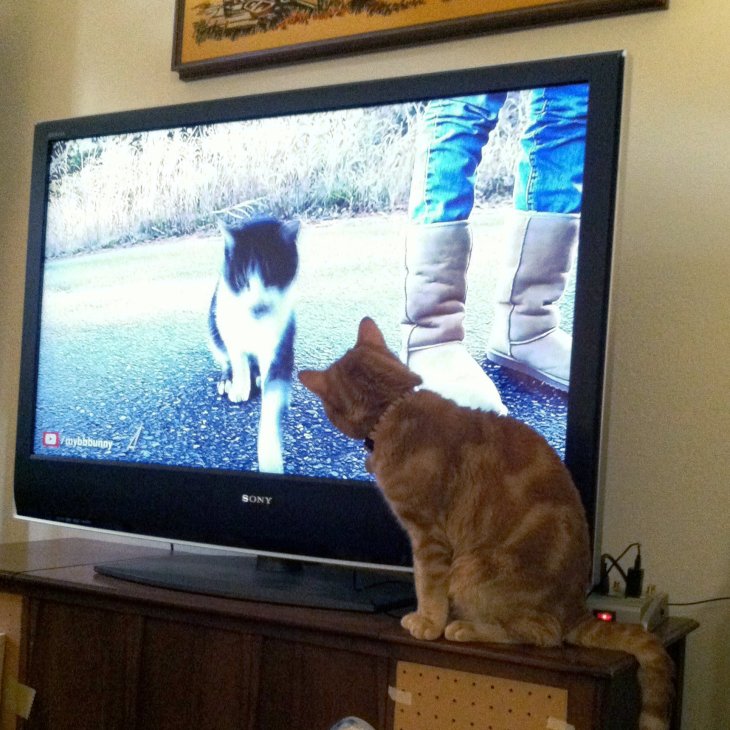


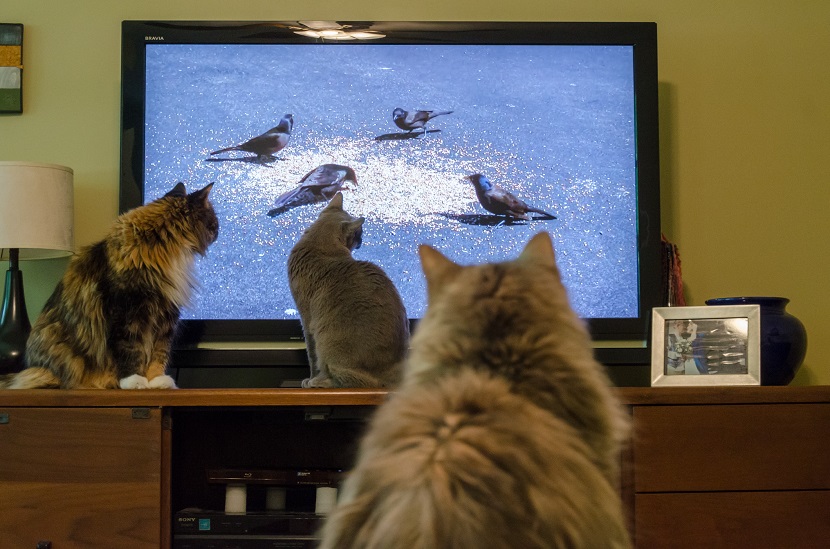
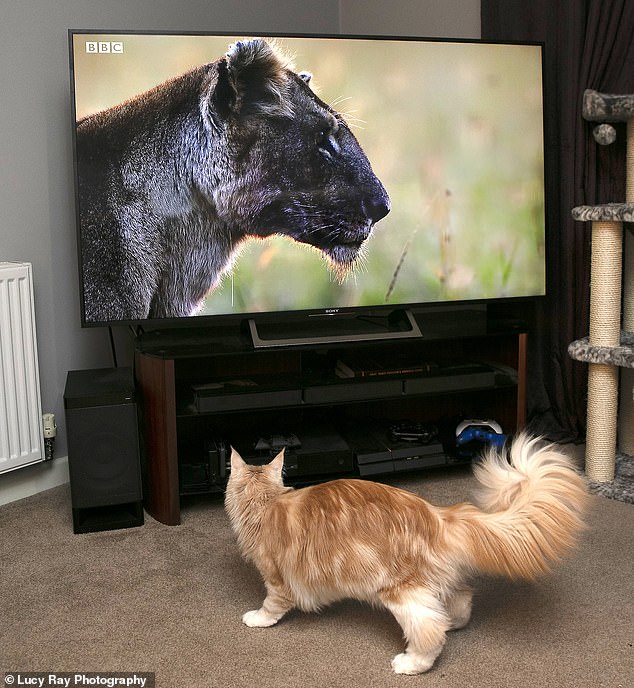
I once had a cat that used to get glued to the TV screen when downhill skiing was on.

The Sydney funnel-web spider (Atrax robustus) is a species of venomous mygalomorph spider native to eastern Australia, usually found within a 100 km (62 mi) radius of Sydney. It is a member of a group of spiders known as Australian funnel-web spiders. Its bite is capable of causing serious illness or death in humans if left untreated.
The Sydney funnel-web has a body length ranging from 1 to 5 cm (0.4 to 2 in). Both sexes are glossy and darkly coloured, ranging from blue-black, to black, to shades of brown or dark-plum coloured.

The Sydney funnel-web is medium to large in size, with body length ranging from 1 to 5 cm (0.4 to 2 in). Both sexes are glossy and darkly coloured, ranging from blue-black, to black, to brown or dark-plum coloured. The carapace covering the cephalothorax is almost hairless and appears smooth and glossy. Another characteristic are finger-like spinnerets at the end of their abdomen. The shorter-lived male is smaller than the female, but longer-legged. The average leg length for the spider in general is six to seven centimeters.
Distribution is centred on Sydney, extending north to the Central Coast and south to the Illawarra region, and west to the Blue Mountains in New South Wales.
The spider can be found in moist microhabitats, including under logs and foliage.
Sydney funnel-web spiders are mostly terrestrial spiders, favouring habitats with moist sand and clays.
Sydney funnel-web spider venom contains a compound known as δ-atracotoxin, an ion channel inhibitor, which makes the venom highly toxic for humans and other primates. However, it does not affect the nervous system of other mammals. These spiders typically deliver a full envenomation when they bite, often striking repeatedly, due to their defensiveness and large chitinous cheliceral fangs. There has been no reported case of severe envenoming by female Sydney funnel-web spiders, which is consistent with the finding that the venom of female specimens is less potent than the venom of their male counterparts. In the case of severe envenomation, the time to onset of symptoms is less than one hour, with a study about Sydney funnel-web spider bites finding a median time of 28 minutes. This same study revealed that children are at particular risk of severe Sydney funnel-web spider envenoming, with 42% of all cases of severe envenoming being children.
There is at least one recorded case of a small child dying within 15 minutes of a bite from a funnel-web.
The bite of a Sydney funnel-web is initially very painful, with clear fang marks separated by several millimetres. The size of fangs is responsible for the initial pain. In some cases the spider will remain attached until dislodged by shaking or flicking it off. Physical symptoms can include copious secretion of saliva, muscular twitching and breathing difficulty, disorientation and confusion, leading to unconsciousness.
A Sydney funnel-web bite is regarded as a medical emergency requiring immediate hospital treatment. Current guidelines for antivenom recommend two vials, or four vials if symptoms of envenomation are severe. Patients are assessed every 15 minutes, with further vials recommended if symptoms do not resolve. The most vials used to treat a bite is 12. The patient was a 10-year-old boy who was bitten in February 2017 by a male Sydney funnel-web that was hiding in a shoe.
The antivenom was developed by a team headed by Struan Sutherland at the Commonwealth Serum Laboratories in Melbourne. Since the antivenom became available in 1981, there have been no recorded fatalities from Sydney funnel-web spider bites. In September 2012, it was reported that stocks of antivenom were running low, and members of the public were asked to catch the spiders so that they could be milked for their venom. One dose of antivenom requires around 70 milkings from a Sydney funnel-web spider.
The Australian Reptile Park receives Sydney funnel-web spiders as part of its milking program. In January 2016, they received a male Sydney funnel-web with a 10-centimetre (4 in) leg span. The spider was described by the park as the largest specimen that it had ever seen.
 The MarkoZen Blog