Cats do have a fascination with sinks and tubs, not to mention taps, faucets and even water coolers. And they say cats are afraid of the water.



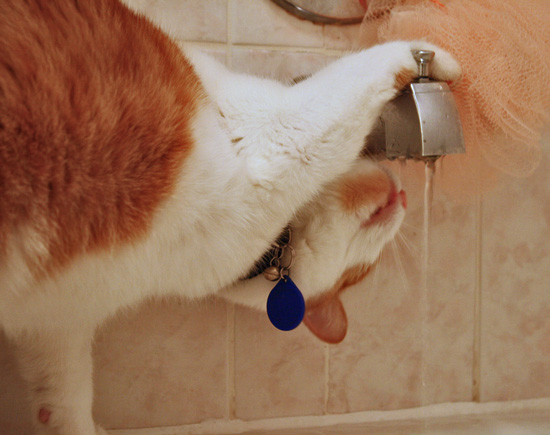



Cats do have a fascination with sinks and tubs, not to mention taps, faucets and even water coolers. And they say cats are afraid of the water.
A North Dakota cemetery worker was left scratching his head when he stumbled upon a trio of turkeys eerily circling a gravestone. The creepy scene was reportedly filmed by Paul Eickhof at the Riverside Cemetery in the city of Fargo. In the cemetery worker’s footage, featured above, the three turkeys can be seen continuously running around a memorial marker labeled ‘Harris.’ While it is uncertain how long their ‘ritual’ had been unfolding, one can surmise that it was quite a while based on the ring of exposed ground encircling the gravestone in the otherwise snow-covered cemetery.
As for the cause of the weird incident, which Eickhof rightly called “quite bizarre,” wildlife experts say that the circling was actually typical behavior from turkeys as the not particularly intelligent animals often get trapped in a loop while examining suspected threats. A similarly strange piece of footage from Massachusetts made headlines back in 2017 when a motorist filmed the creatures eerily walking around a dead cat.
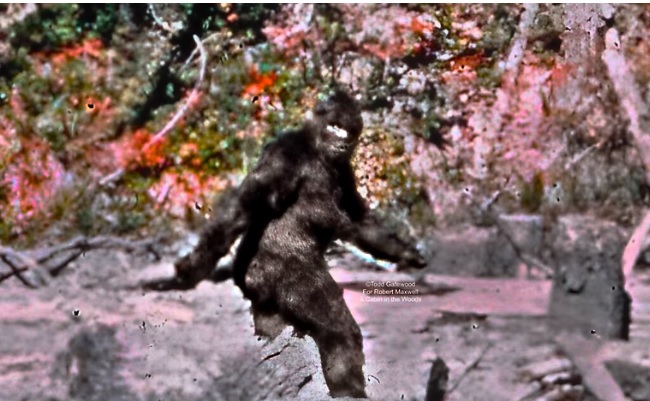
A man’s ongoing efforts to track down the elusive sasquatch in remote areas of British Columbia suggest he’s capable of working, and therefore not entitled to spousal support, a judge has ruled.
The unusual circumstances were detailed in a recent divorce decision handed down in B.C. Supreme Court, which makes multiple references to the 57-year-old’s sasquatch-seeking expeditions.
It was one such venture that led to the couple’s separation in August 2020.
His wife told the court he went on a camping trip on Vancouver Island that month in search of the mythical ape-like creature – and brought along an ex-girlfriend without telling her.
“The respondent was extremely upset by this,” Justice Robin Baird wrote, in his Jan. 17 decision.
“Before the claimant returned home she fired off a text to him declaring that their marriage was over, and she never changed her mind.”
The husband’s claim for spousal support also hinged on him being unable to work due to a mishap that occurred during a previous sasquatch outing years earlier.
The court heard he was staying at a hotel in Sayward – a tiny village of around 300 people on northeast Vancouver Island – when he slipped on an icy staircase and fell in January 2016, suffering a range of injuries including fractures to an ankle and vertebrae.
That unfortunate incident led to chronic and sometimes severe pain that continues to this day, the court heard.
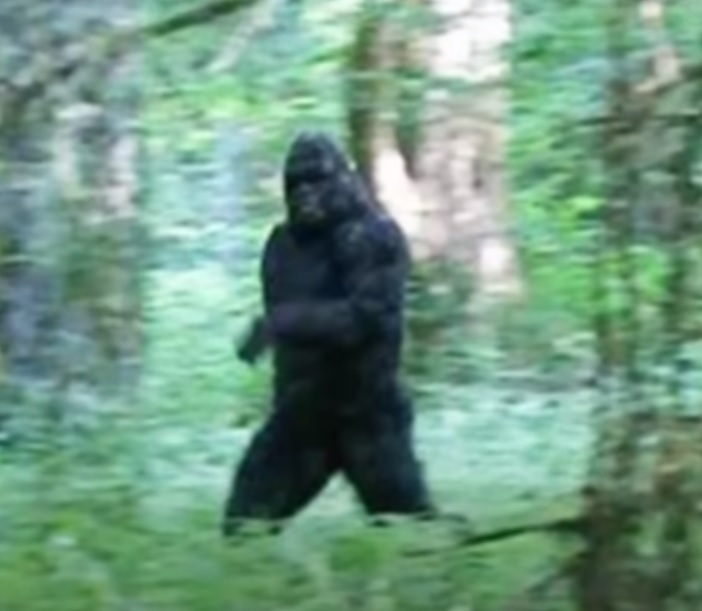
But Baird was ultimately not convinced the husband was left “totally disabled” by the accident, or that he “cannot earn income from employment of some kind or other” – partly because of his ongoing sasquatch-related endeavours.
“The claimant continues to enjoy camping, fishing, hunting, riding ‘quad’ motorcycles, and exploring remote areas of B.C. in search of sasquatch,” the judge wrote.
Baird also noted that the husband “testified with some pride” at being designated a “gifted” student in school, and had “made it clear that he rates his own intellectual abilities to be far above average” – something the judge found could help him find a job, if he sought one.
“I accept that he is no longer suited to work requiring a lot of physical strength or stamina,” he added. “But he told me himself that he has made no effort since 2016 to seek or secure employment in lighter or more sedentary occupations, or to retrain for better paying low-impact jobs in keeping with his superior intellect and aptitudes.”
The judge also found the husband’s evidence to support his medical condition “dated,” as it was the same he’d used while applying for a federal disability pension six years ago, in 2018.
The husband was approved for that pension, which is now supplemented by provincial assistance payments. He also received a $350,000 settlement for his injuries at the Sayward hotel, according to the decision.
Baird approved the couple’s divorce, effective 30 days after the judgment, without awarding spousal support or legal costs to either party.


World’s deadliest snakes
Inland Taipan , central Australia
Dubois’ sea snake Tropical oceanic waters
Eastern brown snake Australia, Papua New Guinea, Indonesia
Yellow bellied sea snake Tropical oceanic waters
Central Ranges taipan Inland, central Australia
Peron’s sea snake Gulf of Siam, Strait of Taiwan, Coral sea islands, and other places
Coastal Taipan Australia

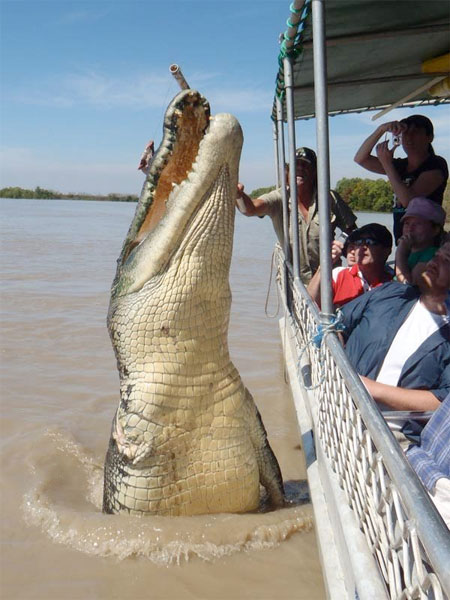
Like Father like Son. Maybe not all the time. Steve Irwin, the Crocodile Hunter, used to bulldog giant salt water crocodiles and handle the deadliest snakes in the world.
His son, Robert Irwin, is tracking Golden Retrievers!

A polar bear swam continuously for over nine days, covering 687km (426 miles), a new study has revealed.
Scientists studying bears around the Beaufort sea, north of Alaska, claim this endurance feat could be a result of climate change.

Polar bears are known to swim between land and sea ice floes to hunt seals.
But the researchers say that increased sea ice melts push polar bears to swim greater distances, risking their own health and future generations.
In their findings, published in Polar Biology, researchers from the US Geological Survey reveal the first evidence of long distance swimming by polar bears (Ursus maritimus).
“This bear swam continuously for 232 hours and 687 km and through waters that were 2-6 degrees C,” says research zoologist George M. Durner.
“We are in awe that an animal that spends most of its time on the surface of sea ice could swim constantly for so long in water so cold. It is truly an amazing feat.”
Although bears have been observed in open water in the past, this is the first time one’s entire journey has been followed.
By fitting a GPS collar to a female bear, researchers were able to accurately plot its movements for two months as it sought out hunting grounds.
The polar bear is the largest terrestrial carnivore, being more than twice as big as the Siberian Tiger. It shares the title of largest land predator (and largest bear species) with the Kodiak bear. Adult males weigh 350–680 kg (770–1500 lbs) and measure 2.4–3 m (7.9–9.8 ft) in length. Adult females are roughly half the size of males and normally weigh 150–249 kg (330–550 lb), measuring 1.8–2.4 metres (5.9–7.9 ft) in length. When pregnant, however, they can weigh as much as 499 kg (1,100 lb).
Polar Bear swimming underwater at San Diego Zoo.

As of 2018, the World Conservation Union (IUCN) reports that the global population of polar bears is 15,000 to 20,000, and is declining. In 2006, the IUCN upgraded the polar bear from a species of least concern to a vulnerable species. It cited a “suspected population reduction of >30% within three generations (45 years)”, due primarily to global warming. Other risks to the polar bear include pollution in the form of toxic contaminants, conflicts with shipping, stresses from recreational polar-bear watching, and oil and gas exploration and development. The IUCN also cited a “potential risk of over-harvest” through legal and illegal hunting.

The dogs are chained up and therefore totally at the mercy of these big fair tempered bears. This happened at Churchill, Manitoba.

 The MarkoZen Blog