Cats do have a fascination with sinks and tubs, not to mention taps, faucets and even water coolers. And they say cats are afraid of the water.



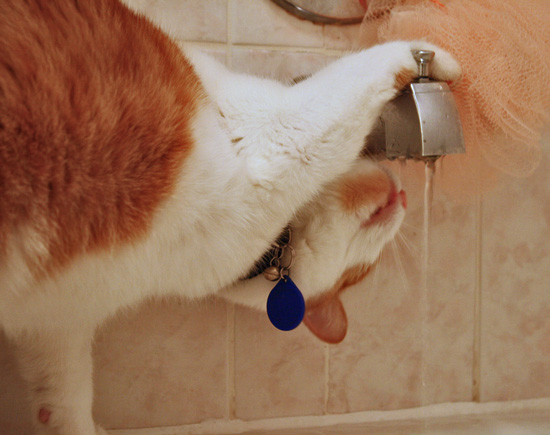



Cats do have a fascination with sinks and tubs, not to mention taps, faucets and even water coolers. And they say cats are afraid of the water.

And it’s a very dumb and ignorant demon.
2024 YR4 turned heads when it became the most dangerously rated asteroid earlier this week.

The potentially hazardous asteroid 2024 YR4 caused consternation over the last few weeks as its odds of hitting Earth in 2032 dramatically rose. Now, those odds have plummeted to near-zero, as astronomers’ calculations of the asteroid’s path have been updated to indicate that Earth is almost certainly not in the space rock’s plans.
Almost. According to NASA’s Center for Near-Earth Object Studies (CNEOS), the asteroid’s current chance of hitting the planet in 2032 is 0.28%, or a 1-in-360 shot. That is a far cry from just earlier this week, when models had the asteroid’s impact probability at a staggering 3.1%, or 1-in-32 odds. It’s safe to say we’re out of the woods—but perhaps still in the backyard of uncertainty? A beleaguered analogy, but suffice it to say that the odds are not zero—but the sudden plummet from such a (relatively) high probability is a sigh of relief.
Though 2024 YR4 isn’t a gigantic asteroid—its size estimates range from 130 to 300 feet wide (40 to 90 meters)—it still is large enough to destroy a large city or region if hit Earth. It just wouldn’t cause a global cataclysm. Hardly reassuring stuff. The asteroid’s impact probability made it a 3 on the Torino Impact Hazard Scale, which measures the danger posed by asteroids. Torino 3s have “a 1% or greater chance of collision capable of localized destruction,” according to CNEOS.
Since the asteroid’s impact odds are now 1-in-360, the asteroid’s Torino risk is rated 1, meaning a “routine discovery in which a pass near the Earth is predicted that poses no unusual level of danger. Current calculations show the chance of collision is extremely unlikely with no cause for public attention or public concern.”
When 2024 YR4’s odds rose earlier this week, it became more hazardous than the head-turning asteroid Apophis, which was one of the most hazardous asteroids when discovered in 2004, but was found in 2021 to not be at risk of hitting Earth for at least a century.
The Asteroid Terrestrial-impact Last Alert System (ATLAS) first spotted 2024 YR4 just after Christmas, when the rock was 515,116 miles (829,000 kilometers) from Earth. Within a month, the asteroid’s odds crept up to a 1.2% chance—which sounds small, but is still a serious number when we’re talking about the chances of an asteroid with the potential to raze an entire city or region on our verdant little world. The odds kept growing, from a 1.58% chance of impact on February 2 to a 2.2% chance of striking on February 10.
But as experts told Gizmodo, this steady movement in the odds was expected. That’s because, as astronomers narrowed the range of potential paths for the asteroid, Earth remained in it. So while the total pool of paths shrank, Earth’s placement in the path meant its footprint covered more of the total possible area. Now, the asteroid’s potential path window has shrunk enough that it seems very unlikely that the rock will hit Earth.
A North Dakota cemetery worker was left scratching his head when he stumbled upon a trio of turkeys eerily circling a gravestone. The creepy scene was reportedly filmed by Paul Eickhof at the Riverside Cemetery in the city of Fargo. In the cemetery worker’s footage, featured above, the three turkeys can be seen continuously running around a memorial marker labeled ‘Harris.’ While it is uncertain how long their ‘ritual’ had been unfolding, one can surmise that it was quite a while based on the ring of exposed ground encircling the gravestone in the otherwise snow-covered cemetery.
As for the cause of the weird incident, which Eickhof rightly called “quite bizarre,” wildlife experts say that the circling was actually typical behavior from turkeys as the not particularly intelligent animals often get trapped in a loop while examining suspected threats. A similarly strange piece of footage from Massachusetts made headlines back in 2017 when a motorist filmed the creatures eerily walking around a dead cat.
Ice Road Truckers is a reality television series that premiered on History on June 17, 2007. It features the activities of drivers who operate trucks on seasonal routes crossing frozen lakes and rivers in remote frozen territories in Canada and Alaska. In the first few seasons the long haul semi trucks operated mainly in Alaska and the Canadian Northwest Territories. But in the last few seasons the truckers have discovered the area of North America with the most ice roads and also the most treacherous. The Canadian province of Manitoba.
Many of Manitoba’s isolated Native communities in the central and northern part of the province do not have access to year round roads or rail lines. The Native reserves are located in areas of thick forest and thousands of lakes. Therefore the winter roads are the only way to get supplies up to those communities. Thousands of tons of freight is hauled to the communities during the short winter road season, usually January, February and the first half of March. Once the melt starts, the roads disintegrate. Hundreds of kilometres of the ice roads are just that, roads running on frozen lakes. When the lake ice starts to melt it can be quite hazardous.

I have always wondered what kind of support the truckers receive when they are out in the bush hundreds of miles from nowhere. When old grizzled God-fearing trucker Alex Debogorski is hauling across a frozen lake what back-up does he have when the ice starts cracking? While Alex is praying to the heavens to keep him dry there is always cameras shooting his movement from many different angles, some from outside his semi truck.
And when foul mouthed trucker Art Burke is swearing like a drunken sailor because he took a wrong turn and is 300 miles in the opposite direction of where he should be, a helicopter is filming his semi’s movement from a thousand feet up. When Art starts getting bleeped out by the program censors because of his obscene and indescribably vulgar diatribes he is talking to somebody who is riding with him. And when Art runs out of fuel and he is pacing around in the snow there are two different cameras capturing his every lewd gesture.
How isolated and in potential peril are the Ice Road Truckers? A recent photo seems to shed some light on this question.

The back-up and support package that shadows the Ice Trucks is extensive. Middle: Polar Industries truck driven by swear-master Art Burke; middle left: two F-350 Ford pick-ups providing mobile camera footage from different angles outside the truck; top left: Jet ranger helicopter that doubles as a camera platform and air ambulance; bottom left: the main satellite receiving central processing television truck; bottom right; 4-wheel drive ambulance with defibrillators, body thaw-out receptacles and neuro-cryogenicist surgeons; middle right: super-heavy X-1000 Mack telescopic arm tow recovery vehicle, and for good measure, a high-speed all-terrain mobile crane. Just in case a semi needs to be plucked out of a very deep lake.
In my opinion I’d say the Ice Truckers are covered pretty good for any contingency.
An odd viral video from Guatemala features what appears to be a gaggle of baby dinosaurs in front of an ancient monument, but the ‘prehistoric creatures’ are really just a clever illusion. The weird footage, which has drawn comparisons to a scene from the Jurassic Park films, was reportedly posted on social media earlier this month. In the video, several small animals that bear an uncanny resemblance to baby brontosauruses can be seen meandering around in some grass. As one might imagine, the footage had many online viewers doing a double-take at the wondrous sight that ultimately turned out to have a prosaic explanation.
Rather than a group of heretofore undiscovered tiny dinosaurs roaming around Guatemala, the creatures seen in the video are actually coatis, which are small mammals that reside in South and Central America as well as Mexico and the southwestern United States. The reason why the diminutive animals look like baby brontosauruses is because the footage is reversed, which makes it seem as though their tails were their heads. A similarly eyebrow-raising scene of coatis masquerading as tiny dinosaurs dashing along a beach also went viral in 2022. To that end, this more recent video from Guatemala has amassed a staggering 125 million views since appearing online in just a few weeks.








 The MarkoZen Blog
