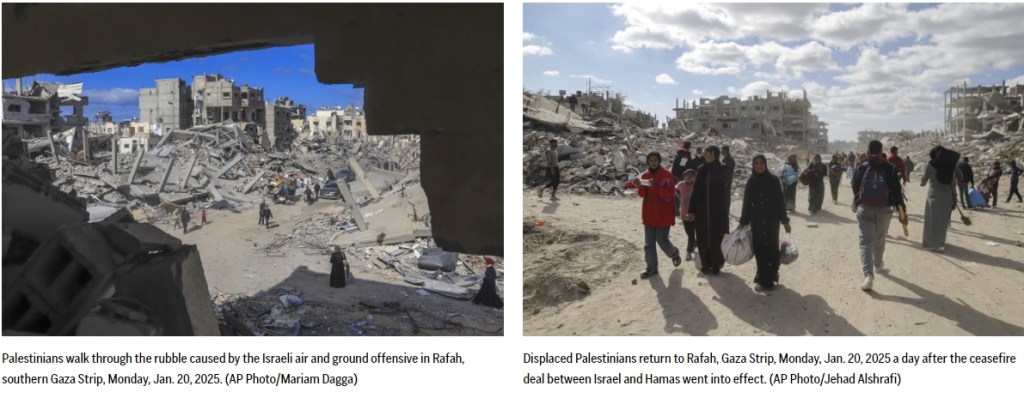
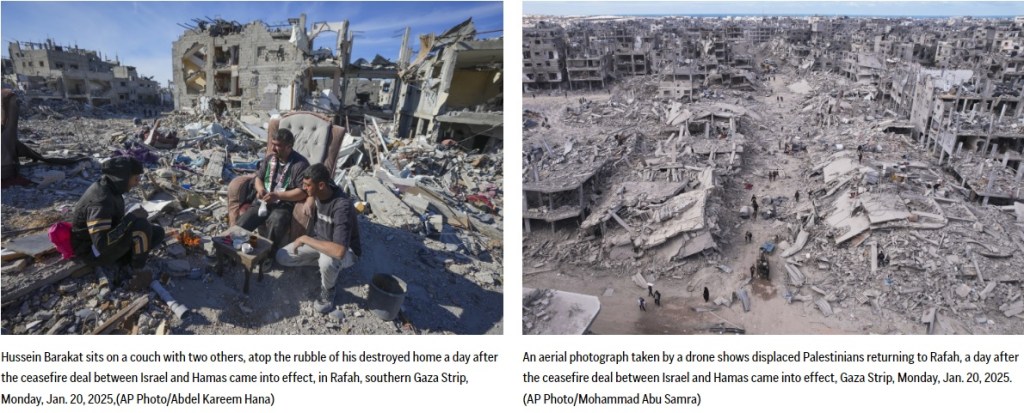
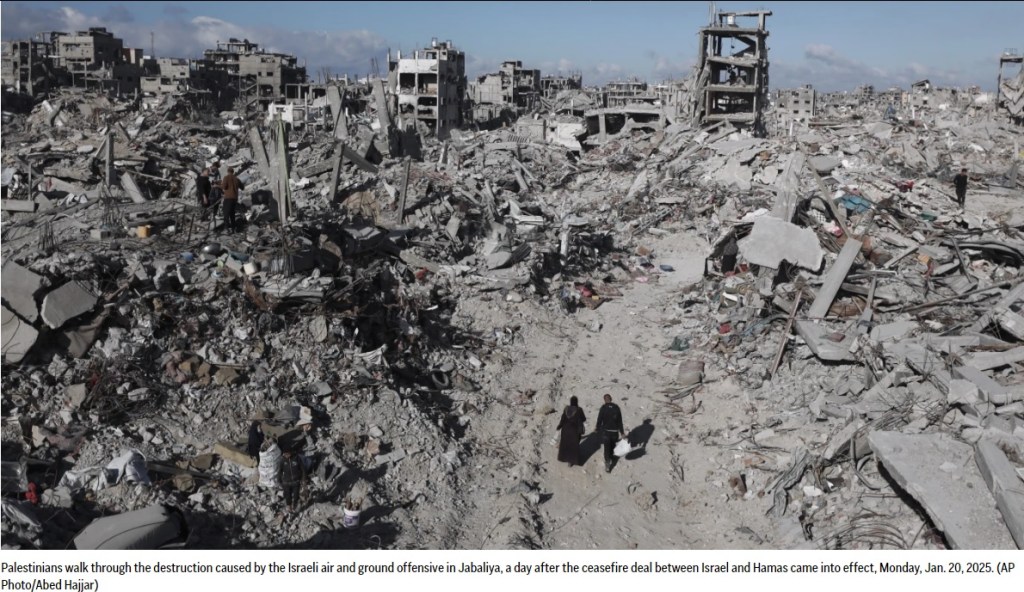
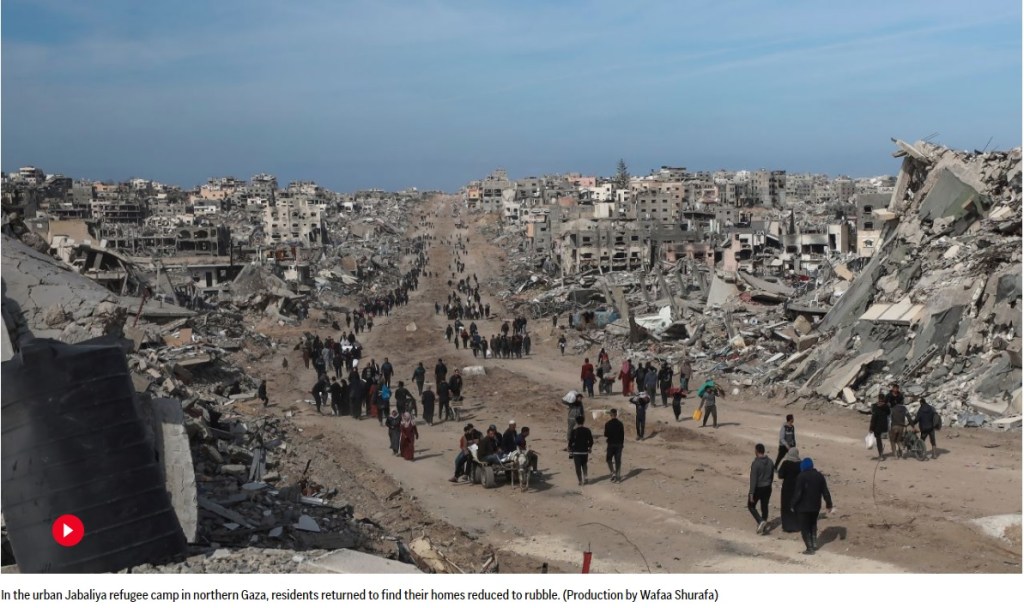
RAFAH, Gaza Strip (AP) — Palestinians in Gaza are confronting an apocalyptic landscape of devastation after a ceasefire paused more than 15 months of fighting between Israel and Hamas.
Across the tiny coastal enclave, where built-up refugee camps are interspersed between cities, drone footage captured by The Associated Press shows mounds of rubble stretching as far as the eye can see — remnants of the longest and deadliest war between Israel and Hamas in their blood-ridden history.

“As you can see, it became a ghost town,” said Hussein Barakat, 38, whose home in the southern city of Rafah was flattened. “There is nothing,” he said, as he sat drinking coffee on a brown armchair perched on the rubble of his three-story home, in a surreal scene.
Critics say Israel has waged a campaign of scorched earth to destroy the fabric of life in Gaza, accusations that are being considered in two global courts, including the crime of genocide. Israel denies those charges and says its military has been fighting a complex battle in dense urban areas and that it tries to avoid causing undue harm to civilians and their infrastructure.
However, estimates put the civilian deaths at over 45,000. Possibly as high as 70,000!
Military experts say the reality is complicated.
“For a campaign of this duration, which is a year’s worth of fighting in a heavily urban environment where you have an adversary that is hiding in amongst that environment, then you would expect an extremely high level of damage,” said Matthew Savill, director of military sciences at the Royal United Services Institute, a British think-tank.
Savill said that it was difficult to draw a broad conclusion about the nature of Israel’s campaign. To do so, he said, would require each strike and operation to be assessed to determine whether they adhered to the laws of armed conflict and whether all were proportional, but he did not think the scorched earth description was accurate.
International rights groups. including Amnesty International and Human Rights Watch, view the vast destruction as part of a broader pattern of extermination and genocide directed at Palestinians in Gaza, a charge Israel denies. The groups dispute Israel’s stance that the destruction was a result of military activity.
Airstrikes throughout the war toppled buildings and other structures said to be housing militants. But the destruction intensified with the ground forces, who fought Hamas fighters in close combat in dense areas.
If militants were seen firing from an apartment building near a troop maneuver, forces might take the entire building down to thwart the threat. Tank tracks chewed up paved roads, leaving dusty stretches of earth in their wake.
The military’s engineering corps was tasked with using bulldozers to clear routes, downing buildings seen as threats, and blowing up Hamas’ underground tunnel network.
Experts say the operations to neutralize tunnels were extremely destructive to surface infrastructure. For example, if a 1.5-kilometer (1-mile) long tunnel was blown up by Israeli forces, it would not spare homes or buildings above, said Michael Milshtein, a former Israeli army intelligence officer.
“If (the tunnel) passes under an urban area, it all gets destroyed,” he said. “There’s no other way to destroy a tunnel.”
 The MarkoZen Blog