Mount Kilimanjaro in Tanzania has a very unique appearance in relation to other giant mountains of the world. First of all the upper reaches of the mountain are not covered in ice and snow, and the sparse vegetation at the top give the mountain a dark chocolate colour. Second is the volcanic crater in the middle of the flat top. It reminds me of a big mound of chocolate sprinkled lightly with whip cream.
Kilimanjaro, with its three volcanic cones, Kibo, Mawenzi, and Shira, is a dormant volcanic mountain in Kilimanjaro National Park, Tanzania. It is the highest mountain in Africa and the highest free-standing mountain in the world at 5,895 metres or 19,341 feet above sea level (the Uhuru Peak/Kibo Peak).
Kilimanjaro is composed of three distinct volcanic cones: Kibo 5,895 m (19,341 ft); Mawenzi 5,149 m (16,893 ft); and Shira 3,962 m (13,000 ft). Uhuru Peak is the highest summit on Kibo’s crater rim.
Kilimanjaro is a large stratovolcano. Two of its three peaks, Mawenzi and Shira, are extinct while Kibo (the highest peak) is dormant and could erupt again. The last major eruption has been dated to between 150,000 and 200,000 years ago.
Although it is dormant, Kibo has fumaroles that emit gas in the crater. Several collapses and landslides have occurred on Kibo in the past, one creating the area known as the Western Breach.
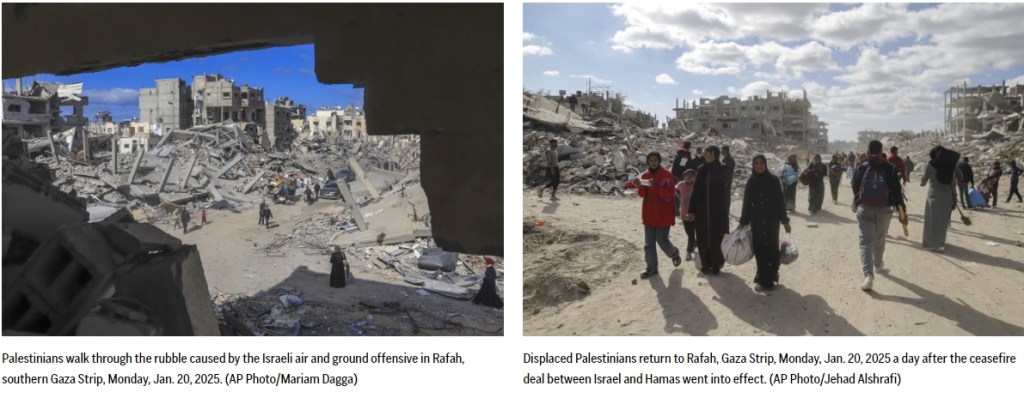
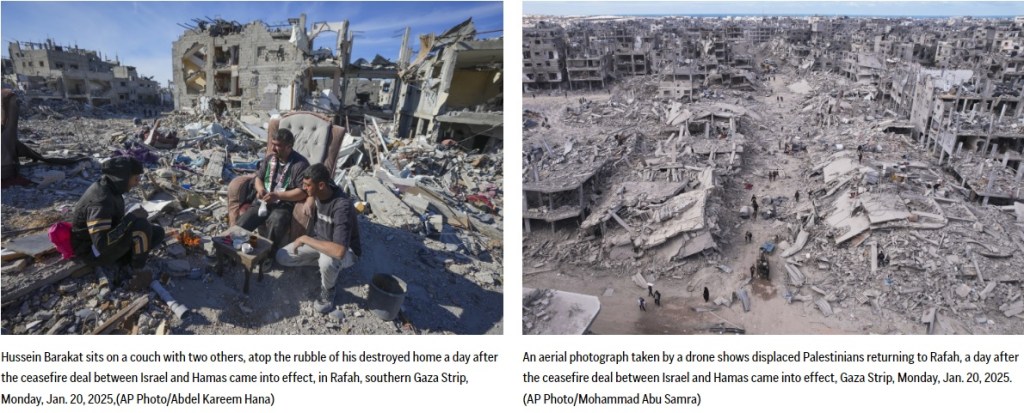
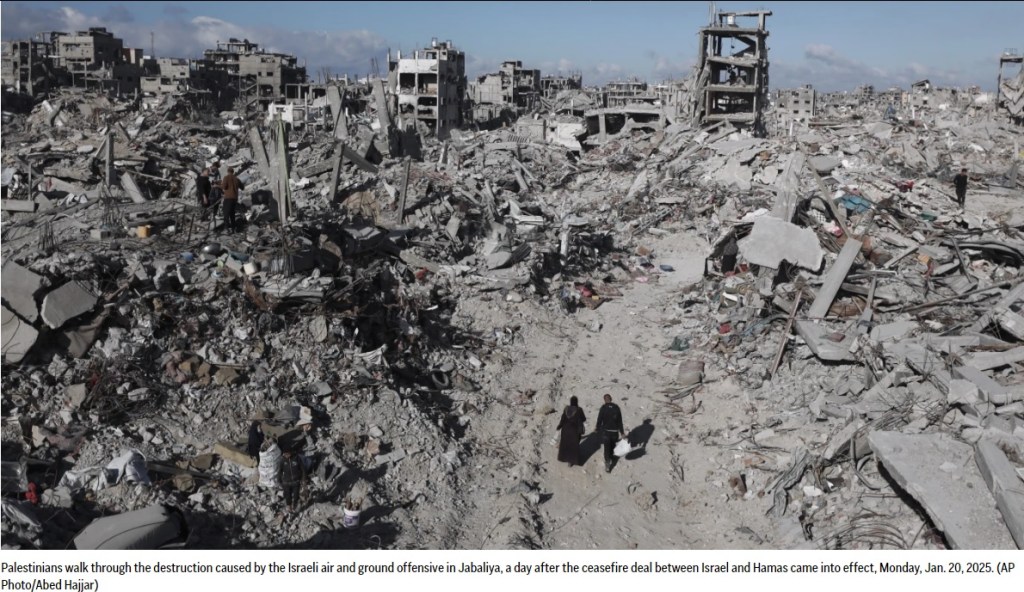
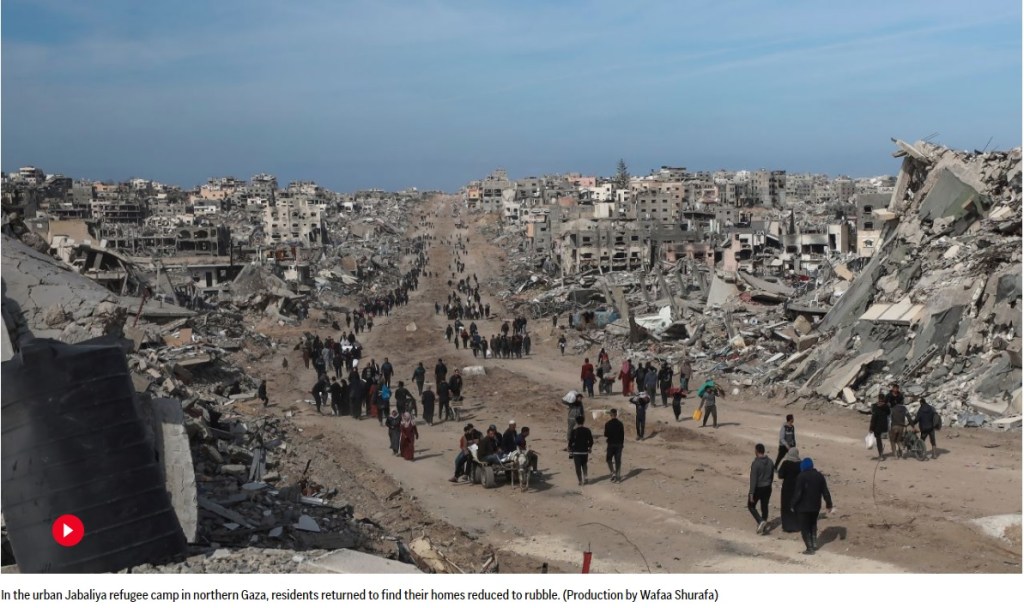
RAFAH, Gaza Strip (AP) — Palestinians in Gaza are confronting an apocalyptic landscape of devastation after a ceasefire paused more than 15 months of fighting between Israel and Hamas.
Across the tiny coastal enclave, where built-up refugee camps are interspersed between cities, drone footage captured by The Associated Press shows mounds of rubble stretching as far as the eye can see — remnants of the longest and deadliest war between Israel and Hamas in their blood-ridden history.
“As you can see, it became a ghost town,” said Hussein Barakat, 38, whose home in the southern city of Rafah was flattened. “There is nothing,” he said, as he sat drinking coffee on a brown armchair perched on the rubble of his three-story home, in a surreal scene.
Critics say Israel has waged a campaign of scorched earth to destroy the fabric of life in Gaza, accusations that are being considered in two global courts, including the crime of genocide. Israel denies those charges and says its military has been fighting a complex battle in dense urban areas and that it tries to avoid causing undue harm to civilians and their infrastructure.
However, estimates put the civilian deaths at over 45,000. Possibly as high as 70,000!
Military experts say the reality is complicated.
“For a campaign of this duration, which is a year’s worth of fighting in a heavily urban environment where you have an adversary that is hiding in amongst that environment, then you would expect an extremely high level of damage,” said Matthew Savill, director of military sciences at the Royal United Services Institute, a British think-tank.
Savill said that it was difficult to draw a broad conclusion about the nature of Israel’s campaign. To do so, he said, would require each strike and operation to be assessed to determine whether they adhered to the laws of armed conflict and whether all were proportional, but he did not think the scorched earth description was accurate.
International rights groups. including Amnesty International and Human Rights Watch, view the vast destruction as part of a broader pattern of extermination and genocide directed at Palestinians in Gaza, a charge Israel denies. The groups dispute Israel’s stance that the destruction was a result of military activity.
Airstrikes throughout the war toppled buildings and other structures said to be housing militants. But the destruction intensified with the ground forces, who fought Hamas fighters in close combat in dense areas.
If militants were seen firing from an apartment building near a troop maneuver, forces might take the entire building down to thwart the threat. Tank tracks chewed up paved roads, leaving dusty stretches of earth in their wake.
The military’s engineering corps was tasked with using bulldozers to clear routes, downing buildings seen as threats, and blowing up Hamas’ underground tunnel network.
Experts say the operations to neutralize tunnels were extremely destructive to surface infrastructure. For example, if a 1.5-kilometer (1-mile) long tunnel was blown up by Israeli forces, it would not spare homes or buildings above, said Michael Milshtein, a former Israeli army intelligence officer.
“If (the tunnel) passes under an urban area, it all gets destroyed,” he said. “There’s no other way to destroy a tunnel.”
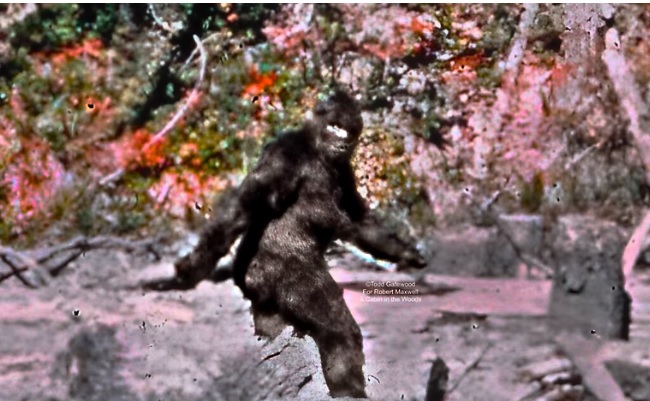
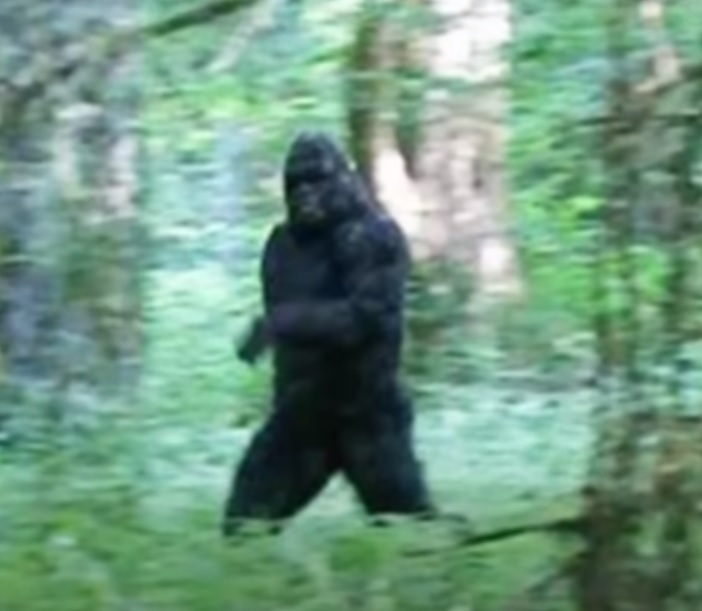
A man’s ongoing efforts to track down the elusive sasquatch in remote areas of British Columbia suggest he’s capable of working, and therefore not entitled to spousal support, a judge has ruled.
The unusual circumstances were detailed in a recent divorce decision handed down in B.C. Supreme Court, which makes multiple references to the 57-year-old’s sasquatch-seeking expeditions.
It was one such venture that led to the couple’s separation in August 2020.
His wife told the court he went on a camping trip on Vancouver Island that month in search of the mythical ape-like creature – and brought along an ex-girlfriend without telling her.
“The respondent was extremely upset by this,” Justice Robin Baird wrote, in his Jan. 17 decision.
“Before the claimant returned home she fired off a text to him declaring that their marriage was over, and she never changed her mind.”
The husband’s claim for spousal support also hinged on him being unable to work due to a mishap that occurred during a previous sasquatch outing years earlier.
The court heard he was staying at a hotel in Sayward – a tiny village of around 300 people on northeast Vancouver Island – when he slipped on an icy staircase and fell in January 2016, suffering a range of injuries including fractures to an ankle and vertebrae.
That unfortunate incident led to chronic and sometimes severe pain that continues to this day, the court heard.
But Baird was ultimately not convinced the husband was left “totally disabled” by the accident, or that he “cannot earn income from employment of some kind or other” – partly because of his ongoing sasquatch-related endeavours.
“The claimant continues to enjoy camping, fishing, hunting, riding ‘quad’ motorcycles, and exploring remote areas of B.C. in search of sasquatch,” the judge wrote.
Baird also noted that the husband “testified with some pride” at being designated a “gifted” student in school, and had “made it clear that he rates his own intellectual abilities to be far above average” – something the judge found could help him find a job, if he sought one.
“I accept that he is no longer suited to work requiring a lot of physical strength or stamina,” he added. “But he told me himself that he has made no effort since 2016 to seek or secure employment in lighter or more sedentary occupations, or to retrain for better paying low-impact jobs in keeping with his superior intellect and aptitudes.”
The judge also found the husband’s evidence to support his medical condition “dated,” as it was the same he’d used while applying for a federal disability pension six years ago, in 2018.
The husband was approved for that pension, which is now supplemented by provincial assistance payments. He also received a $350,000 settlement for his injuries at the Sayward hotel, according to the decision.
Baird approved the couple’s divorce, effective 30 days after the judgment, without awarding spousal support or legal costs to either party.
Beach front properties are left destroyed by the Palisades Fire, as some remain standing at left, Jan. 9, 2025 in Malibu, Calif. (AP Photo/Mark J. Terrill)
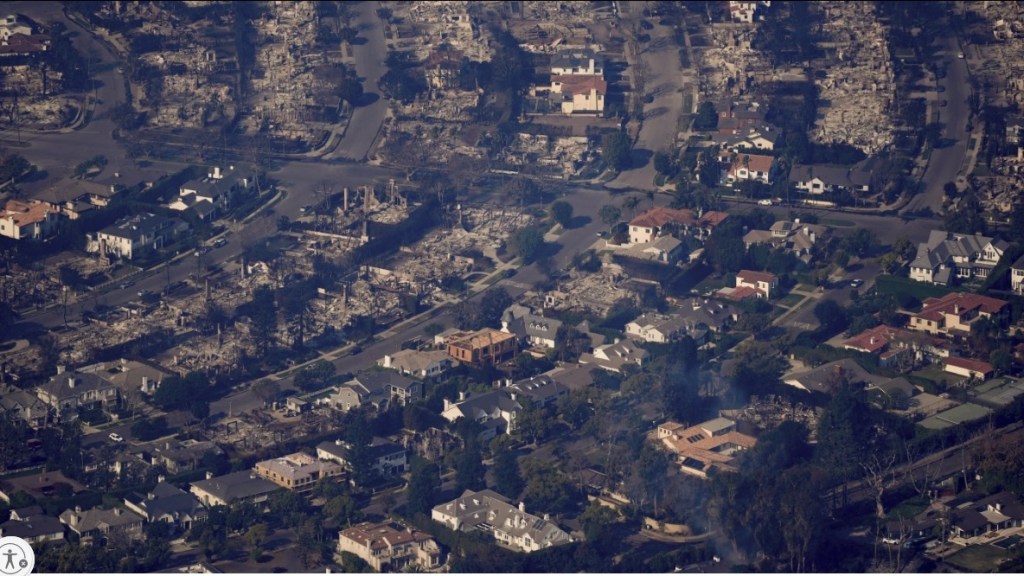
Rows of the remains of charred homes filled the Los Angeles landscape as flames engulfed entire neighborhoods.
But among the crumbling walls, some homes stand untouched.
A swing hangs in front of an intact home and a home destroyed by the Palisades Fire in the Pacific Palisades neighborhood of Los Angeles, Jan. 12, 2025. (AP Photo/Mark J. Terrill)
Through a mixture of luck and building design, handfuls of houses in neighborhoods otherwise reduced to ash withstood the punishing flames that destroyed thousands of homes and killed at least 24 people.
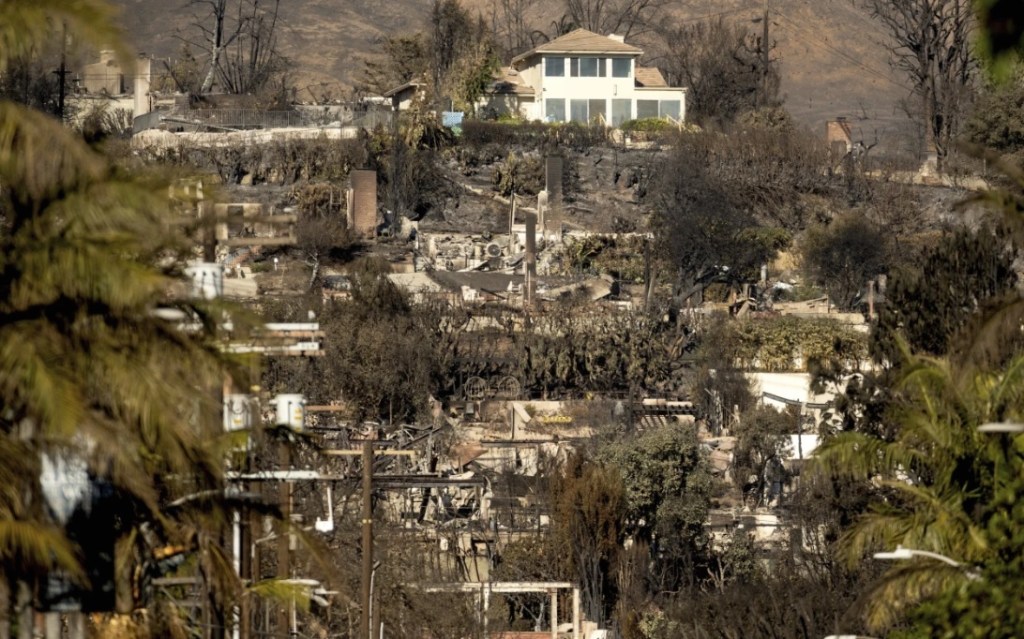
The differences were stark: One home atop a hill stood between burnt trees and bushes, with untouched belongings visible from the windows. Below, the remains of others’ homes — from parts of roofs, fences, walls to air conditioning units and chair swings — were singed and crumpled.
A home stands among residences destroyed by the Palisades Fire in the Pacific Palisades neighborhood of Los Angeles, Jan. 12, 2025. (AP Photo/Noah Berger)
The Walsh House, featured in the “Beverly Hills 90210″ television series, survived. So did its pristine lawn. Next door, the remains of a neighbor’s home was blackened with soot.
The front exterior of the Walsh House featured in the television series “Beverly Hills 90210,” left, stands undamaged next to a house charred by the Eaton Fire, Jan. 9, 2025, in Altadena, Calif. (AP Photo/Chris Pizzello)
Some beachfront properties were also spared, with rows of scorched trees making way for a cluster of unspoiled homes. Others had a different fate, with roofs and trees collapsing into homes, and emergency services working through the debris.
Beach front properties are left destroyed by the Palisades Fire, as others remain, Jan. 9, 2025, in Malibu, Calif. (AP Photo/Mark J. Terrill)
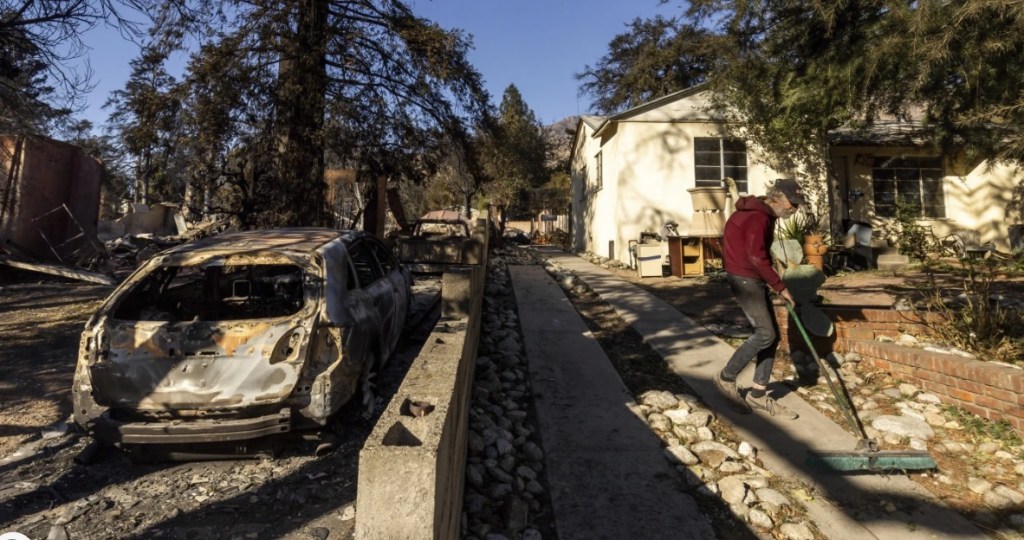
One man, David Slater, swept the driveway of his intact home just feet away from the charred remains of his neighbor’s car and a broken wall. Behind the gate of Slater’s home, too, lay fallen trees and debris.
David Slater, right, clears the driveway from his home, spared from the Eaton Fire, Jan. 12, 2025, in Altadena, Calif. (AP Photo/Ethan Swope)
California’s wildfires bear the fingerprints of climate change. Atmospheric rivers dumped huge amounts of water on the region that caused plenty of plant growth. Then, drought dried them out, creating perfect fodder for the flames.
Firefighters are preparing for a return of dangerous winds that could again stoke the flames on Monday.
Homes along Pacific Coast Highway are seen burned and damaged while a few still stand after the Palisades Fire, Jan. 12, 2025, in Malibu, Calif. (AP Photo/Mark J. Terrill)
The devastation from the Palisades Fire is seen from the air as a house remains standing at bottom in the Pacific Palisades neighborhood of Los Angeles, Jan. 9, 2025. (AP Photo/Mark J. Terrill)
The devastation from the Palisades Fire is visible in the Pacific Palisades neighborhood of Los Angeles, Jan. 9, 2025. (AP Photo/Mark J. Terrill)
A mobile home community devastated by the Palisades Fire is visible at bottom in the Pacific Palisades neighborhood of Los Angeles, Jan. 9, 2025. (AP Photo/Jae C. Hong)
Inland Taipan , central Australia Dubois’ sea snake Tropical oceanic waters Eastern brown snake Australia, Papua New Guinea, Indonesia Yellow bellied sea snake Tropical oceanic waters Central Ranges taipan Inland, central Australia Peron’s sea snake Gulf of Siam, Strait of Taiwan, Coral sea islands, and other places Coastal Taipan Australia
























 The MarkoZen Blog
