Automobile safety tips from decades past

Popular Science magazine had many articles devoted to automobile safety back in the 1930’s, 1940’s, 50’s and 60’s.  The car explosion in those decades revealed many problems and concerns as cars became bigger and faster.  Many of the tips Pop Sci brings up from back in the day could be utilized in today’s world of mass automobile use.

Keep your eyes on the road!

If this cover image doesn’t terrify you into driving safely, we don’t know what will. According to the illustrator, driving 30 miles and hour is as dangerous as driving on the roof of a building.

Manitoba Public Insurance should start preaching these same basic rules.  I don’t know about the one of suspecting every pedestrian of suicide.

1. Learn to judge the conditions of the road and the drivers. 2. It isn’t how fast you can go, it’s how fast you can stop. 3. Keep one car length between you and the car in front of you for every 10 miles on your speedometer. 4. Suspect every pedestrian of suicide. 5. Every intersection is a crash point, so slow down. 6. Signal properly. 7. Expect the worst from the other car.

Get those brakes checked regularly

Speed limits in certain States back in 1960 was 30 mph.  That would be about 52 kph.

Keep those tires up to date and checked out regularly

Little Islands

air Aerial-view-of-Aogashima-a-volcanic-Japanese-island

Aoga-shima island off the coast of Japan

air ireland inishturkbeg

Inishturkbeg Island off Ireland

air male maldives

Male, capital island city of the Maldives

air battleship island japan

Battleship Island, Japan. There was a coal mine under the island, the company built apartment buildings for the workers and their families. It was abandoned in the 1980’s.

air palau

Palau, South Pacific

air lejima japan

Lejima Island, Japan

air sark island

Sark Island, English Channel

air tasmania Babel_Island_Aerial

Babel Island, off Tasmania

air thousand island lake china

Thousand Island Lake, China

air thunder bay

Small island off of Thunder Bay, Ontario

air whitsunday island australia

Whitsunday Island, Australia

Minuteman Nukes are just south of the Manitoba/U.S. border  

Since the end of the Cold War in the 1990’s the two Superpowers, the United States and Russia, have reduced their nuclear arsenals drastically.  But the two military behemoths still possess thousands of nuclear weapons.  The United States Air Force base at Minot, North Dakota is a Minuteman strategic missile base.  Just south of Melita, Manitoba there is enough firepower hunkered in missile silos to wipe out half of red China.  Minot AFB also deploys 32 B-52 strategic nuclear bombers equipped with nuclear bombs.

The LGM-30 Minuteman is a U.S. nuclear missile, a land-based intercontinental ballistic missile (ICBM). As of 2010, the version LGM-30G Minuteman-III is the only land-based ICBM in service in the United States. It is one component of a nuclear triad, which is complemented by the Trident submarine-launched ballistic missile (SLBM) and by nuclear weapons carried by long-range strategic bombers.

The letter “L” in “LGM” indicates that the missile is silo-launched; the “G” indicates that it is designed to attack ground targets; the “M” indicates that it is a guided missile.

The name “Minuteman” comes from the Revolutionary War’s Minutemen. It also refers to its quick reaction time; the missile can be launched in about 1 minute. The Air Force plans to keep the missile in service until at least 2030.

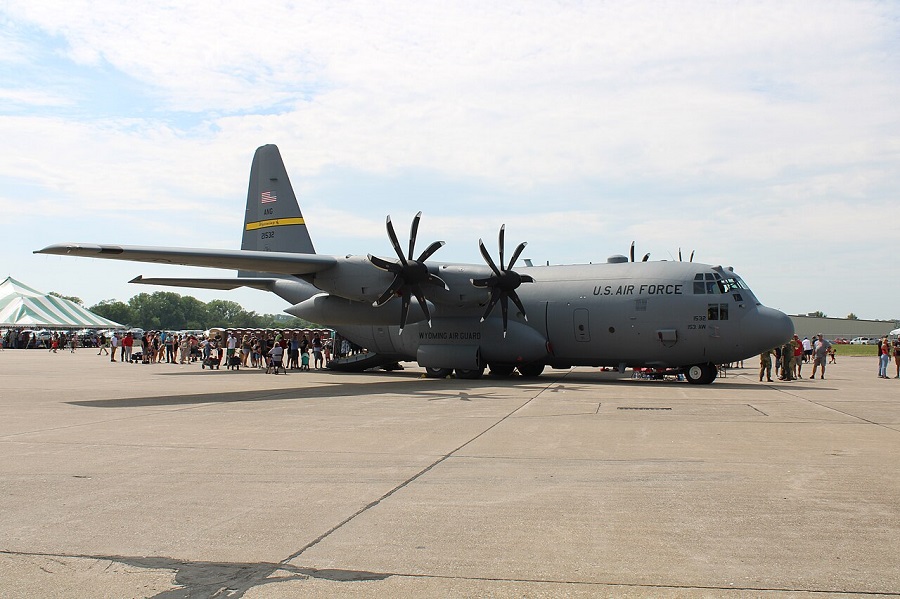
The current US force consists solely of 450 Minuteman-III missiles in missile silos around F.E. Warren AFB, Wyoming; Malmstrom AFB, Montana; and Minot AFB, North Dakota.

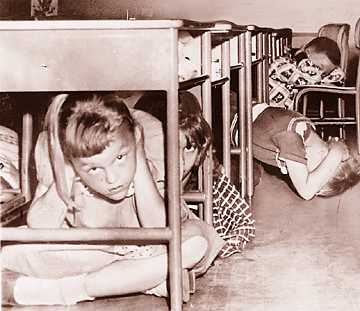
If for some extraordinary reason, the nukes would start flying, the people of Melita and other parts of southwestern Manitoba better Duck and Cover.

1950’s U.S. Duck and Cover promo.  As if this would help.