Year: 2024


The rise and fall of the Boombox
Boombox is a common term for a portable cassette or CD player with two or more loudspeakers and a carrying handle. Other commonly used terms are ghetto blaster, stereo, jambox, boomblaster, Brixton briefcase, and radio-cassette. A boombox is a device typically capable of receiving radio stations and playing recorded music (usually cassettes or CDs, usually at a high volume).

The first boombox was developed by the inventor of the audio compact cassette, Philips of the Netherlands. Their first ‘Radiorecorder’ was released in 1966. The Philips innovation was the first time that radio broadcasts could be recorded onto cassette tapes without the cables or microphones that previous stand-alone cassette tape recorders required. Although sound quality of early tape recordings was poor, improvements in technology and the introduction of stereo recording, chromium tapes, and noise reduction made hifi quality devices possible. Several European electronics brands, such as Grundig, also introduced similar devices.
Boomboxes were soon also developed in Japan in the early 1970s and became popular there due to their compact size and impressive sound quality. The Japanese brands soon took over a large portion of the European boombox market and were often the first Japanese consumer electronics brands that a European household might purchase. The Japanese innovated by creating different sizes, form factors, and technology, introducing such advances as stereo boomboxes, removable speakers, in-built TV receivers, and inbuilt CD players.
The boombox was introduced to the American market during the mid-1970s, with the bulk of production being carried out by Panasonic, Sony, Marantz, and General Electric. It was immediately noticed by the urban adolescent community and soon had a large market, especially in metropolitan centers such as New York, Los Angeles, and Washington D.C.
The earlier models were a hybrid that combined the booming sound of large in-home stereo systems and the portability of small portable cassette players; they were typically small, black or silver, heavy, and capable of producing high volumes. The effective AM/FM tuner the coupling of devices such as microphones and turntables.
The development of audio jacks brought the boombox to the height of its popularity, and as its popularity rose, so did the level of innovation in the features included in the box. Consumers enjoyed the portability and sound quality of boomboxes, but one of the most important features, especially to the youth market, was the bass. The desire for louder and heavier bass led to bigger and heavier boxes.
Regardless of the increasing weight and size, the devices continued to become larger to accommodate the increased bass output; newer boombox models were affixed with heavy metal casings to handle the vibrations from the bass.


The 1990s were a turning point for the boombox in popular culture. The rise of the Walkman and other advanced electronics eliminated the need to carry around such large and heavy audio equipment, and boomboxes quickly disappeared from the streets. As boombox enthusiast Lyle Owerko puts it, “Towards the end of any culture, you have the second or third generation that steps into the culture, which is so far from the origination, it’s the impression of what’s real, but it’s not the full definition of what’s real. It’s just cheesy.” The Consumer Electronics Association reported that only 329,000 boombox units without CD players were shipped in the United States in 2003, compared to 20.4 million in 1986.
Although many boomboxes had dual cassette decks and included dubbing, line, and radio recording capabilities, the rise of recordable CDs, the decline of audio cassette technology, and the popularity of high-density MP3 players and smart phones have reduced the popularity of high-quality boomboxes to such an extent that it is difficult to find a new dual-decked stereo. Dubbing remains popular among audiophiles, bootleggers, and pirates, though most tasks are now accomplished through digital means or analog-to-digital conversion technology.
Starting in mid-2010, there are new lines of boomboxes that use Bluetooth technology known as Stereo Bluetooth, or A2DP (Advanced Audio Distribution Profile). They use the wireless Bluetooth technology to “stream” audio to the boombox from a compatible Bluetooth device, such as a mobile phone or Bluetooth MP3 player. An example of this is the JAMBOX, which is marketed as a “Smart Speaker” as it can also function as a speakerphone for voice calls in addition to being an audio playback device.
Are they coming back?

Turkey Black Magic
A driver in Massachusetts was left dumbfounded when he spotted a flock of wild turkeys eerily circling the body of a dead cat!
Jonathan Davis filmed the bizarre scene in the town of Randolph on Thursday and posted it to his Twitter feed joking that the turkeys were trying to give the cat its 10th life.
As one might expect, the creepy video of the ‘turkey witchcraft’ subsequently went viral with amazed viewers offering various suggestions for what the creatures were doing.
Fortunately for anyone who enjoys Thanksgiving, the turkeys were probably not practicing a bird-based form of black magic.
A wildlife official in Massachusetts named David Scarpitti explained that cats are natural enemies of turkeys and, therefore, the curious creatures were likely trying to figure out what the feline was doing in the road.
The spooky circular motion around the downed cat, he said, could have been caused by one turkey performing the motion and then all of the others falling into line behind it, which is the typical way that the birds travel.
Nonetheless, Scarpitti marveled neither he nor any of his colleagues had ever seen such a thing in all their years on the job.
Smash it Up!
We’ve been crying now for much too long
And now we’re gonna dance to a different song
I’m gonna scream and shout til my dying breath
I’m gonna smash it up til there’s nothing left
Oh oh smash it up, smash it up, smash it up
Oh oh smash it up, smash it up, smash it up
People call me villain oh its such a shame
Maybe its my clothes must be to blame
I don’t even care if I look a mess
Don’t want to be a sucker like all the rest
Oh oh smash it up, smash it up, smash it up
Oh oh smash it up, smash it up, smash it up
Smash it up [Repeat: x5]
Smash it up, you can keep your Krishna burgers
Smash it up, and your Glastonbury hippies
Smash it up, you can stick your frothy lager
Smash it up, and your blow wave hairstyles
And everybody’s smashing things down
I said everybody’s smashing things down yeah
Big Time Monkey Business
A Thai city was plunged into chaos this weekend as hundreds of monkeys escaped from their enclosure and took to the streets in search of food, causing concerned police to lock themselves inside their station. The wild incident reportedly occurred in the community of Lopburi, which has long struggled to contain its growing population of increasingly aggressive macaques. One solution to the problem has been to round up the particularly pugnacious primates and keep them in sizeable compounds where they could no longer menace the public. However, the plan backfired spectacularly on Saturday when around 200 of the captured creatures staged a successful jailbreak.
The city was soon flooded with the newly freed macaques, much to the chagrin of one police department that found itself targeted by the troublesome monkeys. Out of fear that the animals would lay waste to the inside of their station while looking for food, cops sealed the building off while calling for all officers on duty to return to headquarters in order to help fend off the creatures. Fortunately, the veritable simian invasion did not last very long as the monkeys were coaxed back to their enclosure with the one thing they had sought: snacks. By Monday, only a few of the macaques remained on the loose with authorities in hot pursuit of the pesky primates that had caused a ruckus in the city over the weekend.
Train Through a Football Stadium
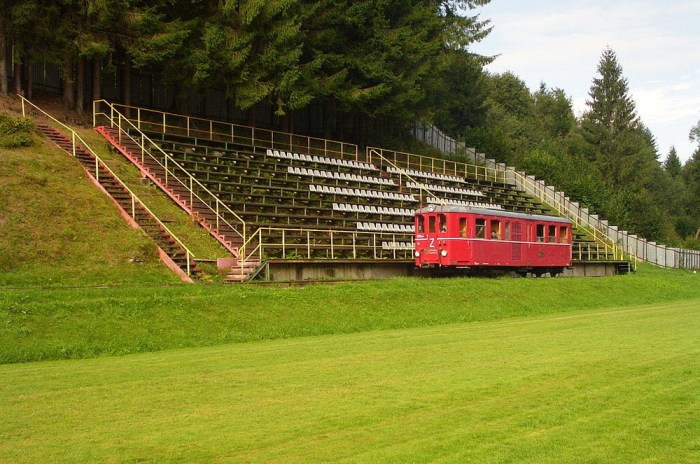
Going to any sporting event to watch your favorite teams play, as opposed to staying at home and watching the live broadcast, has its perks. Stadium is all about the experience—the noise, the crowd, the shouting, the occasional disruption—it all adds to the thrill. So imagine how thrilling the experience must be for spectators watching the TJ Tatran Čierny Balog club play against visiting teams, when the game is disrupted by an old steam train chugging right through the stadium between the stands and the pitch. This municipal stadium in Čierny Balog in Slovakia is the only stadium in the world with a pair of live railway tracks cutting across it.

Čierny Balog is a large municipality, a conglomeration of thirteen villages, which was one of the centers of the anti-Nazi Slovak National Uprising during the Second World War. The historical narrow gauge railway was built in the early 1900s, originally to transport wood between Čierny Balog and Hronec. Later, the network was extended to transport wood from the forests and by the middle of the 20th century the railway had a total length of nearly 132,000 kilometers, and was the most extensive forestry railway network in Czechoslovakia.
When the railway was laid in 1914 there was no football pitch. That was built later, as the village grew. In 1982 the the railway stopped operating, but ten years later, it started running again as a heritage railway for tourists.
The Čierny Hron railway track is now 17 kilometers long.
The football stadium belongs to the local TJ Tatran Čierny Balog club. It’s a small stadium with only two stands on one side, and open on the rest. The tracks pass directly in front of the stands.











Interesting Planet






 as seen from a plane









 The MarkoZen Blog