
⋅

.

.

.

.

.

.

.

.

.

.

.

.

⋅
.
.
.
.
.
.
.
.
.
.
.
.
A flight helmet, sometimes nicknamed a “bone dome”, is a special type of helmet primarily worn by military aircrew.
A flight helmet can provide:

SR-71 Blackbird pilot helmet. The plane flew so fast and high that the helmet resembles a space helmet.


The Soviet (Russian) MIG-25 Foxbat also flew very high and fast.

Chinese helmet variations

U.S. Navy helmet

F/A-18 Super Hornet carrier pilots


F-22 Raptor pilot helmet

U.S. Marine Corp Harrier pilots always wear camo helmets


U.S. Air Force Thunderbirds demo team

Royal Canadian Air Force

F-35 Lightning II

Each helmet costs $400,000!
Vision Systems International (VSI; the Elbit Systems/Rockwell Collins joint venture) along with Helmet Integrated Systems, Ltd. developed the Helmet-Mounted Display System (HMDS) for the F-35 Joint Strike Fighter aircraft. In addition to standard Helmet Mounted Display (HMD) capabilities offered by other systems, HMDS fully utilizes the advanced avionics architecture of the F-35 and provides the pilot video with imagery in day or night conditions. Consequently, the F-35 is the first tactical fighter jet in 50 years to fly without a HUD. A BAE Systems helmet was considered when HMDS development was experiencing significant problems, but these issues were eventually worked out. The Helmet-Mounted Display System was fully operational and ready for delivery in July 2014.
The F-35 does not need to be physically pointing at its target for weapons to be successful. Sensors can track and target a nearby aircraft from any orientation, provide the information to the pilot through their helmet (and therefore visible no matter which way the pilot is looking), and provide the seeker-head of a missile with sufficient information. Recent missile types provide a much greater ability to pursue a target regardless of the launch orientation, called “High Off-Boresight” capability. Sensors use combined radio frequency and infra red (SAIRST) to continually track nearby aircraft while the pilot’s helmet-mounted display system (HMDS) displays and selects targets; the helmet system replaces the display-suite-mounted head-up display used in earlier fighters. Each helmet costs $400,000.
The F-35’s systems provide the edge in the “observe, orient, decide, and act” OODA loop; stealth and advanced sensors aid in observation (while being difficult to observe), automated target tracking helps in orientation, sensor fusion simplifies decision making, and the aircraft’s controls allow the pilot to keep their focus on the targets, rather than the controls of their aircraft.
And Lastly
↓

Let’s keep this going:
For five centuries, the inhabitants of Nuanquan village in Yu County, in the northwestern reaches of Hebei province, China, have marked the Lunar New Year with a remarkable pyrotechnic tradition. Adorned in wide-brimmed straw hats and sheepskin jackets, local blacksmiths engage in a mesmerizing spectacle, flinging ladle after ladle of molten iron against a towering brick wall. Upon impact, the molten metal erupts into a spectacular cascade of sparks, reminiscent of a dazzling fireworks display.







Not quite sure what the message being implied here is.








Lets hope these scenarios stay as Art only.
Unusually mild temperatures in Winnipeg. Ice sculptures and not totally frozen river. I contend global warming is real!





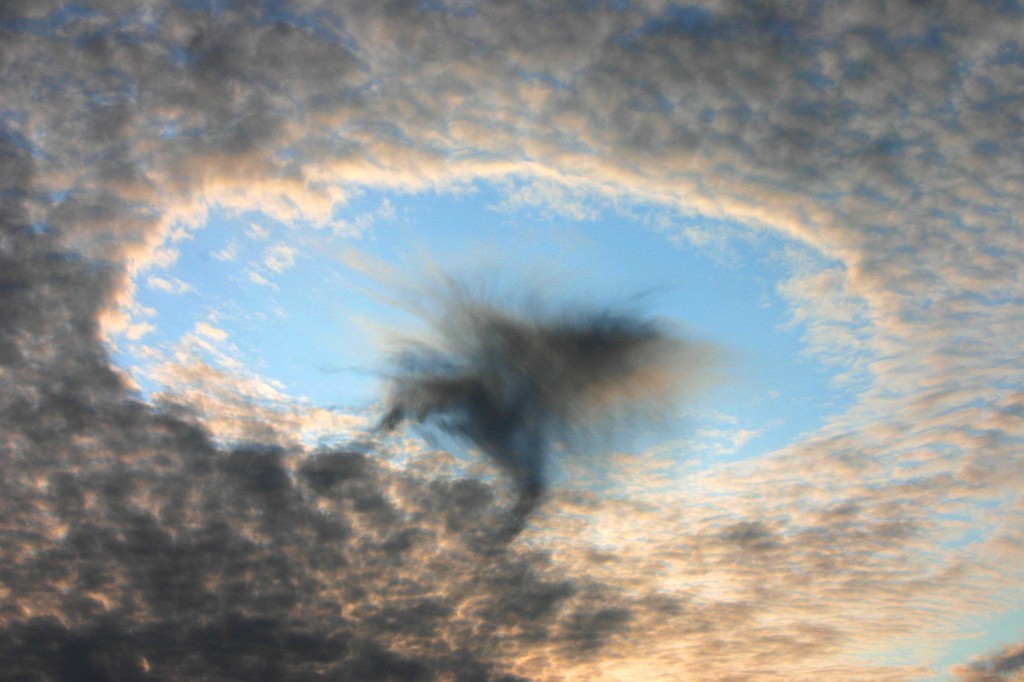
A group of fishermen in Florida were left scratching their heads at the sight of several strange-looking clouds that appeared to be alien in nature. The peculiar incident reportedly occurred last week off the coast of Key West. Capturing the curious scene on film, one of the witnesses can be heard exclaiming “look at these clouds, what is going on” as he spans across the sky showing around seven of the circular formations that somewhat resemble classic flying saucers.
The group subsequently posted the footage online in the hopes that someone could identify the puzzling phenomenon that they witnessed that day. While many viewers jokingly suggested that the anomalies were cloaked extraterrestrial craft, the fishermen were not actually in danger of being abducted by aliens as there is a meteorological explanation for what manifested in the sky. What the group witnessed was, in fact, a weather phenomenon known as a ‘punch hole cloud’ which occurs when planes passing overhead distribute ice crystals that interact with the atmosphere and create the alien-looking formations.
A fallstreak hole (also known as a cavum, hole punch cloud, punch hole cloud, skypunch, cloud canal or cloud hole) is a large gap, usually circular or elliptical, that can appear in cirrocumulus or altocumulus clouds. The holes are caused by supercooled water in the clouds suddenly evaporating or freezing, and may be triggered by passing aircraft.
Because of their rarity and unusual appearance, fallstreak holes have been mistaken for or attributed to unidentified flying objects.





 The MarkoZen Blog