If it wasn’t for Lucille Ball, there wouldn’t be any Trekkies

The ultimate decision to put the original Star Trek series on the air back in 1966 fell into the hands of Lucille Ball. She was a studio executive (Desilu) who wielded power over decisions like which shows will move forward and which shouldn’t. She took the Star Trek plunge, the rest is mega science fiction franchise history.

Lucille Désirée Ball (August 6, 1911 – April 26, 1989) was an American actress, comedienne, model, film studio executive, and TV producer. She was the star of the sitcoms I Love LucyThe Lucy–Desi Comedy HourThe Lucy ShowHere’s Lucy, and Life with Lucy.

How Star Trek was launched:

In April 1964, Roddenberry presented the Star Trek draft to Desilu Productions, a leading independent television production company. He met with Herb Solow, Desilu’s Director of Production. Solow saw promise in the idea and signed a three-year program-development contract with Roddenberry.

The idea was extensively revised and fleshed out during this time – ‘The Cage’ pilot filmed in late 1964 differs in many respects from the March 1964 treatment. Solow, for example, added the Star Date concept.

Desilu Productions had a first-look deal with CBS. Oscar Katz, Desilu’s Vice President of Production, went with Roddenberry to pitch the series to the network. They refused to purchase the show, as they already had a similar show in development, the 1965 Irwin Allen series Lost in Space.

In May 1964, Solow, who previously worked at NBC, met with Grant Tinker, then head of the network’s West Coast programming department. Tinker commissioned the first pilot – which became ‘The Cage’. NBC turned down the resulting pilot, stating that it was ‘too cerebral.’ However, the NBC executives were still impressed with the concept, and they understood that its perceived faults had been partly because of the script that they had selected themselves.

NBC made the unusual decision to pay for a second pilot, using the script called “Where No Man Has Gone Before”. Only the character of Spock, played by Leonard Nimoy, was retained from the first pilot, and only two cast members, Majel Barrett and Nimoy, were carried forward into the series. This second pilot proved to be satisfactory to NBC, and the network selected Star Trek to be in its upcoming television schedule for the fall of 1966.

The second pilot introduced most of the other main characters: Captain Kirk (William Shatner), chief engineer Lt. Commander Scott (James Doohan) and Lt. Sulu (George Takei), who served as a physicist on the ship in the second pilot but subsequently became a helmsman throughout the rest of the series. Paul Fix played Dr. Mark Piper in the second pilot; ship’s doctor Leonard McCoy (DeForest Kelley) joined the cast when filming began for the first season, and he remained for the rest of the series, achieving billing as the third star of the series. Also joining the ship’s permanent crew during the first season were the communications officer, Lt. Nyota Uhura (Nichelle Nichols), the first African-American woman to hold such an important role in an American television series; the captain’s yeoman, Janice Rand (Grace Lee Whitney), who departed midway through the first season; and Christine Chapel (Majel Barrett), head nurse and assistant to McCoy. Walter Koenig joined the cast as Ensign Pavel Chekov in the series’ second season.

In February 1966, Star Trek was nearly killed by Desilu Productions, before airing the first episode. Desilu had gone from making just one half-hour show (The Lucy Show), to deficit financing a portion of two expensive hour-long shows, Mission: Impossible and Star Trek. Solow was able to convince LUCILLE BALL that both shows should continue.

ballx3

Imagine the world without Trekkies.

trekx

trekkies

Roswell-Bound ‘Flying Saucer’ Stopped Again

A pair of UFO buffs’ road trip to Roswell has become an unforgettable journey as their ‘flying saucer’ car is back in the headlines after being pulled over by the cops for a second time. The curious ‘craft’ popped up in the news earlier this week when the Crawford County Sheriff’s Office in Missouri took to social media with the account of how one of their deputies had encountered the odd vehicle as it cruised along the highway. Weirdly enough, just as the amusing photos from the odd traffic stop were going viral, the ‘flying saucer’ found itself yet again on the side of the road after catching the attention of authorities.

Also detailing the stop on social media, the Oklahoma Highway Patrol shared photos of the peculiar car and marveled that “it’s not every day you pull over a UFO.” They went on to recount how the out-of-this-world vehicle had been stopped by a trooper when he noticed that it had an obstructed tag. While the post made no mention of the fact that this was the same flying saucer that was pulled over in Missouri days earlier, it undoubtedly was and, just as in that instance, the UFO buffs were given a warning after they explained that they were headed for Roswell for this weekend’s festivities. Similarly, the second traffic stop has also gone viral, extending the car’s fifteen minutes of fame by a few more days.

It is uncertain where the flying saucer might currently be on its sojourn to Roswell, though one would not be surprised if it winds up being pulled over yet again before making it to New Mexico since it’s certainly not flying under the radar of police. However, when the UFO buffs finally do arrive at the festivities, they are likely to receive a hero’s welcome thanks to its headline-making journey that unfolded over the past week. That said, they might want to fix whatever issue keeps getting them pulled over, since cops may be less forgiving of the ‘craft’ when it’s on the way home from the big event.

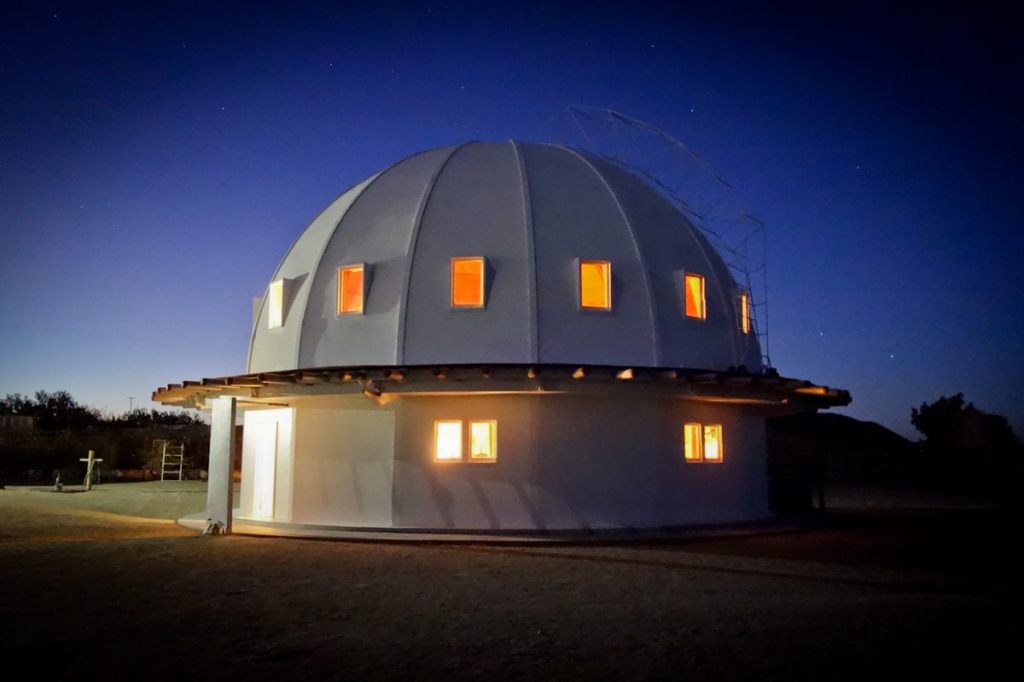
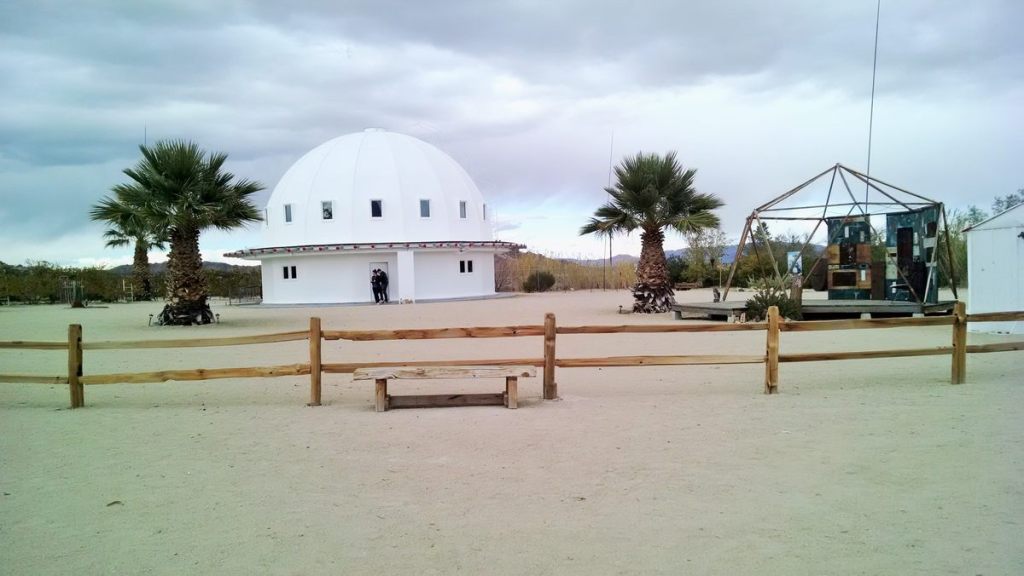
The Integratron

Experience a quartz crystal sound bath inside a storied, all-wood sound-chamber. 

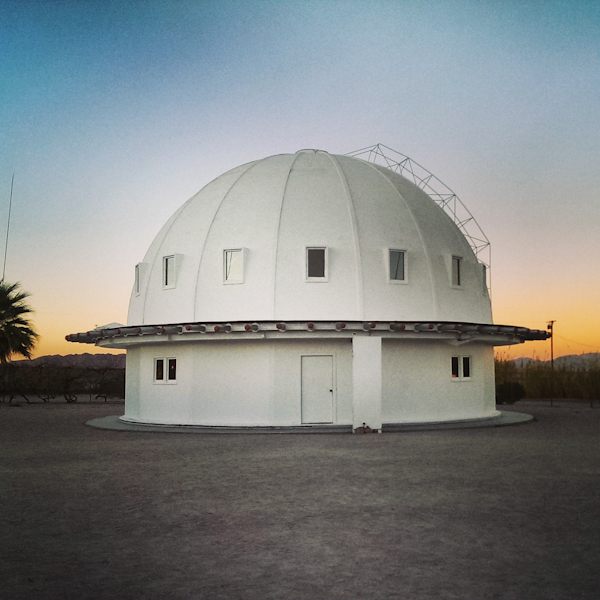
THE INTEGRATRON IS A PARABOLIC dome-shaped structure in the Mojave Desert near Landers, California.

Construction began in 1954 from the design of aeronautical engineer and ufologist, George Van Tassel, who built the dome after allegedly receiving instructions from extraterrestrials from Venus known as “The Council of Seven Lights.” During this UFO encounter, Van Tassel claims that he was invited aboard a Venusian spaceship and given explicit instructions on how to create a machine that could rejuvenate living cell tissues.

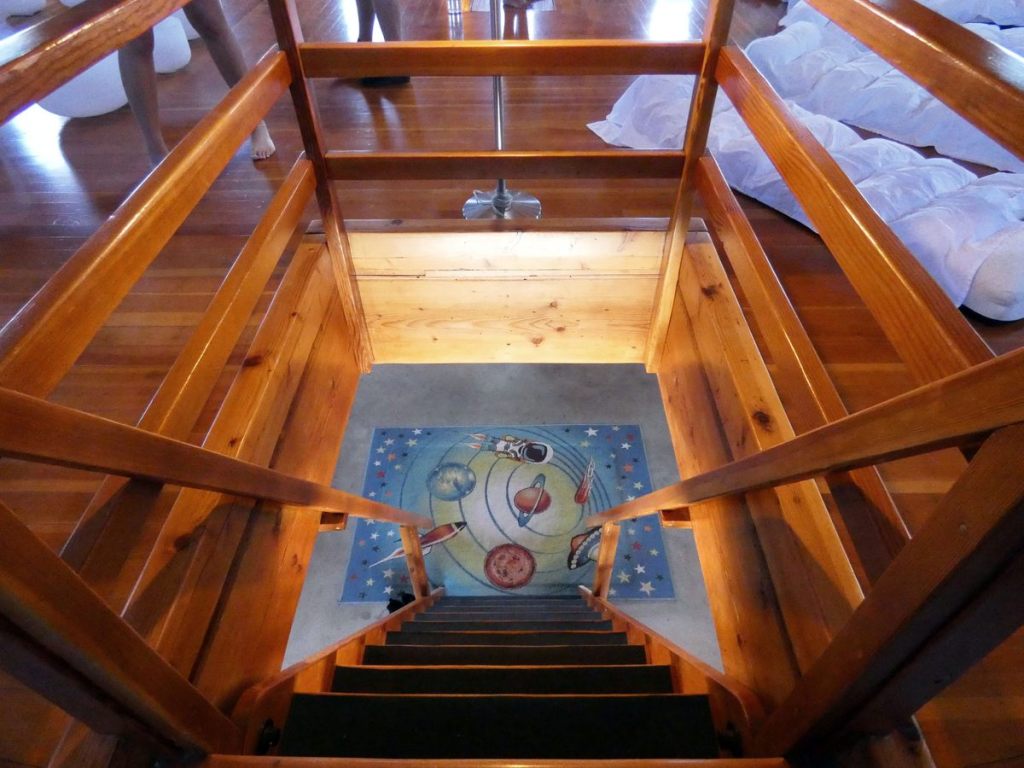
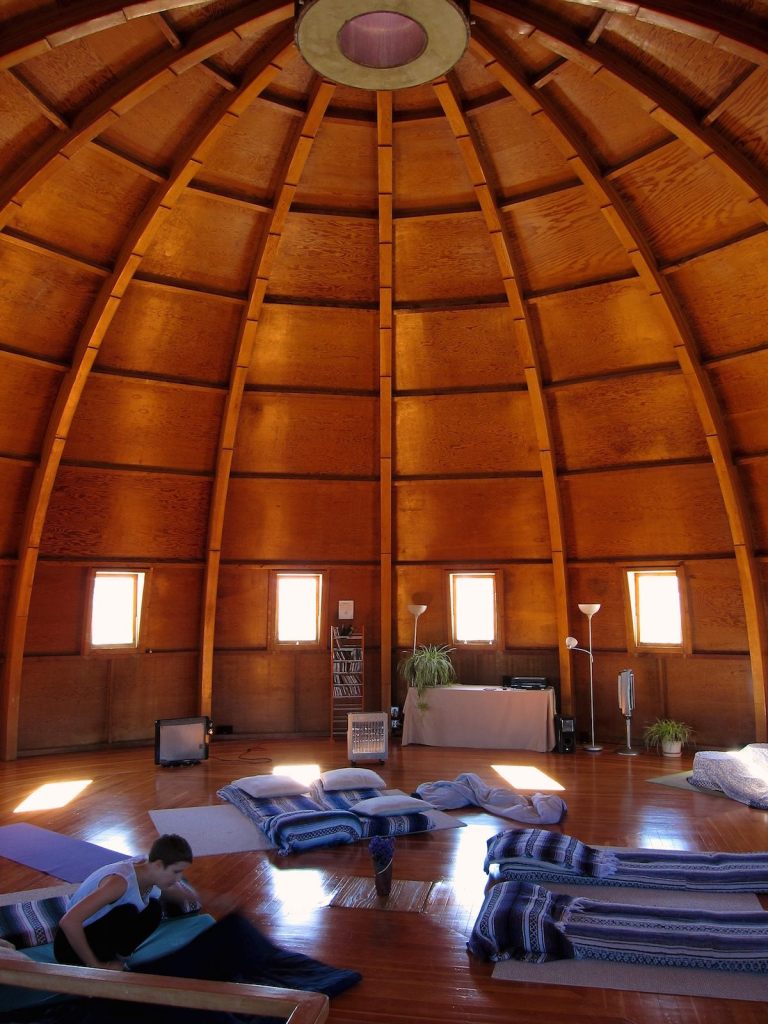
Van Tassel chose the Integratron’s site due to its supposedly powerful geomagnetic energy (though there is no scientific evidence of any such energy), which he believed could be amplified within a wooden parabolic structure. As such, the building was constructed without the use of any nails, consisting only of plywood and fiberglass held together by wood dowels and a 1.5-ton cement ring serving as the keystone. Using these materials, and influenced by the theories of Nikola Tesla and sacred geometry, Van Tassel believed that the Integratron was more than a building and would serve as a combination of a time machine, rejuvenation machine, and an anti-gravity device.

Though Van Tassel worked on the Integratron until his sudden death in 1978, he was never able to test his own creation. His hard work paid off, however, as the building is so structurally sound that it withstood the infamous Landers Earthquake of 1992, which measured as a 7.3 on the Richter scale.

The Integratron was purchased in 2000 by two sisters, Nancy and Joanne Karl, who have been exploring the building’s rejuvenating sonic capabilities through their popular “sound baths.” During the half-hour sound baths, visitors listen to seven musical notes on quartz crystal singing bowls, with each note devoted to the major energy centers–or chakras–of the body.

The bowls are created by crushing and heating 99.99-percent pure quartz to 4,000 degrees Fahrenheit and spinning it in a centrifugal mold. The purity of sound from the bowls, coupled with the acoustics of the all-wood paraboloid, is said to have “alternative” healing powers. 

After the sound bath, visitors can stand and speak in the center of the room and experience the resonance of their own voice reverberated back to them. They can also check out an exhibit on the building’s history, or go outside and enjoy a seat in the shade. 

For the adventurous soul, travel three miles on unpaved roads to Giant Rock, one of the world’s largest free-standing boulders and the site of Van Tassel’s popular “Giant Rock Spacecraft Conventions,” which helped fund the Integratron’s construction.

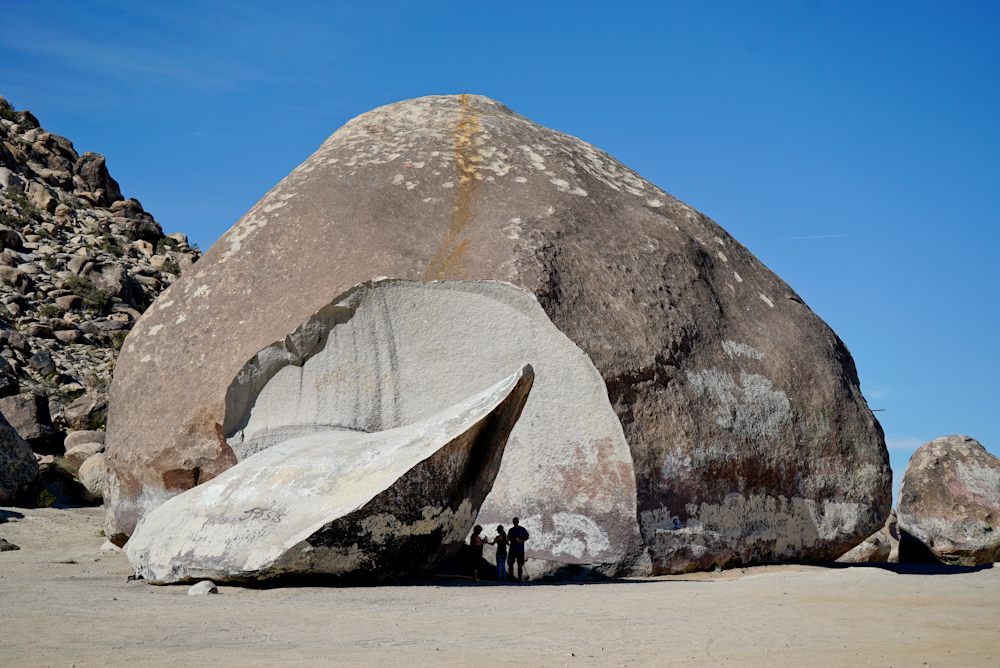
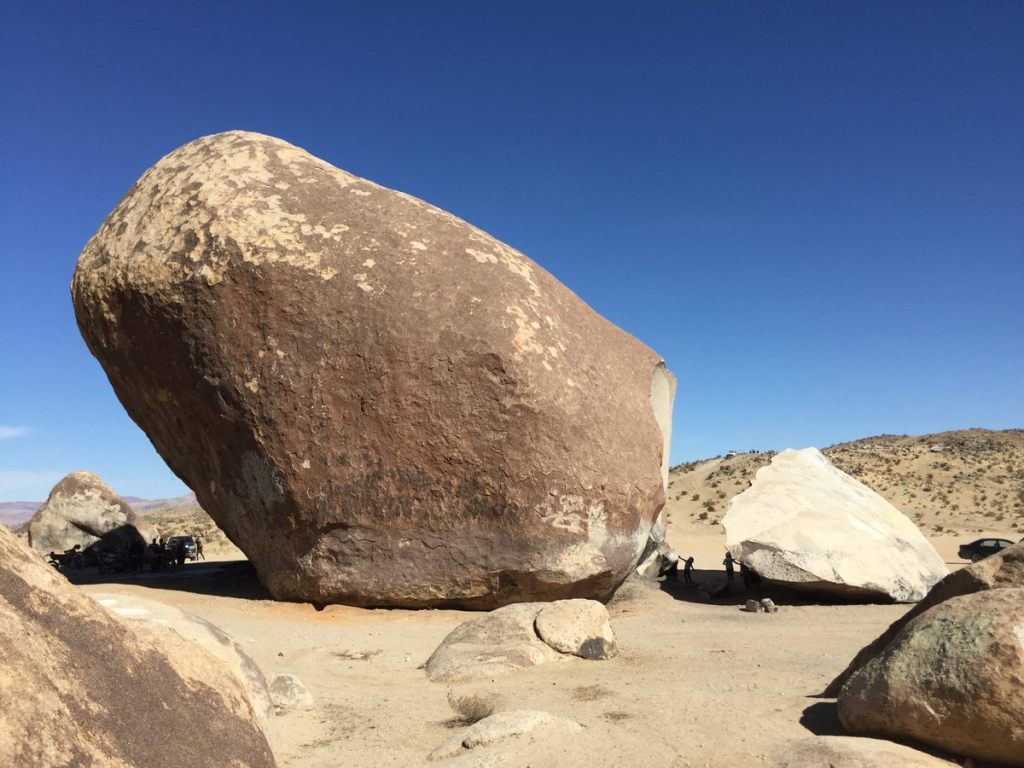
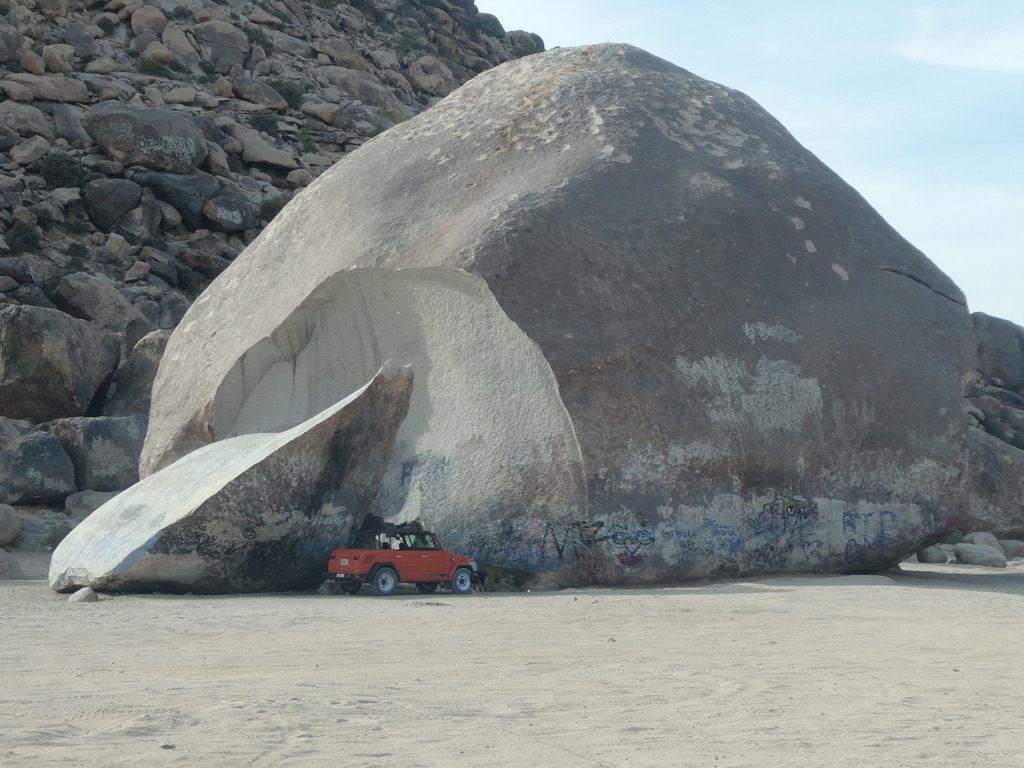
Giant Rock:

THIS SEVEN-STORY GIANT BOULDER HAS attracted UFO conferences, Hopi spiritualists, and the engineers of a “rejuvenation machine.” 

Geologically speaking, Giant Rock—located in California’s Mojave Desert—is roughly seven stories high and covers almost 6,000 square feet. Some say it is the largest freestanding boulder in the world.

This seems apropos:

Bringing Eye Contact back to the 21st Century with the Texting Hat  

hat

Okay, so maybe this isn’t a real thing yet… but, c’mon, you know it’s coming! With the tagline “Bringing eye contact back to the 21st century” the Texting Hat is here to solve all your phone zombie problems. What a great invention. You look like you actually care when in reality who gives a f#@k!

Right now they’re not for sale, but the Texting Hat website encourages you to just make your own goddamned hat:

hat1

Vintage Circus Posters  

Circus16801050

The circus, as it we think of it today, originated in Britain in 1768 by inventor Philip Astley. Astley presented shows that included horse riding tricks, acrobats, music and clowns. None of these elements were new to the British public, but Astley was the first to combine them into a single show.

Astley did not call his “Amphitheatre of Equestrian Arts” a circus. That title was awarded to a later rival’s show in 1782, and became the generic term.

In 1793 Englishman John Bill Ricketts brought the circus to the U.S., opening in Philadelphia.

The traveling circus tent was invented by American Joshua Purdy Brown, replacing the usual wooden construction with a full canvas tent. His system became commonplace by the mid 1830s.

The unique character of the American circus emerged: a traveling tent-show coupled with a menagerie and run by businessmen. It was very different model from European circuses, which for the most part remained under the control of performing families.

P. T. Barnum improved on the circus format, introducing circus trains as transport between towns. He also introduced the “freak” show, exhibiting people who were excessively tall or short, fat or thin, or with medical conditions that gave them unusual appearances. Barnum’s format became popular in Europe around the 1900s.

The number of horse riding performances gradually declined in favor of clowns, acrobats, gymnasts and jugglers, stunt acts such as fire eaters and acts involving animals. The incorporation of animals in circus acts or in menageries has almost ceased after concerns over the standards of their accommodation, training and elements of their performances.

These posters, drawn from the Circus Museum in the Netherlands, demonstrate some of the wide-ranging themes used by European circuses across the 20th century.

circusz

Circus-land-6

1915

“Circus Strassburger”

circusz1

circusz2

1923

“Circus Busch. The Sensational! Marino, Destroyer of cars. The strongest driver in the world.”

circus-poster-c1918-granger

Circa 1918

circusz3

circusz4

1932

“Looping the loop in the open ring. Laughing in the face of death! The World Champion Nic. Diavolo. Circus Maxo.”

OLYMPUS DIGITAL CAMERA