
By Kaushik
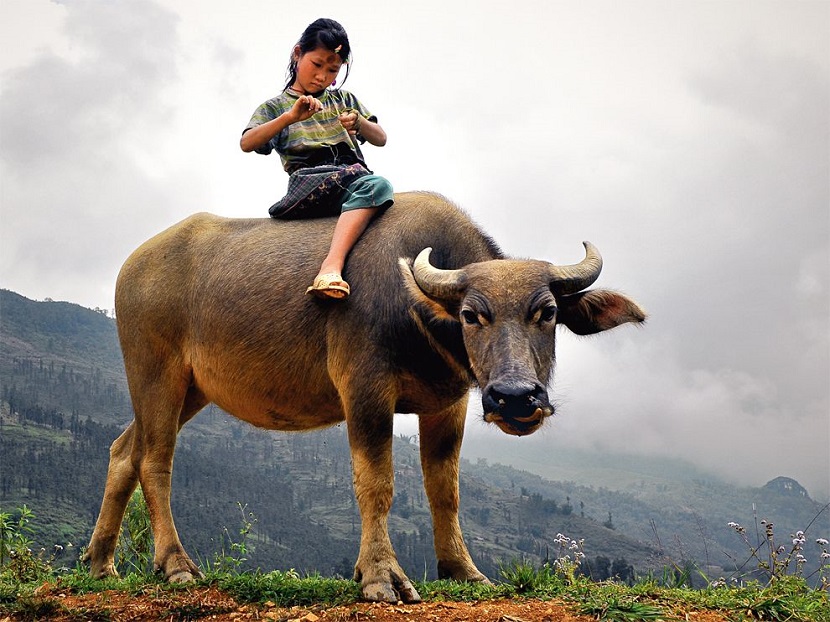
Italian photographer Gabriele Galimberti is always traveling the world in search of adventure, good stories, and interesting people. For his latest project entitled “Toy Stories”, Galimberti photographed children from around the world with their most prized possesion. He did not expect to uncover much we did not already know. “At their age, they are pretty all much the same,” is his conclusion after 18 months working on the project. “They just want to play.”
But it’s how they play that seemed to differ from country to country. Galimberti found that children in richer countries were more possessive with their toys. “At the beginning, they wouldn’t want me to touch their toys, and I would need more time before they would let me play with them,” says the Italian photographer. “In poor countries, it was much easier. Even if they only had two or three toys, they didn’t really care. In Africa, the kids would mostly play with their friends outside.”
However, there are many similarities in which the kids regard their toys, especially when it comes to their function. Galimberti met a six-year-old boy in Texas and a four-year-old girl in Malawi who both maintained their plastic dinosaurs would protect them from the dangers that await them at night. More common was how the toys reflected the world each child was born into – the girl from an affluent Mumbai family loves Monopoly, because she likes the idea of building houses and hotels, while the boy from rural Mexico loves trucks, because he sees them rumbling through his village to the nearby sugar plantation every day. A Lativian kid plays with miniature cars because his mother drove a taxi, while the daughter of an Italian farmer has an assortment of plastic rakes, hoes and spades.
Working for Toy Stories, Galimberti learned as much about the parents as he learned about the children. Parents from the Middle East and Asia, he found, would push their children to be photographed even if they were initially nervous or upset, while South American parents were “really relaxed, and said I could do whatever I wanted as long as their child didn’t mind”.
v

Watcharapom – Bangkok, Thailand
v

Stella – Montecchio, Italy
v

Ralf – Riga, Latvia
v

Botlhe – Maun, Botswana
v

Orly – Brownsville, Texas
v

Noel – Dallas, Texas
v

Maudy – Kalulushi, Zambia
v

Li Yi Chen – Shenyang, China
v

Chiwa – Mchinji, Malawi
v

Davide – La Valletta, Malta
v

Cun Zi Yi – Chongqing, China
v

Arafa & Aisha – Bububu, Zanzibar
v

Tyra – Stockholm, Sweden
As a hopefully beautiful summer approaches Winnipeg , the citizens realize the dark, cold, windy, snow covered hell frozen over reality of an impending winter will be here in five months .

Winters in Winnipeg are usually long and dry with occasional blasts of bitterly cold weather from the northwest. Out of Canada’s 100 largest cities, Winnipeg’s winter is the tenth coldest with an average low of −20.2 °C (−4.4 °F). The snow cover season lasts 132 days; usually from November till March, sometimes earlier or later. From December through February the maximum daily temperature exceeds 0 °C (32 °F), on average, for only 10 days and the minimum daily temperature falls below −20 °C (−4 °F) on 49 days. The coldest temperature ever recorded in Winnipeg was −47.8 °C (−54 °F), on 24 December 1879 and the coldest since then was −45 °C (−49 °F) on 18 February 1966. Within the past twenty years, the temperature has dipped below −40.0 °C (−40 °F) once on 5 February 2007 as well as both 29 and 30 January 2004. On 1 February 1996 the temperature was −41.8 °C (−43.2 °F) however, the wind chill was -57.1, making this the coldest windchill in the city’s history.
But let us think ahead. If the funding and technology could coalesce, what about a dome, or domes for the city? That way the citizens could sit outside on their decks, mow the lawn and never have to plug in the car year round. The city’s snow removal budget would be non-existent, that extra revenue could be applied to the dome payments. Outdoor swimming pools could stay open all the time, drive-in restaurants could sell ice cream for 12 months and cyclists could inflame the tempers of drivers all bloody year! It would be sensational!
If the city, provincial and federal governments could each provide 10 billion dollars, and the elite prosperous entrepreneurs combined with the business oligarchs of Winnipeg provide another 10 billion, voila, the project rockets skyward. Lets do it!
Downtown Winnipeg in January

Notice a second dome in the background protecting St. Boniface
The Osborne Village area during a polar vortex in February

Sensational! Go canoeing on the Assiniboine River while a Siberian Polar Front invades western Canada, and Edmontonians are freezing their backsides, ha!
The Golden Boy atop the Legislative building would not have to endure blistering ice pellets that rain down from the frozen ionosphere.

What seems like unattainable dreams can come true, we just have to believe and stay with the dream. Persist, never say die! The dream also needs a gold mine to be discovered underneath downtown Winnipeg.


Canadians’ enthusiasm for hockey was in evidence during the Korean War, in which 27,000 Canadian troops participated in defense of freedom.
The winter of 1952 was bone-chilling enough for the Imjingang River to freeze over, a river in northern Gyeonggi-do Province that flows down and across the middle of the Korean Peninsula. At the time, the peninsula was still at war, as the Korean War had broken out in late June 1950.
Among the U.N. forces defending the South Korean side against the North were many Canadian soldiers. They were stationed along the western front abutting the Imjingang River and they were on their guard against any intrusion from the north. A biting wind howled across the riverside, however, and almost froze the gun-toting soldiers as well as the river. The winter weather turned the river itself into a great field of ice. Even amid the tense situation, with battle happening at any time, the young soldiers felt the urge to take part in their traditional winter sport: ice hockey.
They couldn’t suppress their desire for the sport, so at last members of two Canadian battalions: the Princess Patricia’s Canadian Light Infantry (PPCLI) and the Royal 22nd Regiment (R22R) turned the frozen river into an ice rink for a hockey match. The glacial winter air didn’t stop the soldiers’ passion for their sport. The match took place “in the sound of the heavy guns of nearby U.S. Army artillery”, just a short distance from the front lines of the struggle against Communist forces, recalled Korean War veteran Vince Courtenay.
Although the exact origins of ice hockey are much disputed, ice hockey is thought to have first developed in the 19th century in Canada. Scholars agree that the rules for ice hockey were first codified at McGill University in Montreal, in 1879. Since then, Canada has been synonymous with the sport.

During this game, the 3rd Battalion Princess Patricia’s won 4-2 against the 1st Battalion of the Royal 22e Regiment.

Brigadier John Rockingham drops the puck for a match between 1st Battalion, Princess Patricia’s Canadian Light Infantry (left) and 2nd Battalion, Royal 22e Regiment “Vandoos” (right) during the Korean War. Playing for the Patricias was Private W. Wolfe. For the Royal 22e Regiment, Private R. Halley.

Many of these troops were surprised to find in Korea a climate not much different from that which they had left in Canada, with cold winters meaning frozen rivers where they could play their favorite sport.

The matches took place “in the sound of the heavy guns of nearby U.S. Army artillery,” just a short distance from the front lines of the struggle against Communist forces, said Korean War veteran Vince Courtenay.

It would have been a startling sight for enemy soldiers from the hills above the Imjin River in the winters of 1952 and 1953 — Canadians fighting for the puck on shimmering ice between deadly battles for precious terrain on the Korean Peninsula at the height of the Cold War conflict.
The Reptilian alien is a fixture of science-fiction, from H.P. Lovecraft’s tales of Valusians to the Cardassians in Star Trek, to the Visitors of the television series V. But could ancient myths about reptilian creatures provide evidence that they are more than just a pop-culture creation? Legends of serpent beings can be found on every continent. The Bible, the Quran and the ancient texts known as the Nag Hammadi codices all describe reptilian entities interacting with humans. In Central and South America people worship the feathered serpent god called Kulkukan or Quetzalcoatl. In India, the Nagas are half-human half-reptile gods who live underground in a place called Patala. And in China and Japan, many emperors claim to be the descendants of dragons. Could these stories represent real Reptilian beings that people all over the world actually encountered in the ancient past?

The Ancient Aliens hair guy is quite unaware of what is going to hit him.


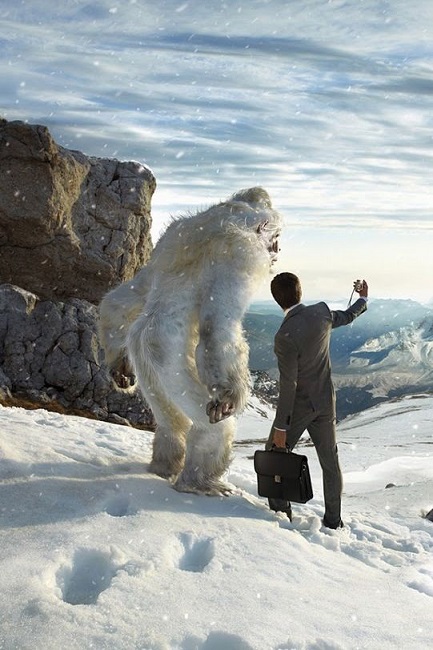
The NHL may soon have a rather sizeable cryptozoological presence on the ice as ‘Yeti’ has emerged as a possible name of a forthcoming franchise based in Utah. Team owners Smith Entertainment Group announced on Thursday that the proverbial abominable moniker was among the six finalists alongside the Utah Hockey Club, Mammoth, Outlaws, Blizzard, and Venom. For those who would like to see the legendary beast of the Himalayas come to the NHL, they can help make it happen as the ultimate decision on the new team’s name has been left up to the public with an online vote that ends on June 20th. Should ‘Yeti’ come out on top, it will actually be the second NHL team to be named after a cryptid as the Seattle franchise adopted the moniker ‘Kraken’ back in 2020.
Lily Munster, Countess of Shroudshire (née Dracula), is a fictional character in the CBS sitcom, The Munsters, originally played by Yvonne De Carlo. The matriarch of the Munster household, Lily is a vampire.
Lily was born in 1827 to Sam Dracula (Grandpa) and his 166th wife (referred to only as “Grandma”). She lived with Grandpa for some time in Transylvania (a region in Romania) before meeting Herman Munster and marrying him in 1865. She, Grandpa, and Herman moved to America sometime before the mid-1940s and adopted her sister’s child, Marilyn. In the mid-1950s, she gave birth to Eddie, her and Herman’s only child.
Her name is presumably derived from the tradition of the lily as a flower of death, or a vague reference to Lilith, a female demon of Jewish mythology.

Lily is the matriarch of the Munster family. She is very close with her niece, Marilyn. She has a werewolf for a brother, who appears in one episode, and a sister who is mentioned a few times who is Marilyn’s mother. Lily is the voice of reason in the Munster household, often relied upon to set problems right, and typically mediates when Herman and Grandpa squabble.

Lily and Herman
Lily also has a fiery temper. While she is deeply in love with Herman (“Pussycat,” as she calls him), she also frequently gets very angry at him (due to his frequent stupidity and occasional selfishness), and Herman often meekly discloses his fear (to others) of being on the receiving end of her wrath. She also has reprimanded her own father (Grandpa) on several occasions for his own foolish actions and stubborn self-righteousness.
Lily is a beautiful and slender woman who appears to be in her middle age years, although she is actually hundreds of years old. A white streak in her hair recalls the monster’s mate from Bride of Frankenstein. Lily usually dresses in an ankle-length pale pink gown that appears faded and old, and she sometimes also wears a scarf. Her necklace features a bat-shaped medallion. When away from the Munster house, she sometimes wears a long silver cape with a hood. In the episode “Munsters Masquerade”, Lily demonstrates the ability to float in the air while dancing.
Gothic Underwear

Herman loves it


#10 Coors Light (United States)
2005 rank: 7
Market share: 1.3%
Outsold Coors by almost 13 to 1

#9 Brahma (Brazil)
2005 rank: 5
Market share: 1.5%
Brazilian beer also in AB InBev family

#8 Harbin (China)
2005 rank: 15
Market share: 1.5%
Chinese brand owned by AB InBev

#7 Heineken (Netherlands)
2005 rank: 6
Market share: 1.5%
Oldest brand in the top 10 (142 years)

#6 Yanjing (China)
2005 rank: 16
Market share: 1.9%
Billed as “the state beer of China”


#5 Skol (Brazil)
2005 rank: 3
Market share: 2.2%
InBev’s top beer before the merger with AB

#4 Budweiser (United States)
2005 rank: 2
Market share: 2.3%
The dethroned “King of Beers.” Chef David Chang is now a spokesman.

#3 Bud Light (United States)
2005 rank: 1
Market share: 2.5%
Sales volume down 7% since 2009

#2 Tsingtao (China)
2005 rank: 10
Market share: 2.8%

#1 Snow (China)
2005 rank: 11
Market share: 5.4%
Sales volume up 573% since 2005

United States

Canada


An exotic type beer. Rogue brewing from Portland, Oregon

ROGUE Sriracha Hot Stout Beer, made from Huy Fong original hot chili sauce and sun ripened Rogue Farms ingredients, is ready to drink with soups, sauces, pasta, pizza, hot dogs, hamburgers, chow mein, or anything you’d like to wash down with a spicy kick.
Get a load of this crazy sauce!

They say the third time’s a charm, and this time the collision of crazies created a Pretzel, Raspberry & Chocolate ale inspired by Voodoo Doughnut’s Voodoo Doll doughnut. The Voodoo people say the magic is in the hole. We think it’s also in the bottle.

Cheers!





















 The MarkoZen Blog