Year: 2023
‘Dog-Headed Pig Monster’ Sightings Reported By Namibian Villagers
Here we go again with another blood sucking unknown creature. Could this be a mutated Chupacabra? Is it black magic or are the Space Aliens trying to spook us?
Some say it’s a witch doctor, a warlock, or a work of black magic. Others say it’s a hybrid animal somewhere between a dog and a pig. But whatever it is, residents in Namibia are saying the strange creature they’ve seen wreaking havoc on their villages is nothing they’ve ever encountered before, according to the website Life’s Little Mysteries.
Villagers living near the Kalahari desert in northern Namibia have reported seeing an odd creature with a head like a dog and the shoulders of a pig, mostly white in color and with hairless spots on its back, according to the site.
They say the beast has been attacking dogs, goats and other domestic animals seemingly out of nowhere, as the region’s arid landscape is sparse in trees and shrubbery where animals might hide.
“This is an alien animal that the people have not seen before. We don’t have a forest here, only bushes. So, this must be black magic at play,” Andreas Mundjindi, a Namibian official, told the newspaper Informante.
One resident who spoke with Informante said villagers are taking precautions against the creature by staying in groups, and that many believe it’s an intelligent being that came from the house of a grey-haired man.

“Everyone believes it is his beast and even he knows that we think so,” the villager told Informante. “When it comes our side in the night, all the dogs are barking, but if it goes back west, then it’s all hush. People must be safe. We don’t want to be mauled by things we don’t know.”
The sightings follow a number of reports out of Africa in recent years involving alleged sightings of strange creatures. In 2009, the Namibian newspaper New Era reported that a number of villagers had filed complaints with police stating that a mysterious tiger-like creature had been sucking blood of their livestock.
Police spokeswoman Christina Fonsech told the paper that police tried to track the creature’s footprints, which were doglike, though bigger.
“We followed them but they walked until a spot where they just vanished,” Fonsech told New Era. “It’s difficult to explain what happened to those footprints because they looked as if they climbed onto something but it was in an open space, so we don’t know what happened.

One elusive creature of legend from the Congo region, known as the “Mokele-mbembe,” has intrigued myth hunters for years. Believed by some to be the surviving ancestor of a dinosaur, similar to the rumored Loch Ness Monster, the animal has been reported in sightings as far back as 1776, according to research by cryptozoologist William Gibbons.
Gibbons published a description of the creature, written by a German captain during a colonial expedition of the Congo in 1913:
The animal is said to be of a brownish gray color … its size approximating that of an elephant. It is said to have a long and very flexible neck. Some spoke of a long muscular tail like that of an alligator. Canoes coming near it are said to be doomed; the animals are said to attack the vessels at once and to kill the crews but without eating the bodies. The creature is said to live in the caves that have been washed out by the river in the clay of its shores at sharp bends. It is said to climb the shore even in daytime in search of its food; its diet is said to be entirely vegetable.
The 638 Assassination Attempts by the CIA on Fidel Castro

Castro quote: “If surviving assassination attempts were an Olympic event, I would win the gold medal.”
The United States’ Central Intelligence Agency made many attempts to assassinate Fidel Castro during his time as the President of Cuba. All the attempts on Fidel Castro’s life failed.
Following World War II, the United States became secretly engaged in a practice of international political assassinations and attempts on foreign leaders. For a considerable period of time, the U.S. Government officials vehemently denied any knowledge of this program since it would be against the United Nations Charter. On March 5, 1972, Richard Helms, Central Intelligence Agency (CIA) Director, declared that, “no such activity or operations be undertaken, assisted, or suggested by any of our personnel.” In 1975, the U.S. Senate convened the Senate Select Committee to Study Governmental Operations with Respect to Intelligence Activities. It was chaired by the Senator Frank Church (D-Idaho). The Church Committee uncovered that CIA and other governmental agencies employed a so-called tactic of “plausible deniability” during decision-making related to assassinations. CIA subordinates were deliberately shielding the higher-ranking officials from any responsibility by withholding full amount of information about planned assassinations. Government employees were obtaining tacit approval of their acts by using euphemisms and sly wording in communications.
Early attempts
According to CIA Director Richard Helms, Kennedy Administration officials exerted a heavy pressure on the CIA to “get rid of Castro.” It explains a staggering number of assassination plots, aiming at creating a favorable impression on President John F. Kennedy. There were five phases in the assassination attempts, with planning involving the CIA, the Department of Defense, and the State Department:
- Prior to August 1960
- August 1960 to April 1961
- April 1961 to late 1961
- Late 1961 to late 1962
- Late 1962 to late 1963
Mafia engagement
According to the CIA documents, the so-called Family Jewels that were declassified in 2007, one assassination attempt on Fidel Castro prior to the Bay of Pigs invasion involved noted American mobsters Johnny Roselli, Salvatore Giancana and Santo Trafficante.
In September 1960, Momo Salvatore Giancana, a successor of Al Capone’s in the Chicago Outfit, and Miami Syndicate leader Santo Trafficante, who were both on the FBI’s Ten Most Wanted list at that time, were indirectly contacted by the CIA about the possibility of Fidel Castro assassination. Johnny Roselli, a member of the Las Vegas Syndicate, was used to get access to Mafia bosses. The go-between from the CIA was Robert Maheu, who introduced himself as a representative of several international businesses in Cuba that were expropriated by Castro. On September 14, 1960, Maheu met with Roselli in a New York City hotel and offered him US$150,000 for the “removal” of Castro. James O’Connell, who identified himself as Maheu’s associate but who actually was the chief of the CIA’s operational support division, was present during the meeting. The declassified documents did not reveal if Roselli, Giancana or Trafficante accepted a down payment for the job. According to the CIA files, it was Giancana who suggested poison pills as a means to doctor Castro’s food or drinks. Such pills, manufactured by the CIA’s Technical Services Division, were given to Giancana’s nominee named Juan Orta. Giancana recommended Orta as being an official in the Cuban government, who had access to Castro.
Allegedly, after several unsuccessful attempts to introduce the poison into Castro’s food, Orta abruptly demanded to be let out of the mission, handing over the job to another unnamed participant. Later, a second attempt was mounted through Giancana and Trafficante using Dr. Anthony Verona, the leader of the Cuban Exile Junta, who had, according to Trafficante, become “disaffected with the apparent ineffectual progress of the Junta”. Verona requested US$10,000 in expenses and US$1,000 worth of communications equipment. However, it is unknown how far the second attempt went, as the assassination attempt was canceled due to the launching of the Bay of Pigs Invasion.
Later attempts
The Church Committee stated that it substantiated eight attempts by the CIA to assassinate Fidel Castro in 1960–1965. Fabián Escalante, a retired chief of Cuba’s counterintelligence, who had been tasked with protecting Castro, estimated the number of assassination schemes or actual attempts by the Central Intelligence Agency to be 638, and split them among U.S. administrations as follows:
- Dwight D. Eisenhower (1959–1961): 38
- John F. Kennedy (1961–1963): 42
- Lyndon B. Johnson (1963–1969): 72
- Richard Nixon (1969–1974): 184
- Jimmy Carter (1977–1981): 64
- Ronald Reagan (1981–1989): 197
- George H. W. Bush (1989–1993): 16
- Bill Clinton (1993–2000): 21
Some of them were a part of the covert CIA program dubbed Operation Mongoose aimed at toppling the Cuban government. The assassination attempts reportedly included cigars poisoned with botulinum toxin, a tubercle bacilli-infected scuba-diving suit along with a booby-trapped conch placed on the sea bottom, an exploding cigar (Castro loved cigars and scuba diving, but he quit smoking in 1985), a ballpoint pen containing a hypodermic syringe preloaded with the lethal concoction “Blackleaf 40”, and plain, mafia-style execution endeavors, among others. There were plans to blow up Castro during his visit to Ernest Hemingway’s museum in Cuba.

Some of the plots were depicted in a documentary film entitled 638 Ways to Kill Castro (2006) aired on Channel 4 of the British public-service television. One of these attempts was by his ex-lover Marita Lorenz, whom he met in 1959. She agreed to aid the CIA and attempted to smuggle a jar of cold cream containing poison pills into his room. When Castro learned about her intentions, he reportedly gave her a gun and told her to kill him but her nerves failed. Some plots aimed not at murder but at character assassination; they, for example, involved using thallium salts to destroy Castro’s famous beard, or lacing his radio studio with LSD to cause him disorientation during the broadcast and damage his public image. The last documented attempt on Castro life was in 2000, and involved placing 90 kg of explosives under a podium in Panama where he would give a talk. The plot was organized by CIA and foiled by Castro’s security team.
Castro once said, in regards to the numerous attempts on his life he believed had been made, “If surviving assassination attempts were an Olympic event, I would win the gold medal.”
Repercussions
Besides attempts on Fidel Castro, the CIA has been accused of involvements in the assassination of such foreign leaders as Rafael Trujillo, Patrice Lumumba and Ngo Dinh Diem. The Church Committee rejected political assassination as a foreign policy tool and declared that it was “incompatible with American principle, international order, and morality.” It recommended Congress to consider developing a statute to eradicate such or similar practices, which was never introduced. Instead, President Gerald Ford signed in 1976 an Executive Order 11905, which stated that, “No employee of the United States government shall engage in, or conspire in, political assassination.”
U.S. F-15E Strike Eagle flying at low level over Norway

Cool GoPro footage shot by 492nd and 493rd Fighter Squadrons during Arctic Fighter Meet 2021.
From May 23 to 27, the 48th Fighter Wing from RAF Lakenheath, trained alongside the Norwegian, Swedish and Finnish air forces during exercise Arctic Fighter Meet 2016.
Seven jets (F-15C and F-15E) from the 492nd and 493rd Fighter Squadrons deployed to Bodø airbase, Norway, to conduct BFM (basic fighter maneuvers) and DACT (Dissimilar Air Combat Training) to improve combined air operations.
The Arctic Fighter Meet gave the U.S. pilots the opportunity to train with the “Nordics”: Finnish Air Force F-18s, Royal Norwegian Air Force F-16s and Swedish Air Force Gripens. “That allows us to get a different perspective on how other aircraft maneuver because when we go to war, we don’t expect to fight other F-15s” said Maj. Nick Norgaard, the Arctic Fighter Meet 2021 project officer in a release.
The joint training gave also the Eagle pilots a chance to shoot some interesting GoPro footage.
Alaska based F-15E

“Elephant Walk” of 70 F-15E Strike Eagles of the US Air Force’s 4th Fighter Wing at Seymour Johnson AFB, North Carolina, April 16th 2012.

Now that is one hell of a lot of punch!
Bigfoot Filmed From Train in Colorado?
An intriguing video filmed from a passenger train in Colorado shows a curious bipedal creature that some believe to be Bigfoot lurking on a mountain. The remarkable footage came to light this week by way of Shannon Parker, who explained to a local media outlet that the sighting took place on Sunday as she and her husband, Stetson, were riding on the Narrow Gauge Railroad which connects the communities of Durango and Silverton. As the trip was winding down, the couple looked out the window of the train and were stunned to see what appeared to be a creature walking along a mountainside on two feet before squatting down in some brush.
Fortunately, the couple were not the only passengers to see the possible Sasquatch as a man sitting next to them also observed the peculiar creature and managed to film it with his cell phone. According to Shannon, she later showed the footage and some pictures from the sighting to workers on the train and they had no explanation for what the oddity on the mountainside could have been. “When we spoke to the conductor on the train he told us he hasn’t ever seen anything like it before,” she recalled to Newsweek, “and he himself has experienced unexplainable things while snowshoeing in those mountains.”
Since being posted online, the footage has spread like wildfire with many marveling at how clear it is in comparison to the average purported Bigfoot video. That said, response to the sighting has been largely mixed with some suggesting that the creature in the scene is a genuine Sasquatch, while more skeptical observers have posited that perhaps it was some kind of prank either orchestrated by the train company or a mischievous individual hoping to pull a fast one on the passengers.













Grazer is third female winner of Fat Bear Week

By Madeline Halpert
BBC News, New York
The wait is over. After a highly anticipated week of competition, voters have crowned a new winner of Fat Bear Week.
They chose 128 Grazer, a defensive mother bear and first-time winner of the sought-after title.
She beat second placed 32 Chunk, a larger bear, by more than 85,000 votes.
“The gutsy girl grounded the guy with a gut,” the Alaska Katmai National Park & Preserve, which hosts the event, said in a tweet.
“32 Chunk, proved his prominent posterior was worthy of a whopping win. But in the end, Chunk got Grazered,” the park service added.
Fat Bear week, an online event founded in 2014 by former park ranger Mike Fitz, has become an internet sensation, attracting millions of viewers each year.
Each year, fans pick their favourite of 12 plump brown bears from Alaska’s Katmai National Park that have gathered along the Brooks River to chomp on salmon and pack on as many pounds before winter.
This year, Grazer received a whopping total of 108,321 votes, according to Explore.org, which tracks the contest for the park service.
A large mother to two litters of cubs with a long muzzle and “conspicuously blonde ears”, Grazer is one of the fattest bears to hunt for salmon in the Brooks River, the National Park Service said.
She was introduced to the area as a young cub in 2005, and has since become one of the most successful fishers on the waters.
“She can chase down fleeing salmon in many parts of the river or patiently scavenge dead and dying salmon after they spawn,” the National Park Service said.
She has guts, too. The National Park Service said Grazer often preemptively confronts and attacks much larger and more dominant male bears to ensure her cubs’ safety.
This year, she beat two favourites for the title: 480 – aka Otis – a 27-year-old brown bear weighing roughly 1,200lb, and 747 – or Colbert – a two-time Fat Bear Week champion weighing about the same.
Her final rival, Chunk – a large adult male with a low-hanging belly – has come out of his shell in recent years, growing from a fairly deferential bear to one of the river’s largest and most dominant males.
Still, he proved no match for Grazer, whose “combination of skill and toughness makes her one of Brooks River’s most formidable, successful, and adaptable bears”, the National Park Service said.
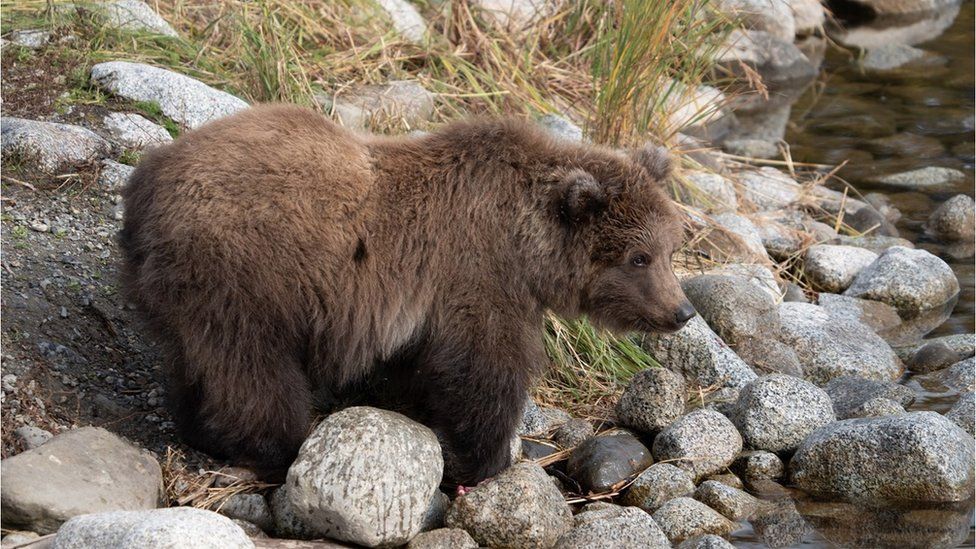 IMAGE SOURCE,NPS PHOTO / F. JIMENEZImage caption,
Can the newcomer make his mark? Bear 806 Jr is less than a year old, but shows significant promise (and fluff)

10,000 Bedroom Nazi Hotel intended to give workers a holiday at the beach
Stretching for over three miles along the white sandy beach on Germany’s Baltic Sea island of Ruegen, lies the world’s biggest hotel with 10,000 bedrooms all facing the sea. But for 70 years since it was built, no holiday maker has ever stayed there. This is hotel Prora, a massive building complex built between 1936 and 1939 by the Nazis as part of their “Strength through Joy” (“Kraft durch Freude,” KdF) programme. The aim was to provide leisure activities for German workers and spread Nazi propaganda. Locals call Prora the Colossus because of its monumental structure.
Prora lies on an extensive bay between the Sassnitz and Binz regions, known as the Prorer Wiek, on the narrow heath (the Prora) which separates the lagoon of the Großer Jasmunder Bodden from the Baltic Sea. The complex consist of eight identical buildings that extend over a length of 4.5 kilometres and are roughly 150 metres from the beach. A workforce of 9,000 took three years to build it, starting in 1936, and the Nazis had long-term plans for four identical resorts, all with cinema, festival halls, swimming pools and a jetty where Strength Through Joy cruise ships would dock.
![prora-16[6]](https://markosun.files.wordpress.com/2013/01/prora-166.jpg)
Dr. Robert Ley envisaged Prora as a parallel to Butlins – British “holiday camps” designed to provide affordable holidays for the average worker. Prora was designed to house 20,000 holidaymakers, under the ideal that every worker deserved a holiday at the beach. Designed by Clemens Klotz (1886–1969), all rooms were planned to overlook the sea, while corridors and sanitation are located on the land side. Each room of 5 by 2.5 metres (16’5″ x 8’3″) was to have two beds, an armoire (wardrobe) and a sink. There were communal toilets and showers and ballrooms on each floor.
Hitler’s plans for Prora were much more ambitious. He wanted a gigantic sea resort, the “most mighty and large one to ever have existed”, holding 20,000 beds. In the middle, a massive building was to be erected. At the same time, Hitler wanted it to be convertible into a military hospital in case of war. Hitler insisted that the plans of a massive indoor arena by architect Erich Putlitz be included. Putlitz’s Festival Hall was intended to be able to accommodate all 20,000 guests at the same time. His plans included two wave-swimming pools and a theatre. A large dock for passenger ships was also planned.
During the few years that Prora was under construction, all major construction companies of the Reich and nearly 9,000 workers were involved in this project. With the onset of World War II in 1939, building on Prora stopped and the construction workers transferred to the V-Weapons plant at Peenemünde. The eight housing blocks, the theatre and cinema stayed as empty shells, and the swimming pools and festival hall never materialised. During the Allied bombing campaign, many people from Hamburg took refuge in one of the housing blocks, and later refugees from the east of Germany were housed there. By the end of the war, these buildings housed female auxiliary personnel for the Luftwaffe.
Beach side

In 1945 the Soviet Army took control of the region and established a military base at Prora. The Soviet Army’s 2nd Artillery Brigade occupied block 5 of Prora from 1945 to 1955. The Soviet military then stripped all usable materials from the building. In the late 1940s two of the housing blocks – one on the North and one on the South – were demolished and the remains mostly removed.
In the late 1950s the East German military rebuilt several of the buildings. Since the buildings had been stripped to the bare brick in the late 1940s, most of the exterior and interior finish that can be seen today was done under East German control. After the formation of the German Democratic Republic’s (GDR’s) National Peoples Army in 1956, the buildings became a restricted military area housing several East German Army units. The most prominent were the elite 40. Fallschirmjägerbataillon Willi Sänger (40th Parachute Battalion “Willi Sänger”) which was housed in block 5 from 1960 to 1982. Block 4 on the north side was used for urban combat training by the Parachute Battalion and others. Large sections remain as ruins to this day. Also housed in the building from 1982 to 1990 was the East German Army Construction Battalion “Mukran”, where conscientious objectors served as noncombatant Construction Soldiers (Bausoldaten) to meet their military service obligation. A part of the building also served as the East German Army’s “Walter Ulbricht” convalescent home.
![prora-3[2]](https://markosun.files.wordpress.com/2013/01/prora-32.jpg)
![prora-13[5]](https://markosun.files.wordpress.com/2013/01/prora-135.jpg)
In 2013, a German company, Metropole Marketing, bought the rights to refurbish Prora and market the units as summer homes. By that year, refurbished apartments in the so-called Colossus were on sale for as much as 700,000 euros ($900,000) apiece. The completion date was estimated as 2016. In 2016, the first of the new apartments opened in Block 1. The Prora Solitaire hotel in Block 2 opened in time for summer 2016, and some reconstructed flats were for sale in that Block by mid 2017. At that time, four of the buildings were in the process of redevelopment, a fifth was used as a youth hostel while the remaining three remained in ruins.
A November 2017 update indicated that most of the units (flats) in Block 1 had been sold, having been marketed as summer homes for those who live in Hamburg and Berlin. Many were listed by owners as short term rentals on sites such as Airbnb and HomeAway.
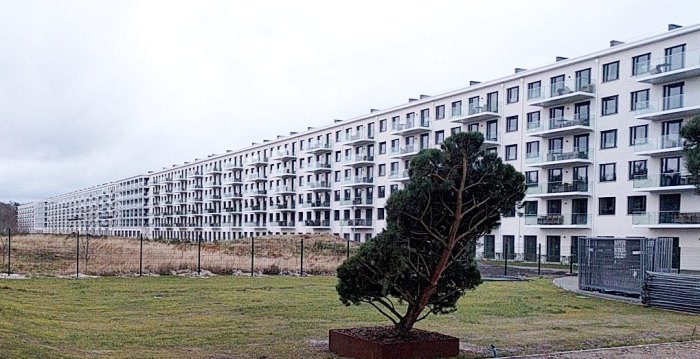
Renovated part in 2016

Renovations after 2019:


Falowiec: The Wave Building of Gdańsk
In the late 1960s and the early 1970s, a series of peculiarly shaped apartment blocks were constructed in the Polish city of Gdańsk. They were collectively called “Falowiec”, from the Polish word “fala,” which means “wave,” and whose plural form is “falowce.” These buildings earned the name Falowiec due to their distinctive wave-like pattern as they alternate between blocks.
There are eight such buildings in Gdańsk, with the most renowned located in the Przymorze block. It has 11 floors, 16 staircases, 1,792 apartments in which nearly six thousand tenants live. It’s like a small town.

Photo credit: Reddit
The dimensions of the building—32 meters high, 13 meters wide, and 860 meters long—place it among the leading residential giants. The building stretches like a huge train with three bus stops along its length, and four addresses. The building is so large that it affects the air movement creating a microclimate around it. In the north it is colder, and snow and frost last longer. In the south, the average temperature is slightly higher, and in hot weather, grass and trees dry faster.
The Falowiec were built during a period when there was an acute housing shortage. The buildings were meant to be a temporary solution. However, they became embedded in the seaside landscape for many years.
The blocks were designed and erected according to a similar scheme. Most of the apartments are accessed from open galleries that run along the north wall. In the beginning, it was possible to walk from one end of the building to the other. But then, boarders erected walls separating the individual apartments from each other.

There are a total of eight Falowce in Gdańsk. All of them were built in the 1960s and 1970s, when there was a huge housing shortage. They were meant to be a temporary solution. However, they became embedded in the seaside landscape for many years.
The blocks were designed and erected according to a similar scheme. Most of the apartments are accessed from open galleries that run along the north wall. They used to be able to walk from one end of the building to the other. Then, on the galleries, walls grew up, separating the individual cages from each other. The blocks have balconies on the south side.
The shape of the buildings resembles a sea wave. Hence their name. Vice-President Wojtkowiak still remembers when the largest of the wave houses, at Obrońców Wybrzeża Street, was settled. — It was done in stages. When the residents moved into the first segment, the next ones were still being finished, he recalls.
The giant’s surroundings resembled a construction site for a long time. There were piles of sand around, concrete slabs lying around, one could only dream of lawns or even a sidewalk. But for most people, their own apartment was quite an ennoblement. Especially living in a place like this. From the upper floors of the block you can see the sea, and in good weather even the Hel Peninsula.


The Widest Freeway in the World
Where else? Houston, Texas of course.

When constructed during the 1960s, the I-10 Katy from Houston, known as the Katy Freeway, was built with six to eight lanes wide barring side lanes, being modest by Houston standards because existing traffic demand to the farming area of West Houston was relatively low. As the population and economic activity increased in the area vehicular traffic increased, reaching an annual average daily traffic (AADT) of 238,000 vehicles just west of the West Loop in 2001.
In 2000 increased traffic levels and congestion led to plans being approved for widening of the freeway to 16 lanes with a capacity for 200,000 cars per day. An old railway running along the north side of the freeway was demolished in 2002 in preparation for construction which began in 2004. The interior two lanes in each direction between SH 6 and west I-610, the Katy Freeway Managed Lanes or Katy Tollway, were built as high-occupancy toll lanes and are managed by the Harris County Toll Road Authority. The section just west of SH 6 to the Fort Bend–Harris county line opened in late June 2006. Two intersections were rebuilt (Beltway 8 and I-610), toll booths were added, together with landscaping as part of Houston’s Highway Beautification Project. Most of the section between Beltway 8 and SH 6 had been laid by September 2006 and work was completed in October 2008.
Tolls on the managed lanes vary by vehicle occupancy, axle count and time of day. High occupancy vehicles may travel for free at certain times.

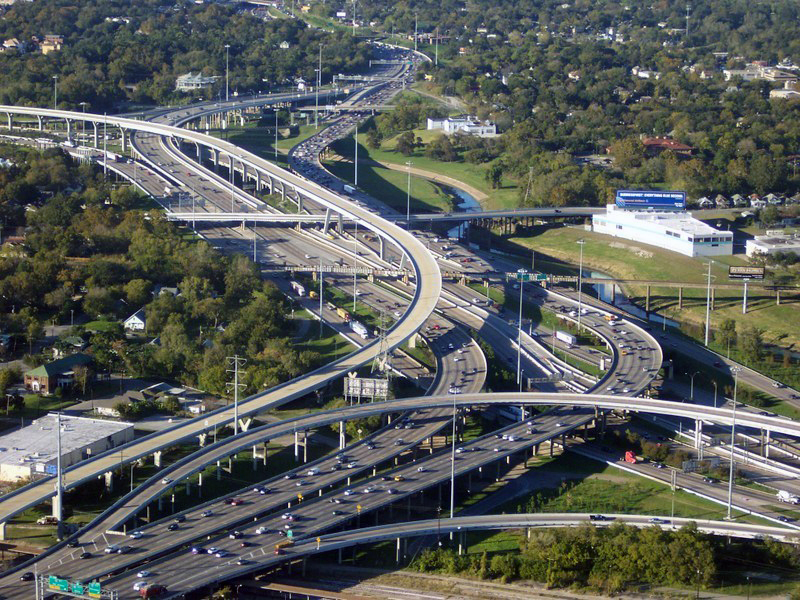
Interstate 10 (I-10) is the major east–west Interstate Highway in the Southern United States. In the U.S. state of Texas, it runs east from Anthony, at the border with New Mexico, through El Paso, San Antonio and Houston to the border with Louisiana in Orange, Texas. At just under 880 miles (1,420 km), the Texas segment of I-10, maintained by the Texas Department of Transportation, is the longest continuous untolled freeway in North America that is operated by a single authority, a title formerly held by Ontario Highway 401.


 The MarkoZen Blog